
Financial Reporting · Beginner · 11 minutes · No ads
10-K
Also called Form 10-K 10-K annual report annual SEC filing
A 10-K is a detailed annual report filed with the SEC by a US public reporting company. It explains the business and its risks, presents management’s discussion of results, and includes audited annual financial statements and notes. Investors use it as a primary source for understanding what a company reported, while remembering that the filing describes the past and does not predict investment returns.

Key takeaways
- A 10-K is an annual SEC filing that gives a detailed view of a public reporting company’s business, risks and financial condition.
- Its financial statements are audited, but an audit does not guarantee future performance or eliminate every risk of error.
- Read the fiscal year end and filing date separately because they answer different timing questions.
- Use the business, risk factors, MD&A, financial statements and notes together rather than relying on one headline number.
- Compare the current filing with earlier 10-Ks and later 10-Qs or 8-Ks to identify changes.
What is a 10-K?
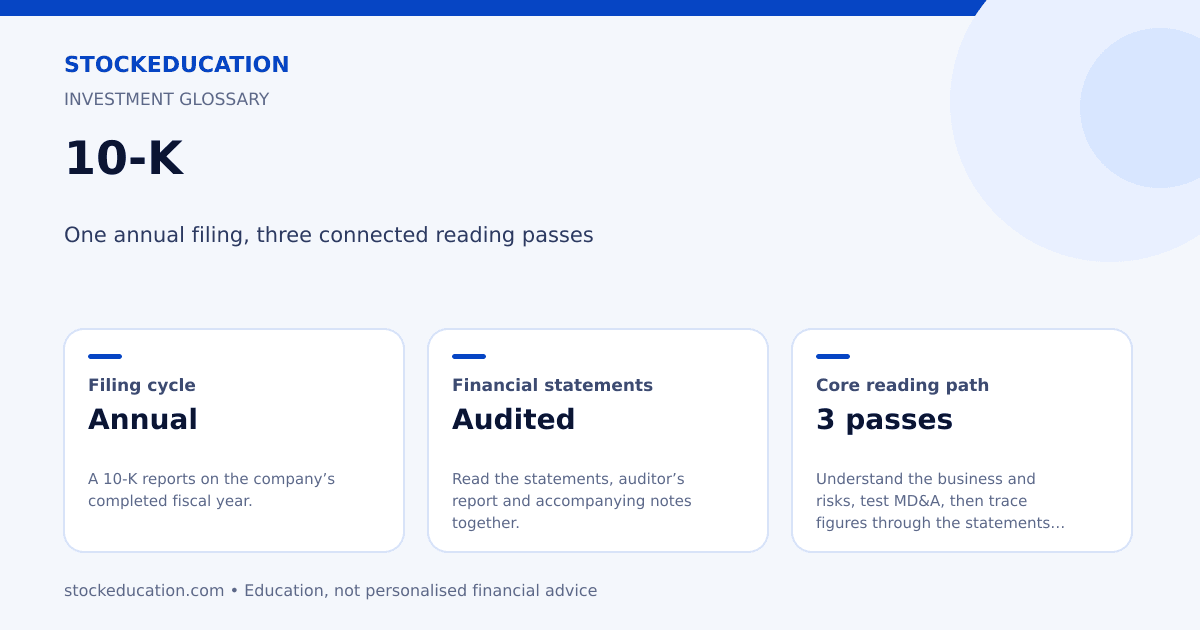
A 10-K is the annual report that a US public reporting company files with the Securities and Exchange Commission. It combines a description of the business, major risks, management’s discussion, audited financial statements and detailed notes. Unlike a shareholder annual report, a 10-K follows a prescribed regulatory structure.
Beginners can use the Company Financial Reports lesson to learn a practical reading order. The AI Earnings Call Analyzer can help organize a filing into research questions, but every important figure and claim should still be checked against the original filing.
How 10-K works
| Step | What happens |
|---|---|
| 01 · Confirm the company | Match the legal company name and ticker so you do not read a similarly named issuer’s filing. |
| 02 · Record both dates | Write down the fiscal year end and SEC filing date before comparing the report with news or another period. |
| 03 · Scan the filing structure | Use the table of contents and item numbers to locate the business, risks, MD&A, statements and notes. |
| 04 · Understand the business | Identify how the company earns revenue, its operating segments and the resources or customers on which it depends. |
| 05 · Read risk factors | Note material risks and compare the language with the previous annual filing for meaningful changes. |
| 06 · Review MD&A | Record management’s explanations for changes in results, liquidity and known trends or uncertainties. |
| 07 · Trace figures into the notes | Check definitions, accounting policies and supporting detail behind important statement line items. |
| 08 · Read the auditor and controls disclosures | Understand the audit opinion, scope and any disclosed control issues without treating the audit as an investment guarantee. |
| 09 · Check later filings | Look for amendments and subsequent 10-Q or 8-K filings that may update the annual picture. |
| 10 · Write evidence-based questions | Separate reported facts, management explanations and your own assumptions before reaching a conclusion. |
The formula
10-K research picture = Business model + Risk disclosures + MD&A + Audited financial statements + Notes
MD&A = Management’s Discussion and Analysis, where management explains results, liquidity and important trends or uncertainties. Audited financial statements = The annual statements and related notes examined by an independent registered public accounting firm. Research picture = A structured view of reported evidence, not a valuation formula or prediction.
Worked example: tracing a hypothetical revenue change
Assume a fictional company reports revenue of $540 million for Year 2 and $500 million for Year 1. The reported increase is $40 million, calculated as $540 million minus $500 million. The percentage increase is 8%, calculated as $40 million divided by $500 million. That calculation is only the starting point. Read MD&A to learn management’s explanation, such as whether sales volume, pricing or an acquisition contributed. Then inspect the revenue recognition and segment notes for definitions and detail. Check the cash flow statement and receivables because an 8% revenue increase does not mean cash collections also rose 8%. These figures are invented solely to demonstrate a reading method and are not a market quote or a real company’s results.
Why it matters
A 10-K matters because it brings several kinds of primary evidence into one regulated filing. It can show how the company earns revenue, what management identifies as material risks, why results changed, how much cash moved through the business and which accounting judgments affect reported figures. Reading these disclosures together helps an investor ask better questions and verify claims made in presentations or news coverage. The filing remains historical information, however, and cannot establish that a stock is suitable, fairly valued or likely to rise.
Organize a long filing
Use the document analyzer to identify changes and questions, then verify every important point in the original filing.
- Verify figures, dates and quotations against the original SEC filing.
No account is required for the educational tool. Read the filing lesson first
What the filing covers
A 10-K is organized into prescribed parts and items rather than written as a simple investor brochure. Important areas include the business description, risk factors, legal proceedings, properties, market information, MD&A, audited financial statements, notes and disclosures about controls. Some information may be incorporated by reference from another filed document, commonly a definitive proxy statement. Follow that reference when the omitted subject matters to your research instead of assuming the 10-K contains every relevant detail on its own.
How to read the business and risks
Begin with the business section to identify products, services, customers, markets, competition and operating segments. Then read the risk factors for company-specific and industry risks. A long list is not a probability ranking or proof that every risk will occur. Compare the wording with the prior year’s filing to spot additions, removals or changes in emphasis. Connect each important risk to the financial statements where possible: customer concentration may relate to revenue notes, while refinancing risk may relate to debt maturities and liquidity disclosures.
How to use MD&A
Management’s Discussion and Analysis gives management’s explanation of financial condition, operating results, liquidity and relevant trends or uncertainties. Use it to understand why management says revenue, margins, cash or major line items changed. Treat that explanation as management’s perspective, then test it against the statements and notes. Separate quantified effects from broad language, note any non-GAAP measures and reconcile them where the filing provides a reconciliation. Also distinguish historical explanations from forward-looking statements that remain uncertain.
How to read the audited statements
The financial statement section generally includes the income statement, balance sheets, cash flow statement, statement of stockholders’ equity and accompanying notes. Record the currency, units and periods before comparing numbers. The independent auditor’s report explains the scope and opinion, while the notes describe accounting policies, estimates, debt, taxes, segments, commitments and other details. An unmodified audit opinion gives assurance about presentation under the applicable framework; it does not certify the investment, guarantee accuracy in every respect or predict future results.
Dates, amendments and later filings
The fiscal year end is the closing date of the annual reporting period, while the filing date is when the 10-K was submitted to EDGAR. Those dates may be weeks apart. A filing can therefore be newly submitted but describe an earlier period. Check whether the company later filed a Form 10-K/A amendment, and read subsequent 10-Q and 8-K filings for developments after year end. When comparing companies, remember that fiscal calendars can differ, so two filings labeled with the same calendar year may not cover matching economic periods.
Turning disclosure into research questions
A useful reading process converts disclosures into questions rather than a simple pass or fail score. If revenue rose, ask whether volume, price, currency or acquisitions drove it. If profit rose faster than operating cash flow, inspect working capital and noncash items. If debt increased, review maturities, interest terms and covenant disclosures. If a risk appears important, search the notes and later filings for related amounts or events. This approach keeps the filing connected to evidence while avoiding the mistake of treating one ratio or management statement as a complete investment conclusion.
Comparison
| Filing | Usual timing | Main purpose | Financial statement status |
|---|---|---|---|
| Form 10-K | Annually | Comprehensive business, risk and financial review | Annual financial statements are audited |
| Form 10-Q | Quarterly for applicable reporting periods | Interim update on results and financial condition | Interim financial statements are generally unaudited |
| Form 8-K | After specified reportable events | Reports particular material events or information | Depends on the item and exhibits |
| Shareholder annual report | Associated with annual shareholder communications | Communicates annual information to shareholders | May include or accompany 10-K information but is a distinct document |
Check yourself
Which reading approach gives the most complete understanding of a company’s 10-K?
The sections answer different but connected questions. The business and risks provide context, MD&A gives management’s explanation, and the audited statements and notes provide reported figures and accounting detail. No single number gives the full picture.
Show the answer
Read the business, risks, MD&A, audited statements and notes together
Things people get wrong
Mistake 01 Treating the filing date as the period end
The filing may be submitted weeks after the fiscal year closes, so record both dates.
Mistake 02 Reading only headline earnings
Net income alone cannot explain cash generation, financial position, accounting estimates or business risks.
Mistake 03 Skipping the notes
Notes define policies and provide detail about debt, segments, taxes, commitments and other important line items.
Mistake 04 Assuming audited means risk free
An audit provides assurance under professional standards but does not guarantee future performance or make the stock suitable.
Mistake 05 Ignoring amendments and later filings
A 10-K/A or a later 10-Q or 8-K may revise or update information after the original annual filing.
Mistake 06 Confusing the 10-K with the shareholder annual report
The documents are distinct even when a company combines them or reproduces similar material.
Questions people ask about 10-K
What is a 10-K in simple terms?
It is a detailed annual report that a US public reporting company files with the SEC, covering its business, risks, management’s analysis and audited annual financial statements.
Where can I find a company’s 10-K?
Search the company in the SEC’s free EDGAR database and filter the filing type to 10-K. Confirm the company identity, fiscal year and filing date.
Is a 10-K the same as an annual report to shareholders?
No. Investor.gov explains that the Form 10-K annual report is distinct from the annual report sent to shareholders, although companies may combine or share content between them.
Are the financial statements in a 10-K audited?
Yes, the 10-K includes audited annual financial statements. The auditor’s report should be read for the opinion and scope, but an audit is not a guarantee of future results.
What is the difference between a 10-K and a 10-Q?
A 10-K provides the fuller annual view with audited annual statements, while a 10-Q provides an interim quarterly update with financial statements that are generally unaudited.
What is the difference between a 10-K and an 8-K?
A 10-K is the scheduled annual filing. An 8-K reports specified events or information between scheduled periodic reports.
Which sections should a beginner read first?
Start with Business, Risk Factors, MD&A, Financial Statements and Supplementary Data, and the notes. Then review the auditor’s report, controls and any topic relevant to your question.
Does a strong 10-K mean the stock is a good investment?
No. The filing supplies historical disclosures and management’s explanations, but valuation, uncertainty, portfolio fit and future outcomes require separate analysis.
The bottom line
A 10-K is the central annual SEC filing for understanding what a US public reporting company says it does, the risks it faces and the financial results it reported. Read the business, risk factors, MD&A, audited statements and notes as a connected record. Confirm dates and units, compare prior and later filings, and distinguish reported facts from management explanations and your own assumptions. The document is a foundation for research, not a prediction or an investment recommendation.
Sources
- SEC Investor.gov: Form 10-K
- SEC Investor.gov: How to Read a 10-K
- SEC Division of Corporation Finance: Financial Reporting Manual Topic 1
How we produced the figuresDefinitions and filing structure were checked against current SEC and Investor.gov primary guidance. The numerical example is explicitly hypothetical and demonstrates a reading method rather than reporting a real issuer’s results.
Learn how to read company filings
Follow a beginner-friendly process for finding and comparing 10-K, 10-Q and 8-K filings.
About this page. Written by Associate Professor Charles Lo, CPA, PhD and edited by Felix La Spina. Checked against reliable sources before publication. No ads and no paywall. Editorial standards · How we fact check · Corrections log · Report an error
Educational information only. Nothing on this page is personal financial, tax or legal advice. Investing involves risk, including the possible loss of principal.

