
Investing fundamentals · 8 minute read · No ads
Compound Interest
Also called compounding, interest on interest, compound growth
Compound interest is interest calculated on both the original principal and previously accumulated interest. Because each period’s interest is added to the balance, future interest is calculated on a growing base.
 Written by Associate Professor Charles Lo, CPA, PhD
 Reviewed by Felix La Spina Published
Last reviewed
Key takeaways
- Compound interest earns interest on principal and on interest already added to the balance.
- Time, rate, compounding frequency and contributions all affect the result.
- A smooth calculator projection is an illustration, not a promise of investment returns.
- Fees, inflation and debt can compound against you as powerfully as returns can compound for you.
What is Compound Interest?
Compound interest is the process of calculating interest on an original principal and on interest that has already been added to the balance. Over repeated periods, that creates growth on growth. For debt, it creates interest on interest.
How Compound Interest works
| Step | What happens |
|---|---|
| 01 · Set the starting assumptions | Identify the principal, annual rate, number of years and compounding frequency. Add contribution timing if money will be deposited regularly. |
| 02 · Convert the rate to each period | Divide the annual rate by the number of compounding periods per year. Convert the percentage to a decimal before calculating. |
| 03 · Apply the formula for every period | Add each period’s interest to the balance so it becomes part of the base for the next period. |
| 04 · Stress-test the result | Compare lower and higher rates, include fees and inflation where relevant, and treat investment outputs as scenarios rather than forecasts. |
The formula
A = P(1 + r/n)^(nt)
A = ending balance; P = starting principal; r = annual interest rate written as a decimal; n = number of compounding periods per year; t = number of years. This formula excludes regular contributions, fees, tax, inflation and changing rates.
Try it with your own numbers
Move any slider and the curve redraws. This is a simplified projection with a constant rate, no tax and no fees.
You contribute $180,000Compounding adds $429,985
$10,000 compounded at 7% for 10 years
Assume $10,000 earns a fixed 7% annual rate, compounded once per year, with no deposits or withdrawals. The calculation is $10,000 × (1.07)10 = $19,671.51. The original principal is $10,000 and the accumulated interest is $9,671.51.
This is a mathematical illustration, not an investment forecast. Real market returns change from year to year, and fees, tax and withdrawals can reduce the ending value.
Why it matters
Compounding explains why time and reinvestment matter so much in long-term saving and investing. Small differences in return, fees or starting date can create large differences over decades because each difference is carried into the next period.
Use the Compound Interest Calculator to test your own assumptions, then read the detailed compound interest guide for practical context and investment caveats.
Why compound interest accelerates
In the first period, interest is calculated on the starting principal. Once that interest is added to the balance, the next period starts from a larger number. The same rate therefore produces a larger dollar amount of interest. Repeating that cycle creates growth on growth.
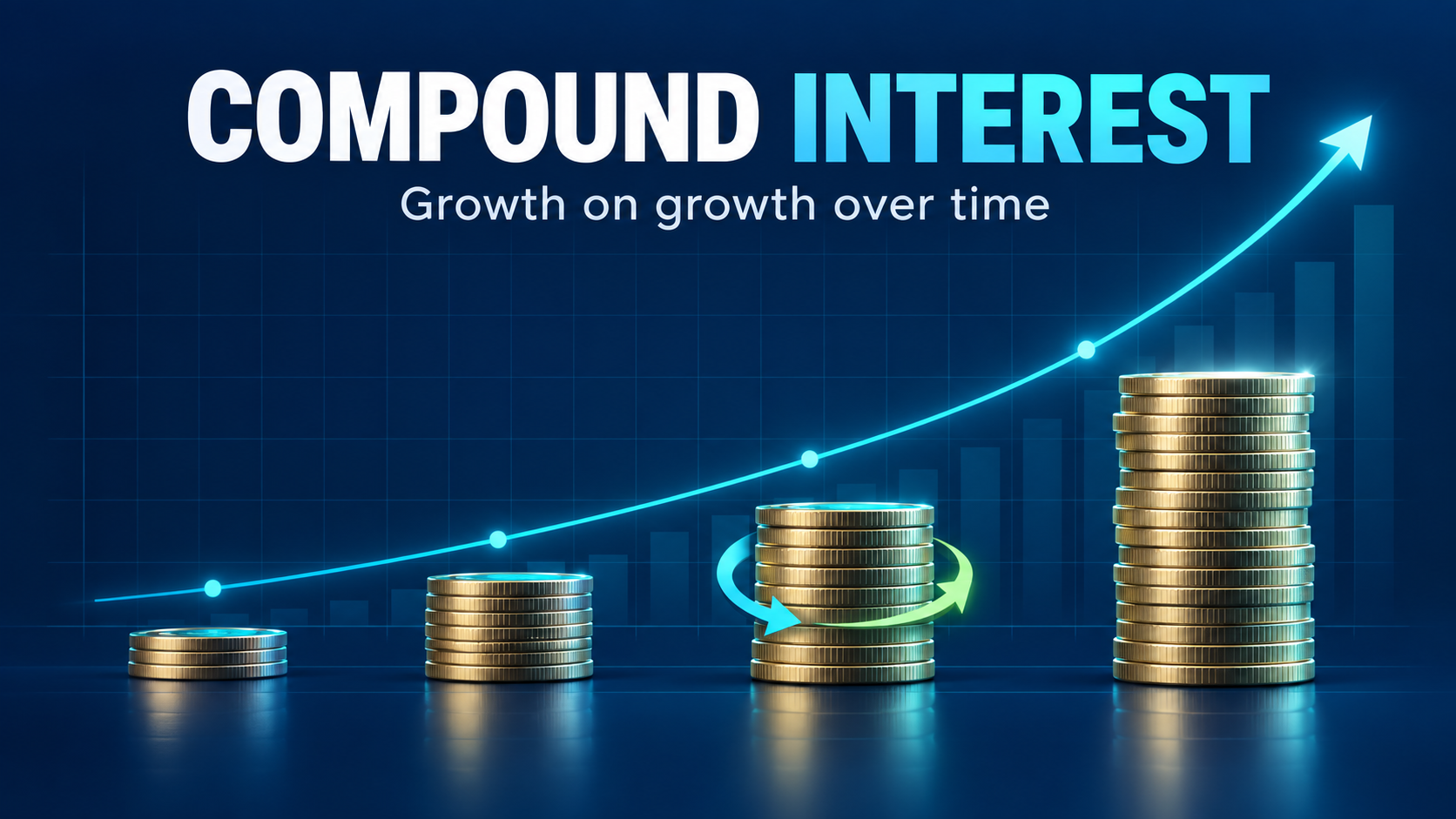
This is why a compound-growth curve bends upward instead of rising in a straight line. The effect can look modest at first because the accumulated interest is still small. Later, the interest already earned becomes a meaningful part of the base, so each new period can add more than the one before it.
The four inputs that drive the result
Four inputs determine the basic result: principal, rate, time and compounding frequency. Principal is the amount that begins compounding. The rate determines how quickly the balance changes in each period. Time determines how many cycles occur. Compounding frequency determines how often accrued interest joins the balance.
Regular contributions add another important input. Each contribution has its own time to compound, so an amount deposited earlier generally has more growth periods than the same amount deposited later. Withdrawals work in the opposite direction because money removed can no longer participate in future growth.
A simple ten-year example
Suppose $10,000 earns a fixed 7% annual rate and compounds once a year. No money is added or removed. The table shows how the balance grows even though the rate stays unchanged.
| Point in time | Calculation | Ending balance |
|---|---|---|
| Start | Original principal | $10,000.00 |
| End of year 1 | $10,000 × 1.07 | $10,700.00 |
| End of year 5 | $10,000 × 1.07^5 | $14,025.52 |
| End of year 10 | $10,000 × 1.07^10 | $19,671.51 |
After ten years, $9,671.51 of the balance is accumulated interest. By comparison, simple interest at 7% on the original $10,000 would add $700 every year and produce $17,000 after ten years. The extra $2,671.51 in the compound example comes from earning interest on earlier interest.
How regular contributions change the picture
When someone deposits money monthly, the basic lump-sum formula is no longer enough by itself. Every contribution begins on a different date and compounds for a different number of periods. Contribution timing also matters: a deposit made at the beginning of a month gets one more period than a deposit made at the end.
A calculator can handle this timing consistently, but the output is only as useful as its assumptions. Separate total contributions from estimated growth so you can see how much of the ending balance came from money added and how much came from the assumed rate.
Compound growth in investing is not guaranteed
A bank account may credit interest according to stated account terms, but investment returns do not arrive as a fixed, smooth percentage. Markets rise in some periods and fall in others. A calculator that assumes the same positive rate every year is useful for understanding the mathematics, but it does not predict the path or outcome of an investment.
Losses also compound. A 20% fall requires a 25% gain to return to the starting value because the recovery begins from a smaller base. This asymmetry is one reason investors should treat projected return rates as scenarios, not promises, and should consider risk alongside potential growth.
Fees, inflation and debt also compound
Fees reduce the balance that remains available to grow. A seemingly small annual fee can create a much larger long-term gap because the fee is removed and the money that could have been earned on it is also lost. Inflation reduces what a future dollar can buy, so a larger nominal balance does not necessarily mean the same increase in purchasing power.
Compounding can also work against a borrower. When unpaid interest is added to a debt balance, future interest may be calculated on a larger amount. The Consumer Financial Protection Bureau and FINRA both emphasize that compound interest can help savings grow but can make debt more expensive. The direction depends on whether interest is being credited to you or charged to you.
Comparison
| Feature | Simple interest | Compound interest |
|---|---|---|
| Interest is calculated on | Original principal only | Principal plus accumulated interest |
| Growth pattern | Linear when the rate and principal stay fixed | Accelerating when interest remains in the balance |
| Ten-year result on $10,000 at 7% annually | $17,000 | $19,671.51 |
| Common uses | Some short-term loans or simplified examples | Savings, deposits, debt and long-term growth models |
Check yourself
Which statement best describes compound interest?
Compound interest uses a growing base: once interest is added to the balance, it can itself earn or incur interest in later periods.
Show the answer
Interest is calculated on principal and previously accumulated interest
Things people get wrong
Mistake 01 Treating an assumed return as guaranteed
Investment markets do not deliver the same positive return every year. A smooth curve is a mathematical illustration, not a forecast.
Mistake 02 Confusing APR with APY
APR states a nominal annual rate, while APY reflects the effect of compounding over a year. Compare like with like.
Mistake 03 Ignoring fees, tax and inflation
Each can reduce the amount that remains or the purchasing power of the final balance. Small annual differences can become large over time.
Mistake 04 Forgetting that debt can compound
Interest added to an unpaid balance can cause future interest charges to rise. Compounding is not automatically beneficial.
Questions people ask about Compound Interest
What is compound interest in simple terms?
It is interest earned or charged on the original amount plus interest that has already been added to the balance.
How is compound interest different from simple interest?
Simple interest is calculated only on the original principal. Compound interest uses a balance that includes previously accumulated interest.
What is the compound interest formula?
For one fixed principal, A = P(1 + r/n)^(nt), where P is principal, r is the annual rate, n is compounding periods per year and t is years.
Does compounding more often always produce more?
With the same stated nominal annual rate and no other changes, more frequent compounding generally produces a slightly higher ending balance. Account terms and APY should still be checked.
Is compound growth guaranteed when investing?
No. Investment returns vary and losses can occur. A fixed-rate calculator result is an illustration, not a prediction.
Can compound interest work against me?
Yes. Interest can compound on debt, while fees and inflation can reduce the value of long-term growth.
The bottom line
Compound interest means that previously accumulated interest becomes part of the balance used for later calculations. Its effect depends on the principal, rate, time, frequency and cash flows. The formula is exact for its assumptions, but investment outcomes are uncertain, so projections should be tested as scenarios rather than treated as promises.
Sources
Run your own compound-growth scenario
Change the starting amount, rate, timeframe, compounding frequency and regular contributions. The result separates what you put in from the growth created by your assumptions.
About this page. Written by Associate Professor Charles Lo, CPA, PhD and reviewed by Felix La Spina before publication. No ads and no paywall. Editorial standards · How we fact check · Corrections log · Report an error
Educational information only. Nothing on this page is personal financial, tax or legal advice. Investing involves risk, including the possible loss of principal.

