
Investment Glossary · Quick read · No ads
Hedge Fund
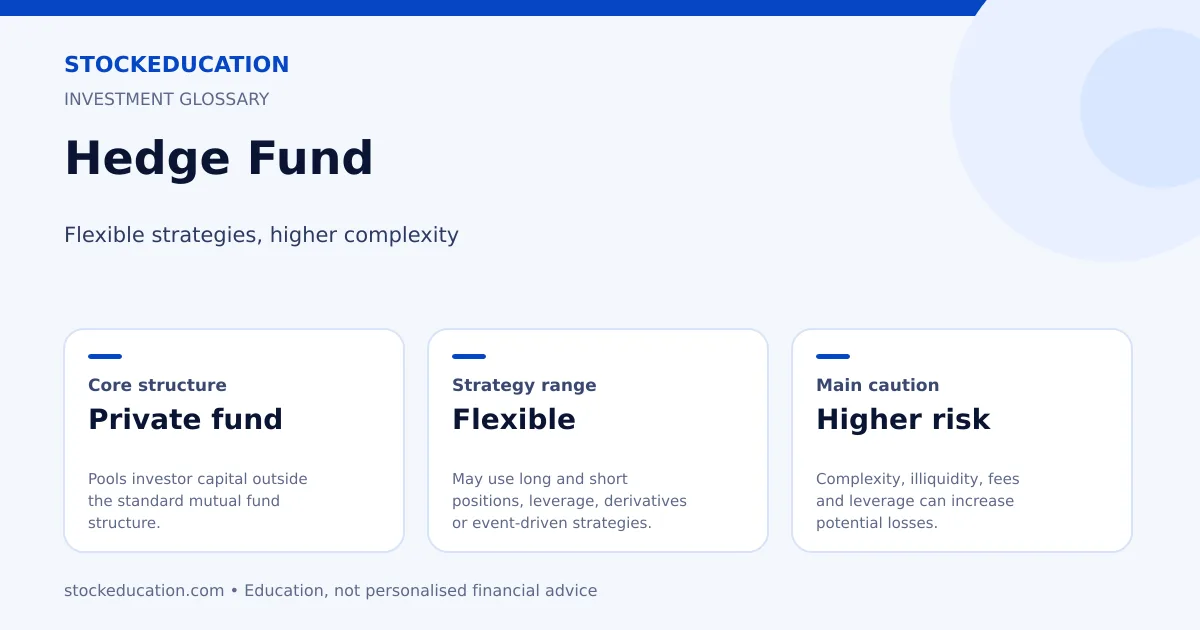
A hedge fund is a private investment fund that pools capital and uses flexible strategies—such as long and short positions, leverage, derivatives or event-driven investing—to pursue returns. The label does not identify one strategy; the fund documents do.

Key takeaways
- A hedge fund is a private pooled investment vehicle, not a single investment strategy.
- Managers may use short selling, leverage, derivatives and event-driven trades.
- Eligibility, minimum investments, liquidity terms and disclosure can differ from public funds.
- Fees, conflicts, valuation methods and strategy complexity deserve careful review.
- Leverage and illiquidity can magnify both gains and losses.
What is Hedge Fund?
A hedge fund is a private investment fund that pools capital and uses a broad range of strategies, such as long and short positions, leverage, derivatives or event-driven investing, to pursue returns. “Hedge fund” is a broad industry term rather than a single investment strategy, so the fund’s offering documents and strategy determine what it actually does.
Hedge funds can offer flexibility, but that flexibility can increase complexity, illiquidity and investment-loss risk. The Investor.gov hedge fund guide explains common investor eligibility and risk considerations, while the SEC hedge fund bulletin highlights the importance of reviewing strategies, fees, conflicts and fund documents before investing.
How Hedge Fund works
| Step | What happens |
|---|---|
| 01 · Define the role | Decide what portfolio objective the fund is intended to serve and what loss or illiquidity would be acceptable. |
| 02 · Read the mandate | Identify permitted assets, leverage, shorting, derivatives, concentration limits and circumstances allowing strategy changes. |
| 03 · Check the economics | Review management fees, performance allocation, expenses, high-water marks, hurdle rates and potential financing costs. |
| 04 · Test liquidity | Confirm dealing dates, notice requirements, lockups, gates, suspension rights, side pockets and expected redemption timing. |
| 05 · Assess operations | Examine valuation, custody, administration, auditing, reporting, conflicts, key-person provisions and business continuity. |
| 06 · Compare risk and fit | Consider drawdowns, scenario risks, transparency and complexity against the investor’s horizon and need for capital. |
| 07 · Make a documented decision | Record unanswered questions, assumptions and reasons the fund’s terms fit—or do not fit—the intended allocation. |
The formula
Investor outcome ≈ gross return − management fees − performance fees − trading, financing and fund expenses
Gross return represents the fund’s investment result before management fees, performance allocations, trading costs, financing charges and other expenses. The investor outcome is an estimate because fund agreements may apply different fee bases, high-water marks, hurdle rates, valuation methods and expense allocations. Leverage, short positions and illiquid holdings can cause realized results to differ materially from a simple fee-adjusted calculation.
A worked example
Hypothetical example: An eligible investor contributes $100,000 to a hedge fund. Suppose the fund earns a 10% gross return, producing $10,000 before deductions. If the fund charges a 2% management fee on starting capital ($2,000) and a 20% performance allocation on the remaining $8,000 profit ($1,600), the investor’s estimated ending value would be $106,400: $100,000 + $10,000 − $2,000 − $1,600. This illustration excludes trading costs, financing charges, taxes, high-water-mark effects, valuation changes and other fund expenses. Actual terms differ, and leverage or illiquidity could produce a loss instead of a gain.
Why it matters
Hedge funds can expand an investor’s opportunity set, but flexibility also makes comparison harder. A fund may combine instruments, borrowing and trading techniques that create risks not visible in a headline return. Understanding the mandate, liquidity terms, fee structure, valuation process and conflicts helps an investor distinguish a strategy that fits from one whose risks are merely difficult to see. Private-fund access and a sophisticated manager do not guarantee superior performance or protection from loss.
Structure and investor access
A hedge fund typically collects commitments or subscriptions from a limited group of investors under private offering documents rather than offering continuously to the general public like a retail mutual fund. The manager, fund vehicle, administrator, prime broker, custodian and other service providers each have distinct roles. Eligibility standards, minimum investments, investor representations and transfer restrictions vary by fund and jurisdiction. Private-fund status can mean less standardized public disclosure, so an investor must rely heavily on the offering memorandum, subscription materials, audited reports and contractual terms. Access is therefore only one part of the decision: understanding what is being purchased, who controls it and how investors may redeem is equally important.
Strategy is broader than the label
“Hedge fund” does not tell an investor whether a manager is conservative, directional, market-neutral or highly concentrated. Some funds buy securities they expect to rise; others short securities they expect to fall, trade relative value, pursue merger or restructuring situations, or combine several approaches. A fund can change exposures as market conditions evolve, subject to its mandate and risk controls. Two funds carrying the same label may therefore have very different return drivers, benchmarks, drawdown patterns and liquidity terms. Strategy analysis should identify the instruments used, markets traded, geographic exposure, concentration limits, cash management, hedging policy and circumstances in which the manager may depart from historical practice.
Leverage, short selling and derivatives
Leverage uses borrowed money or financial arrangements to increase market exposure relative to the fund’s capital. Short selling seeks to benefit from a decline in a security, but it can involve borrowing costs, recalls, collateral requirements and theoretically substantial losses if the price rises sharply. Derivatives can transfer or reshape exposure through contracts whose value depends on an underlying asset, rate, index or event. These tools may help a manager hedge or express a view efficiently, but they also introduce counterparty, margin, model, basis and liquidity risks. Losses can accelerate when positions move together, collateral is demanded or the fund must reduce exposure during stressed conditions.
Fees, expenses and conflicts
A hedge fund’s economic result depends on more than its gross investment return. Investors should examine management fees, performance allocations, fund expenses, transaction costs, financing charges, audit and administration costs, and the method used to calculate incentive compensation. Terms may address high-water marks, hurdle rates, clawbacks, related-party transactions and allocation of investment opportunities. Conflicts can arise when a manager runs several funds, trades personal or affiliated accounts, values hard-to-price assets, uses affiliated service providers or allocates limited opportunities among clients. Clear disclosures do not remove conflicts, but they help investors judge whether controls, governance and incentives are appropriate.
Liquidity, valuation and reporting
Many hedge funds permit subscriptions and redemptions only on specified dates and may impose notice periods, gates, lockups, suspension rights or side pockets for difficult-to-sell assets. A reported net asset value can involve estimates when markets are thin, securities are complex or valuations depend on models and third-party inputs. Delayed liquidity can matter most when an investor needs cash or when market conditions deteriorate. Review the dealing calendar, valuation policy, redemption mechanics, reporting timetable, audit arrangements and treatment of side-pocketed investments. Historical returns should also be read with drawdowns, volatility, exposure changes and valuation uncertainty rather than viewed as a promise of future performance.
Due diligence and risk judgment
Evaluating a hedge fund requires matching the strategy with the investor’s objectives, time horizon, tolerance for loss and need for access to capital. Useful questions include who makes decisions, how risk limits operate, how the fund performed in different environments, what could cause a permanent loss, and how the manager handles operational disruption. Review legal and regulatory disclosures, service-provider arrangements, financial statements, conflicts, cybersecurity practices and key-person provisions where available. No checklist eliminates uncertainty. The central judgment is whether the expected role of the fund justifies its fees, complexity, limited liquidity and possibility of losses that may be difficult to forecast or recover from.
Comparison
| Feature | Hedge fund | Public mutual fund | Exchange-traded fund |
|---|---|---|---|
| Access | Private offering; eligibility and restrictions may apply | Generally public retail access | Generally public exchange access |
| Liquidity | Dealing dates, notice periods or lockups may apply | Usually frequent redemption at net asset value | Trades during market hours; market liquidity varies |
| Strategy | Broad mandate may include shorting, leverage or derivatives | Strategy and diversification rules are more standardized | Portfolio and trading structure disclosed under fund rules |
| Disclosure | Private documents and periodic reports vary | Standardized public disclosures are generally available | Public holdings and fund documents vary |
| Risk | Complexity, leverage and illiquidity can be substantial | Risks depend on portfolio and mandate | Market, tracking and trading risks apply |
Check yourself
Which statement best describes a hedge fund?
A hedge fund is generally a privately offered pooled investment vehicle with a broad possible mandate. Its actual strategy, fees, liquidity and risks are determined by its governing and offering documents.
Show the answer
2. A privately offered pooled fund that may use varied strategies and instruments
Things people get wrong
Mistake 01 Treating the label as a strategy
Assuming every hedge fund behaves alike can hide major differences in exposures, liquidity, leverage and return drivers.
Mistake 02 Focusing only on past returns
A strong historical result does not reveal all drawdowns, valuation uncertainty, fees, financing costs or future regime risk.
Mistake 03 Ignoring redemption terms
Lockups, notice periods, gates and side pockets can prevent access to capital when it is most needed.
Mistake 04 Underestimating leverage
Borrowing and derivatives can magnify losses, collateral calls and forced selling during stressed markets.
Mistake 05 Skipping document review
Relying on a pitch or summary instead of the offering documents can leave important fees, conflicts and investor rights unexplored.
Questions people ask about Hedge Fund
What is a hedge fund?
It is a privately offered pooled investment fund that may use a broad range of strategies and instruments; the term does not describe one uniform approach.
Can a hedge fund lose money?
Yes. Market movements, leverage, short positions, illiquidity, valuation changes, operational failures and fees can all reduce investor capital.
Do hedge funds always hedge market risk?
No. Some hedge funds hedge extensively, while others take directional or concentrated exposures. The mandate and actual portfolio determine the risk.
Why can hedge funds be less liquid?
Private funds may accept redemptions only on specified dates and may impose notice periods, lockups, gates or other restrictions.
Are hedge funds suitable for every investor?
No. Eligibility, risk tolerance, time horizon, financial capacity and need for liquidity all matter, and professional advice may be appropriate.
What documents should an investor review?
Review the offering memorandum, subscription agreement, partnership or operating agreement, fee disclosures, financial reports and risk disclosures.
How do fees affect returns?
Management fees, performance allocations, fund expenses, trading costs and financing charges reduce the return retained by the investor.
The bottom line
A hedge fund is a flexible private investment structure, not a promise of superior returns or a uniform level of protection. Evaluate the actual mandate, leverage, fees, conflicts, valuation methods and redemption terms before deciding whether its potential role justifies its complexity and risk.
Sources
About this page. Written by Associate Professor Charles Lo, CPA, PhD and edited by Felix La Spina. No ads and no paywall. Editorial standards · How we fact check · Corrections log · Report an error
Educational information only. Nothing on this page is personal financial, tax or legal advice. Investing involves risk, including the possible loss of principal.


