
Investment Glossary · Quick read · No ads
Interest Rate
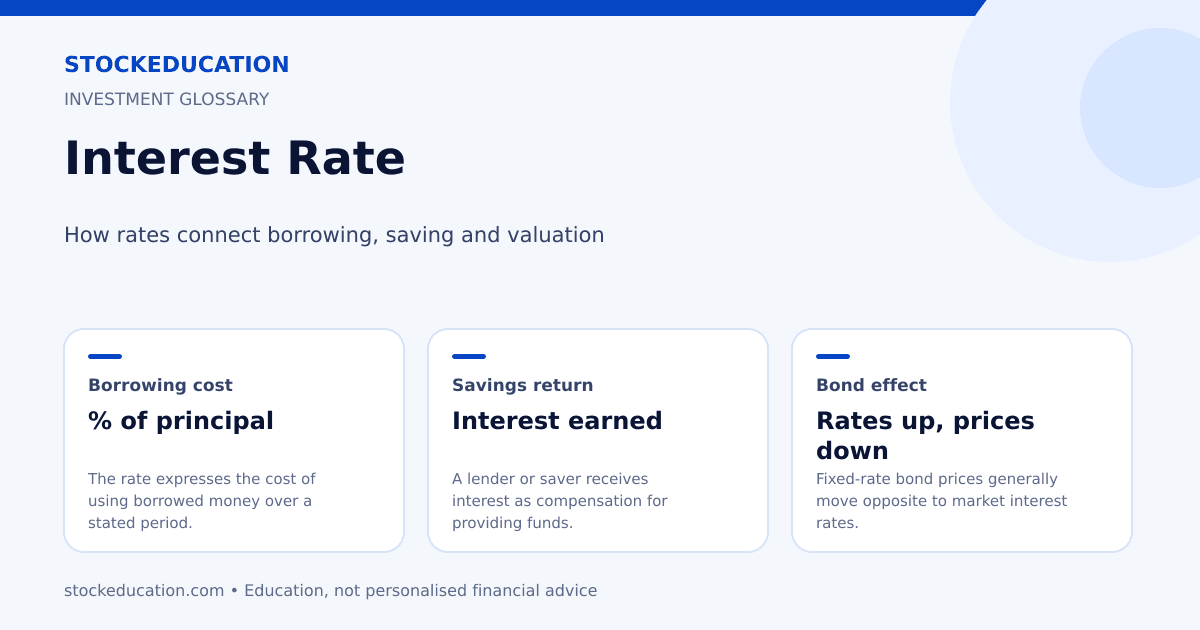
An interest rate is the percentage cost of borrowing money or the percentage return earned for lending or saving it over a stated period.

Key takeaways
- An interest rate expresses compensation for using money over time.
- Fixed rates stay constant under the agreement, while variable rates can change with a reference rate or policy conditions.
- The quoted rate may not equal the effective cost because compounding, fees and payment timing affect what is actually paid.
- Higher rates generally increase borrowing costs and can reduce spending, investment and valuation multiples.
- Fixed-rate bond prices generally move inversely to market interest rates.
What is Interest Rate?
An interest rate is the price paid to borrow money or the return earned for lending or saving it, usually stated as a percentage of the principal over a defined period. Rates can be fixed or variable, and the quoted rate may differ from the effective annual cost after compounding or fees.
Interest rates matter in financial analysis because they affect borrowing costs, bond prices, household and business spending, and valuation assumptions. The Federal Reserve influences short-term rates through the federal funds rate, while investors should also consider credit risk, maturity, inflation and whether a rate is nominal or effective. For a related valuation perspective, see P/E ratio lesson and review the approved Bonds glossary lesson.
How Interest Rate works
| Step | What happens |
|---|---|
| 01 · Identify the rate basis | Determine whether the quote is nominal, effective, fixed or variable, and note the stated period. |
| 02 · Inspect the cash flows | Record principal, payment dates, compounding, amortization and any fees or penalties. |
| 03 · Assess risk and reset terms | Review credit risk, maturity, benchmark, spread, caps, floors and refinancing exposure. |
| 04 · Compare like with like | Use a consistent annualized measure and matching time horizon rather than comparing isolated percentages. |
| 05 · Test the financial effect | Consider how higher or lower rates affect payments, bond prices, earnings, cash flows and valuation assumptions. |
| 06 · Read the contract or prospectus | Confirm the legal obligations, repayment terms and conditions before relying on a rate for a decision. |
The formula
Simple interest: I = P × r × t; total amount: A = P + I. With periodic compounding: A = P × (1 + r/n)^(n×t).
I = interest paid or earned; A = ending amount including principal and interest. P = principal; r = annual stated rate as a decimal; t = time in years; n = compounding periods per year. The formulas are simplified illustrations and do not include fees, taxes, changing balances, defaults or payment timing effects. For an amortizing loan, interest is calculated on the outstanding balance and principal declines as payments are made. For example, 5% is represented as 0.05 in a formula. An effective annual rate depends on compounding frequency and cash-flow timing, so it should not be confused with every advertised nominal rate or an all-in borrowing cost. _Source basis: Federal Reserve, https://www.federalreserve.gov/faqs/why-do-interest-rates-matter.htm; Investor.gov, https://www.investor.gov/introduction-investing/investing-basics/investment-products/bonds-or-fixed-income-products/bonds_.
A worked example
Hypothetical worked example: A borrower has a $10,000 balance at a simple annual interest rate of 5% for 2 years. Using I = P × r × t, interest is $10,000 × 0.05 × 2 = $1,000, so the ending amount would be $11,000 before fees, taxes or payments. If the same amount compounded annually, A = $10,000 × (1 + 0.05)^2 = $11,025, producing $1,025 of interest. This is only an illustration: an amortizing loan calculates interest on the declining outstanding balance, while fees, payment timing, changing rates and credit conditions can materially change the actual cost.
Why it matters
Interest rates connect monetary policy to household budgets, corporate financing, bond prices and investment valuation. A change in rates can alter the cost of new debt, the expense of refinancing existing debt, the return available from savings and the discount rate applied to future cash flows. The effect is not uniform: borrowers, lenders, short-duration assets, long-duration assets and companies with different balance sheets respond differently. Understanding the rate type, reset terms, compounding and risk spread helps investors avoid treating one quoted percentage as a complete measure of financial cost or return.
What an interest rate measures
An interest rate translates the time value and use of money into a rate applied to principal. For a borrower, it is compensation paid to obtain funds before repayment; for a lender or saver, it is potential income for supplying funds and accepting uncertainty. The percentage alone is incomplete without the period, balance method and payment schedule. A rate quoted annually may be calculated on a simple basis or compounded, and fees can make the economic cost higher than the advertised figure. Comparing rates therefore requires a consistent basis such as an annualized effective rate, while also considering whether the balance declines as payments are made.
Fixed and variable rates
A fixed interest rate is set for the relevant contractual period, making scheduled interest easier to forecast when the principal and payment terms are known. A variable rate can reset as an underlying benchmark, central-bank environment or contractually defined index changes, often with an added spread. Variable borrowing may begin with a lower rate but exposes the borrower to future increases; variable savings or lending can provide higher income when market rates rise. The reset frequency, caps, floors, margin, introductory period and reference rate matter as much as the initial quote. Analysts should read the agreement rather than infer risk from the label alone.
Nominal, effective and total borrowing cost
A nominal rate states a percentage without fully showing the effect of intra-year compounding or associated charges. An effective annual rate incorporates the timing and frequency of compounding, so it can be more useful for comparing products with different payment schedules. The total cost of credit may also include origination charges, servicing fees, points, penalties or required deposits. For a saving product, taxes, withdrawal restrictions and compounding affect the realized return. A fair comparison uses the same principal, time horizon and cash-flow assumptions, and distinguishes the contractual interest calculation from the broader all-in cost or return.
Interest rates and central-bank policy
Central banks influence financial conditions by setting or guiding a short-term policy rate and communicating how policy may respond to inflation, employment and economic conditions. Changes in short-term rates can flow through money markets, bank funding costs, consumer credit and business financing, although transmission is neither immediate nor identical across products. Lenders also price credit risk, liquidity, maturity and competition. Consequently, a policy move does not mechanically produce the same change in every quoted rate. Investors should separate the policy rate from the rate on a particular loan or security and examine the spread that reflects the instrument's additional risks.
Rates, bonds and prices
A fixed-rate bond promises contractual interest payments and repayment of principal subject to the issuer's obligations. When newly available market rates rise, an existing bond with a lower coupon generally becomes less attractive, so its market price tends to fall until its yield is more competitive. When market rates fall, the reverse pressure generally applies. The size of the price response depends on maturity, duration, coupon, credit quality, liquidity and embedded options. Holding a bond to maturity does not eliminate default risk or opportunity cost, and selling before maturity exposes the investor to the current market price rather than simply the original principal.
Rates in valuation and business analysis
Interest rates affect valuation through financing costs, discount rates, demand and the opportunity cost of capital. Higher rates can reduce the present value of distant cash flows, pressure highly leveraged businesses through interest expense and weaken demand for rate-sensitive purchases. They can also improve income for cash-rich institutions or savers, depending on asset mix and deposit pricing. A valuation should not treat a rate change as a universal one-direction result: revenue exposure, debt maturities, refinancing needs, hedges, pricing power and cash balances all matter. Comparing a company's earnings multiple or cash-flow value with rates requires examining the full operating and capital structure context.
Comparison
| Feature | Fixed rate | Variable rate | Effective-rate perspective |
|---|---|---|---|
| Rate behavior | Remains constant for the agreed period | Can reset with a benchmark or contract rule | Reflects compounding and timing rather than just the stated quote |
| Forecasting | Usually easier for scheduled interest | Requires assumptions about future resets | Improves comparisons across payment schedules |
| Main exposure | Inflation and opportunity cost if market rates change | Payment or income uncertainty when rates move | Fees and cash-flow timing can change the true cost or return |
| Common analysis | Budget certainty and refinancing date | Benchmark, spread, caps, floors and reset dates | Annualized cost or return on a consistent basis |
Check yourself
Which statement best describes the usual relationship between market interest rates and existing fixed-rate bond prices?
Existing fixed-rate bonds generally become less attractive when newly issued comparable bonds offer higher rates, so their market prices tend to fall until their yields become more competitive. The size of the move depends on maturity, duration, coupon, credit quality, liquidity and other features.
Show the answer
2. Bond prices generally fall when market rates rise.
Things people get wrong
Mistake 01 Comparing unlike rates
Do not compare a nominal quote with an effective rate or an all-in cost without aligning compounding, fees and timing.
Mistake 02 Ignoring variable-rate exposure
A low initial rate may reset later, so inspect the benchmark, spread, reset dates, caps and floors.
Mistake 03 Treating policy rates as universal prices
Central-bank rates influence conditions, but credit risk, maturity, liquidity and competition determine individual rates.
Mistake 04 Assuming bonds always return principal at market value
A bond may repay principal at maturity under its obligations, but selling earlier exposes the investor to price and credit risk.
Mistake 05 Using rates without balance-sheet context
Higher rates can hurt leveraged companies while benefiting cash-rich businesses, so examine debt maturities, hedges and cash balances.
Mistake 06 Confusing interest with total return
Coupon or account interest does not capture price changes, taxes, defaults, fees or reinvestment outcomes.
Questions people ask about Interest Rate
What is an interest rate?
It is the percentage cost of borrowing money or return earned for lending or saving it over a defined period.
What is the difference between a fixed and variable rate?
A fixed rate remains unchanged for the agreed period, while a variable rate can reset according to a benchmark, spread or contractual rule.
Why can the effective rate differ from the advertised rate?
Compounding frequency, payment timing, fees and other charges can change the annualized economic cost or return.
How do higher rates usually affect bonds?
Prices of existing fixed-rate bonds generally fall when comparable market rates rise, although the size of the move depends on duration, coupon, credit and liquidity.
Why does the Federal Reserve matter to interest rates?
Its policy actions and guidance influence short-term financial conditions, which can flow into other rates without determining every loan or security yield.
Do higher rates always hurt companies?
No. They often increase financing costs and can reduce demand, but cash-rich companies or businesses with favorable pricing and limited refinancing needs may be less affected.
What should an investor check before comparing rates?
Check the rate basis, compounding, fees, term, payment schedule, reset rules, credit risk, liquidity and whether the comparison concerns price, yield or total return.
The bottom line
An interest rate measures the cost of using money or the return for providing it. Compare rates only after aligning the rate basis, compounding, fees, timing, risk and contractual terms. Higher rates often raise borrowing costs and pressure fixed-rate bond prices, but the effect varies by balance sheet, maturity, cash flows and credit quality.
Sources
About this page. Written by Associate Professor Charles Lo, CPA, PhD and edited by Felix La Spina. No ads and no paywall. Editorial standards · How we fact check · Corrections log · Report an error
Educational information only. Nothing on this page is personal financial, tax or legal advice. Investing involves risk, including the possible loss of principal.


