
Investment Glossary · Quick read · No ads
Maintenance Capital Expenditure
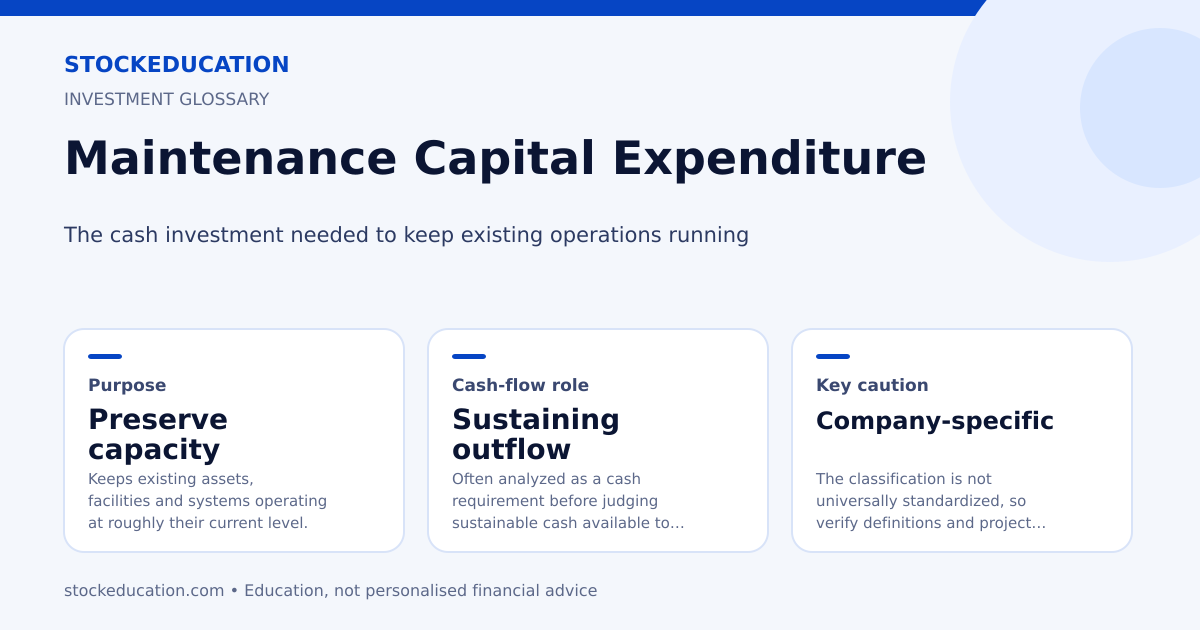
Maintenance capital expenditure is cash spending required to preserve the existing operating capacity, condition or productive ability of a business's assets. It is often called sustaining capex, but the company's own definition should be checked because the measure is not uniformly standardized.

Key takeaways
- Maintenance capital expenditure preserves existing operating capacity rather than deliberately expanding it.
- It can include replacing worn equipment, renewing facilities or maintaining essential technology and infrastructure.
- The amount is often disclosed by management, but it may need to be estimated from filings and operating context.
- Maintenance capex is commonly subtracted from operating cash flow when analyzing cash available after sustaining investment.
- A low maintenance-capex estimate can make free cash flow appear stronger if essential replacement needs are deferred.
What is Maintenance Capital Expenditure?
Maintenance capital expenditure is spending needed to keep existing assets, facilities, systems or equipment operating at roughly their current capacity and condition. It is different from growth capital expenditure, which is intended to expand capacity, enter new markets or add new revenue-producing assets.
Investors usually estimate maintenance capital expenditure from a company’s filings, management disclosures and asset replacement needs. It is not normally a separately standardized GAAP line, so compare the company’s definition with its cash flow statement and use the figure carefully when assessing free cash flow.
How Maintenance Capital Expenditure works
| Step | What happens |
|---|---|
| 01 · Read the cash flow statement | Identify the period, units and line items for purchases of property, plant and equipment and other long-lived assets. |
| 02 · Find management's classification | Search the annual report, earnings materials and investor presentation for maintenance, sustaining, replacement or discretionary capex disclosures. |
| 03 · Separate project purposes | Classify spending by whether it preserves current capacity, expands capacity or serves both purposes. |
| 04 · Test the estimate | Compare with depreciation, asset age, operating capacity, historical spending, regulatory needs and management guidance. |
| 05 · Label the result clearly | State whether the calculation uses total capex, disclosed maintenance capex or an analyst estimate and identify the limitations. |
| 06 · Use it in context | Compare cash flow after sustaining investment with debt, dividends, acquisitions and the company's reinvestment requirements. |
| 07 · Review the next filing | Update the estimate when new project descriptions, asset plans or cash flow data become available because the classification can change over time. |
The formula
Cash flow after maintenance investment = Operating cash flow − Estimated maintenance capital expenditure
Operating cash flow = cash generated or used by operating activities during the period. Estimated maintenance capital expenditure = cash investment classified as necessary to preserve existing operating capacity. The result is an analytical measure and should not be presented as a universally standardized GAAP metric.
A worked example
Illustrative example: assume a company reports operating cash flow of $100 million and total capital expenditure of $60 million. Management says $35 million maintained existing facilities and equipment, while $25 million expanded capacity. Operating cash flow minus total capex is $40 million. Operating cash flow minus illustrative maintenance capex is $65 million. The second figure is not standardized free cash flow; it is cash flow after the assumed sustaining investment. The example uses hypothetical figures only and is not a real market quote, company result or forecast.
Why it matters
Maintenance capital expenditure helps investors separate cash needed to preserve the current business from spending intended to expand it. That distinction can improve analysis of sustainable free cash flow, debt repayment capacity, dividends and valuation. Because the classification is often company-specific, the figure must be supported by filings and operational evidence.
Maintenance versus growth capital expenditure
Maintenance capital expenditure supports the continuation of current operations. Examples may include replacing an aging production machine with a comparable machine, repairing essential infrastructure or renewing software and systems needed to keep serving existing customers. Growth capital expenditure is intended to increase capacity, geographic reach, product range or future revenue potential. The distinction is not always visible in a cash flow statement, so an investor should read management discussion, investor presentations, footnotes and segment information before assigning a project to either category.
Where the figure appears in company filings
A company's statement of cash flows may show purchases of property, plant and equipment or another investing cash outflow, but it usually does not identify which portion is maintenance. Management may provide sustaining, replacement, maintenance or discretionary-capital categories in an earnings release, annual report or investor presentation. The SEC explains that investing activities generally include purchases or sales of long-term assets such as property, plant and equipment. Use the filing's units, fiscal period and reconciliation carefully, and do not treat a management estimate as a standardized accounting measurement.
How maintenance capex affects free cash flow
A common analytical measure of free cash flow starts with operating cash flow and subtracts capital expenditure. If total capital expenditure includes both maintenance and growth projects, subtracting only maintenance capex produces a different measure that may be useful for judging cash generation after sustaining investment. For example, with illustrative operating cash flow of $100 million and illustrative maintenance capex of $35 million, cash flow after maintenance investment would be $65 million. Those figures are hypothetical and are not a market quotation or company forecast.
Estimating an undisclosed amount
When management does not disclose maintenance capex directly, an estimate can use several forms of evidence: historical replacement spending, depreciation and asset age, maintenance schedules, production capacity, store or site counts, regulatory requirements and management commentary. Depreciation is not a cash outflow and is not automatically equal to maintenance capex. Compare several years, investigate unusual investment cycles and test whether the estimate is consistent with the physical assets needed to sustain reported output.
Why the classification matters to valuation
Maintenance capital expenditure can affect how much cash a business can distribute, repay, reinvest or use to reduce debt without weakening its current operations. If analysts classify necessary maintenance as growth and exclude it from sustaining needs, they may overstate sustainable cash available and valuation; classifying too much spending as maintenance can understate that cash and valuation. The classification is especially important in asset-heavy industries, where large replacement programs may be necessary even when reported earnings and operating cash flow are stable.
Limitations and investor judgment
Maintenance capex is not a precise substitute for the cash a company must spend in every future period. Asset condition, inflation, technology changes, regulation, acquisitions and changes in service quality can alter the requirement. A company may also defer maintenance, capitalize internal costs or group projects into broad categories. Treat the measure as an analytical estimate supported by evidence, not as a guaranteed recurring expense. Compare the estimate with cash flow statements, balance-sheet assets, operational metrics and management's stated plans.
Comparison
| Category | Main purpose | Typical analytical treatment | Main caution |
|---|---|---|---|
| Maintenance capital expenditure | Preserve existing assets and capacity | Consider as a sustaining cash requirement | Definition may be estimated or company-specific |
| Growth capital expenditure | Expand capacity, products or markets | Analyze as discretionary or expansion investment | Expansion projects may also replace old assets |
| Total capital expenditure | Includes multiple asset-investment categories | Reconcile to the cash flow statement | Does not reveal maintenance share by itself |
| Depreciation expense | Allocate asset cost for accounting | Compare as context, not as a cash proxy | Noncash expense may differ from replacement spending |
Check yourself
A company reports illustrative operating cash flow of $100 million, total capital expenditure of $60 million and estimated maintenance capex of $35 million. What is cash flow after the estimated maintenance investment?
Cash flow after estimated maintenance investment is operating cash flow minus maintenance capex: $100 million − $35 million = $65 million. This is an illustrative analytical measure, not automatically standardized free cash flow.
Show the answer
$65 million
Things people get wrong
Mistake 01 Treating depreciation as maintenance capex
Depreciation is a noncash accounting expense and may differ materially from the cash required to maintain assets.
Mistake 02 Assuming all capex is growth
Some projects replace worn assets without increasing capacity, while other projects combine replacement and expansion.
Mistake 03 Using management labels without checking evidence
Read the filing, project description, asset condition and operating context before accepting a classification.
Mistake 04 Ignoring deferred maintenance
Temporarily low maintenance spending can reflect postponed repairs rather than permanently lower requirements.
Mistake 05 Comparing companies without reconciling definitions
Businesses may use different labels, scopes, periods and treatments for sustaining or maintenance investment.
Questions people ask about Maintenance Capital Expenditure
What is maintenance capital expenditure?
It is spending needed to preserve existing assets and operating capacity, such as replacing worn equipment or maintaining essential facilities.
Is maintenance capex the same as total capital expenditure?
No. Total capex can include maintenance, replacement, expansion, acquisitions of productive assets and other investment categories.
Is maintenance capital expenditure a GAAP line item?
Usually not. It is commonly an analytical or management classification, so the company's definition and supporting disclosures matter.
How is maintenance capex used in free cash flow analysis?
Analysts may subtract it from operating cash flow to estimate cash remaining after sustaining investment, but the resulting measure should be labeled clearly.
Can maintenance capex be higher than depreciation?
Yes. Inflation, asset replacement cycles, technology changes and regulatory requirements can make cash replacement spending differ from depreciation.
Where can investors find the amount?
Look in annual reports, quarterly filings, earnings releases, investor presentations, capital-allocation discussions and notes describing property and equipment spending.
The bottom line
Maintenance capital expenditure is the investment required to keep a business's existing operating base functioning. It can be useful for judging sustainable cash generation, but it is not a universally standardized accounting number. Verify the company's definition, distinguish replacement from expansion, compare several periods and show clearly whether your calculation uses total capex or an estimated maintenance-only amount.
Sources
About this page. Written by Associate Professor Charles Lo, CPA, PhD and edited by Felix La Spina. No ads and no paywall. Editorial standards · How we fact check · Corrections log · Report an error
Educational information only. Nothing on this page is personal financial, tax or legal advice. Investing involves risk, including the possible loss of principal.


