
Investment Glossary · Quick read · No ads
Market Price
Market price is the current price at which a security is quoted or traded. A quote commonly shows the bid, the highest displayed buying offer, and the ask, the lowest displayed selling offer. The latest completed trade may differ from both prices, particularly when trading is active or prices are changing quickly.

Key takeaways
- Market price describes a current marketplace quote or completed transaction, not a guaranteed measure of intrinsic value.
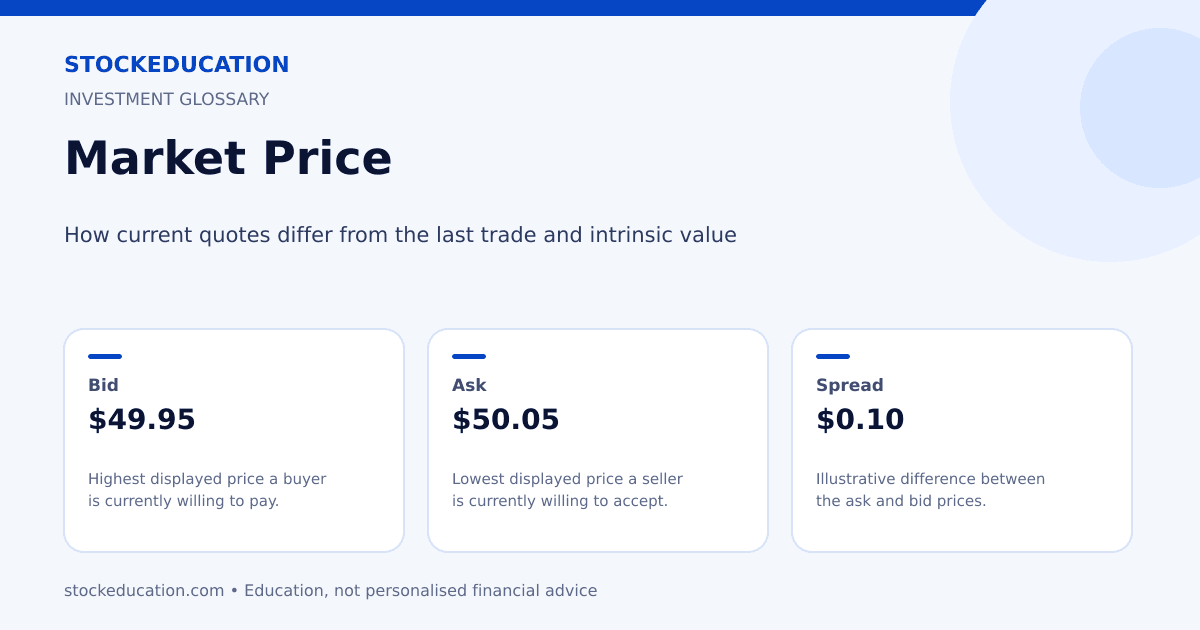
- The bid is the highest displayed price a buyer currently offers, while the ask is the lowest displayed price a seller currently accepts.
- The spread is the difference between the ask and bid and is a direct trading-cost consideration for an immediate transaction.
- The last-traded price records a completed transaction and can become stale relative to a changing bid and ask.
- A market order seeks immediate execution and generally fills near the available bid or ask, but it does not guarantee the last-traded price.
What is Market Price?
How Market Price works
| Step | What happens |
|---|---|
| 01 · Check the timestamp and trading status | Determine whether the quote is real-time, delayed, during regular hours or from another session. |
| 02 · Read both sides of the quote | Identify the bid, ask, displayed size and spread rather than relying only on the last trade. |
| 03 · Match the order type to the objective | Use a price limit when controlling execution price matters, or recognize the uncertainty of a market order. |
| 04 · Consider liquidity and size | Assess whether the displayed quantity can support the intended transaction without moving through multiple levels. |
| 05 · Separate price from value | Compare the market quote with a documented valuation analysis instead of treating either one as definitive. |
| 06 · Review the execution | Check the actual fill price, quantity and any partial fills after the order is completed. |
The formula
Spread = Ask price − Bid price Illustrative midpoint = (Bid price + Ask price) ÷ 2 Illustrative dollar spread cost for one immediate buy-and-sell round trip = Ask price − Bid price
Bid price: highest displayed price a buyer currently offers. Ask price: lowest displayed price a seller currently accepts. Spread: gap between ask and bid; it is not a guaranteed profit and can change before execution. Midpoint: arithmetic reference between bid and ask, usually not an immediately executable price. These formulas describe quote mechanics and do not estimate intrinsic value or guarantee execution prices. Example: with a $49.95 bid and $50.05 ask, spread = $0.10 and midpoint = $50.00; the figures are illustrative, not a market forecast or recommendation.
A worked example
Hypothetical example: Suppose a stock quote shows a bid of $49.95, an ask of $50.05, and a last trade of $50.00. The spread is calculated as $50.05 − $49.95 = $0.10, while the illustrative midpoint is ($49.95 + $50.05) ÷ 2 = $50.00. An investor placing an immediate market buy order might pay about $50.05 if sufficient shares are available at the ask. An investor selling immediately might receive about $49.95 at the bid. A one-share buy-and-sell round trip would therefore encounter a quoted difference of $0.10 before commissions, fees, taxes or price movement. If the investor submits an order for more shares than are available at $50.05, the remaining shares could fill at higher prices, producing a weighted-average execution above the first ask. Similarly, a market sell could execute across several lower bid levels. The $50.00 midpoint is useful for comparison but is not normally guaranteed as an executable price. The example is hypothetical and simplified: displayed quotes can change, sizes may be limited, data may be delayed, and actual execution depends on order type, venue, liquidity, timing and market conditions. None of these figures establishes intrinsic value or represents an investment recommendation.
A second hypothetical illustrates why the last trade is not always the actionable quote. Assume the last completed transaction occurred at $50.00. News then causes new buyers to raise the bid to $50.20 and sellers to set the ask at $50.30. The last trade remains $50.00 because no later transaction has completed, but a new immediate buyer may need to pay near $50.30. Conversely, if selling pressure changes the quote to a $49.70 bid and $49.80 ask, the historical last trade may be above both current sides. The correct interpretation depends on whether the displayed number is a bid, ask, midpoint or completed trade, and on when the quote was recorded.
For a portfolio holding 100 shares, a purely illustrative mark using the last trade of $50.00 would be 100 × $50.00 = $5,000. A rough liquidation reference using the current bid would be 100 × $49.95 = $4,995 if all shares could sell at that price, while an immediate purchase reference using the ask would be 100 × $50.05 = $5,005 if all shares were available there. These calculations do not guarantee that 100 shares can transact at one level. They show why portfolio marks, executable proceeds and replacement cost can differ, particularly for large orders or thinly traded securities.
Why it matters
Market price matters because it is the starting point for an investor deciding whether and how to trade, estimate a portfolio’s current value, or compare a security with a valuation estimate. Confusing the last trade with an executable quote can lead to unexpected fills. Ignoring the spread can understate transaction costs, while treating a quote as intrinsic value can turn an uncertain estimate into false precision. Reading bid, ask, spread, last trade, size and timing together creates a more realistic view of what the market currently offers.
Bid, Ask and the Quoted Market
A stock quote normally presents two sides of the market. The bid is the highest price currently displayed by a buyer willing to purchase, and the ask is the lowest price currently displayed by a seller willing to sell. An investor selling immediately generally interacts with the bid, while an investor buying immediately generally interacts with the ask. These prices are not permanent promises: orders can be cancelled, replaced or consumed by other trades. A quote may also show size, meaning the number of shares available at each level. Looking at both price and size gives more information than treating one headline number as the entire market.
Last Trade Versus Current Quote
The last-traded price is the price of the most recently completed transaction. It is useful as a record of where buyers and sellers last matched, but it may not be the price available for a new order. If new buying interest raises the ask and bid after the previous transaction, the last trade can sit below the current quote; the reverse can happen when selling pressure appears. The difference is especially important in fast markets, thinly traded securities, after news, or outside the most active trading hours. A careful reading of a quote identifies whether a displayed number is a bid, ask, midpoint, or completed trade.
The Bid-Ask Spread
The bid-ask spread is the numerical distance between the ask and bid. With a bid of $49.95 and an ask of $50.05, the spread is $0.10. The midpoint, $50.00 in that illustration, is a convenient reference but may not be an executable price. A narrow spread often indicates stronger competition among displayed orders and can reduce the apparent friction of an immediate transaction, although spread width can change with volatility, liquidity, order size and trading venue. A wide spread means that buying at the ask and selling at the bid can produce an immediate difference even if the quote does not otherwise move.
Market Orders and Execution
A market order prioritizes execution rather than a specified price. For a stock with available sellers, a buy market order generally executes near the current ask; a sell market order generally executes near the current bid. If the order is larger than the displayed quantity, it may fill across several price levels, producing a weighted average different from the first quote observed. Quotes can also change between order submission and execution. Consequently, a market order does not guarantee the last-traded price, the midpoint, or even a single price. Investors should consider liquidity, volatility, size and trading hours before assuming that a displayed market price is the amount they will receive.
Market Price and Intrinsic Value
Market price is an observation of what the marketplace is quoting or recently paid. Intrinsic value is an estimate of what a security may be worth based on a valuation method, such as discounted cash flow, comparable companies, earnings power or asset value. The two can differ because investors use different expectations about growth, profitability, interest rates, risk and future cash flows. A market price below an investor’s estimate does not by itself prove that a security is undervalued, because the estimate may be wrong or the market may incorporate risks the analysis overlooked. Comparing price with value therefore requires explicit assumptions and a margin of safety rather than a simple label.
Reading Market Price in Context
A useful market-price review combines the quote with time, venue, liquidity and the security’s trading conditions. Confirm whether the data is real-time or delayed, whether the market is open, and whether the displayed size is meaningful for the intended order. For less liquid securities, a quoted price may represent only a small quantity and may not describe the cost of a larger position. For a portfolio, market price supports marking holdings to market and calculating an estimated current value, but the result can change before liquidation. Historical charts also need context: a prior closing price, adjusted price and current bid or ask answer different questions.
Comparison
| Quote element | What it represents | Immediate trading relevance | Principal limitation |
|---|---|---|---|
| Bid price | Highest displayed buying offer | Reference for an immediate sale | May change or have limited size |
| Ask price | Lowest displayed selling offer | Reference for an immediate purchase | May not cover the desired order size |
| Last trade | Most recent completed transaction | Historical record of matched orders | May be stale versus the quote |
| Midpoint | Arithmetic center of bid and ask | Neutral comparison reference | Usually not an executable price |
Check yourself
A stock has a bid of $49.95, an ask of $50.05 and a last trade of $50.00. Which statement is most accurate?
The spread is calculated as ask minus bid: $50.05 − $49.95 = $0.10. A market buy generally executes near available selling offers at or around the ask, but the price is not guaranteed. The midpoint and last trade are references rather than guaranteed execution prices.
Show the answer
2. The spread is $0.10, and an immediate market buy generally interacts near the ask.
Things people get wrong
Mistake 01 Treating the last trade as the guaranteed current price
The last trade records a completed transaction and may differ from the current bid and ask.
Mistake 02 Assuming the midpoint is executable
The midpoint is a reference calculation; a buyer may need to pay the ask and a seller may receive the bid.
Mistake 03 Ignoring spread and order size
A small displayed spread may not describe the cost of a large order or a thinly traded security.
Mistake 04 Confusing market price with intrinsic value
A quote reflects current market conditions, while value is an estimate that depends on assumptions.
Mistake 05 Expecting a market order to guarantee price
Execution is generally prioritized, and the fill can differ from the observed quote as prices move.
Mistake 06 Using delayed or stale data without checking
A quote’s timestamp and trading session affect whether it describes conditions available for a new order.
Questions people ask about Market Price
What is market price?
It is the current marketplace quote or the price of a recently completed transaction, depending on the context.
Is market price the same as intrinsic value?
No. Market price is observable and time-sensitive, whereas intrinsic value is an analytical estimate based on assumptions about future economics.
What is the difference between bid and ask?
The bid is the highest displayed buying offer; the ask is the lowest displayed selling offer.
Why can the last price differ from the market price shown in a quote?
The last price is historical, while new orders may have changed the current bid and ask after that transaction.
What does the spread tell an investor?
It shows the difference between ask and bid and provides an indication of immediate trading friction, subject to liquidity and changing quotes.
Does a market order execute at the last-traded price?
No. It generally executes near available bid or ask prices and does not guarantee the last-traded price.
Why might a quoted price be unreliable for a large order?
The displayed quantity may be small, so a larger order can consume several price levels and receive a different average fill.
Can market price change while an order is being submitted?
Yes. Quotes can change between observation, submission and execution, particularly in volatile or thin markets.
The bottom line
Market price is a time-sensitive observation of what buyers and sellers are quoting or what they most recently paid. Read the bid, ask, spread, size, timestamp and last trade together, and do not confuse an executable quote with a midpoint or an estimate of intrinsic value.
Sources
About this page. Written by Associate Professor Charles Lo, CPA, PhD and edited by Felix La Spina. No ads and no paywall. Editorial standards · How we fact check · Corrections log · Report an error
Educational information only. Nothing on this page is personal financial, tax or legal advice. Investing involves risk, including the possible loss of principal.


