
Investment Glossary · Quick read · No ads
Present Value (PV)
Present value is the estimated value today of a future payment or cash flow after discounting it at a stated rate for the time until receipt.

Key takeaways
- Present value translates a future payment into an equivalent value today.
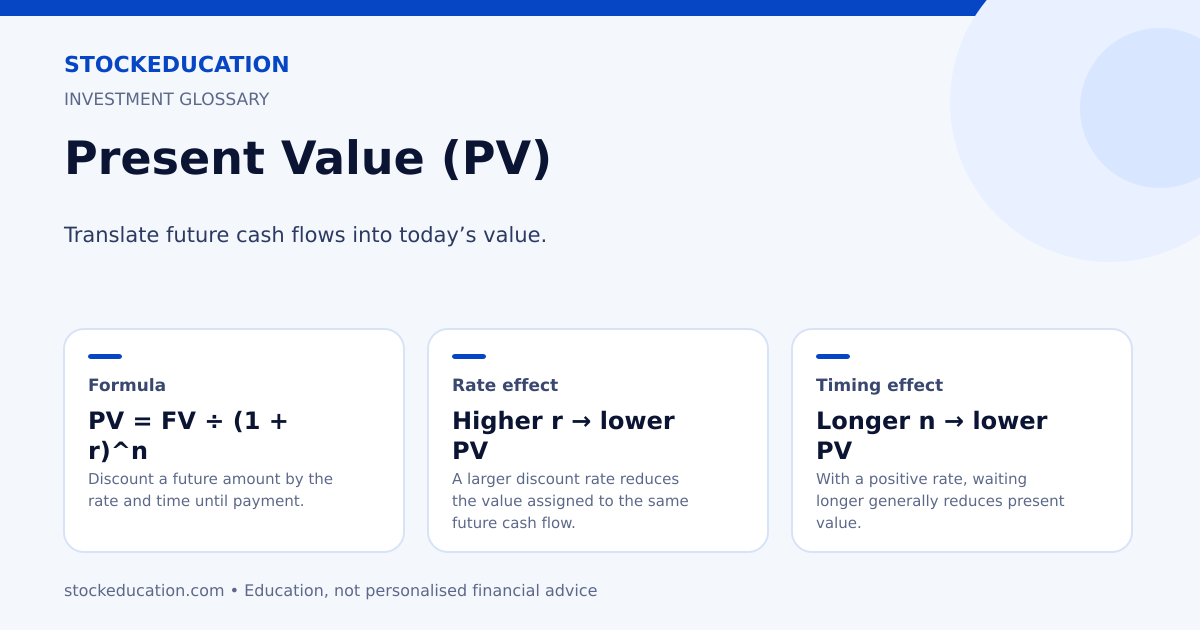
- A higher discount rate or a longer waiting period generally lowers present value.
- The discount rate should match the cash flow’s timing, currency and risk.
- A PV calculation is an estimate based on assumptions, not a guaranteed market price.
- Discounted cash flow valuation adds the present values of expected future cash flows and other value components.
What is Present Value (PV)?
Present value (PV) estimates what a future payment or cash flow is worth today when you apply a stated discount rate. It is a foundation of discounted cash flow analysis because money available today can be invested, while future cash flows remain uncertain.
Use PV to compare cash flows received at different dates, test valuation assumptions and understand why higher discount rates reduce estimated value. For a broader valuation application, continue to Discounted Cash Flow and practice the arithmetic with the Compound Interest Calculator.
How Present Value (PV) works
| Step | What happens |
|---|---|
| 01 · Define the cash flow and date | Identify the amount being valued and the exact date or period when it is expected to arrive. |
| 02 · Choose a matching discount rate | Select a rate appropriate for the cash flow’s risk, currency, timing and cash-flow definition. |
| 03 · Align the periods | Express the rate and number of periods on the same annual, quarterly, monthly or other basis. |
| 04 · Apply the formula | Divide the future cash flow by one plus the periodic rate raised to the number of periods. |
| 05 · Test the result | Recalculate using alternative rates, timing and cash-flow assumptions and explain the sensitivity. |
| 06 · Interpret cautiously | Compare the estimate with alternatives, but do not treat PV as a guaranteed price or return forecast. |
The formula
PV = FV ÷ (1 + r)^n
PV = present value today FV = future value or payment amount r = discount rate per period n = number of periods until payment
A worked example
Hypothetical example: a future payment of $1,210 is due in two years and the selected annual discount rate is 10%. PV = $1,210 ÷ (1 + 0.10)^2 = $1,000. The result means that $1,000 invested at 10% annually would grow to $1,210 after two years, before considering taxes, fees or risk differences. This is an invented teaching example and not a real market quote, forecast or recommendation. At the same rate, receiving the same payment in three years would reduce its PV to about $909.09.
Why it matters
Present value gives investors a common basis for comparing cash flows that arrive at different dates. It supports discounted cash flow analysis, project evaluation and sensitivity testing, while making clear that valuation depends on timing, risk and discount-rate assumptions.
What present value measures
Present value puts a future amount on a common time basis. If a payment is scheduled for a later date, PV asks how much money invested today at the chosen discount rate would grow to that future amount. This makes cash flows arriving in different years easier to compare. The answer is conditional: changing the rate, date or payment amount changes the result. In investing, PV is a valuation building block rather than a promise that the market will eventually trade at the calculated figure.
The present value formula
For one future cash flow, the standard formula is PV = FV ÷ (1 + r)^n. FV is the future value, r is the discount rate per period and n is the number of periods. The rate and period must match: an annual rate normally pairs with years, while a monthly rate pairs with months. The exponent causes discounting to compound across time. When the cash flow is received immediately, n is zero and PV equals FV. When the cash flow is later, the denominator is greater than one and PV is lower than FV when the rate is positive.
Worked hypothetical example
Suppose a hypothetical investment pays $1,210 exactly two years from today and the selected annual discount rate is 10%. PV = $1,210 ÷ (1 + 0.10)^2 = $1,210 ÷ 1.21 = $1,000. This is an invented teaching example, not a market quote, forecast or recommendation. If the same $1,210 payment arrived after three years at 10%, its PV would be about $909.09. If the two-year payment were discounted at 12% instead, its PV would be about $964.60. The comparisons show how timing and the chosen rate affect the estimate.
Present value in company valuation
In discounted cash flow analysis, analysts forecast future cash flows and discount each one back to the valuation date. They may also estimate a terminal value at the end of the forecast period and discount that terminal value separately. The cash flow definition must be consistent with the discount rate: cash flows to the whole firm commonly pair with a rate reflecting debt and equity financing, while cash flows to equity require an equity-focused rate. The SEC describes DCF as discounting estimated future cash flows to the present using a targeted or appropriate rate, while noting that assumptions about risk and cash flow matter.
Sensitivity, uncertainty and interpretation
PV is sensitive to inputs, especially when the cash flow is far in the future or when a valuation includes a large terminal value. A small change in the discount rate can materially change the result because the rate is compounded over time. A careful analysis tests several rates, growth assumptions and timing cases, labels observed facts separately from estimates and explains why the selected rate is reasonable. A PV estimate below a market price does not prove that the security is overvalued, and a PV estimate above a price does not prove that it is a bargain.
Matching cash flows and discount rates
The discount rate should reflect the risk and characteristics of the cash flow being valued. Nominal cash flows should generally be discounted with a nominal rate, and real cash flows with a real rate. Annual, quarterly and monthly timing should not be mixed without conversion. Analysts also need to state whether cash flows occur at the end or beginning of each period. Using a rate that does not match the cash flow can create false precision even when the arithmetic is correct.
PV versus related valuation concepts
PV concerns the value today of a future amount or stream. Future value moves a current amount forward to a later date. Net present value subtracts the present value of required investments or outflows from the present value of expected inflows. Discounted cash flow is a broader valuation process that may sum PVs of forecast cash flows and a discounted terminal value. Intrinsic value is a wider estimate of what an asset may be worth based on fundamental assumptions, and may be produced by several methods.
Comparison
| Concept | Definition | Time direction | Common use |
|---|---|---|---|
| Present value | Value today of a future cash flow | Future to today | Value one payment or cash-flow stream |
| Future value | Value at a later date of money held today | Today to future | Project growth or accumulation |
| Net present value | Present value of inflows minus present value of outflows | Future cash flows to today | Evaluate an investment or project |
| Discounted cash flow | Valuation method using discounted expected cash flows | Forecast periods to valuation date | Estimate business or asset value |
Check yourself
A hypothetical $1,000 payment is due in two years. If the positive discount rate rises while the payment date stays fixed, what generally happens to its present value?
Present value generally decreases when the discount rate rises because the future payment is divided by a larger compounded discount factor. The result remains an estimate based on the selected assumptions.
Show the answer
It generally decreases
Things people get wrong
Mistake 01 Using mismatched periods and rates
Pair an annual discount rate with annual periods, or convert both inputs to a consistent monthly, quarterly or other periodic basis.
Mistake 02 Treating PV as a guaranteed price
Present value is an assumption-dependent estimate, not proof of intrinsic value, future performance or a market outcome.
Mistake 03 Ignoring timing conventions
State whether cash flows arrive at period end or period beginning and use the correct number of periods.
Mistake 04 Double counting terminal value
Discount terminal value once and keep it separate from the forecast-period cash flows.
Mistake 05 Mixing cash-flow definitions and discount rates
Match enterprise cash flows with an appropriate enterprise discount rate and equity cash flows with an equity-appropriate rate.
Mistake 06 Relying on one precise scenario
Test alternative rates, timing, growth and cash-flow assumptions instead of presenting one output as certain.
Questions people ask about Present Value (PV)
What is the simplest present value formula?
For one future cash flow, PV = FV ÷ (1 + r)^n, where FV is future value, r is the discount rate per period and n is the number of periods.
Why is present value usually lower than future value?
With a positive discount rate, the future amount is divided by a number greater than one to reflect the opportunity cost and uncertainty of waiting.
What happens to PV when the discount rate rises?
Holding the payment and timing constant, a higher discount rate generally lowers present value because the future amount is discounted more heavily.
Can present value be used for a company’s stock?
Yes, as part of methods such as discounted cash flow, but the analyst must forecast appropriate cash flows, choose a consistent discount rate and test uncertainty.
Is present value the same as market price?
No. Market price is an observed trading price at a point in time, while PV is a model output based on selected assumptions.
What is the difference between PV and NPV?
PV values a future amount or stream alone. Net present value generally subtracts the PV of required outflows from the PV of expected inflows.
Why does timing matter so much?
Discounting compounds across periods, so delaying the same payment usually reduces its present value when the discount rate is positive.
The bottom line
Present value is a practical way to compare future money with money today. Calculate it with consistent timing and rates, document whether the inputs are observed or assumed, and test a range of scenarios. Use PV as one component of valuation analysis rather than treating the result as a guaranteed price or investment recommendation.
Sources
About this page. Written by Associate Professor Charles Lo, CPA, PhD and edited by Felix La Spina. No ads and no paywall. Editorial standards · How we fact check · Corrections log · Report an error
Educational information only. Nothing on this page is personal financial, tax or legal advice. Investing involves risk, including the possible loss of principal.


