
Module 6 · Valuation · Lesson 13
Margin of Safety
The cushion between what you pay and what you actually get.
Quick Answer
What Is a Margin of Safety in Investing?
A margin of safety is the discount between a company’s estimated intrinsic value and the price you pay for its shares. For example, buying a stock estimated to be worth $100 for $70 provides a 30% margin of safety. This cushion helps protect investors from valuation mistakes, unexpected problems and market volatility, but it only works when the underlying business remains financially sound. Our DCF valuation tool handles the arithmetic so you can focus on the assumptions.

When Benjamin Graham was asked to distil the essence of intelligent investing into three words, he answered: Margin of Safety. Three words. Six decades of practice. And the foundation of every great value investor who has come after him — Buffett, Klarman, Marks, Greenblatt — all build on this single principle.
The Margin of Safety is the difference between what something is worth and what you pay for it. If a stock is worth $100 and you pay $60, your margin of safety is $40 — a 40% cushion. That cushion does two things. First, it protects you from your own mistakes: every valuation involves assumptions that may turn out wrong, and the buffer absorbs those errors. Second, it produces extraordinary returns when the market eventually agrees with you and prices rise toward fair value.
Without a margin of safety, investing is hope. With one, investing becomes a structural advantage that compounds across hundreds of decisions over a lifetime. This lesson covers what margin of safety actually means in practice, how big it should be, how to find it, and the value traps that look like bargains but are not.
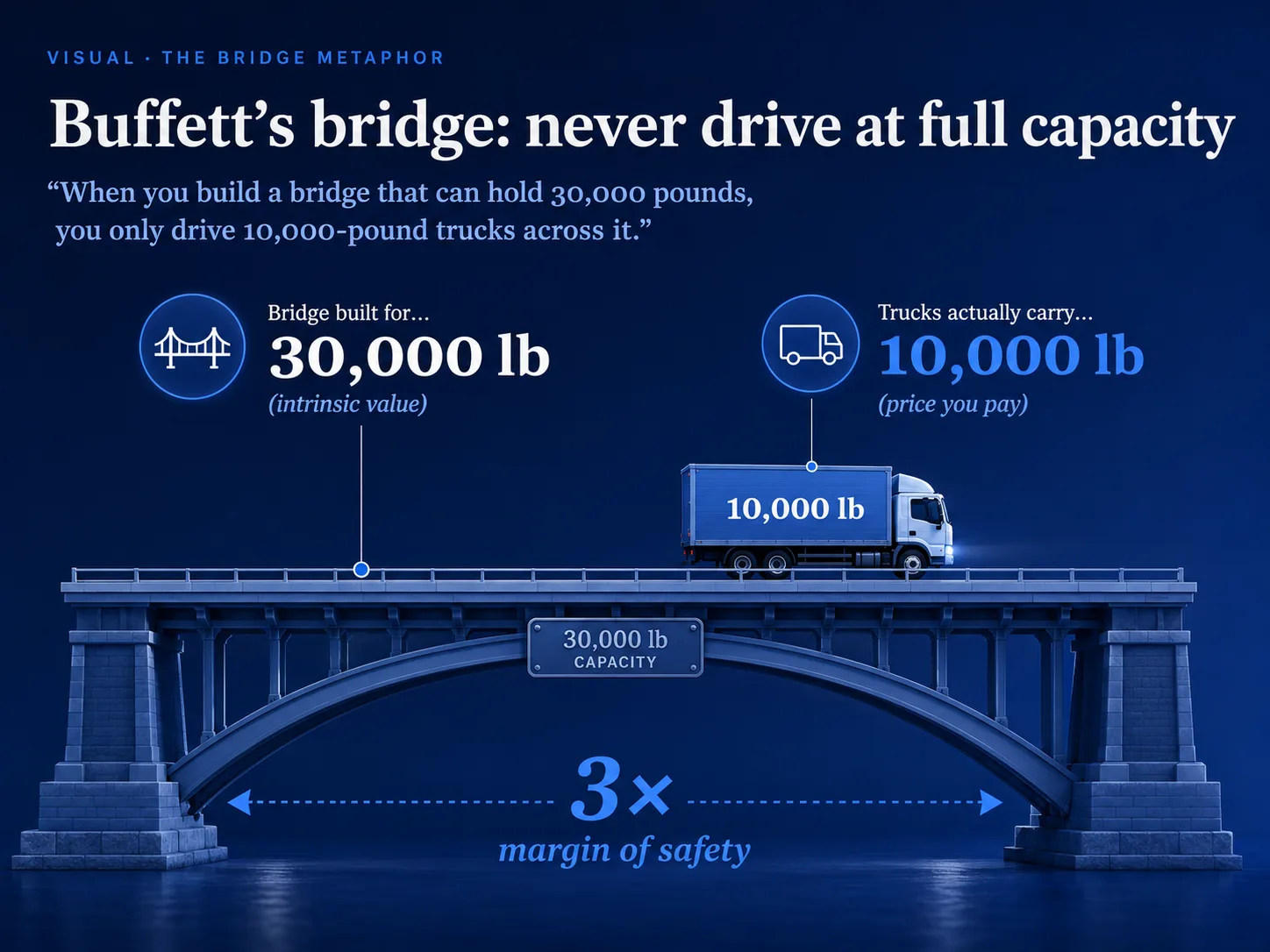
This is the engineering version of value investing. A real engineer would never design a bridge to hold exactly the weight that will cross it. The bridge holds three times more, because materials weaken, loads vary, and disasters happen. The same logic applies to investing. Never buy a stock at exactly your estimated intrinsic value — buy at a sharp discount, so when your estimate proves slightly wrong (and it will), you are still protected.
|
25–50%
Graham’s recommended discount |
3 words
Graham’s whole investing philosophy |
~20%
Buffett’s annualized return over 60 years |
Sources. Graham, The Intelligent Investor (1949). Berkshire Hathaway annual reports.
Part One
The idea in plain English
A margin of safety means paying less than your estimate of value so mistakes and bad luck do not destroy the investment case.
How this looks in real investing
If you estimate a stock is worth $100, buying at $70 gives more protection than buying at $98.
What to avoid
Using aggressive assumptions and then pretending the discount is conservative.
Do this before moving on
Decide your required discount before buying, not after you become emotionally attached.
The five pillars of margin of safety
Margin of safety is not just “buy cheap.” It is five interlocking principles, each one reinforcing the others.
“To distill the secret of sound investment into three words, we venture the motto — ‘Margin of Safety.'”
— Benjamin Graham, The Intelligent Investor
Part Two
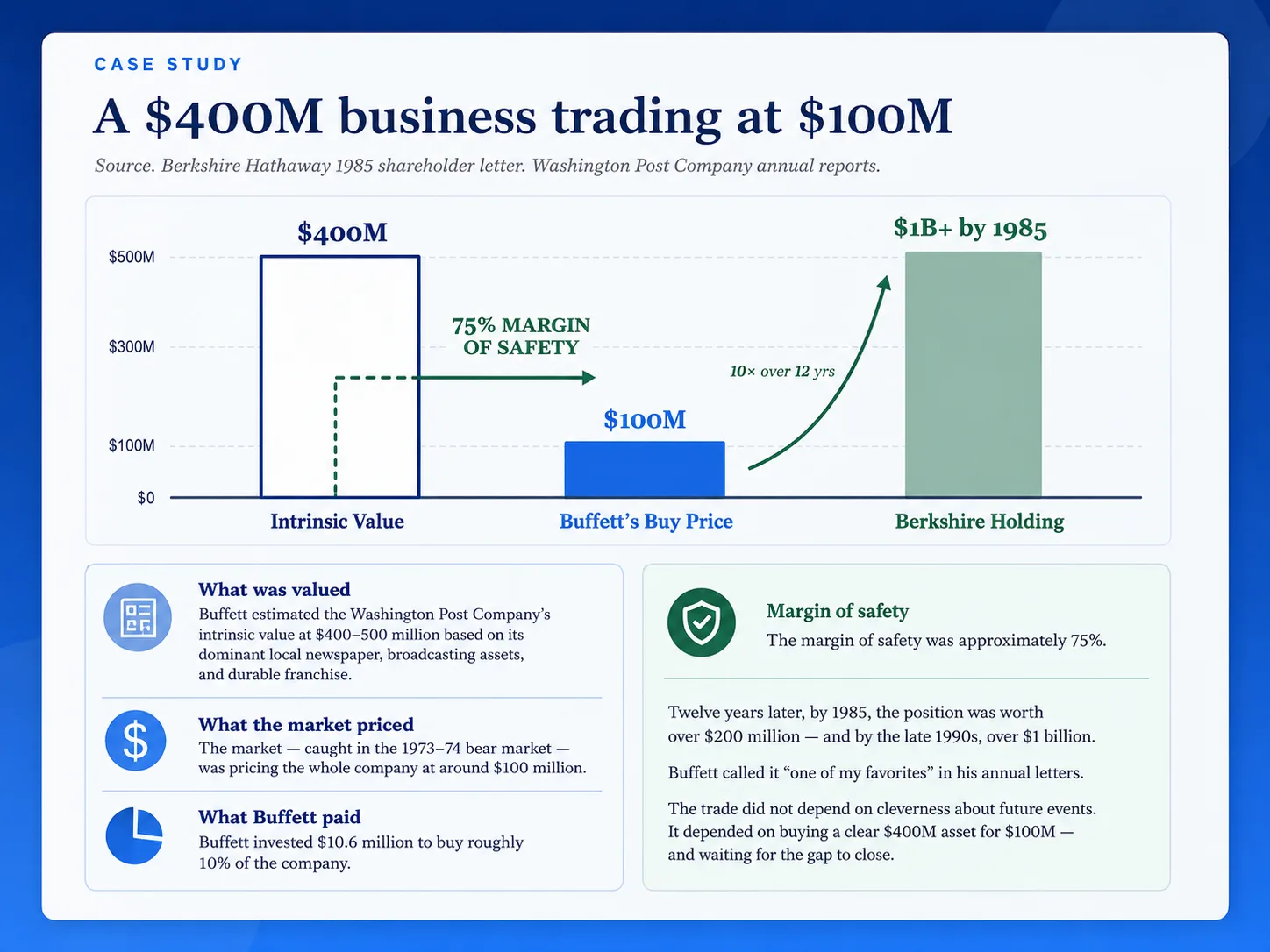
Case study: Buffett buys Washington Post, 1973
One of Buffett’s most celebrated trades demonstrates margin of safety in textbook form. In 1973, the US stock market was in the middle of a brutal bear market — the S&P fell roughly 48% from peak to trough. Quality businesses were trading at fire-sale prices that would have seemed inconceivable two years earlier.
“When you build a bridge that can hold 30,000 pounds, you only drive 10,000-pound trucks across it.”
— Warren Buffett
Part Three
How to apply margin of safety in five steps
Step 1
Estimate value
Step 2
Set required discount
Step 3
Watchlist buy prices
Step 4
Wait patiently
Step 5
Buy when price hits
One. Estimate intrinsic value as a range. Using the methods from Lesson 12 — book value, earnings power, DCF. Express as a range ($70–$110), not a single number. Be conservative with growth assumptions; optimism is the enemy of margin of safety.
Two. Set your required discount. A wide-moat quality business: 25–30% below the bottom of your range. A more uncertain or cyclical business: 40–50% below. A turnaround or distressed name: 60%+ if you proceed at all.
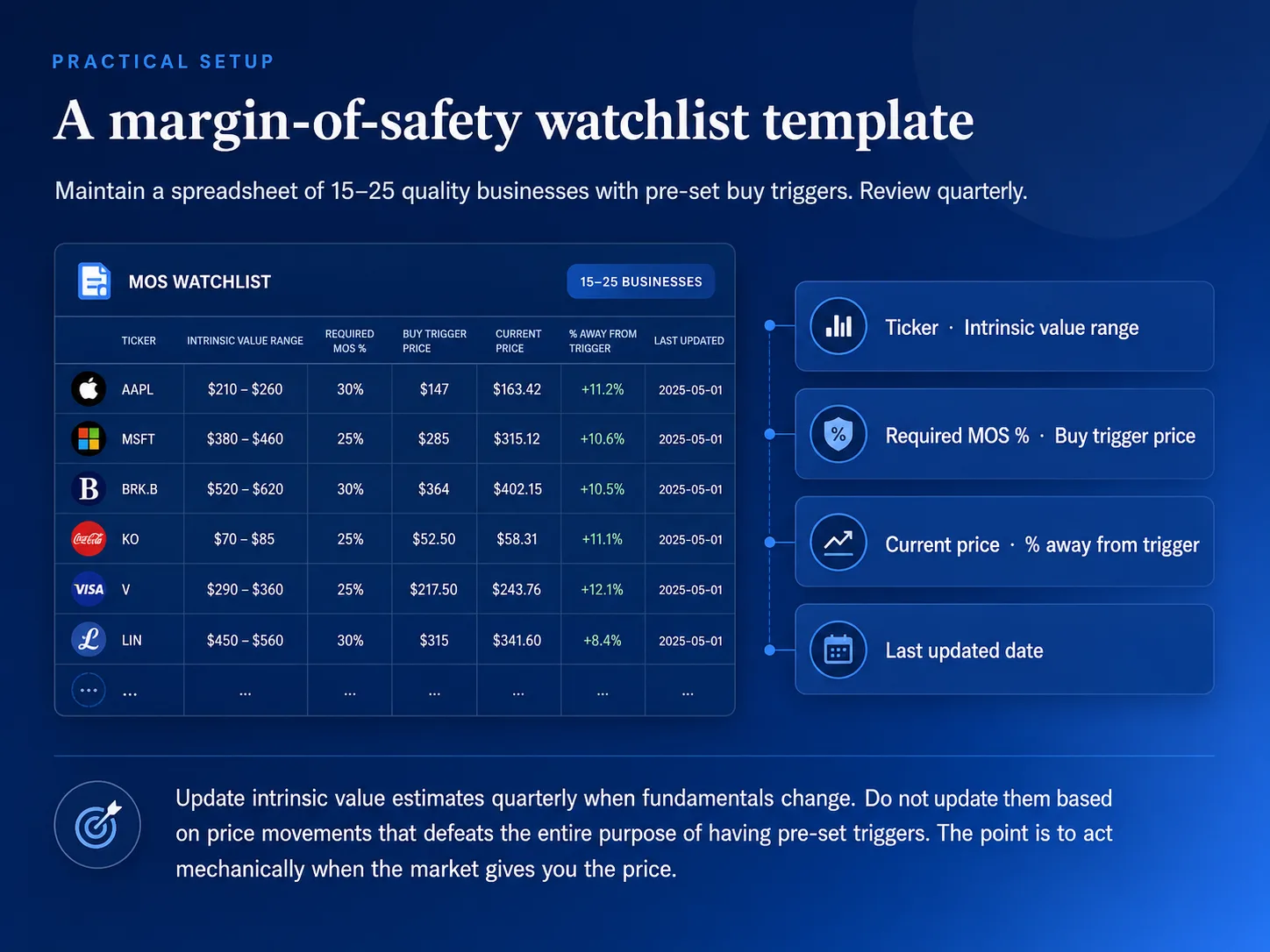
Three. Pre-compute your buy prices. If a stock’s intrinsic value range is $70–$110 and you require 30% margin of safety, your buy trigger is $49 (70% of $70). Write this down. Do not negotiate with yourself in the moment when the market drops.
Four. Wait patiently for the trigger. Most of the time, prices will stay above your buy levels. The patience is the discipline. Buffett famously says investing is like baseball with no called strikes — you can stand at the plate forever waiting for the right pitch.
Five. Buy decisively when the price hits. When the market gives you the price — usually during a panic — act. Have cash ready. Have conviction in writing. The market will rarely give you days; sometimes it gives you hours.
Part Four
Where margin of safety fails
Value traps. A “cheap” stock can stay cheap forever if the underlying business is dying. Sears traded at “discounts to book value” for two decades before bankruptcy. The book value was being silently destroyed as stores closed and inventory was written down. Always combine MOS analysis with moat and management diligence.
Missed opportunities. Strict margin-of-safety investors often miss long bull markets because prices don’t drop to required levels. Buffett held billions in cash for years in the 2010s waiting for opportunities. The cost was paid in lost market gains. This is a real trade-off, not a flaw.
Misjudged intrinsic value. Margin of safety only works if your value estimate is roughly correct. If you estimate fair value at $100 but the real number is $40, paying $60 isn’t a 40% discount — it’s a 50% overpayment. The cushion only protects you against modest errors, not wholesale misreads of the business.
| Risk | Example | Defence |
|---|---|---|
| Value trap | Sears, Kodak — cheap and dying | Verify moat is intact |
| Missed opportunities | Sitting in cash during bull markets | Accept the trade-off; hold index core |
| Misjudged value | Overoptimistic growth assumptions | Use ranges; be conservative |
| Catching falling knives | Buying too early in a decline | Scale in over time, not all at once |
| Confirmation bias | Loving a stock, ignoring red flags | Pre-mortem: “what would prove me wrong?” |
Catching falling knives. A stock that looks like a 40% discount today may be a 60% discount tomorrow. Scale into positions instead of buying everything at once — for example, buy a third now, a third on a 20% further drop, a third on a 40% further drop. This is mechanical and removes the temptation to second-guess yourself.
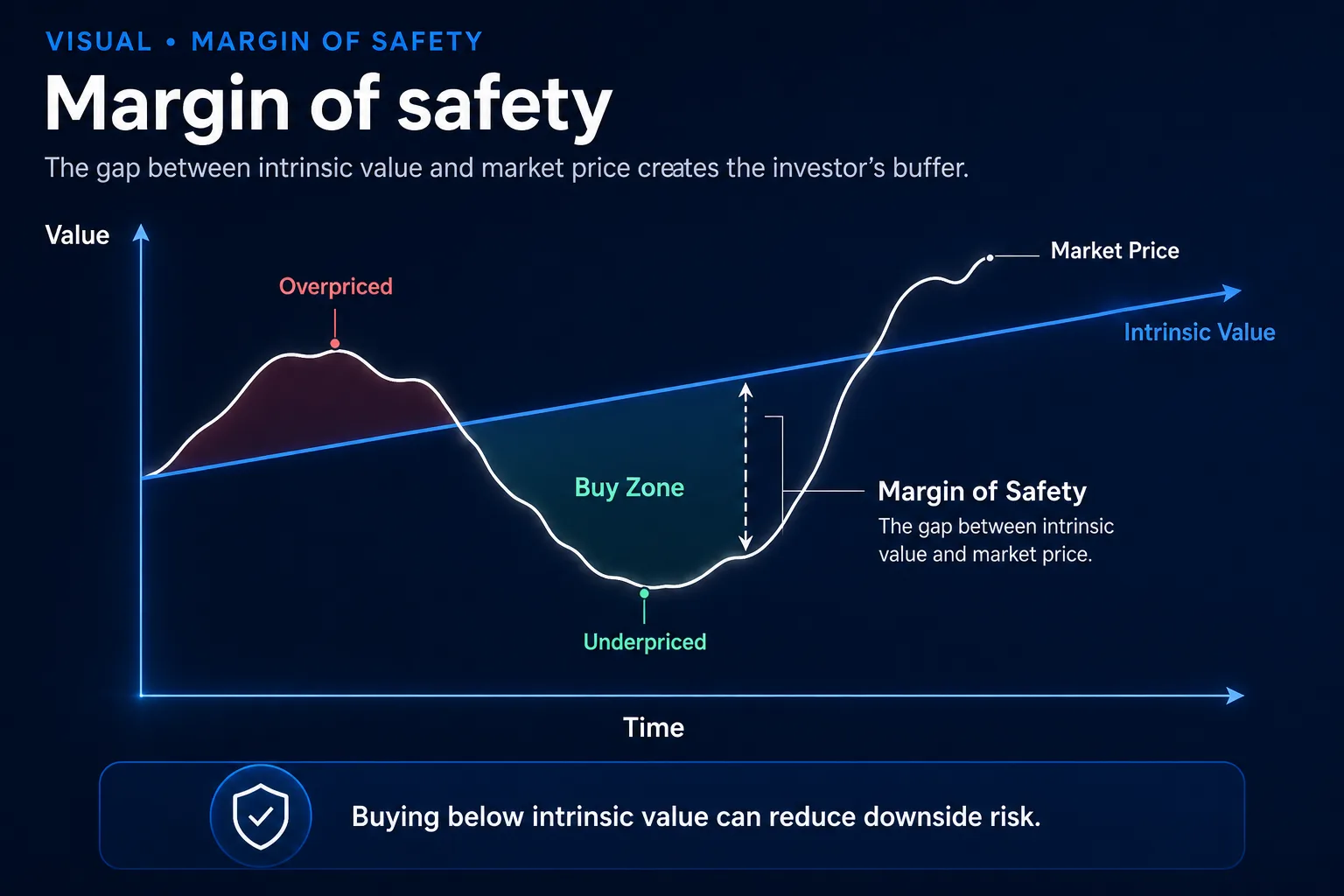
“Low price is the ultimate source of margin for error. If you buy stock with a sufficient margin of safety, the probability is with you.”
— Howard Marks
Investor Wisdom
What the great investors said about the cushion
Ten quotes on the discipline of buying below value — from the people who built the philosophy.
“To distill the secret of sound investment into three words, we venture the motto — ‘Margin of Safety.'”
— Benjamin Graham
Means. If the entire investment philosophy must fit on a postage stamp, this is the philosophy.
Apply. Never buy without margin of safety. Walk away when there isn’t one.
“A margin of safety is achieved when securities are purchased at prices sufficiently below value to allow for human error, bad luck, or volatility.”
— Seth Klarman
Means. The cushion exists precisely because all three — error, luck, volatility — will occur.
Apply. Build for the world as it actually is, not as you wish it were.
“When you build a bridge that can hold 30,000 pounds, you only drive 10,000-pound trucks across it.”
— Warren Buffett
Means. Engineering uses safety factors. So should investing.
Apply. Whatever discount you think you need, demand a bit more.
“Low price is the ultimate source of margin for error.”
— Howard Marks
Means. Quality matters, but price is what creates the actual safety. Even a great business can be a bad investment at the wrong price.
Apply. Quality plus low price beats quality plus high price every time.
“The three most important words in investing are margin of safety.”
— Warren Buffett
Means. A direct endorsement of Graham’s philosophy from his most famous student.
Apply. Make margin of safety the first question of every investment decision.
“The further the price has fallen below value, the greater the upside and the less the downside.”
— Howard Marks
Means. Margin of safety creates asymmetric returns mathematically, not just intuitively.
Apply. Bigger margin = better risk/reward. Patience pays compounding rewards.
“Investment is most intelligent when it is most businesslike.”
— Benjamin Graham
Means. Real business buyers always negotiate discounts. Stock investors should too.
Apply. Ask yourself: would I buy this entire business at this price? If no, walk away.
“Be fearful when others are greedy, and greedy when others are fearful.”
— Warren Buffett
Means. The deepest margins of safety appear when crowds panic. Be ready to act.
Apply. Keep dry powder. Mass fear creates the prices margin-of-safety investors wait years for.
“The intelligent investor is a realist who sells to optimists and buys from pessimists.”
— Benjamin Graham
Means. Margins of safety appear when pessimists are setting prices.
Apply. Look at headlines: when they are screaming the worst, the prices are best.
“Investment success doesn’t come from buying good things, but rather from buying things well.”
— Howard Marks, The Most Important Thing
Means. Discomfort at the moment of purchase often correlates with subsequent returns. Margin of safety appears in unpopular places.
Apply. If buying feels comfortable, the price is probably too high.
Key Takeaways
Six things to take from this lesson
| 01 | Margin of safety is the gap between intrinsic value and the price you pay — the foundation of value investing. |
| 02 | Five pillars: the gap, error tolerance, asymmetric returns, psychological insurance, value-trap avoidance. |
| 03 | Required discount: 25–30% for quality moated businesses; 40–50% for uncertain or cyclical names. |
| 04 | Buffett’s $10M Washington Post purchase had a 75% margin and grew 100× — the textbook application. |
| 05 | Maintain a watchlist with pre-set buy triggers. When the market panics, act mechanically, not emotionally. |
| 06 | Margin of safety fails against value traps — always combine with moat and management analysis. |
Five Commitments
What you commit to before moving on
Read each one. If you cannot honestly commit to it, the lesson is not finished.
| I. | I will never buy an individual stock without a written intrinsic value estimate and a required margin of safety. |
| II. | I will require at least 25% margin of safety for quality businesses, 40%+ for less certain ones. |
| III. | I will maintain a watchlist with pre-set buy triggers so I act mechanically when the market dislocates. |
| IV. | I will combine MOS with moat and management analysis to avoid value traps disguised as bargains. |
| V. | I will be patient. When no real bargains exist, I will hold cash or index funds and wait rather than force trades. |
End of Lesson
Module 6 . Lesson 13 of 21 . Continue to Lesson 14 . Economic Indicators.
Primary sources and further reading
Use these references to check the definitions, methods and risks discussed in this guide. Examples are for learning and do not predict investment results.
- Berkshire Hathaway: 1992 shareholder letter on margin of safety
- Berkshire Hathaway: 1994 shareholder letter on uncertain value estimates
- FINRA: Investment Risk
- SEC Investor.gov: Using EDGAR to Research Investments
Education only. This guide provides general information, not personal investment, financial or tax advice. Check current rules and official filings before making a decision.


