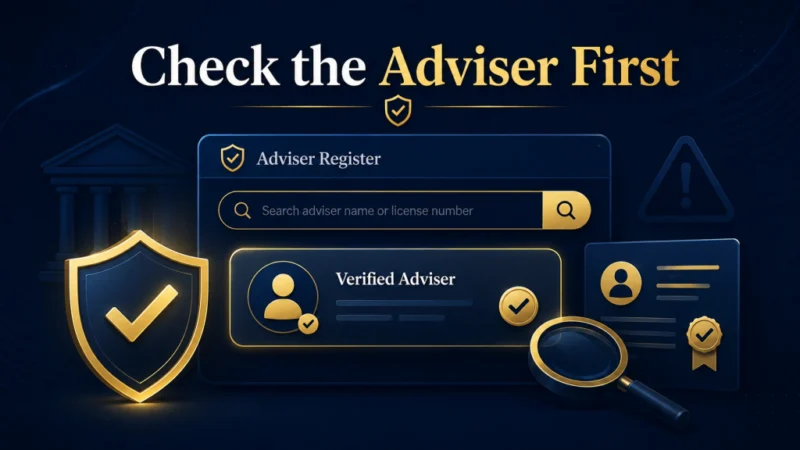
In Australia, ASIC’s Financial Advisers Register lets you look up current and former relevant providers. A name match is the starting point. Check which licensee currently authorises the adviser, their registration status and whether the proposed advice falls within their product permissions.
What the Financial Advisers Register Is
ASIC maintains the Financial Advisers Register for relevant providers who give personal advice to retail clients on relevant financial products. The register includes historical appointments. Check the current details before relying on a person’s claimed authority.
Someone offering advice within the register’s scope should have a record you can verify. Check the spelling, adviser number, current authorisation and registration status. Different requirements can apply to other kinds of advice and to provisional advisers.
What the Register Shows You
Each entry on the register is designed to give you a clear picture of an adviser’s standing. The summary below lists the main fields. You will see the adviser’s name and registration number, their current authorisation status, the licensee they work under now and any previous licensees, the product areas they are authorised to advise on, and the qualifications and training they have listed. Together these let you confirm not just that the adviser is authorised, but the shape of their experience and the firm standing behind them.

How to Search the Register
Searching the register is quick and free, and you only need a little information to start. The steps below set out the process. Open the register on the Moneysmart website, enter the adviser’s name, adviser number, business name or Australian Business Number, and review the result. If a common name returns several people, use the adviser number or ABN to be sure you have the right one, then read the full record and confirm the licensee separately. A few minutes here protects a far larger decision.
What It Confirms and What It Does Not
Check whether the adviser’s appointment is current, which licensee authorises them and which product areas are covered. Check the separate registration status and any suspension or prohibition. A former adviser can still appear in a search, and ASIC does not endorse an adviser’s services. Our pension benefit estimator works out what a defined benefit scheme is worth.

When an Adviser Is Not Listed
If you cannot find someone offering personal advice within the register’s scope, confirm their name and adviser number. Verify the licensee through ASIC and contact it using independently obtained details. Resolve any discrepancy before acting on the advice.

How to Act on What You Find
Once you have the record in front of you, the comparison below helps you read it. Reassuring signs include an adviser who is listed and currently authorised, a licensee you can confirm separately, advice that falls within their authorised product areas, and a history with no gaps you cannot explain. Reasons to pause include not being on the register at all, a licensee you cannot verify, advice that sits outside their authorisation, or any pressure to skip these checks. The register gives you the facts; how you weigh them is the point.
Common Mistakes People Make
These four mistakes reduce the protection the register can give you.
Assuming listed means recommended
Why it backfires: A search result can identify a former adviser as well as a current one. ASIC does not endorse a person simply because an entry appears.
Do this instead: Review the current appointment, registration status, product areas and restrictions. Then assess the advice, fees and suitability for your circumstances.
Stopping at a name match
Why it backfires: Acting on the first person with a matching name can mean you are looking at the wrong adviser entirely.
Do this instead: Use the adviser number or ABN to confirm you have the right person when a name returns several results.
Ignoring an adviser who is not listed
Why it backfires: If the person offers advice within the register’s scope, an unexplained missing record is a warning sign.
Do this instead: Treat a missing listing as a reason to stop, confirm their details, and verify the licensee before going further.
Skipping the licensee check
Why it backfires: Confirming the adviser but not the licensee they operate under leaves part of the picture unverified.
Do this instead: Look up the licensee separately on ASIC’s professional registers and check that its license covers the relevant services.
The Honest Bottom Line
Use the register to identify the adviser, verify their current appointment and check which products they can advise on. Check the separate registration status and any restriction. The licensee’s own records should also match.
ASIC does not recommend advisers on the register. Even after checking current permissions, you still need to consider the proposed advice, fees and fit for your circumstances.
The register is best understood as the first gate, not the whole journey. It answers one important question clearly, whether the person is authorised to give you personal advice, and it gives you the licensee, history and qualifications to go with it. What it cannot do is tell you whether the advice will be good or whether the adviser is right for you. So confirm authorisation on the register, verify the licensee separately, and then judge the advice itself on its merits, its cost and its fit with your goals. Used that way, the register is a quick and powerful first step toward advice you can trust.
Frequently asked questions
What is the ASIC Financial Advisers Register?
It is ASIC’s public record of current and former relevant providers. It covers personal advice to retail clients on relevant financial products. Look at the current appointment, registration status and restrictions before relying on an entry.
How do I search the register?
Go to the Financial Advisers Register on the Moneysmart website and enter the adviser’s name, adviser number, business name or Australian Business Number in the search box. If a name returns several results, use the adviser number or ABN to make sure you are looking at the right person.
What information does the register show?
It shows the adviser’s name and registration number, their authorisation status, their current licensee and any previous licensees, the product areas they can advise on, and their listed qualifications and training. The licensee is the Australian Financial Services licence holder the adviser operates under.
Does being on the register mean ASIC recommends the adviser?
No. A name match can be historical, and ASIC does not endorse the advice. Check the adviser’s current appointment, registration status, product permissions and any suspension or prohibition.
What if my adviser is not on the register?
First confirm the spelling and adviser number. If someone offers personal advice to retail clients on relevant financial products, check their status through the register and verify the licensee independently. Ask the licensee or ASIC about unresolved discrepancies.
Is the register the same as checking the licensee?
They are related but separate. The Financial Advisers Register covers the individual adviser, while ASIC’s Professional Registers Search lets you check the Australian Financial Services licensee they work under. For a full picture, confirm both, using the AFS license number, which stays the same even if the licensee changes its name.
Sources
All claims in this article are supported by the sources listed below. Verify details against the originals before making investment decisions.
- Australian Securities and Investments Commission (Moneysmart). Financial advisers register. Accessed 10 June 2026.
- Australian Securities and Investments Commission. Financial Advisers Register. Accessed 10 June 2026.
Before you act on this
This article explains how something works. It is general education, not advice about your situation. It does not consider your goals, income, tax position or how much risk you can afford.
Investing involves risk, including losing money. Before you act, speak to a licensed professional. You can check whether someone is licensed at Investor.gov and FINRA BrokerCheck.