A critical final verification framework to use immediately before transferring funds to any investment or trading platform.
Many investment fraud victims describe the same moment of regret. They felt uncertainty, noticed a small red flag, hesitated, and then transferred the money anyway. In high-pressure financial situations, that final moment matters. A structured pause can interrupt urgency, reduce emotional momentum, and force the decision back onto evidence. You can test any approach you have received against our investment scam radar tool.
According to the Federal Trade Commission, consumers reported $12.5 billion in fraud losses in 2024, with investment scams accounting for $5.7 billion of that total. The FBI Internet Crime Complaint Center reported $16.6 billion in cybercrime losses in 2024, with investment fraud representing the highest loss category. Regulators globally continue to warn that modern fraud operations use artificial intelligence, cloned websites, impersonation tactics, cryptocurrency transfers, and psychological pressure to accelerate payment decisions.
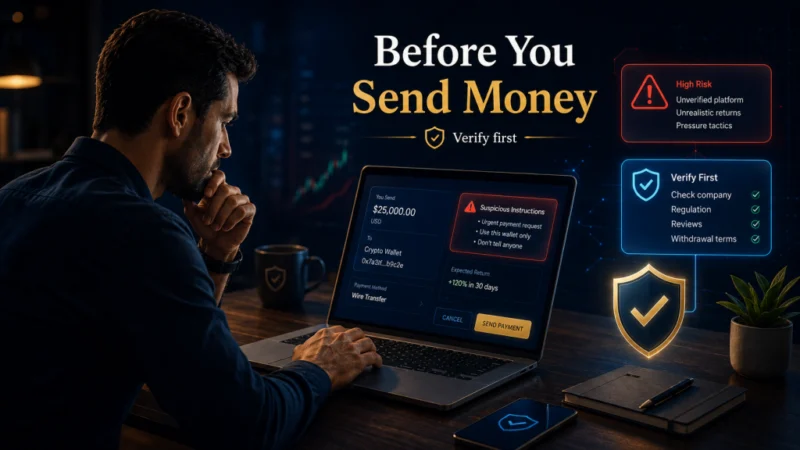
Before sending money, pause and complete a structured final verification review. This before-you-send-money checklist is designed to be used immediately before transferring funds to any investment platform, trading platform, crypto opportunity, broker, adviser, or online financial offer.
Why a Final Checklist Matters
Investment fraud often succeeds because it creates speed. Victims are pushed toward action before they can verify details properly. They may be told the opportunity closes today, the market is moving now, limited allocation remains, or funds must be sent immediately. These phrases are designed to create urgency, not clarity.
A final checklist creates a deliberate interruption. Instead of asking, “Do I feel convinced?”, it asks, “Have I verified this independently?” That distinction matters. Professional websites, polished representatives, AI-branded dashboards, and profit screenshots can all be manufactured. Official records, matching legal entities, realistic economics, clear withdrawal terms, and verifiable payment rails are much harder to fake consistently.

Step One: Confirm You Have Independently Verified Regulation
Ask yourself clearly: have I independently verified the legal entity in official government or regulator databases? Verification must happen outside the investment website. Do not rely on a logo, a certificate, a screenshot, or a registration number shown by the platform itself.
Use official regulator resources where relevant:
- United States: FINRA BrokerCheck and the SEC.
- Australia: ASIC registers and the financial advisers register.
- United Kingdom: Financial Conduct Authority register.
- Canada: AreTheyRegistered.ca and provincial securities regulators.
- Singapore: MAS Financial Institutions Directory.
Confirm that the entity exists, the license is active, the services offered match the marketing claims, and the contact details match the regulator listing exactly. If you have not independently confirmed regulation, do not send money.
Step Two: Evaluate Return Realism
Ask whether the promised returns are realistic compared with normal market behavior. Major equity markets have historically averaged around 10% annually over long periods, but that figure is not smooth, guaranteed, or available every week. Real markets involve volatility, drawdowns, losing periods, and uncertainty.
Be extremely cautious if a platform promises guaranteed daily profit, fixed weekly percentage returns, no losing trades, or artificial intelligence that removes risk. These claims contradict basic market reality. No legitimate investment removes risk or guarantees consistent profit. If the return claim appears unrealistic, do not proceed.
Step Three: Confirm Withdrawal Terms Clearly
Before sending money, make sure you understand the withdrawal procedure, processing timeframe, fee structure, and tax handling. A legitimate financial provider should explain these clearly before you deposit. You should not discover hidden withdrawal conditions only after your money is already inside the platform.
Be cautious if you are told you must pay capital gains tax before withdrawing, upgrade your account to access funds, deposit additional money to unlock profits, or send a separate payment to release your balance. Legitimate institutions generally deduct lawful fees internally from balances. If extra payment is required before withdrawal, risk is extremely high.
Step Four: Review Payment Instructions Carefully
Payment instructions often reveal fraud risk. Ask whether you are being told to send cryptocurrency directly to a wallet, wire funds to a personal name, transfer money to a country unrelated to the company registration, or act urgently before the details can be checked.
Cryptocurrency transfers are generally irreversible. Wire transfers can be difficult to reverse once settled. If payment instructions appear unusual, inconsistent, personal, crypto-only, or rushed, pause immediately.

Step Five: Conduct a Final Independent Search
Before sending funds, do one last independent search. Search the company name plus “scam”, executive names, the website domain plus “scam”, wallet addresses where relevant, and any regulator warning lists connected to the country involved.
Review official warning lists from bodies such as the FCA, ASIC, SEC, and other national regulators. If the entity appears on a warning list, disengage immediately. If the search results show inconsistent company names, complaints about withdrawals, cloned website warnings, or fake registration claims, do not send money.
Step Six: Evaluate Your Emotional State
Fraud relies on emotional momentum. Ask yourself whether you feel pressured, afraid of missing out, trusting someone you have never met, or relying on screenshots rather than official records. If emotional intensity is high, delay the transfer.
Urgency is a manipulation tool, not proof of opportunity quality. A legitimate investment should survive a 24-hour pause, independent review, and verification through official sources. If the person promoting the opportunity reacts badly to delay, that is itself a warning sign.
Step Seven: Discuss It With an Independent Party
Before sending significant funds, consider whether you have discussed the opportunity with an independent licensed financial adviser, spoken to a trusted third party, and taken at least 24 hours to reflect. Independent perspective reduces vulnerability because it removes the decision from the emotional environment created by the seller or scammer.
This is especially important if the opportunity came through a private message, social media relationship, online group, dating app, messaging app, influencer promotion, or overseas contact. Scam operations often isolate victims by discouraging independent advice.
Step Eight: Evaluate Artificial Intelligence and Technology Claims
Modern scams often use artificial intelligence branding. Ask whether AI is presented as eliminating risk, whether dashboards look perfectly smooth, whether testimonials are highly polished but unverifiable, and whether customer support is always available but vague or automated.
AI tools can generate synthetic trading dashboards, simulated performance histories, deepfake videos, automated chat responses, and realistic-looking testimonials. Technology sophistication does not confirm legitimacy. Regulation, custody, withdrawals, payment instructions, and economic logic still matter more than presentation.
Step Nine: Review Each Warning Sign
Check whether any of the following apply; do not use their count as permission to pay:
- Unsolicited contact.
- Guaranteed returns.
- Pressure to act quickly.
- Requirement to pay tax before withdrawal.
- Cryptocurrency-only deposit.
- Unverified regulatory status.
- Vague legal entity disclosure.
- Unrealistic profit display.
Do not send money if you cannot independently verify the legal entity or its required regulatory authorisation, if the offer promises guaranteed trading profits or high returns without risk, or if you are told to pay extra money to release a withdrawal. Any one of these is enough to stop; other passed checks do not cancel it out. Confirm contact details independently because scammers can impersonate registered firms. This checklist is an educational prompt, not a validated fraud-probability or safety score, and a low count does not establish legitimacy. See the FCA guidance on clone firms and the CFTC warning about withdrawal demands.
Step Ten: Take Protective Action if Doubt Persists
If uncertainty remains, do not send funds. Stop communication, preserve all records, and report suspicious activity through official channels. Early reporting may help prevent additional victims and may assist authorities in identifying connected fraud networks.
- United States: FBI IC3 and FTC ReportFraud.
- Australia: Scamwatch and ASIC.
- United Kingdom: Report fraud or cyber crime in England, Wales or Northern Ireland to Report Fraud. In Scotland, contact Police Scotland on 101. Report an unauthorised financial firm or investment scam to the FCA as well.
- Canada: Canadian Anti-Fraud Centre and securities regulators.
- Singapore: Singapore Police Force and MAS.

The Compounding Reality Check
If a platform promises a 1% daily guaranteed return, compounding over one year would produce extraordinary growth. Such performance would exceed historical market behavior by significant margins. If a system like that genuinely existed, the operator would not need public deposits to scale it.
Unrealistic compounding claims contradict economic fundamentals. The stronger the return promise, the stronger the verification burden should be. If the pitch relies on impossible maths, constant urgency, and private payment instructions, treat the risk as severe.
Common Mistakes People Make
These mistakes commonly happen in the final moments before sending money.
Sending money before checking the regulator
Why it backfires: A convincing website can hide an unregistered, cloned, or fake entity.
Do this instead: Search official regulator databases yourself and confirm the exact legal name, license status, services, and contact details.
Believing guaranteed returns
Why it backfires: Guaranteed daily or weekly profits contradict normal market behavior and are commonly used in investment fraud.
Do this instead: Compare return claims against realistic long-term market history and demand clear risk disclosure.
Paying extra money to withdraw
Why it backfires: Requests for tax payments, unlock fees, account upgrades, or release fees are common signs that the platform does not intend to return funds.
Do this instead: Stop sending funds, preserve records, contact your bank or exchange, and report through official channels.
Letting urgency override verification
Why it backfires: Pressure to act quickly reduces critical thinking and can push you into an irreversible transfer.
Do this instead: Delay the payment, discuss the opportunity with an independent person, and complete the full checklist before acting.
Frequently asked questions
What should I check before sending money to an investment platform?
Check the legal entity, official regulatory status, return claims, withdrawal terms, payment instructions, warning lists, and whether you are being pressured. If regulation cannot be independently confirmed or payment instructions look unusual, do not send money.
Is a guaranteed daily return a scam warning sign?
Yes. Guaranteed daily or weekly returns are a serious warning sign because real markets are uncertain and volatile. No legitimate investment can remove risk or guarantee constant profit.
Should I pay tax or a fee before withdrawing investment profits?
Be extremely cautious. Requests to pay tax, release fees, unlock fees, or account upgrade charges before withdrawal are common scam patterns. Stop sending funds and verify through official channels before taking any further action.
Are cryptocurrency investment transfers reversible?
Cryptocurrency transfers are generally irreversible once confirmed on-chain. If you suspect fraud, contact the exchange used immediately, preserve transaction IDs, and report the matter through official agencies.
Can AI trading dashboards prove an investment is legitimate?
No. AI dashboards, smooth performance charts, testimonials, and automated support can be created or manipulated. Legitimacy should be based on regulation, custody, withdrawal integrity, realistic returns, and independent verification.
What should I do if I already sent money and now suspect fraud?
Stop communication, do not send additional funds, preserve all records, contact your bank or crypto exchange immediately, change passwords, enable multi-factor authentication, and report through official fraud and securities channels in your country.
Sources
All claims in this article are supported by the sources listed below. Verify details against the originals before making investment decisions or reporting suspected fraud.
- Federal Trade Commission. FTC fraud and consumer protection information. Accessed 22 June 2026.
- Federal Bureau of Investigation Internet Crime Complaint Center. IC3 cybercrime and fraud reporting. Accessed 22 June 2026.
- Financial Industry Regulatory Authority. BrokerCheck. Accessed 22 June 2026.
- U.S. Securities and Exchange Commission. SEC investor and enforcement resources. Accessed 22 June 2026.
- Australian Securities and Investments Commission. ASIC registers and investor warnings. Accessed 22 June 2026.
- Financial Conduct Authority. FCA register and warning list. Accessed 22 June 2026.
- Scamwatch. Australian scam reporting and education. Accessed 22 June 2026.
Before you act on this
This article explains how something works. It is general education, not advice about your situation. It does not consider your goals, income, tax position or how much risk you can afford.
Investing involves risk, including losing money. Before you act, speak to a licensed professional. You can check whether someone is licensed at Investor.gov and FINRA BrokerCheck.