Risk versus return is the trade-off between what an investment might earn and what could go wrong. A projected return is a possibility rather than a promise. Investors need to consider their goals, financial capacity and time horizon alongside any attractive upside.
Potential return and realised return are different
Potential or expected return describes an estimate before the outcome is known. Realised return is what actually happened. An investment advertised with a higher potential return can still deliver a lower return or lose capital. The risk-return relationship is a reason to investigate uncertainty, not a rule that rewards every risky choice.
Return can come from changes in value and payments such as dividends or interest. Compare figures on the same basis: the same period, with consistent treatment of fees, taxes and reinvestment. A favourable historical result is not a forecast.
A simple scenario comparison
Imagine two hypothetical investments of $1,000. In a favourable scenario, A finishes at $1,080 and B at $1,200. In an unfavourable scenario, A finishes at $950 and B at $650. B’s larger possible gain comes with a larger possible loss in these invented scenarios.
These are illustrations, not probabilities, forecasts or product recommendations. They are not enough to calculate an expected return. Ask what supports each scenario, whether more severe losses are possible, and whether you could still meet your goal if the bad outcome occurred.
Risk includes more than daily price movements
- Business risk: a company can disappoint or fail, reducing the value of its shares.
- Volatility: prices can move sharply even when a business remains operating.
- Liquidity risk: an investment may be difficult to sell when you need the money.
- Inflation risk: purchasing power can fall even if the account balance rises.
- Interest-rate risk: rate changes can affect bond prices, particularly when selling before maturity.
A low-volatility investment can still carry other risks. Ask which risks you are accepting rather than relying on a single label such as “safe” or “high return”.
Time horizon and capacity for loss
The relevant horizon is when you need to use the money. Short-term spending needs may leave little time to wait after a decline. A longer horizon may allow greater tolerance for fluctuations, but it does not guarantee that a particular stock will recover.
Distinguish how a loss would feel from what it would do to your finances. Being comfortable with volatility does not necessarily mean you can afford it. An investment that jeopardises an essential goal is not made suitable by an optimistic forecast.
Diversification changes portfolio risk
Holding a range of investments can reduce dependence on one company, sector or asset class. Consider the underlying holdings: several funds can overlap heavily. Diversification can reduce concentration risk while leaving exposure to broader market declines. It cannot guarantee a profit or prevent every loss.
Our risk management guide explains related concepts. Use research to understand how a new holding affects the portfolio rather than assessing its upside in isolation.
Trading controls do not remove the trade-off
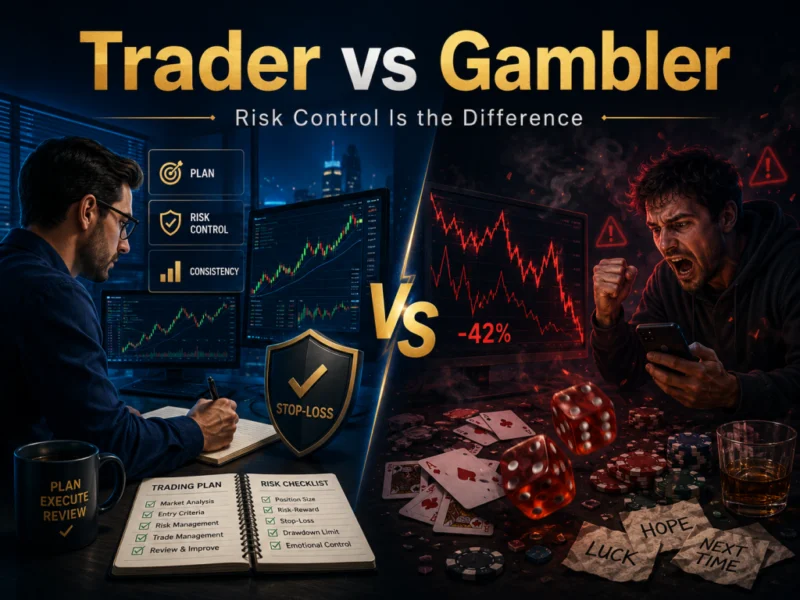
Position sizing and exit rules address part of trading risk. They do not turn an uncertain investment into a guaranteed return. The earlier order-execution caveat remains relevant:
Good risk management follows a clear order on every trade. Set a planned risk budget and exit level before entering, then size the position using the distance to that level. An ordinary stop order becomes a market order when triggered: price gaps, slippage and fast markets can produce a worse execution price and a larger loss than planned. A stop-limit order controls the acceptable price but may not execute. The discipline is in planning the exit and allowing for these limitations, rather than treating the stop as a guaranteed loss cap. See the SEC explanation of order types.
See our order types lessons for the mechanics. An intended exit price and an investment’s actual downside are different things.
Questions to ask before accepting more risk
- What produces the potential return, and what assumptions could fail?
- What losses are plausible, including outcomes worse than the example?
- When will I need access to the money?
- How does this affect concentration and liquidity in my portfolio?
- What fees and conditions apply, and are claims independently verifiable?
Be cautious about promises of high returns with little or no risk. Education can help you frame these questions; it cannot determine an appropriate investment for your personal circumstances.
Frequently asked questions
Does taking more risk guarantee more return?
No. Greater risk may accompany higher potential returns, but the realised outcome can still be a loss.
Is volatility the only investment risk?
No. Business failure, liquidity, inflation and interest rates can also affect outcomes.
Can diversification prevent all losses?
No. It can reduce reliance on a single holding but does not remove market risk.
Does a stop loss cap my investment loss?
No. An ordinary stop becomes a market order when triggered, so gaps or slippage can worsen the execution price. A stop-limit order may not fill.
Sources
Primary investor-education sources checked on 13 October 2026. The scenario comparison above is an invented educational example.
- SEC Investor.gov, What is Risk?.
- SEC Investor.gov, Investment Products.
- SEC Investor.gov, Asset Allocation and Diversification.
- SEC Investor.gov, Types of Orders.
Before you act on this
This article explains how something works. It is general education, not advice about your situation. It does not consider your goals, income, tax position or how much risk you can afford.
Investing involves risk, including losing money. Before you act, speak to a licensed professional. You can check whether someone is licensed at Investor.gov and FINRA BrokerCheck.