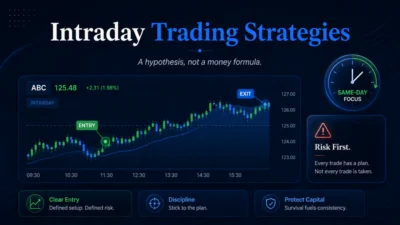
Ask about day trading strategy and most people want to know one thing: when to buy. But the entry signal is just the steering wheel. The thing that actually keeps you in the game is the seatbelt, risk management, and risk control matters even when account rules change. Under FINRA’s transition, a broker that still uses the prior pattern day trader rule must apply the former $25,000 minimum to accounts designated for pattern day trading on margin. Ask your broker which framework applies. This guide draws on FINRA’s explanation of the transition.
Why Most Day Trading Strategies Miss the Real Point
Walk into any discussion of day trading strategy and you will find people arguing about entries: which indicator, which pattern, which secret setup signals the moment to buy. It is the wrong obsession. An entry signal is like the steering wheel of a car, it points you somewhere, but it does nothing to keep you safe when things go wrong. The thing that actually keeps a trader in the game is risk management, the seatbelt, and it is precisely what beginners neglect until a single bad trade does serious damage. A clever entry with no risk control is not a strategy; it is a faster way to lose money. The most important shift a new trader can make is to stop asking when to buy and start asking how much to risk and where to get out. Everything useful in day trading strategy flows from that reordering of priorities.
The Common Strategy Styles, Briefly
It is still worth knowing the main styles, if only so you can see how similar they really are beneath the labels. Scalping means making many small trades, aiming for tiny gains on each and relying on volume and tight discipline. Momentum trading means trying to ride a strong short term move while it lasts. Breakout trading means entering as a price pushes through a level it has struggled to cross. Reversal trading means betting that a move is about to turn, which is as dangerous as it sounds. Range trading means buying near the bottom and selling near the top of a price band. These styles attract endless debate, yet they share the same hard reality: each one wins on some trades and loses on others, and none of them is a reliable path to profit on its own. The style is the easy part; surviving the losing trades is the hard part, and that is not about style at all.

An Edge Is Nothing Without Risk Management
A trading edge means a positive expected result after gains, losses and costs. A high win rate alone cannot establish an edge. Oversized positions can still produce severe losses. Plan the position size and exit before entering, and allow for a gap, slippage or an order that fails to execute.

Position Sizing and Stop Losses: The Real Strategy
Position sizing starts with the loss you are prepared to risk and an estimate of where you could exit. Actual losses may exceed that estimate. A stop-market order becomes a market order when triggered and may fill far from the stop price. A stop-limit order restricts the execution price but can go unfilled.
“The PDT Rule Is Gone”? The Math Still Isn’t.
FINRA’s replacement intraday margin framework took effect on 4 June 2026. A broker may keep using the previous PDT framework until it transitions, no later than 20 October 2027. After transition, the former PDT designation and $25,000 minimum no longer apply, although other margin requirements remain. Firms can monitor margin in real time or calculate an intraday deficit once daily under the new rule. Check which approach your broker uses. The change in account access does not remove market risk or the effect of leverage.

The Costs and the Competition
Commissions, execution costs and competition can reduce trading results. The bid-ask spread is a potential execution cost. An immediate purchase at the ask and sale at the bid would lose the spread if the quote stays constant. Actual execution can differ. Margin can magnify losses, and emotions can disrupt a trading plan. Estimate realistic costs before treating a paper strategy as profitable.

How to Test a Strategy Without Losing Money
Given all this, the smartest thing a beginner can do is test before risking real capital. A practice account, or simulator, lets you practice orders using virtual funds. Check the feed timing and how the simulator models fills, spreads and costs. Keep records of winning and losing trades. Simulated results cannot establish what a live trade would earn or how you would respond with your own money at risk.
Common Mistakes People Make
Day trading strategies fail in the same predictable ways, almost always by obsessing over entries while ignoring risk. Here are the four that do the most damage.
Obsessing over entries while ignoring risk
Why it backfires: Pouring all your attention into finding the perfect entry signal, while neglecting how much you risk and where you exit, is how a single bad trade can wipe out many good ones.
Do this instead: Treat risk management as the core of your strategy, sizing every trade from how much you can lose and deciding your exit before you enter, with the entry signal as the secondary detail.
Trading without stop losses
Why it backfires: Holding a losing trade and hoping it comes back, with no predefined exit, is the classic way small losses turn into account ending ones.
Do this instead: Plan an exit and size the position for adverse moves. Stop-market orders can fill well beyond the trigger in a fast market, and stop-limit orders may never fill.
Reading a broker’s transition as a green light
Why it backfires: A broker that has transitioned no longer applies the former $25,000 PDT minimum. Easier access at that firm does not reduce trading risk or remove other margin requirements.
Do this instead: Where a broker has transitioned, FINRA’s former PDT minimum no longer applies. Other requirements and the potential for substantial day-trading losses remain.
Ignoring costs and testing nothing
Why it backfires: Assuming a strategy works without accounting for spreads, costs and competition, and without testing it, means trading a fantasy that often fails in reality.
Do this instead: Count costs honestly, including potential spread costs that depend on execution, and test any strategy on a simulator over many trades before risking real capital.
The Honest Bottom Line
A trading plan should address position size, execution costs, leverage and potential losses. Brokers may transition to FINRA’s new framework through 20 October 2027. Ask which rules apply to your account. Compare short-term trading risks with a diversified long-term portfolio designed around your goals. Diversification can reduce concentration risk, although losses remain possible. This article is educational information, not financial advice.
Before you act on this
This article explains how something works. It is general education, not advice about your situation. It does not consider your goals, income, tax position or how much risk you can afford.
Investing involves risk, including losing money. Before you act, speak to a licensed professional. You can check whether someone is licensed at Investor.gov and FINRA BrokerCheck.
Frequently asked questions
What is the best day trading strategy for beginners?
No single strategy can guarantee a profit. Learn how position sizes, execution costs and exit orders affect potential loss. Many day traders suffer severe losses early and never become profitable.
Why is risk management more important than the entry signal?
Because an entry signal only points you somewhere, while risk management keeps you in the game. A few oversized losses can wipe out many small wins, so position sizing and predefined exits, not the perfect setup, decide whether you survive long enough for any edge to matter. Experienced traders often say risk management is the strategy.
How does the PDT transition affect day trading?
The replacement framework took effect on 4 June 2026, but brokers may keep the former PDT rules until they transition, no later than 20 October 2027. After transition the old $25,000 PDT minimum no longer applies. New intraday margin requirements permit real-time monitoring or a once-daily deficit calculation. Market risk and other margin requirements remain.
Do I still need 25,000 dollars to day trade?
It depends on the broker’s transition and whether you borrow. A broker still applying the former PDT framework must enforce its $25,000 minimum for designated pattern day traders. After transition, that FINRA minimum no longer applies. FINRA generally requires $2,000 in equity for leveraged trading, while unleveraged trading can use available cash. House requirements may be higher. Ask your broker which rules apply to your account and whether you will incur interest on a margin loan.
How do I test a day trading strategy safely?
Use a practice account to learn order entry and compare hypothetical results under the simulator’s specific assumptions. Record all trades, costs and possible slippage. A simulation cannot establish actual profitability or reproduce the pressure of losing real money.
Can you really make money day trading?
Some traders profit, while others suffer substantial losses. Execution prices, possible spread costs and commissions affect results, as do leverage and competition. The quoted spread is not a fixed fee charged on every trade. Compare realistic net results with the risks of the strategy.
Sources
All claims in this article are supported by the sources listed below. Verify details against the originals before making investment decisions.
- Financial Industry Regulatory Authority (FINRA). Regulatory Notice 26-10: Intraday Margin Standards. Accessed 10 June 2026.
- Financial Industry Regulatory Authority (FINRA). Brokerage Accounts. Accessed 10 June 2026.