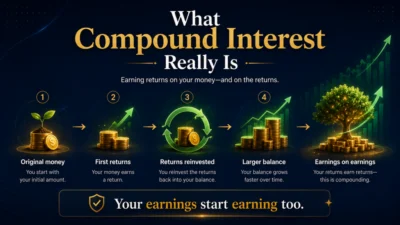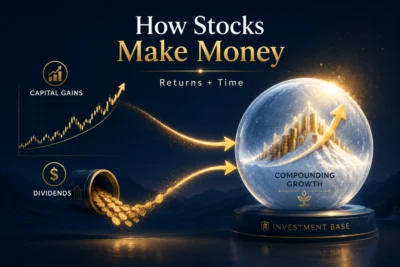
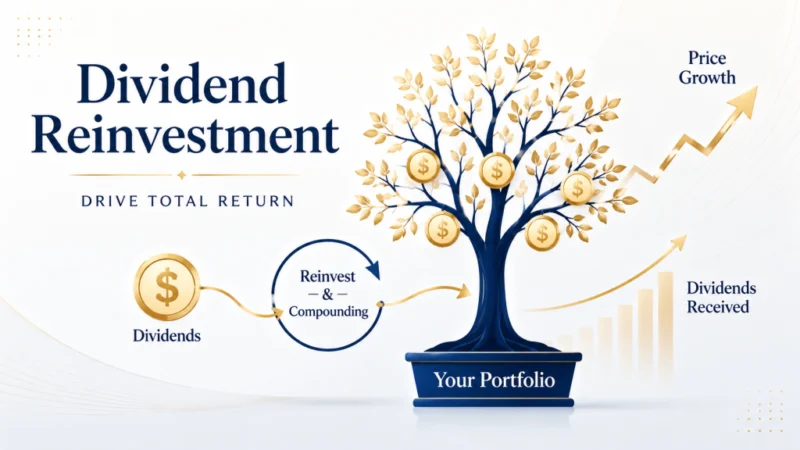
When a company pays a dividend, what you do with it matters enormously. Reinvested rather than spent, those payments can buy additional shares and change your future investment returns, while the dividend itself is only one part of the total return a stock actually delivers. The clearest way to see this is to follow the cash: a dividend is your slice of a company’s profits, and feeding each slice back in buys more shares that may receive future dividends, although payments and share values can fall. This guide explains how dividend reinvestment compounds, why total return, price change plus dividends, is what truly matters, and how to think about dividends sensibly, drawing on the SEC, FINRA and IRS. Our dividend reinvestment calculator shows what reinvesting does over time.
Dividends are your share of the profits
At its heart, a dividend is beautifully simple: it is the company sharing its profits directly with you, its owner. When you own shares in a company, you own a small piece of that business, and when the business earns profits, it has a choice about what to do with them, and one option is to distribute some of those profits to its shareholders as a dividend. This is educational guidance, not personalized advice.

What a dividend is and how it is paid
To understand dividends properly, start with the mechanics of what they are and how they reach you. A dividend is a distribution of a portion of a company’s earnings to its shareholders, formally decided and announced, or declared, by the company’s board of directors. Once declared, it becomes a payment the company intends to make to its owners, usually in cash, deposited into your investment account. Dividends are typically paid on a regular schedule, often quarterly for U.S. companies, with schedules varying by issuer and market, so a shareholder in a dividend paying company receives several payments across the year. This is educational guidance, not personalized advice.
How dividends impact your investment
Here is the part many investors misunderstand, and where understanding the real impact of a dividend matters most: a dividend is not free money added on top of an unchanged share price. When a company pays out cash as a dividend, that cash leaves the business, so the company is worth slightly less afterwards, and the share price reflects this. For an ordinary cash dividend, the ex-dividend date determines entitlement separately from the later payment date. Holding other factors constant, the ex-dividend price reflects the dividend entitlement leaving the shares; actual prices also reflect market news. Special distributions can follow different date rules. The $100 = $95 + $5 diagram is an illustration assuming no other price changes, fees or taxes; the $5 entitlement is paid on the payment date. Our dividend calendar shows the ex-dates and pay dates you need to watch. This is educational guidance, not personalized advice.

Dividends and your total return
Because a dividend is not extra money conjured from thin air, the right way to judge a dividend paying investment is through its total return, which is the key concept tying dividends to your actual results. Total return combines two sources: the income you receive from dividends, and the change in the price of the shares you hold. A stock might pay a steady dividend while its price rises, falls or stays flat, and it is the combination of the dividend income and the price change that determines how well your investment has actually done. This is educational guidance, not personalized advice. Our dividend income planner turns a yield into an expected income figure.
The power of reinvesting dividends
If you do not need dividend income now, reinvesting is one option that uses compounding through additional share ownership. Reinvesting means using the cash dividends you receive to buy more shares of the investment, rather than taking the cash to spend. More shares may receive future declared dividends, but cuts and capital losses remain possible. Check plan eligibility, purchase timing, fractional-share treatment and fees. In a U.S. taxable account, reinvesting a taxable dividend does not remove the obligation to report the income; account and jurisdiction rules differ. This is educational guidance, not personalized advice.

What to watch: yield, sustainability and risk
If you are drawn to dividends, a few measures and warnings help you avoid common pitfalls. The dividend yield, the annual dividend as a percentage of the share price, lets you compare the income different stocks pay relative to price, but a higher yield is not automatically better. A high quoted yield can reflect a price decline, an unusual distribution or other factors. Check whether the yield uses trailing or expected dividends, whether special payments are included, and whether future payments are sustainable. You can check what a payout actually returns with our dividend yield calculator. This is educational guidance, not personalized advice.

The role of dividends in your portfolio
Stepping back, it helps to see the sensible role dividends can play in a portfolio, neither dismissing them nor overemphasising them. For many investors, especially those seeking income, such as retirees, dividends offer a valuable stream of cash from their investments without needing to sell holdings, which can be genuinely useful. For long term investors focused on growth, the ability to reinvest dividends and compound is the main attraction. This is general education, not personalized advice.
The honest bottom line
A dividend is your share of a company’s profits, paid directly to you as an owner, your slice of the profit pie. It is a distribution of earnings declared by the board, usually paid as cash, often quarterly for U.S. companies, though many growing companies pay none and reinvest instead. Crucially, a dividend is not free money: for an ordinary cash dividend, the ex-dividend price effect is distinct from the payment date, and actual price changes also reflect other information. This is educational information, not financial advice.
Common mistakes investors make about dividends
Dividends are widely misunderstood. Here are the four mistakes to avoid.
1. Thinking a dividend is free money
Why it backfires: Believing a dividend is costless income added on top of an unchanged share price ignores that the price typically drops by roughly the dividend on the ex dividend date, so the payment is a transfer of value, not new wealth.
Do this instead: Understand that paying a dividend moves value from the share price into your pocket, recognize you cannot reliably profit by buying just before a dividend and selling after, and treat dividends as a transfer rather than a costless bonus.
2. Chasing the highest yield
Why it backfires: Buying whatever stock offers the biggest dividend yield ignores that an unusually high yield often reflects a fallen price and real problems, signalling a dividend at risk of being cut rather than a bargain.
Do this instead: Favour sustainable dividends well covered by profits from financially sound companies over the highest headline yields, and treat a suspiciously high yield as a reason for caution and further research, not an opportunity.
3. Judging by dividends instead of total return
Why it backfires: Focusing on dividend income alone ignores total return, the combination of income and price change, so a high yielding stock whose price is declining can deliver a poor result despite the appealing income.
Do this instead: Judge dividend paying investments by their total return, considering both the income and the change in share price, rather than being seduced by a high yield that may come at the expense of falling capital.
4. Distorting a portfolio to chase dividends
Why it backfires: Concentrating a whole portfolio in a narrow set of high yielding stocks for income ignores the loss of diversification and the risk that comes with abandoning a balanced, total return focused approach.
Do this instead: Treat dividends as one valuable element of a diversified, total return focused portfolio rather than the single overriding goal, receiving dividends naturally from broad holdings and reinvesting or taking them as your needs require.
Frequently asked questions
What is a dividend?
A dividend is a payment a company makes to its shareholders out of its profits, distributing some of its earnings to the people who own it. The simplest way to picture it is as your slice of the profit pie: when a company earns profits, it can share some with its owners, paid usually as cash, simply because you own part of the company. Dividends are formally declared by the board of directors and typically paid on a regular schedule, often quarterly for U.S. companies, with schedules varying by issuer and market. Not every company pays one: many large, established firms do as a sign of strength, while many younger, fast growing companies reinvest all their profits instead. A dividend is therefore a discretionary distribution of profits, not a universal feature of stocks.
Is a dividend free money?
No, and this is widely misunderstood. A dividend is not free money added on top of an unchanged share price. When a company pays out cash as a dividend, that cash leaves the business, so the company is worth slightly less afterwards, and on the ex dividend date the stock typically begins trading at a price reduced by roughly the amount of the dividend. In effect, paying a dividend moves value from the share price into your pocket, rather than creating new wealth from nowhere. This is why you cannot reliably profit by buying a stock just before its dividend and selling straight after, since the price drop tends to offset the dividend. A dividend is a transfer of part of your investment’s value to you, not a costless bonus.
How do dividends affect my total return?
They are one of its two components. Total return combines the income you receive from dividends and the change in the price of the shares you hold, and it is the combination that determines how well your investment has actually done. A stock might pay a steady dividend while its price rises, falls or stays flat. This matters because focusing on dividends alone can mislead you: a high yielding stock whose price is steadily declining may deliver a poor total return despite the appealing income, while a company paying little dividend but growing strongly may reward you far more overall. So consider dividends as part of the total return picture rather than in isolation, judging investments by total return rather than yield alone.
Should I reinvest my dividends?
Reinvesting uses cash dividends to buy additional shares instead of taking cash. Those shares may receive future dividends, but payments, share values and total returns can fall. Consider cash needs, allocation, concentration, costs and tax before choosing automatic reinvestment. Check the provider’s eligibility, timing, fractional-share and fee terms. In a U.S. taxable account, reinvesting a taxable dividend does not by itself remove income reporting or tax obligations; other account and jurisdiction rules differ. Compare outcomes over the same period and on a consistent reinvestment, fee and tax basis.
Is a higher dividend yield better?
Not necessarily, and assuming so is a common trap. The dividend yield, the annual dividend as a percentage of the share price, lets you compare the income stocks pay relative to price, but a higher yield is not automatically better. A high quoted yield can reflect a price decline, an unusual distribution or other factors. Check whether the yield uses trailing or expected dividends, whether special payments are included, and whether future payments are sustainable. What matters more than size is sustainability: earnings coverage is only one indicator; cash flow, debt, capital needs and payout policy also matter, and no coverage ratio guarantees future payment. So favour sustainable, well covered dividends from financially sound companies over the highest headline yields, and treat a suspiciously high yield as a reason for caution.
Are dividends guaranteed?
Future common-share dividends are discretionary and can be reduced or omitted. Rights to an already declared payment and preferred-share terms are separate matters. Such cuts often come precisely when a business is struggling and its share price is already falling, which is a painful double blow for an income focused investor. This is why the sustainability of a dividend matters so much, and why an unusually high yield, which can reflect a market expecting a cut, should be treated with caution rather than enthusiasm. Dividends can be a genuine and valuable source of income from sound, stable companies, but they should never be assumed to be certain, and a sensible investor diversifies rather than relying on any single company’s dividend.
Sources
These sources provide background on dividends, ex-dividend dates and U.S. tax treatment. Check current issuer announcements, plan terms and applicable account and jurisdiction rules before acting. If you learn better from pictures than paragraphs, the visual lesson library covers the same ground in diagrams.
- U.S. Securities and Exchange Commission, Investor.gov, Ex-Dividend Dates: When Are You Entitled to Stock and Cash Dividends. Accessed 25 November 2026.
- Internal Revenue Service, Publication 550 (2025), Dividends Used To Buy More Stock. Accessed 25 November 2026.
Before you act on this
This article explains how something works. It is general education, not advice about your situation. It does not consider your goals, income, tax position or how much risk you can afford.
Investing involves risk, including losing money. Before you act, speak to a licensed professional. You can check whether someone is licensed at Investor.gov and FINRA BrokerCheck.