
The Richest Man in Babylon
About this summary
This is our summary of the ideas in this book, written in our own words. It is not the book, it is not authorized by the author or publisher, and it is not a substitute for reading it.
The strategies described belong to the author. Including them here is not our recommendation that you use them.
Book summary
The Richest Man in Babylon
By George S. Clason · First published 1926
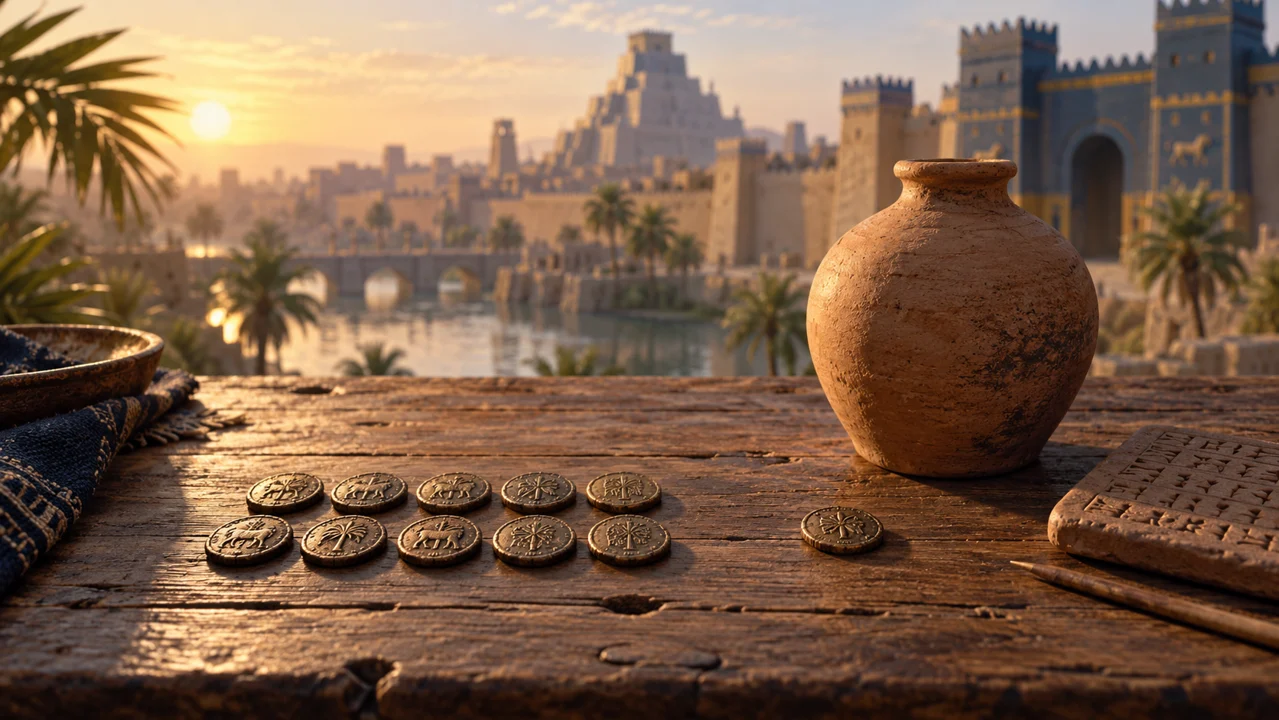
An independent educational summary of the author’s ideas. Historical figures and examples are not current statistics or personal financial targets. Investing and borrowing involve risks; examples do not guarantee results.
Quick Answer
What Is The Richest Man In Babylon About?
The Richest Man in Babylon teaches personal finance through parables set in ancient Babylon. George S. Clason began issuing them as thrift pamphlets in 1926, and banks handed them out widely. The core rule is to pay yourself first: keep a tenth of all you earn, control spending, invest carefully and repay debts. It suits beginners wanting simple saving habits.
Clason’s people and dialogue are fictional teaching stories, not evidence that an ancient budgeting formula guarantees wealth. The later clay-tablet chapter uses a fictional correspondence frame; it is not a verified archaeological discovery. His 10% saving rule and 10/70/20 debt split illustrate discipline, but must fit essential costs, debt obligations and an affordable cash reserve.
Chapter 1: The Man Who Desired Gold
Hard Work, Empty Purse
Bansir, a chariot builder, is thoroughly discouraged. He has worked hard for years in what the story calls the richest city in all the world, yet his purse is empty. Clason opens with a problem many earners recognize: a steady income does not, by itself, create wealth.
The Two Shekel Request
His friend Kobbi, a lyre player, arrives hoping to borrow two shekels until after the noblemen’s feast. Bansir replies that if he had two shekels, he could lend them to no one. Two hardworking friends, both broke, set up the book’s central idea: earning money and keeping it are different skills.
A Dream Of Plenty
Bansir describes a dream in which he was a man of means, casting shekels to beggars without a second thought. Kobbi calls it a pleasant dream, but it only sharpens the contrast with Bansir’s empty purse. Wishing for money, the scene suggests, is not a plan; the friends need a method.
Ask Someone Who Knows
Kobbi suggests they find out how others acquire gold and do as they do. Their boyhood friend Arkad, who studied beside them as youngsters, has grown so rich that the king is said to seek his help. The pair decide to ask Arkad for his secret, and to invite other old friends along.
Skill Is Not Enough
The lesson for a modern reader is that talent and effort at work do not turn into savings on their own. Bansir builds fine chariots and Kobbi plays well, yet neither has anything put aside. The next chapter supplies the rule they were missing, and it starts with the next paycheck rather than a bigger one.
Plan Step: Measure The Gap
Write down last month’s take-home pay, essential costs, debt payments and the amount actually saved. The remainder includes necessary spending as well as optional purchases. Look for a manageable saving amount rather than treating every dollar not saved as waste.
Chapter 2: The Richest Man In Babylon
Same Start, Different Result
Arkad’s old friends ask why he grew rich while they, who started as his equals, did not. Arkad replies that he was not endowed with superior powers or wisdom, so he decided that time and study would be required. Wealth, in his telling, comes from learning a few rules and following them for years.
The Scribe’s Bargain
As a young scribe, Arkad carved laws into clay tablets. Algamish, a rich money lender, ordered a copy of a long law and found it unfinished when he returned. Arkad asked Algamish to tell him how he too could become rich, offering to finish the tablet in return, and the lender shared his secret.
Pay Yourself First
Algamish’s answer is the book’s core rule. In the chapter The Richest Man in Babylon, he tells Arkad: “A part of all you earn is yours to keep. It should be not less than a tenth no matter how little you earn.” Saving comes first, before spending, and it applies to small incomes too.
Trusting The Wrong Expert
After a year of saving, Arkad handed his money to Azmur, a brickmaker traveling to Tyre, to buy rare jewels from the Phoenicians. They sold Azmur worthless bits of glass. The lesson Arkad draws is blunt: seek the advice of people whose daily work is handling money rather than a brickmaker dabbling in jewels.
Eating The Children
The next year Arkad lent his savings to Aggar, a shield maker, to buy bronze, and the loan paid him income. He spent it on a great feast with honey, fine wine and spiced cake. Algamish laughed: “You do eat the children of your savings.” Earnings must stay invested before they can compound.
Four Years Of Proof
Arkad kept saving a tenth for four years, which he calls proof of his definite purpose. When Algamish died, he made Arkad one of his heirs. Arkad’s friends call that luck. Arkad answers that the habit came first: he had already shown the lender he could keep what he earned.
The Pebble Promise
Arkad describes willpower as finishing any task you set yourself, however small. If he promises himself to pick up a pebble and cast it into a stream every day, he keeps that promise without excuses. Small promises kept build the discipline that makes saving automatic rather than a monthly debate.
Plan Step: Set Your Tenth
Clason proposes keeping at least a tenth, but that is the author’s rule rather than a universal requirement. Choose an amount that fits essential bills and minimum debt payments. If using an automatic transfer, check its timing and your account balance so it does not trigger an overdraft. A smaller affordable amount can be a starting point.
Chapter 3: Seven Cures For A Lean Purse
The King’s Problem
When King Sargon returned to Babylon after defeating the Elamites, his Royal Chancellor reported that the city’s gold had flowed to a few very rich men, because they knew how to keep it. The king summoned Arkad, who asked for a class of one hundred men to learn his seven cures.
Start Thy Purse To Fattening
The first cure: for every ten coins you put in your purse, spend only nine. Arkad compares it to a basket that receives ten eggs each morning and loses nine each evening; it soon overflows. He says he got along just as well once he stopped spending more than nine tenths of his earnings.
Control Thy Expenditures
The second cure distinguishes necessary costs from desires and asks readers to budget. Today, lifestyle inflation means choosing to spend more as income rises; price inflation means the same purchases cost more. Neither implies that every household can cut essential spending to exactly 90% of income.
Make Thy Gold Multiply
The third cure is to put savings to work. Arkad’s first profitable investment was a loan to Aggar, a shield maker who imported bronze once a year, with the interest added to the principal. He also tells of a farmer who left ten pieces of silver with a money lender for his son until the boy turned twenty, so the earnings could compound.
Guard Thy Treasures From Loss
The fourth cure puts safety of principal first. Arkad asks whether it is wise to chase larger earnings when the money itself may be lost, and he retells how his first savings vanished with Azmur the brickmaker. His advice: do not trust your own judgment alone; consult people experienced in handling money.
Make Thy Dwelling Profitable
The fifth cure is to own your home. Arkad argues that a family living on nine tenths should turn part of that into an investment, and that a lender will help a buyer who has saved a reasonable part of the price. Today that saved part is a down payment, though owning brings costs that renters avoid.
Insure A Future Income
The sixth cure asks savers to build a treasure for old age and to protect their families. Arkad even predicts that wise men will one day devise a plan to insure against death. For a modern reader, the same cure points to retirement accounts and, for families that rely on one income, life insurance.
Increase Thy Ability To Earn
The seventh cure is to grow your skills, because the more wisdom we have, the more we may earn. Arkad wants desires to be definite: five pieces of gold is a tangible goal, then twenty, then a thousand. He adds duties that protect a good name, such as paying debts promptly and not buying what you cannot pay for.
Chapter 4: Meet The Goddess Of Good Luck
Gambling Is Not Luck
In the Temple of Learning, Arkad leads a debate on how to attract good luck. The group agrees that gaming tables and races take more gold than they give, and Arkad himself confesses he has lost far more at the races than he won. Few successful citizens, they suspect, got their start by gambling.
Luck Means Opportunity
The discussion shifts from chance to opportunity. Luck in this chapter is less a gift than a chance someone was ready to take. To attract good luck, the group concludes, a person must take advantage of opportunities as they appear, which usually means acting before every doubt is settled.
The Land Deal Missed
One member recalls a plan to turn a barren tract just beyond the city’s outer walls into productive land. Each partner would pay a tenth of his earnings into the enterprise until the land was ready. He put it off and spent his money on other things, and the venture proved more profitable than anyone had predicted.
Nine Hundred Sheep
A buyer tells of a farmer who offered him a flock the farmer said numbered nine hundred sheep. Counting the milling animals proved impossible, so the buyer put off the deal until they could be counted, and the chance slipped away. He now makes a prompt deposit once he is convinced a bargain is wise.
Procrastination Is The Enemy
Arkad names the common thread: good luck fled from procrastination in both stories. He calls procrastination a spirit within all men and admits he had to conquer it himself. No one, he argues, reaches full success until he has crushed the urge to put things off.
Plan Step: Start This Week
For a saver, the opportunity most often missed is simply starting. Choose a date this week for your first automatic transfer, even if the amount is small, and put it in your calendar. A plan that starts next month has a way of starting the month after that.
Chapter 5: The Five Laws Of Gold
Gold Or Wisdom
The chapter opens with a question: offered a heavy bag of gold or a clay tablet carved with words of wisdom, which would you choose? All twenty seven listeners call out for the gold. The tale that follows argues for the tablet: without wisdom, gold is quickly lost; with it, people who start with none can gain it.
Nomasir’s Hard Lesson
The story follows Nomasir, Arkad’s son, who sets out with gold and a clay tablet of his father’s laws. The gold flees his inexperienced hands like a wild hare. Reading the tablet at last, he admits that had he sought wisdom first, his gold would not have been lost. Many investors learn the same way.
Law One: Save A Tenth
The first law says gold comes gladly, and in growing amounts, to anyone who puts aside at least a tenth of his earnings. It restates Algamish’s rule as a promise: a steady saver attracts wealth over time. The chapter stresses doing it consistently and investing the savings wisely.
Laws Two And Three
The second law says gold works diligently and contentedly for a wise owner who finds it profitable employment. The third says gold stays with a cautious owner who invests on the advice of people skilled in handling it. Together they describe patient investing, guided by people who know the field.
Laws Four And Five
The fourth law warns that gold slips away from owners who invest in businesses or purposes they are not familiar with. The fifth says gold flees anyone who would force it to impossible earnings or who follows the tempting advice of tricksters. The rich men of Nineveh, the story notes, took no chance of losing their principal.
Proof In Nineveh
Earlier in the book, Kobbi mentions that Nomasir has grown wealthy in Nineveh. This chapter shows how: he learned the laws the hard way, then followed them. The narrator’s closing point is that anyone who follows the same laws can become, like Nomasir, rich and respected.
Plan Step: Write Your Rules
Turn the five laws into written rules: the share of pay you save, where it goes, whose advice you trust, what you will not invest in, and the return claim that makes you walk away. Keep the list with your account details and reread it before any new investment.
Chapter 6: The Gold Lender Of Babylon
A Gift From The King
Rodan, a spearmaker who has received fifty pieces of gold from the king, visits Mathon, a gold lender, for advice. His sister wants him to lend the gold to her husband, Araman. Mathon teases him at first, asking whether he has been unlucky at the gaming table or entangled by some lady.
The Chest Of Tokens
Mathon brings out a chest decorated with bronze designs that holds tokens left by his borrowers, with a bronze neck piece on a scarlet cloth at the top. Each token comes with a story about a loan. The chest is his record of which borrowers proved worth the risk, and why.
A Loan Needs Backing
The tokens are pledges, things of value that borrowers left behind as security. The lesson is that a loan is only as safe as what stands behind it, whether a pledge or earnings that can cover the payments. Good intentions, however sincere, are not collateral, and a family tie does not change the arithmetic.
Advice Before Family Loans
One token belongs to a mother who borrowed gold so her son could partner with a caravan owner. The partner left the youth stranded in a distant city. Asked whether she sought his advice, Mathon says she would not hear doubts about her son. Family lending mixes love with risk, and a bad loan can strain family ties.
Let Experience Guard It
Mathon urges Rodan to place his gold where it will be guarded safely by the wisdom and experience of people who know lending. The king’s gift, he says, will teach him much wisdom. Learning to protect money turns out to matter as much as earning it.
A Little Caution
The chapter’s motto, in The Gold Lender of Babylon, is “Better a little caution than a great regret.” Mathon also warns that gold slips away in unexpected ways from people unskilled in guarding it. The time to be careful is before the money leaves your hands.
Plan Step: Lending Rules
Decide now what you would lend to friends or family, and treat any such loan as money you can afford to lose. Keep it separate from your saved tenth, so one generous moment cannot undo a year of saving. Write the rule down before anyone asks.
Chapter 7: The Walls Of Babylon
A City Under Attack
Old Banzar, a grim warrior of another day, guards the passageway to the top of Babylon’s walls. The Assyrians have swept down unexpectedly from the north, and his post is the crucial point of attack. Soldiers with clanking bronze shields tramp past, and a small girl tugs at his belt for news.
Fear Inside The Walls
Inside the city, families can only wait. Their lives, homes and savings depend on defenses built long before the attack began. Clason uses their fear to make a financial point: protection has to be built in calm times, because it is too late to start once the crisis arrives.
Three Weeks And Five Days
For three weeks and five days the attack rages with scarcely a pause, and the city survives it. Babylon does not survive because anyone predicted the assault, but because its walls were built long before the enemy arrived. Preparation, not prediction, is what protects the people inside.
Modern Walls
Clason calls the walls of Babylon an outstanding example of the human need and desire for protection. For a household today, the walls are an emergency fund, suitable insurance and diversified investments. Each is built before it is needed, so a job loss or illness does not force a desperate sale or a costly loan.
Plan Step: Build Your Wall
Choose an initial emergency-reserve target based on likely expenses, income stability and responsibilities. Compare the monthly contributions needed over two different deadlines using a 0% return assumption. Keep near-term emergency money accessible; a diversified stock portfolio can still fall when you need cash.
Chapter 8: The Camel Trader Of Babylon
Hungry And In Debt
Tarkad, son of Azure, has eaten nothing for two whole days except two small figs taken from over a garden wall. He is broke, in debt and avoiding the people he owes. Dabasir, a camel trader, takes him aside and tells him the story of his own youth.
Living Beyond His Means
As a young man, Dabasir explains, he spent more than he earned and borrowed from friends to make up the difference. Soon he could not use his earnings both to live on and to pay his debts. The debts, as he is later told, ran him out of Babylon.
Sold For Two Silver Pieces
Dabasir fled Babylon and ended up a slave, bought for two pieces of silver by a Syrian desert chief. There Sira, a childless woman in the chief’s household, asks him whether he has the soul of a free man or the soul of a slave. A man with a slave’s soul, the story argues, becomes one.
Determination Finds A Way
Sira tells Dabasir his debts are the enemies that drove him from Babylon, and sends him off across a desert barren of food and water. In The Camel Trader of Babylon he sums up what saved him: “Where the determination is, the way can be found.” He makes it home and starts repaying.
Enemies And Friends
Back in Babylon, Dabasir resolves to pay his debts as fast as he can, and he explains why: “My debts were my enemies, but the men I owed were my friends for they had trusted me and believed in me.” The story adds that no one can respect himself without repaying honest debts.
Seeing Clearly Again
Clason presents determination as the turning point in Dabasir’s story. That moral does not establish that real debt or poverty results from weak character. Illness, job loss, care responsibilities, borrowing costs and inadequate income can all constrain a household’s choices. A workable plan needs numbers and circumstances as well as motivation.
Plan Step: List Every Debt
List each debt, its balance, interest rate, minimum payment and due date. Clason’s fictional repayment split is a discussion example, not a reason to miss required payments or invest while expensive debt grows. Consider the role of an affordable cash buffer separately from long-term investments.
Chapter 9: The Clay Tablets From Babylon
Letters From Nottingham
Clason frames this chapter as correspondence about ancient tablets. This is part of the book’s fictional teaching device, not proof of excavated financial records or evidence that its budget split suits every borrower. Editions contain different material; 1926 refers to the start of the pamphlet series, not necessarily this later chapter.
A Ten, Seventy, Twenty Split
Dabasir’s tablets set out his plan. He keeps one tenth of all he earns as his own, lives on seven tenths with his wife, and divides the remaining two tenths honorably and fairly among the people who trusted him with loans. Saving continues even while he is deep in debt, which is the plan’s key twist.
Small, Regular Payments
With a gold lender’s help, Dabasir learns to repay his debts in small sums. He finds it easier to pay just debts than to avoid them, and each time he pays himself a tenth first. The tablets end on the day he pays the last of his debts.
The Professor Tries It
The letter writer and his wife, humiliated for years by old debts, test the plan. They list every debt, show the list to each creditor and set aside 20% of income each month to repay them in a little over two years. They live on 70%, starting with a negotiated cut in their rent.
Debts Down, Savings Up
By the second letter, their debts are being paid down while their investment grows, and they vow never again to let living expenses exceed 70% of income. The plan works because it asks for three habits at once: save first, repay steadily and live within a fixed budget.
Plan Step: Run The Split
For hypothetical take-home pay of $3,000 a month, Dabasir’s 10/70/20 split means $300 saved, $2,100 for living costs and $600 toward debt. These amounts total $3,000. If essential costs or required debt payments exceed those amounts, the split needs adjustment; its percentages do not override real obligations.
Chapter 10: The Luckiest Man In Babylon
A Merchant And An Heir
Sharru Nada, the merchant prince of Babylon, rides at the head of his caravan with Hadan Gula, grandson of his old partner Arad Gula. The young man spends shekels as fast as they reach his purse and declares that work was made for slaves. Sharru Nada answers with his own story.
Chained Beside Megiddo
Sharru Nada was once a slave, with a bronze collar around his neck and a heavy chain between him and the next captive. Megiddo was chained next to him, with Zabado, a sheep thief, beside Megiddo. Megiddo tells him he likes to do good work, because work is the best friend he has ever known. The idea changes Sharru Nada’s life.
Honey Cakes And Enterprise
Owned by a baker, Sharru Nada asks to learn how to make honey cakes, and a plan emerges for him to sell them in the streets at two for a penny. The next day he bakes an extra supply. Buyers like the enterprise with which he offers them, and his work starts to earn him something of his own.
Gaming And Barley Beer
The story also shows the other path. Characters are ruined by gaming houses and barley beer, and a master in the story loses heavily at the gaming tables. Easy pleasures, Clason suggests, drain the very resources that steady work builds, and they do it quickly.
The Grandfather’s Secret
The twist is that Arad Gula, the grandfather, had also known deep misfortune. Hadan Gula protests that he will not hear lies about him, but the story honors Arad Gula for rising above it to become a leading citizen of Damascus. By the end, Hadan asks whether work was his grandfather’s secret key to the golden shekels.
Work Was The Luck
The luckiest man in Babylon, it turns out, was lucky mainly in learning to value his work. The last parable ends where the seventh cure began: the surest route to more gold is more skill and effort, with part of every gain kept for yourself.
Plan Step: Grow Your Income
Pick one skill that could raise your pay within a year, and schedule time to build it. When your income rises, raise your savings transfer by the same percentage, so your tenth grows with you. Update the numbers you plan to use in the Savings Goal Calculator.
Chapter 11: An Historical Sketch Of Babylon
Why Babylon
Clason ends with a short history explaining his choice of setting. The book presents Babylon as the richest city in the world of its day, and the sketch says its outstanding rulers are remembered for their wisdom, enterprise and justice. The setting lets him present money rules as old and proven.
Riches Built By People
Throughout the book, Babylon’s wealth is credited to its people rather than to luck; in the Seven Cures chapter the story says the city’s riches were the result of its people’s wisdom. The sketch extends that theme: prosperity was built, so it can be learned.
Walls Of Legend
Clason describes the city’s enormous walls and says their total length is estimated at between nine and eleven miles. He notes that Cyrus, one of the great conquerors of the period, hoped to take those impregnable walls. Treat such figures as Clason’s description rather than settled archaeology.
Glory Fades, Rules Last
Clason writes that Babylon’s glory has faded and the proud walls of its temples have crumbled to dust, yet its wisdom has been preserved. That is his case for the book: the buildings did not last, but the money rules still work for anyone who uses them.
Plan Step: Review Each Year
Review income, essential costs, debts and progress toward savings goals. A cash reserve has a different job from a stock investment, so comparing it directly with the S&P 500 can be misleading. For investment comparisons, use equivalent dates, cash flows, risk and treatment of dividends, fees and taxes.
What Has Held Up
Pay yourself first: keep not less than a tenth of all you earn and put it to work (The Richest Man In Babylon; The Five Laws Of Gold).
The durable idea is making saving a regular part of a budget. The exact tenth is a rule in Clason’s stories, not an empirically established minimum for every household. Historical US stock returns cannot prove that a reader will reach a target, or that stocks are suitable for near-term emergency money. See the worked 0% return example below, where progress comes entirely from contributions.
CFPB guidance explains that the right emergency reserve depends on circumstances and that small contributions can help. Set a realistic goal and review cash flow; an automatic transfer should not cause an overdraft. Investor.gov discusses paying down high-interest debt before investing. Saving cash and taking investment risk are different decisions.
Verdict: Useful habit; adapt the percentage and account to the goal.
Guard your treasure: gold flees owners who chase impossible earnings or follow the advice of tricksters, so invest where principal is safe and on expert advice (Seven Cures For A Lean Purse; The Five Laws Of Gold; The Gold Lender Of Babylon).
Modern regulators give the same warning. The SEC’s Investor.gov lists high returns with little or no risk as the first red flag of a Ponzi scheme, tells investors to be highly suspicious of any promise of a sure thing, and warns against investments you do not understand. The FTC reported on March 10, 2025 that consumers lost $5.7 billion to investment scams in 2024, more than to any other kind of fraud. Where the book has aged: its model investment is a private loan to a local craftsman, a concentrated bet on one borrower. The modern version of Arkad’s wise counselors is a licensed or registered professional, which the SEC notes federal and state securities laws require.
Verdict: Holds up. SEC Investor.gov: Ponzi Scheme
Try It In A StockEducation Tool
Savings Goal Calculator
Worked example: saving without assumed investment growth
Use hypothetical take-home pay of $3,000 a month. A 10% saving share is $300. A $3,600 goal, starting from $0 with a 0% annual return, takes 12 monthly contributions: $3,600 ÷ $300 = 12. Ignore fees, taxes, withdrawals and inflation for this simple example.
Open the Savings Goal Calculator. The calculator starts from $0 automatically. Enter a $3,600 target, a timeframe of one year and a 0% annual return. Check that the required monthly contribution is $300. Next compare $150 a month: the same goal takes 24 contributions. At $400, it takes nine.
Change only the contribution or the deadline and explain the tradeoff in your notes. These are examples, not targets for your household. A stock-market return is not a dependable way to close a short-term savings gap. Essential bills, minimum debt payments and an accessible cash reserve matter before choosing a saving percentage.
Check Your Understanding
Question 1
What does Algamish tell Arkad is the first step to wealth?
- Keep at least a tenth of everything you earn
- Borrow money to buy rare jewels
- Wait for a lucky opportunity
- Lend your savings to a relative
Show the answer
Answer: A. In The Richest Man in Babylon chapter, Algamish says a part of all you earn is yours to keep, and not less than a tenth.
Question 2
Why did Arkad lose his first year of savings?
- He spent it on a feast
- He trusted a brickmaker to buy jewels for him
- A shield maker never repaid him
- The king taxed it away
Show the answer
Answer: B. Azmur the brickmaker was sold worthless glass, which taught Arkad to seek advice from people whose work is handling money.
Question 3
How did Dabasir divide his earnings to escape debt?
- Half saved and half spent on living costs
- One tenth saved, seven tenths for living, two tenths to creditors
- Everything to creditors until the debts were gone
- Two tenths saved and eight tenths for living
Show the answer
Answer: B. The Clay Tablets chapter shows him paying himself first while repaying creditors from the remaining two tenths.
Read Next
Morgan Housel explains why saving works better as a habit than a calculation, and argues that your savings rate is the money lever you control most. It gives modern reasons for Clason’s oldest rule.
Sources
Primary text and sources supporting the discussion. Budget examples are hypothetical; they are not historical performance claims.
- CFPB: Building an emergency fund
- Investor.gov: High-interest debt before investing
- Penguin Random House: The Richest Man in Babylon, Signet mass market (ISBN 9780451205360)
- Penguin Random House: The Richest Man in Babylon (Plume and Signet formats)
- Penguin Random House Higher Education: The Richest Man in Babylon (ISBN 9780451205360)
- Internet Archive: The Richest Man in Babylon, full text transcription
- Internet Archive: The Richest Man in Babylon, New American Library (Signet) 1988 catalog record
- Internet Archive: The Richest Man in Babylon, Signet scan dated 1955
- Internet Archive: The Richest Man in Babylon, Dauphin Publications 2015 catalog record
- Wikisource: The Richest Man In Babylon and Other Stories (1930)
- LibriVox: The Richest Man in Babylon
- Raptis Rare Books: The Richest Man in Babylon, first edition
- Open Library: The Richest Man in Babylon, work record
- Open Library: Signet edition record (ISBN 9780451205360)
- FRED: Personal Saving Rate (PSAVERT), US Bureau of Economic Analysis
- FRED: Median Household Income in the United States (MEHOINUSA646N), US Census Bureau
- Berkshire Hathaway 2024 shareholder letter
- SEC Investor.gov: Ponzi Scheme
- FTC press release, March 10, 2025: reported fraud losses of $12.5 billion in 2024
- Aswath Damodaran, NYU Stern: Historical Returns on Stocks, Bonds and Bills (updated January 5, 2026)


