
Investment Glossary · Quick read · No ads
Accrued Expense
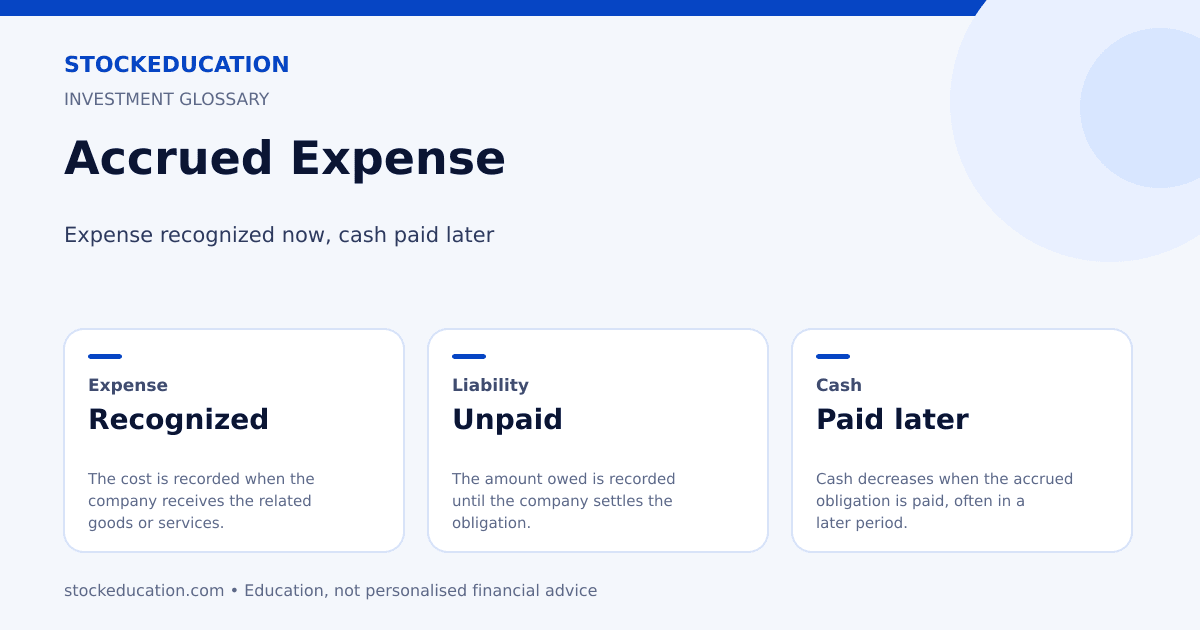
An accrued expense is a cost a company has incurred but has not yet paid or been invoiced for. Accrual accounting records the expense when the related goods or services are received and records an unpaid liability at the same time. This separates the timing of business activity from the timing of cash settlement. Accrued expenses can include wages, interest, rent, taxes, utilities and professional fees. They are commonly reported among current liabilities when expected to be settled within one year or the normal operating cycle. When reviewing a financial statement, compare accrued expense balances with the notes, cash flow statement and operating working-capital changes. The cash flow statement helps explain why an expense recognized in earnings has not yet reduced cash.

Key takeaways
- An accrued expense is recognized before the related cash payment is made.
- The expense reflects goods or services already received during the reporting period.
- A corresponding liability records the company’s unpaid obligation.
- Settlement later reduces cash and usually reduces the accrued liability.
- Investors should analyze accruals with disclosures, working capital and cash flow rather than interpreting the balance in isolation.
What is Accrued Expense?
An accrued expense is a cost a company has incurred but has not yet paid or been invoiced for. Accrual accounting records the expense in the period when the related goods or services are received, while also recognizing a liability for the unpaid amount. This timing helps investors compare reported performance with the activity that produced it, rather than only with the timing of cash payments.
Accrued expenses may include unpaid wages, interest, rent, taxes, utilities or professional fees. They are commonly presented within current liabilities when settlement is expected within one year or the normal operating cycle. When analyzing a financial statement, compare accrued expense balances with the notes, cash flow statement and changes in operating working capital. The cash flow statement can help explain why an expense recognized in earnings has not yet reduced cash.
How Accrued Expense works
| Step | What happens |
|---|---|
| 01 · Identify the underlying activity | Determine which goods or services the company received during the reporting period and whether an unpaid obligation exists. |
| 02 · Estimate the amount | Use payroll records, contracts, usage data, interest calculations, tax rules, purchase records or other evidence to estimate the cost. |
| 03 · Record the period-end accrual | Debit the appropriate expense account and credit an accrued-liability account for the portion incurred but unpaid. |
| 04 · Review classification and disclosure | Determine whether the balance belongs in current liabilities or another category, and inspect whether notes separate material components. |
| 05 · Record settlement or reversal | When payment occurs, debit the accrued liability and credit cash; if an estimate is reversed or differs from the invoice, record the appropriate adjustment. |
| 06 · Analyze the movement | Compare beginning and ending balances with expense, operating cash flow, business activity, seasonality, payment cycles and disclosures. |
The formula
Ending accrued expense liability = Beginning accrued expense liability + Accrued expense additions before settlements − Accrued expense payments or settlements ± Estimate changes and reclassifications
Beginning accrued expense liability: the unpaid accrued balance at the start of the period. Accrued expense additions before settlements: all expense amounts added to this accrued liability during the period, before subtracting payments that clear it. Do not use only costs still unpaid at period-end and then subtract the payments again. Accrued expense payments or settlements: cash payments or other settlements that reduce the liability. Estimate changes and reclassifications: revisions, reversals, foreign-exchange effects or movements between related accounts; these can make the balance change differ from the simple cash-versus-expense timing.
A worked example
Hypothetical example: Assume a company receives $12,000 of consulting services in December, but the consultant will invoice the company in January and payment will occur in February. At December 31, the company recognizes $12,000 of professional-fee expense and a $12,000 accrued-expense liability. Pretax income is therefore $12,000 lower in December, while December cash is unchanged. If the company pays $12,000 in February, it debits the accrued liability by $12,000 and credits cash by $12,000; February does not normally include another $12,000 expense if the original estimate was accurate. A simplified roll-forward is: $0 beginning liability + $12,000 expense incurred but unpaid − $0 December settlement = $12,000 ending accrued liability. In February, the $12,000 payment reduces both the liability and cash. This is hypothetical and omits taxes, reversals, foreign-exchange effects, discounts, partial payments and any difference between the estimate and the final invoice. If the final invoice is $12,500, the additional $500 generally requires an adjustment; if it is $11,700, the company may reverse or reduce $300, subject to its accounting policy.
Why it matters
Accrued expenses matter because they connect reported profitability, liabilities and cash timing. A company can report an expense and lower income before paying cash, or pay cash for obligations recognized in an earlier period. That timing affects operating cash flow, working-capital analysis, liquidity assessment and the interpretation of earnings quality. Investors who look only at the income statement may miss obligations accumulating on the balance sheet; investors who look only at cash may overlook costs already incurred. Reviewing the size, composition, trend and reversal of accruals helps distinguish ordinary operating timing from unusual estimation or payment patterns. The most useful analysis combines the balance-sheet line with note disclosures, the related expense, operating cash flow and the company’s business cycle.
Recognition and timing
Accrual accounting is designed to report the economic effects of transactions and events in the periods in which they occur. If employees perform work in December but receive payment in January, the company has incurred compensation cost in December. It records compensation expense and a liability for the unpaid amount in December, then records the cash settlement in January. The same logic applies to interest that accumulates between payment dates, utilities consumed before billing, rent obligations, taxes arising from activity and professional services already provided. The central question is not whether cash moved, but whether the company received a benefit or incurred an obligation during the reporting period. This timing improves period-to-period comparison, although estimates and later adjustments can affect precision.
Balance-sheet presentation
Accrued expenses are liabilities because they represent obligations created by past activity that are expected to require future settlement. They are often included in current liabilities when payment is expected within one year or the normal operating cycle, though classification depends on the nature and timing of the obligation. A balance-sheet line may aggregate several categories, while a footnote separates compensation, taxes, interest, rent, royalties, professional fees or other items. Investors should therefore read the accompanying notes rather than assuming that one line has a single economic cause. Comparing the balance with revenue, operating costs, employee count, inventory purchases or other relevant drivers can reveal whether the liability reflects normal seasonality, business growth, delayed payment or a change in estimation.
Journal-entry mechanics
A typical period-end accrual increases the relevant expense account and credits an accrued-liability account. The entry raises reported expenses and lowers pretax income for the period, while also increasing liabilities; it does not directly reduce cash at recognition. When the obligation is paid, the company debits the liability and credits cash, so the settlement normally has little or no new expense effect if the original estimate was accurate. If the estimate changes, the company may record an additional expense or a reversal. Accruals can also be reversed automatically at the start of the next period and replaced with the actual invoice or payroll entry. The exact account names vary, but the economic sequence remains expense now, liability until settlement, and cash later.
Cash-flow interpretation
Accrued expenses help explain why net income and operating cash flow differ. An increase in an operating accrued-liability balance generally means the company recognized costs without paying the full amount during the period, which is typically a positive adjustment in the operating section under the indirect cash-flow method. A decrease can indicate that prior obligations were paid, creating a use of cash relative to current-period expense recognition. This interpretation is not mechanical in every case: acquisitions, reclassifications, foreign-exchange effects, noncash items and changes in presentation can affect the movement. Investors should reconcile the cash-flow adjustment to the balance-sheet change and disclosures, then consider whether the pattern reflects ordinary timing or persistent payment deferral.
Analysis and quality of earnings
An accrued-expense balance is not inherently positive or negative. A growing balance may accompany expansion, seasonal payroll, higher taxes, increased service consumption or longer normal settlement cycles. It may also signal aggressive estimation, understated cash needs or pressure to defer payments. A falling balance may indicate efficient settlement, a seasonal reversal, lower activity or the use of cash to clear old obligations. Useful analysis compares accruals with the related expense, operating cash flow, days payable or other business-specific measures, and checks whether reversals and adjustments are recurring. Large, unusual or rapidly changing components deserve attention in the notes. The goal is not to treat every accrual as manipulation, but to understand whether liability changes are consistent with operations and disclosed accounting policies.
Distinguishing related accounts
Accrued expenses, accounts payable, deferred revenue and prepaid expenses describe different positions in the timing of cash, performance and obligation. Accounts payable often represents an invoiced amount owed to a trade supplier, while an accrued expense may be estimated before an invoice arrives or may be separately classified by the company. Deferred revenue is cash received before the company delivers the promised goods or services and is a liability for future performance, not a cost already incurred. A prepaid expense is an asset created when cash is paid before the company receives the related benefit. These distinctions matter because each account affects earnings, working capital and cash flow at different points. Always follow the issuer’s accounting policy and presentation when comparing companies.
Comparison
| Account | What it represents | Initial financial-statement effect | Cash timing |
|---|---|---|---|
| Accrued expense | Cost incurred but unpaid, often before an invoice arrives | Expense increases and liability increases | Cash paid later |
| Accounts payable | Amount invoiced and owed, commonly to a trade supplier | Liability increases when the payable is recorded; expense or inventory may already be recognized | Cash paid at settlement |
| Prepaid expense | Cash paid before the related benefit is received | Asset increases initially; expense recognized as benefit is used | Cash paid first |
| Deferred revenue | Cash received before promised goods or services are delivered | Liability increases initially; revenue recognized as performance occurs | Cash received first |
Check yourself
A company receives services in December, records the related accrued expense at year-end, and pays the provider in January. Which statement is most accurate?
Accrual accounting recognizes the expense when the related services are received. The unpaid amount is recorded as a liability in December, and cash decreases when the company settles that liability in January.
Show the answer
2. December expense and an accrued liability increase; January cash decreases when the liability is paid.
Things people get wrong
Mistake 01 Treating an accrued expense as a cash payment
Recognition of an accrued expense usually reduces income and increases a liability, but it does not reduce cash until the obligation is settled.
Mistake 02 Assuming every accrued expense is accounts payable
Accounts payable often refers to invoiced trade amounts, while accrued expenses may be estimated or separately classified; the issuer’s policy and presentation control.
Mistake 03 Interpreting a larger accrual as automatically negative
Growth, seasonality, higher activity or normal billing delays can increase accruals, although unusual estimation or payment deferral may require investigation.
Mistake 04 Ignoring the notes and cash-flow statement
A balance-sheet line may combine compensation, taxes, interest, rent and other items, so disclosures and working-capital movements are needed for context.
Mistake 05 Assuming the liability change equals the current-period expense
Payments, reversals, reclassifications, foreign-exchange effects and estimate changes can make the ending balance differ from the period’s expense.
Questions people ask about Accrued Expense
What is an accrued expense?
It is a cost recognized for goods or services already received even though the company has not yet paid and may not yet have received an invoice.
Is an accrued expense an asset or a liability?
It is generally a liability because it represents an unpaid obligation created by past activity.
Does recording an accrued expense reduce cash?
No. Recording it normally increases expense and the accrued liability; cash decreases when the obligation is paid or otherwise settled.
What are common examples of accrued expenses?
Common examples include unpaid wages, interest, rent, taxes, utilities, royalties and professional fees.
How does an accrued expense affect net income?
The expense usually reduces pretax income in the period when the related goods or services are received, even if payment occurs later.
How does an accrued expense affect operating cash flow?
Under the indirect method, an increase in an operating accrued-liability balance is generally a positive working-capital adjustment, while a decrease is generally a use of cash, subject to other movements.
Is an accrued expense the same as accounts payable?
Not necessarily. Accounts payable often represents invoiced trade obligations, while accrued expenses may be estimated or classified separately; companies can define and present them differently.
Can an accrued expense be reversed?
Yes. Companies may reverse an estimate in a later period and record the actual invoice or payroll entry, with any difference recognized according to the applicable policy.
The bottom line
An accrued expense records a cost when the company receives the related benefit, while recording the unpaid amount as a liability. Cash is paid later, so the account links earnings, working capital, liquidity and operating cash flow. Analyze its composition, trend, reversals and disclosures rather than treating a rising or falling balance as automatically good or bad.
Sources
About this page. Written by Associate Professor Charles Lo, CPA, PhD and edited by Felix La Spina. No ads and no paywall. Editorial standards · How we fact check · Corrections log · Report an error
Educational information only. Nothing on this page is personal financial, tax or legal advice. Investing involves risk, including the possible loss of principal.


