
Investment Glossary · Quick read · No ads
Asset Allocation
Asset allocation is the process of dividing an investment portfolio among asset categories such as stocks, bonds, and cash. The target mix should reflect the investor’s goal, time horizon, risk tolerance, and need for liquidity; it does not guarantee a particular return or prevent losses.

Key takeaways
- Asset allocation sets the broad mix of asset categories in a portfolio.
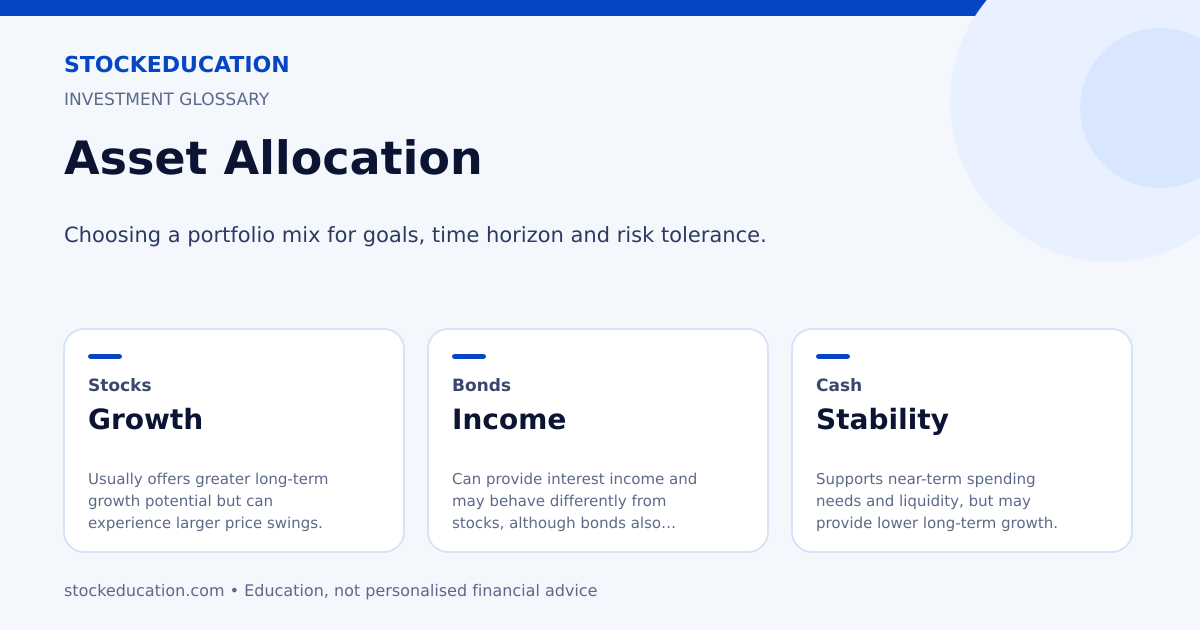
- Stocks may support long-term growth but can experience substantial volatility and losses.
- Bonds may provide income and diversification, but they still carry interest-rate, credit, and market risks.
- Cash supports liquidity and near-term spending but may have less long-term growth potential.
- Time horizon and risk tolerance help determine whether a more growth-oriented or defensive mix is appropriate.
What is Asset Allocation?
Asset allocation is the way an investor divides a portfolio among asset categories such as stocks, bonds, and cash. The appropriate mix depends on the investor’s financial goal, investing time horizon, and ability and willingness to accept potential losses. It is a planning decision, not a guarantee of a particular return.
For example, an investor saving for a distant goal may be able to accept more market volatility than someone who expects to withdraw the money soon. Asset allocation works alongside diversification, which spreads investments within and across asset categories. Investors can also compare the portfolio’s expected return with its risk before choosing a target mix by reviewing expected return.
How Asset Allocation works
| Step | What happens |
|---|---|
| 01 · Define the objective and horizon | State what the money is for, when it may be needed, how much may be required, and whether the date or amount could change. |
| 02 · Assess liquidity needs | Separate emergency reserves and near-term spending from money intended for longer-term growth, because assets may need to be sold at an inconvenient time. |
| 03 · Evaluate risk tolerance and capacity | Consider willingness to experience losses alongside income, savings, debt, obligations, job stability, and the practical ability to wait through a decline. |
| 04 · Choose target category weights | Set percentages for stocks, bonds, cash, and any other appropriate categories so the weights total 100% and reflect the plan’s trade-offs. |
| 05 · Implement and inspect the holdings | Use suitable securities or funds, then check costs, concentration, overlap, issuer exposure, maturity, tax effects, and liquidity rather than relying only on category labels. |
| 06 · Review and rebalance | Compare actual weights with targets after market changes or life events and decide whether to rebalance, considering taxes, fees, transaction costs, and account rules. |
The formula
Portfolio allocation = stocks + bonds + cash + other assets, with weights totaling 100%
Each weight represents the percentage of the portfolio assigned to an asset category, and all category weights should add to 100%. The formula describes portfolio structure, not a forecast of return, a guarantee of safety, or a complete measure of risk. The appropriate weights depend on the goal, time horizon, liquidity needs, risk tolerance, and risk capacity.
A worked example
Hypothetical worked example: Assume Maya has a $100,000 portfolio for a retirement goal 25 years away. After considering her ability and willingness to tolerate losses, she chooses a target allocation of 70% stocks, 25% bonds, and 5% cash. The arithmetic is: $100,000 × 70% = $70,000 in stocks; $100,000 × 25% = $25,000 in bonds; and $100,000 × 5% = $5,000 in cash. The weights total 100%, so the portfolio is fully assigned. If stocks later rise while the other categories do not, the actual mix might become 76% stocks, 19% bonds, and 5% cash. Maya could then review whether rebalancing is appropriate, considering taxes, fees, transaction costs, account rules, and her circumstances. This example is hypothetical and is not a recommendation. It does not predict returns or show how the portfolio would behave in a downturn. A 70% stock allocation could experience a substantial decline, and bonds or cash are not risk-free. Maya would also need to consider emergency savings, debt, inflation, withdrawal timing, tax treatment, investment costs, and whether the selected funds or securities are sufficiently diversified. A different goal or shorter time horizon could justify a different mix. Asset allocation should be evaluated as a plan for managing trade-offs, not as a promise that a particular percentage will produce a particular outcome.
Why it matters
Asset allocation matters because the broad mix of a portfolio strongly influences how it may behave in rising, falling, and changing market conditions. It connects investment choices to the purpose of the money: a long-term growth goal may tolerate more volatility, while a near-term spending need may require greater liquidity and stability. A deliberate allocation can also reduce the chance that an investor takes more risk than intended or sells in response to an unexpected decline. It is not a guarantee against loss, and a suitable mix can still produce disappointing results, but it provides a practical framework for setting expectations, diversifying exposure, and reviewing whether the portfolio remains consistent with the investor’s circumstances.
What Asset Allocation Means
Asset allocation describes the portfolio-level decision about how much capital belongs in broad investment categories rather than which individual security to purchase. Stocks, bonds, and cash have different patterns of potential return, volatility, income, liquidity, and loss. A portfolio with a large stock allocation will generally have more exposure to equity-market movements, while a larger bond or cash allocation may reduce some fluctuations but can also reduce growth potential. The decision is best understood as a framework for managing trade-offs. It does not eliminate risk, forecast every market movement, or ensure that an investor reaches a goal.
Time Horizon and Financial Goals
The time until money is needed is one of the central inputs to an allocation decision. A distant retirement objective may allow an investor to tolerate temporary declines because there may be more time for contributions and recovery. A near-term tuition payment, home purchase, or planned withdrawal leaves less time to recover from a market fall, so liquidity and preservation may receive greater weight. The goal also matters: growth, income, preservation, and spending support can justify different mixes. Time horizon is not fixed forever; it shortens as a goal approaches and should be reconsidered when the date, amount, or importance of the goal changes.
Risk Tolerance and Risk Capacity
Risk tolerance is the investor’s willingness to experience losses or volatility without abandoning the plan. Risk capacity is the financial ability to withstand those losses, considering income, emergency savings, debt, obligations, and the timing of withdrawals. These ideas can differ: someone may feel comfortable with volatility but lack the resources to recover from a large decline, or have strong finances but dislike fluctuating account values. A suitable allocation should respect both. Questionnaires can organize the discussion, but they cannot replace judgment. Investors should consider how they might behave during a prolonged downturn, not merely how they feel when markets are rising.
Stocks, Bonds, and Cash
Stocks represent ownership interests and generally provide the portfolio’s main source of long-term growth potential, but their prices can change sharply and losses can be substantial. Bonds represent lending arrangements that may provide interest, yet they face credit, interest-rate, inflation, liquidity, and market risks. Cash and cash-like holdings are useful for spending needs, reserves, and flexibility, although inflation can erode purchasing power and the opportunity cost of holding cash can be meaningful over long periods. These categories are not automatically safe or interchangeable; the specific security, issuer, maturity, fund structure, and economic environment affect the actual risk.
Diversification and Implementation
Asset allocation operates at a broad level, while diversification spreads exposure within and across categories. A stock allocation, for example, may be diversified by company, industry, geography, or investment style; a bond allocation may vary by issuer, maturity, and credit quality. Funds can make broad exposure easier, but investors should still examine holdings, costs, concentration, and overlap. Implementation should match the intended allocation without creating unnecessary complexity. Diversification cannot guarantee a profit or prevent losses, and owning many investments that respond to the same economic factor may provide less diversification than it appears to provide.
Rebalancing and Review
Market movements can cause a portfolio’s actual weights to drift away from its target. Rebalancing means buying, selling, or redirecting contributions to restore the intended relationship among asset categories. A calendar schedule, a tolerance-band approach, or a combination may be used, with attention to taxes, fees, transaction costs, and account rules. Review is also appropriate after a major change in goal, time horizon, income, liquidity needs, or risk capacity. Rebalancing is not a reliable way to predict markets; it is a discipline for keeping the portfolio aligned with the plan rather than allowing recent performance to determine the mix.
Comparison
| Category | Primary role | Main trade-off | Common risks |
|---|---|---|---|
| Stocks | Long-term growth potential and ownership exposure | Greater potential growth may come with larger price swings and losses | Market, business, concentration, and valuation risk |
| Bonds | Potential income and a different source of portfolio exposure | Income and relative stability can vary as rates, credit conditions, and prices change | Interest-rate, credit, inflation, liquidity, and market risk |
| Cash | Liquidity, reserves, and near-term spending support | Lower volatility may come with lower long-term growth and inflation exposure | Inflation, reinvestment, and purchasing-power risk |
| Other assets | Additional sources of exposure or diversification | Complexity, cost, and limited liquidity may increase | Asset-specific, market, liquidity, and valuation risk |
Check yourself
An investor has a near-term spending goal and limited ability to recover from a market decline. Which principle is most relevant when setting the portfolio’s asset allocation?
A near-term goal and limited ability to recover from losses are important constraints. Allocation should reflect time horizon, liquidity needs, willingness to bear volatility, and financial capacity to withstand losses. No allocation guarantees safety or a particular result.
Show the answer
2. Consider the goal’s time horizon, liquidity needs, risk tolerance, and risk capacity together.
Things people get wrong
Mistake 01 Treating an allocation as a guaranteed return or safety plan
A target mix describes exposure to asset categories; it cannot guarantee a return, prevent losses, or eliminate volatility. Stocks, bonds, and cash all have risks that should be understood before implementation.
Mistake 02 Choosing a mix from a rule of thumb alone
A commonly quoted percentage may not fit the investor’s goal, time horizon, liquidity needs, risk tolerance, or risk capacity. The same allocation can be unsuitable for two people with different circumstances.
Mistake 03 Confusing risk tolerance with risk capacity
Feeling comfortable with market swings is different from having the financial resources and time to withstand them. Consider income, emergency savings, debt, obligations, and withdrawal timing as well as emotional comfort.
Mistake 04 Ignoring drift after market movements
A portfolio can move away from its target as categories produce different returns. Review the allocation and consider taxes, fees, transaction costs, and account rules before rebalancing.
Mistake 05 Assuming many holdings automatically mean diversification
Several funds or securities may overlap or depend on the same company, industry, country, or economic factor. Check underlying holdings, concentration, costs, and correlations rather than counting investment names.
Mistake 06 Using cash for every long-term need
Cash can support liquidity and near-term spending, but inflation and forgone growth can reduce its purchasing power over long periods. Match the cash reserve to actual spending and emergency needs.
Questions people ask about Asset Allocation
What is asset allocation?
Asset allocation is the intentional division of a portfolio among broad categories such as stocks, bonds, and cash. The mix is selected to fit a goal, time horizon, liquidity needs, and the investor’s ability and willingness to bear risk.
Why does asset allocation matter?
The broad mix strongly influences how a portfolio may behave in different market conditions. It connects investment choices to the purpose of the money and can help an investor avoid taking more risk than intended.
How should time horizon affect an allocation?
A longer time horizon may provide more time to withstand temporary declines, while a near-term withdrawal gives less time to recover from a loss. The goal’s timing, amount, and importance should all be considered.
Are bonds and cash risk-free?
No. Bonds can face interest-rate, credit, inflation, liquidity, and market risks. Cash can lose purchasing power to inflation and may provide less long-term growth, although it can be useful for liquidity and near-term spending.
What is the difference between risk tolerance and risk capacity?
Risk tolerance is the willingness to experience volatility or losses. Risk capacity is the financial ability to withstand them, based on resources, obligations, income, savings, debt, and withdrawal timing. A suitable allocation considers both.
What is rebalancing?
Rebalancing is restoring a portfolio toward its target weights after market movements or changes in contributions. It may involve buying, selling, or redirecting contributions, while accounting for taxes, fees, transaction costs, and account rules.
Does diversification eliminate investment risk?
No. Diversification can spread exposure, but it cannot guarantee a profit or prevent losses. Investments that appear different may still respond to the same economic or market factor.
Should everyone use the same stock, bond, and cash percentages?
No. There is no single allocation suitable for every goal or investor. Circumstances, time horizon, liquidity needs, risk tolerance, risk capacity, taxes, and implementation choices can lead to different targets.
The bottom line
Asset allocation is the portfolio’s broad blueprint: decide how much belongs in stocks, bonds, cash, and other categories, then review whether that mix still fits the goal and the investor’s circumstances. A thoughtful allocation manages trade-offs; it does not promise returns or prevent losses.
Sources
About this page. Written by Associate Professor Charles Lo, CPA, PhD and edited by Felix La Spina. No ads and no paywall. Editorial standards · How we fact check · Corrections log · Report an error
Educational information only. Nothing on this page is personal financial, tax or legal advice. Investing involves risk, including the possible loss of principal.


