
Investment Glossary · Quick read · No ads
Bond Yield
Bond yield is the return a bond provides, expressed as a percentage. The appropriate yield measure depends on whether you are measuring income at today’s price, estimating the return from purchase to maturity, or evaluating how market-rate changes affect bond value.

Key takeaways
- Bond yield expresses a bond’s return as a percentage.
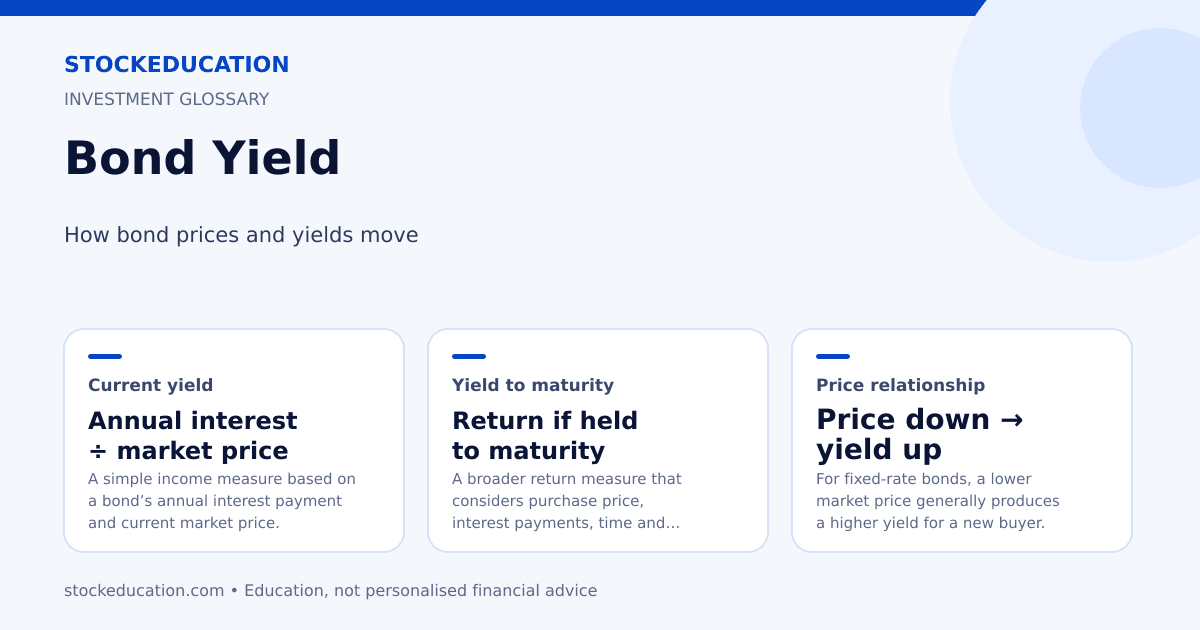
- Current yield divides annual interest by the bond’s current market price.
- Yield to maturity considers price, coupon payments, time and repayment at maturity.
- Fixed-rate bond prices and yields generally move in opposite directions.
- A higher yield may reflect a lower price, greater credit risk, longer duration or other risks.
- Yield comparisons are meaningful only when maturity, credit quality, taxation and calculation methods are considered.
What is Bond Yield?
Bond yield is the return a bond provides, expressed as a percentage. It can refer to current yield, yield to maturity, or another measure that relates a bond’s cash payments and price. The right measure depends on whether you are comparing income, holding the bond to maturity, or assessing its market value.
Bond prices and yields generally move in opposite directions: when market interest rates rise, existing fixed-rate bond prices tend to fall and their yields tend to rise. Learn how to connect interest rates to bond yields, and compare bond income with the earnings yield measure used in stock analysis.
How Bond Yield works
| Step | What happens |
|---|---|
| 01 · Identify the yield measure | Decide whether the question concerns simple current income, YTM, yield to call or another convention. |
| 02 · Collect comparable inputs | Record the bond’s price, face value, coupon, maturity, payment frequency, call terms, credit quality, taxes and fees. |
| 03 · Calculate or obtain the yield | For current yield, divide annual coupon interest by market price and multiply by 100; for YTM, use a suitable cash-flow calculation. |
| 04 · Check the assumptions | Confirm that scheduled payments, maturity repayment, reinvestment and compounding assumptions match the quoted figure. |
| 05 · Compare risks and scenarios | Consider interest-rate sensitivity, default risk, liquidity, inflation, taxation and the possibility of selling before maturity. |
| 06 · Review the result over time | Market prices and yields change, so a quoted yield is a snapshot rather than a promise of realized return. |
The formula
Current yield = Annual coupon interest ÷ Current market price × 100 YTM ≈ the annualized discount rate that makes the present value of all scheduled coupon payments and the maturity repayment equal to the bond’s market price.
Annual coupon interest: the bond’s scheduled interest payments over one year. Current market price: the amount paid for the bond today, usually stated per bond or per 100 of face value. YTM: yield to maturity, an annualized estimate based on price, cash flows, time to maturity and repayment of face value. The YTM line is an approximation in notation; exact calculation normally requires solving for the discount rate numerically and depends on payment timing and assumptions about reinvestment and payment.
A worked example
Hypothetical example: Assume a $1,000 face-value bond pays a 5% annual coupon, or $50 per year. If the bond currently trades for $950, its current yield is $50 ÷ $950 × 100 = 5.26%. That calculation measures annual coupon income against today’s price. A buyer who holds the bond to maturity may also receive the $50 difference between the $950 purchase price and the $1,000 repayment, so the bond’s yield to maturity would generally be higher than 5.26%, subject to the exact payment schedule and compounding convention. This is not a forecast or investment recommendation. It assumes the issuer makes scheduled payments and repays face value; actual results can differ if the bond is sold early, defaults, is callable, incurs transaction costs or has coupons reinvested at different rates.
Why it matters
Bond yield helps investors translate a bond’s cash payments and market price into a return measure that can be compared with alternatives. It matters because a coupon rate alone does not show what a buyer earns at today’s price, and a quoted yield can conceal credit, duration, call, liquidity, inflation and reinvestment risks. Understanding the price-yield relationship also explains why a bond portfolio may lose market value when rates rise even though its scheduled coupons have not changed. Use yield as one part of analysis alongside issuer strength, maturity, tax treatment, liquidity and the possibility of selling before maturity.
Coupon Rate Versus Yield
A bond’s coupon rate describes the stated annual interest payment relative to its face value. It normally remains fixed for a conventional fixed-rate bond, so it does not automatically change when the bond trades in the market. Yield instead relates the payment stream to the price an investor pays or to a fuller return calculation. If a bond’s price falls below face value while its coupon remains unchanged, the same cash payment represents a larger percentage of the buyer’s investment. If the bond trades above face value, the payment represents a smaller percentage of that price. Keeping these concepts separate prevents the common error of treating a bond’s printed interest rate as its current return.
Current Yield
Current yield is a simple income comparison: annual coupon interest divided by the bond’s current market price. It is useful when an investor wants a quick view of cash income relative to the amount required to buy the bond today. However, it leaves out the difference between purchase price and face value that will be realized at maturity, and it does not fully account for the timing of cash flows. A bond bought at a discount can therefore have a current yield that understates its expected holding-period return, while a premium bond can have a current yield that overlooks a possible capital loss at maturity. Use it as a snapshot, not as a complete return estimate.
Yield to Maturity
Yield to maturity, commonly abbreviated YTM, is a broader annualized return estimate based on the bond’s current purchase price, coupon payments, time remaining and repayment of face value at maturity. It is most useful for comparing bonds with similar characteristics when the investor expects to hold them until maturity. The calculation assumes scheduled payments are made and uses a reinvestment convention for interim cash flows; actual results can differ if the bond is sold early, the issuer defaults, payments are reinvested at different rates, or the bond is callable. YTM also does not erase credit, liquidity, inflation or interest-rate risk. It is an estimate tied to assumptions, not a guaranteed realized return.
Why Prices and Yields Move Oppositely
Consider an existing fixed-rate bond whose coupon payment is unchanged. When newly issued bonds offer higher market interest rates, the older bond’s fixed payment is less attractive unless its market price falls enough to provide a competitive yield to a new buyer. Conversely, when market rates fall, the older bond’s relatively higher fixed payment can make it more valuable, pushing its price up and its market yield down. This inverse relationship is a general tendency rather than a promise that every bond moves identically. Credit news, liquidity, call features, taxes, supply and demand, and changing expectations can affect both price and yield at the same time.
Risks Behind a High Yield
A high quoted yield is not automatically a bargain. It may result from a discounted price, but it can also compensate investors for higher perceived default risk, limited trading liquidity, long maturity, inflation exposure, call uncertainty or unusual bond terms. Credit risk concerns the issuer’s ability and willingness to make promised payments; interest-rate risk describes the price sensitivity of existing fixed payments when market rates change. Reinvestment risk arises when coupons or principal cannot be reinvested at the assumed rate. Comparing yield without examining these risks can make a riskier bond appear superior to a safer one when the numbers are not economically equivalent.
Comparing Bond Yields Responsibly
A useful comparison starts by matching the measure: current yield for a quick income view, or YTM for a fuller maturity-based estimate. Then check maturity, credit quality, seniority, callability, payment frequency, taxes, fees, liquidity and whether the quoted figure is nominal or adjusted for another feature. A tax-exempt yield may need to be compared with a tax-equivalent yield rather than a taxable figure. A callable bond may require yield to call or yield to worst in addition to YTM. Finally, distinguish expected return from realized return: market prices can change before maturity, and an issuer’s payment performance or an investor’s sale decision can alter the outcome.
Comparison
| Measure | What it calculates | Main inputs | Common limitation |
|---|---|---|---|
| Coupon rate | Stated annual interest relative to face value | Coupon payment and face value | Does not change with market price for a conventional fixed-rate bond |
| Current yield | Annual coupon income relative to today’s price | Annual coupon and market price | Excludes maturity gain or loss and detailed cash-flow timing |
| Yield to maturity | Estimated annualized return if held to maturity | Price, coupons, time, face-value repayment and assumptions | Can differ from realized return if sold early, payments fail or reinvestment differs |
| Yield to call or worst | Return under an early redemption or least-favorable relevant scenario | Price, coupons, call terms and dates | Requires reviewing bond features and may not describe the result if the bond is not called |
Check yourself
A fixed-rate bond’s annual coupon is $50 and its current market price is $950. What is its approximate current yield?
Current yield equals annual coupon interest divided by current market price, multiplied by 100: $50 ÷ $950 × 100 = approximately 5.26%.
Show the answer
3. 5.26%
Things people get wrong
Mistake 01 Confusing coupon rate with yield
The coupon is generally calculated from face value, while yield reflects the price paid and may include maturity-related gains or losses.
Mistake 02 Treating current yield as total return
Current yield excludes the effect of buying at a discount or premium, payment timing and the repayment of face value at maturity.
Mistake 03 Assuming a high yield is automatically better
A high yield may compensate for default, liquidity, duration, inflation, call or other risks.
Mistake 04 Ignoring call features
A callable bond may be redeemed before maturity, so yield to call or yield to worst may be more relevant than YTM.
Mistake 05 Comparing unlike bonds
Maturity, credit quality, taxation, payment frequency, fees and liquidity should be considered before comparing quoted yields.
Questions people ask about Bond Yield
What is bond yield?
Bond yield is a percentage measure of the income or return associated with a bond. The appropriate calculation depends on whether the investor wants a simple income measure or an estimate through maturity.
How is current yield calculated?
Current yield equals annual coupon interest divided by the bond’s current market price, multiplied by 100. It does not include every component of a bond’s possible return.
How does yield to maturity differ from current yield?
YTM considers the purchase price, coupon payments, time remaining and repayment of face value at maturity. Current yield considers only annual coupon income relative to the current price.
Why do bond prices and yields usually move in opposite directions?
When market rates rise, an existing fixed coupon becomes less attractive, so its price generally falls until its prospective yield is more competitive. When rates fall, the reverse often occurs.
Does a high bond yield mean the bond is safe?
No. A high yield can reflect a lower price caused by higher perceived credit risk, weaker liquidity, longer duration or other risks.
Can bond yield be guaranteed?
A quoted yield is not necessarily a guaranteed realized return. Defaults, early sale, calls, reinvestment results, fees and changing market conditions can affect the outcome.
Which yield should I use for a callable bond?
Review yield to call and yield to worst as well as YTM. The relevant measure depends on the bond’s terms and the prices and dates used in the calculation.
The bottom line
Bond yield translates a bond’s payments and price into a percentage return measure. Current yield is a quick income calculation, while YTM is a broader estimate that includes maturity repayment and timing assumptions. Compare yields only after considering credit quality, maturity, callability, taxes, liquidity and the possibility of selling before maturity.
Sources
About this page. Written by Associate Professor Charles Lo, CPA, PhD and edited by Felix La Spina. No ads and no paywall. Editorial standards · How we fact check · Corrections log · Report an error
Educational information only. Nothing on this page is personal financial, tax or legal advice. Investing involves risk, including the possible loss of principal.


