
Investment Glossary · Quick read · No ads
Cash Basis Accounting
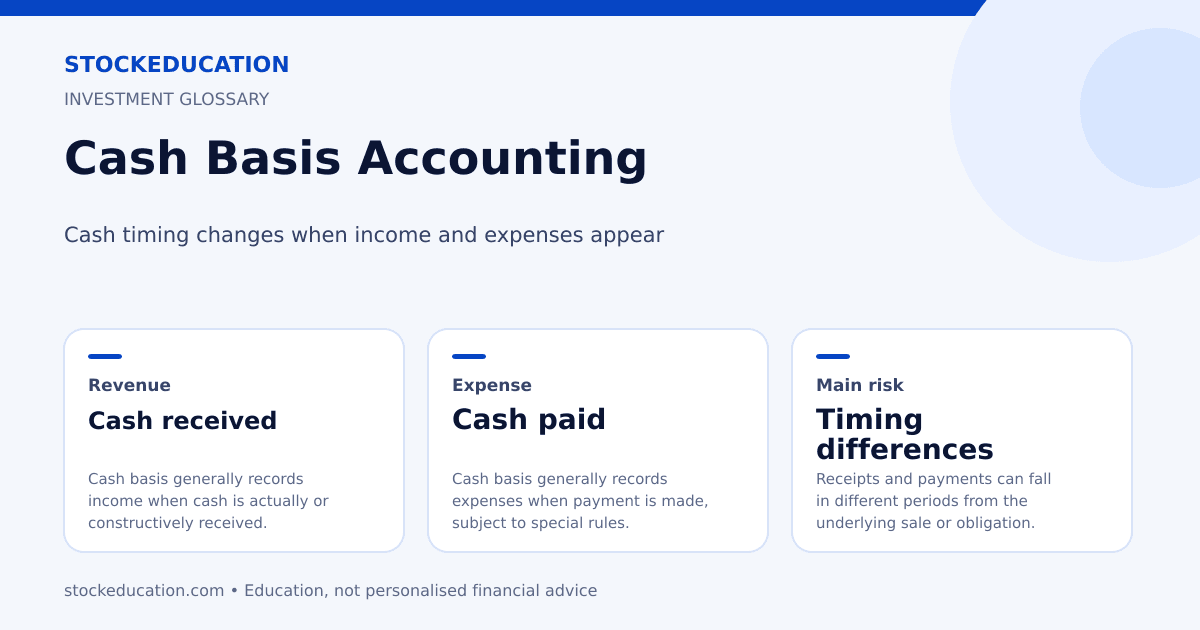
Cash basis accounting records revenue when cash is received and expenses when cash is paid, rather than when revenue is earned or expenses are incurred.

Key takeaways
- Cash basis accounting focuses on the timing of cash receipts and cash payments.
- Revenue may be recorded later than the sale if the customer has not paid.
- An expense may be recorded when paid even if it relates to a different period.
- Cash basis results can differ materially from accrual basis results during periods of changing receivables, payables or prepaid costs.
- Investors should not assume cash basis profit is comparable with GAAP earnings without understanding the accounting basis.
What is Cash Basis Accounting?
Cash basis accounting records income when cash is actually or constructively received and records expenses when they are paid. That timing can make a small business’s reported profit look different from its activity during the period, especially when customers pay invoices later or bills are paid early.
For investors, the method is useful to understand because it differs from the accrual basis used in most financial statements. The IRS explains the cash method and its limitations in Publication 538. Compare reported earnings with the operating cash flow and read the accounting-policy notes before drawing conclusions about business performance.
How Cash Basis Accounting works
| Step | What happens |
|---|---|
| 01 · Identify the accounting basis | Confirm whether the records use cash, accrual, or a permitted combination method. |
| 02 · List cash receipts | Separate actual or constructive receipts that fall within the period being analyzed. |
| 03 · List cash payments | Identify payments and check whether prepaid or capital items require special treatment. |
| 04 · Compare timing differences | Review receivables, payables, unpaid invoices, and deferred items that explain period differences. |
| 05 · Check applicable rules | Confirm consistent application and review relevant requirements before interpreting results. |
| 06 · Interpret performance | Consider the accounting basis alongside cash flows before evaluating profitability or valuation. |
The formula
Cash basis income for a period = cash receipts recognized during the period − cash payments recognized during the period
Cash receipts recognized during the period = income actually or constructively received under the applicable method. Cash payments recognized during the period = expenses paid and recognized under the applicable rules. This simplified relationship is educational and does not replace tax or accounting guidance.
A worked example
Consider a fictional consulting business. It completes $12,000 of work in December but receives the customer’s payment in January. It also receives a $2,000 supplier invoice in December and pays it in January. Under a simple cash basis presentation, neither the $12,000 revenue nor the $2,000 expense is recorded in December because neither cash movement occurred then. January records the $12,000 receipt and the $2,000 payment. Under accrual accounting, the revenue and expense would generally be recognized in December when earned and incurred. These are illustrative figures, not a market quote or an actual company result.
Why it matters
Cash basis accounting can change the period in which revenue and expenses appear. That affects apparent growth, margins and profit comparisons, especially when collections, supplier payments, advance payments or major purchases occur near period end. Investors should identify the accounting basis before comparing results with accrual-based financial statements.
How the cash method records revenue
Under the cash method, revenue is generally recorded when payment is received or constructively received. A completed sale on credit may therefore remain unrecorded as revenue until the customer pays. This timing can simplify bookkeeping, but it also means that reported revenue for a period may not represent all sales made during that period. The IRS describes actual or constructive receipt as relevant to when income enters the cash method calculation.
How the cash method records expenses
Expenses are generally recorded when paid. A business that receives an invoice in December but pays it in January may record the expense in January under a basic cash method. Prepaid expenses can have special rules, so paying cash does not always mean the entire amount is immediately deductible. The economic benefit, tax rules and nature of the payment can affect the result.
Cash basis versus accrual basis
Accrual accounting recognizes income when earned and expenses when incurred, subject to the applicable rules. Cash basis accounting instead follows receipts and disbursements. The difference is mainly timing, but timing can affect reported margins, working capital and apparent growth. A business can show strong cash receipts while having lower accrual revenue, or show accrual revenue before customers have paid.
Why investors should inspect the accounting basis
Most public-company financial statements are prepared using accrual accounting under GAAP, so a cash basis record should not be compared directly with reported public-company earnings without adjustment. Investors should identify the accounting basis, review receivables and payables, and compare profit with operating cash flow. The basis can change the period in which activity appears, even when the underlying transaction is unchanged.
Limits and tax considerations
The cash method may be available to many individuals and smaller businesses, but eligibility and treatment depend on tax rules. Inventory, advance payments, related-party transactions and changes in accounting method can create exceptions or additional requirements. Publication 538 and Publication 334 explain that a taxpayer must apply its chosen method consistently and may need permission or a prescribed procedure to change methods.
Reading cash basis information responsibly
Cash basis numbers can be useful for understanding liquidity and near-term cash movement, but they do not automatically measure economic performance for the period. Separate operating receipts from financing and investing cash flows, check whether a payment is a capital expenditure, and look for unusual timing near period end. A complete analysis uses the accounting policy, supporting records and comparable periods rather than one cash balance.
Comparison
| Feature | Cash basis method | Accrual basis method |
|---|---|---|
| Revenue timing | Generally recorded when cash is received | Generally recorded when earned |
| Expense timing | Generally recorded when cash is paid | Generally recorded when incurred |
| Credit sale treatment | Usually recorded when collected | Usually recorded when the sale is earned |
| Investor interpretation | Sensitive to collection and payment timing | Usually reflects period activity more fully |
Check yourself
A fictional business completes work in December, receives payment in January and uses a simple cash basis. When is the revenue generally recorded?
Under a simple cash basis, revenue is generally recorded when cash is actually or constructively received. The example is illustrative and does not describe a real company.
Show the answer
January, when the cash was received
Things people get wrong
Mistake 01 Treating cash basis profit as the same as economic profit
Cash timing can shift revenue and expenses between periods, so profit may not describe all activity completed during the period.
Mistake 02 Assuming every payment is immediately deductible
Prepaid costs, capital expenditures and other payments may be subject to separate recognition or capitalization rules.
Mistake 03 Comparing cash basis results directly with GAAP results
Public-company financial statements generally use accrual accounting, so the accounting bases must be identified before comparison.
Mistake 04 Ignoring receivables and payables
Unpaid customer invoices and unpaid supplier bills can explain why cash movement differs from reported business activity.
Mistake 05 Changing methods without checking the rules
A change from cash to accrual or from accrual to cash can require consistency, adjustments or approval under applicable tax procedures.
Questions people ask about Cash Basis Accounting
When is revenue recorded under cash basis accounting?
Revenue is generally recorded when cash is actually or constructively received, subject to applicable rules and exceptions.
When is an expense recorded under cash basis accounting?
An expense is generally recorded when it is paid, although prepaid costs, capital expenditures and other special categories may be treated differently.
Is cash basis accounting the same as cash flow accounting?
No. Cash basis accounting is an accounting method for recognizing income and expenses, while a cash flow statement classifies cash movements into operating, investing and financing activities.
Can a cash basis business have accounts receivable?
A business can track unpaid invoices operationally, but under a simple cash method an unpaid invoice generally is not recorded as revenue until collected.
Do public companies use cash basis accounting?
Most public-company financial statements are prepared using accrual accounting under GAAP rather than a pure cash basis.
Can a business change from cash basis to accrual basis?
A change may be possible, but the business must follow the applicable tax and accounting rules, including any required adjustment or approval procedure.
Why can cash basis profit change sharply between periods?
Receipts and payments can cluster in different periods, causing reported revenue and expenses to move even when sales activity is relatively steady.
The bottom line
Cash basis accounting is a timing method: it records income and expenses when cash changes hands, with rules for constructive receipt and special items. It can be simple and useful for tracking liquidity, but it may not show the full economic activity of a period. Identify the accounting basis, compare it with accrual information where available, and review operating cash flow, receivables, payables and accounting-policy notes before evaluating performance.
Sources
About this page. Written by Associate Professor Charles Lo, CPA, PhD and edited by Felix La Spina. No ads and no paywall. Editorial standards · How we fact check · Corrections log · Report an error
Educational information only. Nothing on this page is personal financial, tax or legal advice. Investing involves risk, including the possible loss of principal.


