
Investment Glossary · Quick read · No ads
Cash Return On Invested Capital
Cash Return on Invested Capital (CROIC) measures how much free cash flow a company generates for each dollar of invested capital. A higher ratio can indicate more efficient cash generation, but the result is meaningful only when the numerator, denominator and adjustments are defined consistently.

Key takeaways
- CROIC compares free cash flow with invested capital, not accounting profit with equity alone.
- CROIC is generally a non-GAAP measure and has no single universal calculation.
- A useful analysis reconciles free cash flow to operating cash flow and explains capital expenditure adjustments.
- Average invested capital can reduce distortion when the capital base changes materially during a period.
- Compare CROIC across periods and similar businesses only after checking that the definitions match.
What is Cash Return On Invested Capital?
Cash Return on Invested Capital (CROIC) measures how much defined free cash flow a company generates for each dollar of invested capital. A common calculation divides free cash flow—often operating cash flow minus capital expenditures—by average invested capital. Because companies and analysts may make different adjustments, CROIC is generally a non-GAAP analytical measure rather than a standardized accounting ratio.
Use CROIC to study cash-generation efficiency across periods, while checking working-capital movements, reinvestment needs, acquisitions and unusual cash items. Reconcile the inputs to the cash flow statement and review the SEC non-GAAP guidance. Comparisons are meaningful only when the numerator, denominator and adjustments are defined consistently.
How Cash Return On Invested Capital works
| Step | What happens |
|---|---|
| 01 · Define the measure | State exactly which free-cash-flow and invested-capital definitions will be used. |
| 02 · Collect filing data | Gather operating cash flow, capital expenditures, balance-sheet inputs and disclosed adjustments from comparable periods. |
| 03 · Calculate free cash flow | Subtract the selected capital expenditures and other documented cash adjustments from operating cash flow. |
| 04 · Calculate average invested capital | Average beginning and ending invested capital when the methodology and period data support that approach. |
| 05 · Interpret with context | Compare periods and peers only after checking definitions, investment cycles, working capital and unusual items. |
| 06 · Reconcile and disclose | Explain the calculation, limitations and closest GAAP measures so readers can reproduce the result. |
The formula
CROIC = Free cash flow ÷ Average invested capital
Free cash flow = the company-defined cash flow available after specified operating and investment cash outflows. Average invested capital = the average of beginning and ending invested capital under the stated methodology. CROIC = Cash Return on Invested Capital, expressed as a percentage when the inputs use the same currency units.
A worked example
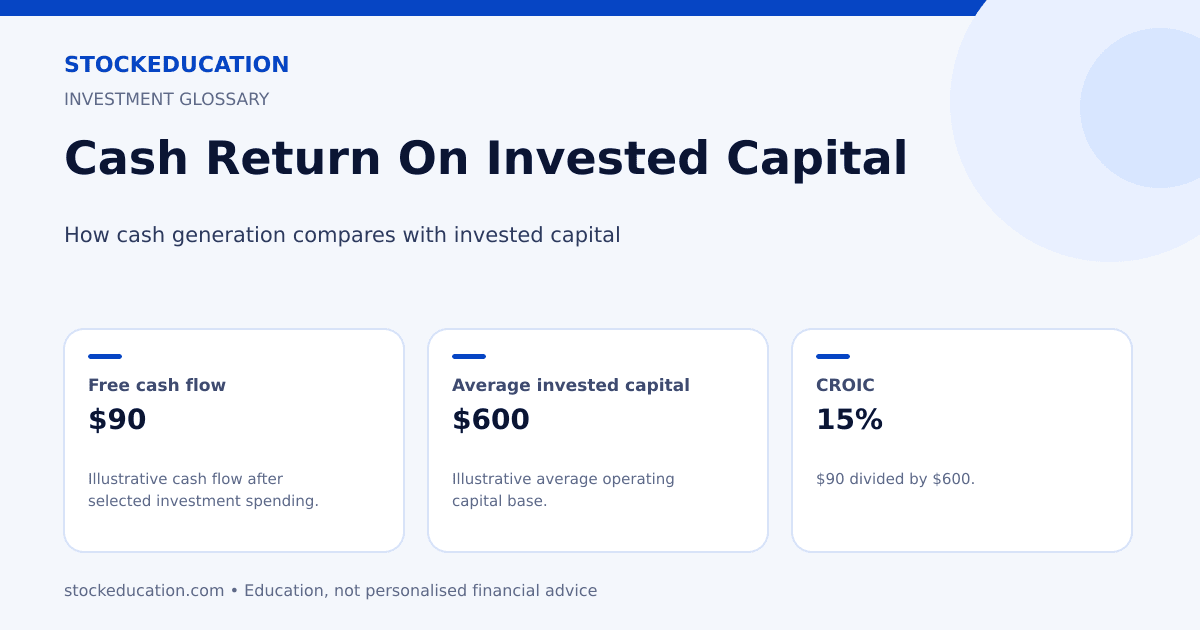
Illustrative example: suppose a business reports operating cash flow of $120 and capital expenditures of $30, producing free cash flow of $90. If invested capital was $560 at the start of the year and $640 at the end, average invested capital is ($560 + $640) ÷ 2 = $600. CROIC is $90 ÷ $600 = 15%. The figures are hypothetical and are not a quoted market result, company disclosure or forecast. In practice, verify whether the company includes acquisitions, lease payments, restructuring cash costs, restricted cash or other adjustments before using the ratio.
Why it matters
CROIC helps connect cash generation with the capital required to run a business. It can reveal whether reported cash returns appear to improve or weaken over time, but it must be paired with a clear reconciliation, comparable periods and an understanding of reinvestment needs.
What Cash Return on Invested Capital measures
Cash Return on Invested Capital links cash generation to the resources committed to the business. The numerator is usually free cash flow, while the denominator is an invested-capital base such as operating assets and working capital or debt plus equity less excess cash. The ratio is intended to describe cash efficiency: how much cash the business produces relative to the capital required to operate it. It does not by itself prove that cash generation is durable, that the company is undervalued or that management allocated capital well. Read the company’s definition and reconcile the calculation before comparing it with another issuer.
Formula and inputs
A commonly used formula is CROIC = free cash flow ÷ average invested capital. Free cash flow is often operating cash flow minus capital expenditures, although some companies make additional adjustments. Average invested capital may be calculated as the average of beginning and ending invested capital, which can better reflect a changing asset base than using only the period-end balance. For a hypothetical illustration, if free cash flow is $90 and average invested capital is $600, CROIC is $90 ÷ $600 = 15%. These figures are invented for teaching and are not a market quote or company result.
How to build the calculation from filings
Start with the company’s Form 10-K or Form 10-Q and locate the statement of cash flows, balance sheet, capital expenditure disclosure and non-GAAP reconciliation. Identify operating cash flow, then determine which property and equipment purchases are treated as capital expenditures. Next, document the company’s invested-capital definition and calculate beginning, ending and average amounts using comparable dates. Check whether cash, restricted cash, leases, acquisitions, restructuring payments or discontinued operations are included or excluded. Preserve the company’s units and period labels, and write down every adjustment so another reader could reproduce the result.
Why the ratio can help valuation analysis
CROIC can provide a bridge between cash-flow analysis and capital efficiency. A business that repeatedly generates strong cash returns on the capital needed to operate may have more flexibility to reinvest, reduce debt, buy back shares or pay dividends. The ratio can also highlight differences between businesses that report similar earnings but require different levels of working capital or property investment. Still, CROIC is only one lens. Growth prospects, competitive advantages, reinvestment needs, financing risk and the price paid for the shares all affect an investment decision.
CROIC compared with accounting ROIC
Traditional ROIC often uses after-tax operating profit divided by average invested capital. CROIC substitutes a cash-flow measure, frequently free cash flow, for the accounting return. This can make CROIC useful when an investor wants to examine cash conversion and capital spending, but it can also introduce volatility from working-capital timing and uneven investment cycles. ROIC may be more appropriate for comparing operating profitability, while CROIC may emphasize cash available after selected reinvestment. Neither measure is automatically superior; the correct choice depends on the question and the consistency of the data.
Limitations and interpretation
CROIC is sensitive to definitions, timing and business model. A company can report high free cash flow because working capital temporarily released cash, because maintenance investment was deferred or because an unusual payment did not recur. A low ratio may reflect a deliberate expansion period rather than poor economics. The SEC warns that non-GAAP measures may lack uniform definitions and can be misleading if adjustments are inconsistent or omit recurring costs. Use several years of data, inspect footnotes and compare the result with operating cash flow, capital expenditure, debt and revenue trends.
Reading the result responsibly
A percentage should be a starting point for questions rather than a verdict. Ask whether free cash flow covers the investment required to maintain the business, whether the invested-capital base includes all operating resources, and whether the ratio changes because of operations or accounting presentation. Compare the company’s own definition over time before comparing it with a peer. A rising CROIC supported by stable cash conversion can be encouraging, while a sudden increase caused by asset sales or working-capital release deserves caution. Pair the ratio with the cash flow statement and primary filings.
Comparison
| Measure | Typical return input | Main question | Main caution |
|---|---|---|---|
| Cash Return on Invested Capital | Free cash flow | How much cash is generated per dollar of invested capital? | Definitions vary and working-capital timing can distort results. |
| Traditional ROIC | After-tax operating profit | How profitable are operations relative to invested capital? | Accounting profit may not equal cash available after investment. |
| Free-cash-flow yield | Free cash flow | How much cash flow is generated relative to market value? | Market price changes can dominate the ratio. |
| Return on equity | Net income | How much accounting profit is generated per dollar of equity? | Leverage and non-operating items can affect the result. |
Check yourself
A company reports illustrative free cash flow of $90 and average invested capital of $600. What is its illustrative CROIC?
CROIC is calculated as free cash flow divided by average invested capital: $90 ÷ $600 = 0.15, or 15%. The figures are hypothetical and are used only to demonstrate the calculation.
Show the answer
15%
Things people get wrong
Mistake 01 Treating CROIC as a GAAP ratio
CROIC is generally a non-GAAP analytical measure, so document the company’s definition and reconcile the inputs before relying on it.
Mistake 02 Using net income as the numerator
Net income is an accounting profit measure; a cash-return calculation normally starts with operating cash flow and specified cash adjustments.
Mistake 03 Ignoring maintenance investment
A high cash figure can be misleading if necessary capital spending is omitted or deferred; inspect the capital expenditure disclosure and business context.
Mistake 04 Comparing incompatible definitions
Two companies may use different free-cash-flow or invested-capital formulas, making their percentages non-comparable without adjustment.
Mistake 05 Reading one period in isolation
Working-capital timing, acquisitions and asset sales can distort a single year; review multiple periods and the underlying filings.
Questions people ask about Cash Return On Invested Capital
Is Cash Return on Invested Capital the same as ROIC?
No. CROIC generally uses free cash flow, while traditional ROIC commonly uses after-tax operating profit. Both divide a return measure by invested capital, but their inputs and purposes differ.
What is the basic CROIC formula?
A common formula is free cash flow divided by average invested capital. The exact definition should be taken from the company’s disclosure or stated clearly by the analyst.
Is CROIC a GAAP measure?
Usually not. CROIC is generally a company-defined or analyst-defined non-GAAP measure, so it requires clear labeling and explanation.
What does a higher CROIC mean?
All else equal, a higher ratio means more defined free cash flow is generated per dollar of defined invested capital. It does not alone establish value creation or investment attractiveness.
Can CROIC be negative?
Yes. Negative free cash flow or a negative defined invested-capital relationship can produce a negative ratio. Investigate operating performance, investment timing and the calculation before interpreting it.
Should I use ending or average invested capital?
Average invested capital is often useful when the capital base changes during the period, but the appropriate choice depends on the stated methodology and the periods available.
Why can CROIC differ from free-cash-flow yield?
CROIC relates free cash flow to operating capital, while free-cash-flow yield usually relates free cash flow to market value or share price. They answer different questions.
The bottom line
Cash Return on Invested Capital is a useful cash-efficiency lens when its calculation is transparent and consistent. Treat the ratio as a supplemental measure, verify every adjustment in the company’s filings, compare several periods and peers on a like-for-like basis, and combine it with valuation, balance-sheet and business-quality analysis.
Sources
About this page. Written by Associate Professor Charles Lo, CPA, PhD and edited by Felix La Spina. No ads and no paywall. Editorial standards · How we fact check · Corrections log · Report an error
Educational information only. Nothing on this page is personal financial, tax or legal advice. Investing involves risk, including the possible loss of principal.


