
Investment Glossary · Quick read · No ads
Collateral
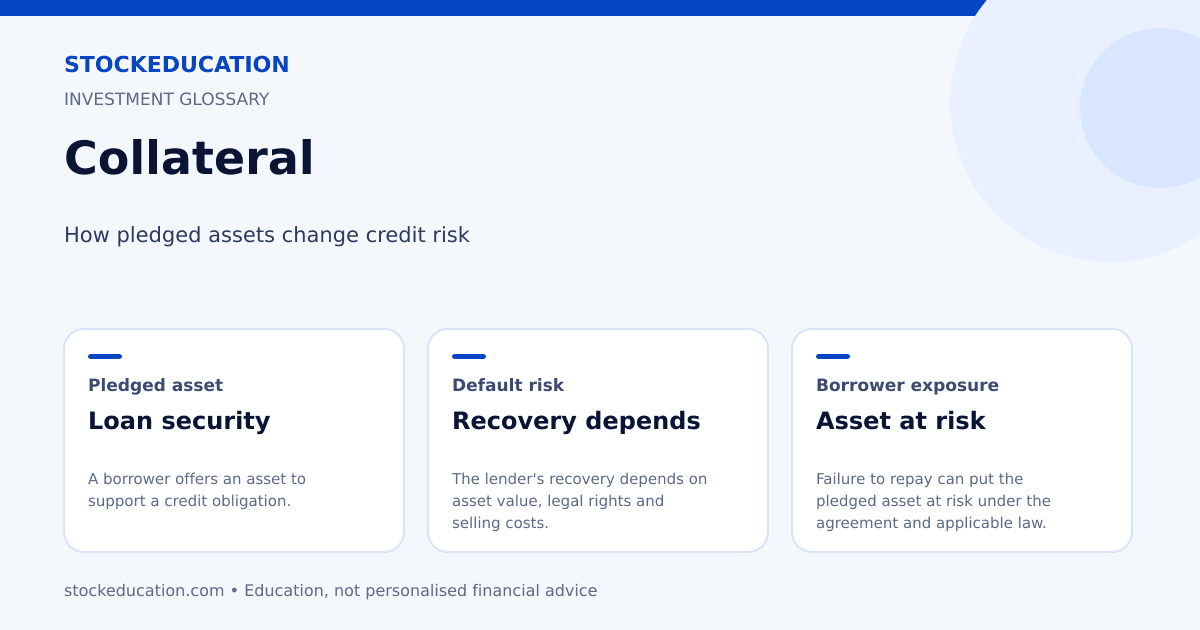
Collateral is an asset pledged to support a loan or other credit obligation. If the borrower defaults, the lender may have rights under the agreement and applicable law to take or sell the pledged asset to recover amounts owed. Common examples include a home, vehicle, business asset or securities account, but the asset’s value does not eliminate repayment, interest-rate, liquidity or legal risks. For an investor or analyst, collateral is part of credit-risk analysis rather than a guarantee of repayment. A secured loan may expose the borrower to losing the pledged asset, while the lender still faces valuation changes, enforcement costs and the possibility that proceeds will not cover the debt. Compare the structure with an balance sheet and review how collateral affects leverage, liquidity and downside risk. For securities-backed borrowing, FINRA's margin-account explanation shows how securities can serve as collateral while interest and repayment obligations remain.

Key takeaways
- Collateral is an asset pledged to support a loan or other credit obligation.
- A secured loan can reduce a lender’s loss exposure, but it does not guarantee full repayment.
- Borrowers may risk losing the pledged asset after default under the agreement and applicable law.
- Collateral analysis should consider value, volatility, liquidity, enforcement costs and debt size.
- Securities can serve as collateral while interest and repayment obligations remain.
What is Collateral?
How Collateral works
| Step | What happens |
|---|---|
| 01 · Identify the pledged asset and obligation | Confirm what property supports the debt, who owns it and which principal, interest, fees and other amounts are secured. |
| 02 · Read the governing documents | Check security interests, perfection, maintenance duties, valuation rules, margin triggers, cure periods, default remedies and cross-default terms. |
| 03 · Estimate realistic recovery value | Start with a defensible current value, then adjust for volatility, liquidity, priority claims, selling costs, legal costs and enforcement time. |
| 04 · Stress-test coverage | Model asset-price declines, delayed sales, additional interest and unexpected costs to see whether recovery could fall below the obligation. |
| 05 · Assess borrower exposure | Determine whether default could lead to asset loss, forced selling, tax or transaction costs and a continuing deficiency. |
| 06 · Compare with broader credit risk | Relate collateral to cash flow, leverage, refinancing needs, secured-debt ranking and the borrower’s ability to service the obligation. |
The formula
Collateral coverage ratio = Realistic recovery value of pledged assets ÷ Outstanding secured obligations
Realistic recovery value = an estimate after applying appropriate value adjustments for market conditions, liquidity, priority claims and selling or enforcement costs. Outstanding secured obligations = principal, accrued interest, fees and other amounts that rank against the pledged collateral under the agreement. A ratio above 1 indicates estimated collateral value exceeds the measured obligation, but it does not guarantee recovery or account for every legal and operational risk. The ratio should be stress-tested for asset-price declines, delayed enforcement and additional costs; it is an analytical measure, not a universal contractual threshold.
A worked example
Hypothetical example: A borrower pledges securities currently worth $150,000 against a secured obligation with $100,000 of principal and $2,000 of accrued interest. If estimated selling and enforcement costs are $8,000, realistic recovery value is $142,000 ($150,000 − $8,000), while the measured obligation is $102,000 ($100,000 + $2,000). The collateral coverage ratio is 1.39, or $142,000 ÷ $102,000. This suggests a $40,000 estimated cushion before considering further price declines, fees, taxes, priority claims or delays. If the securities fall 30%, their market value becomes $105,000; after the same $8,000 cost estimate, recovery value is $97,000, below the $102,000 obligation. The borrower could therefore face a deficiency of about $5,000, subject to the agreement and applicable law. This is only a hypothetical illustration: actual margin requirements, interest accrual, liquidation prices, legal remedies and eligible collateral rules vary. A quoted market value is not a guaranteed liquidation value, and a coverage ratio does not eliminate repayment, volatility or forced-sale risk.
Why it matters
Collateral matters because it affects the distribution of loss between borrower and lender when a credit obligation becomes stressed or defaults. It can improve a lender’s recovery prospects, but recovery depends on realistic value, liquidity, legal priority, enforcement time and selling costs. For borrowers and investors, pledging an asset can create a serious downside: the asset may be sold, and a remaining deficiency may still be owed. Collateral analysis therefore belongs alongside leverage, cash flow, interest expense, market volatility and the terms governing default rather than being treated as a simple safety label.
How collateral supports a secured loan
A secured loan links a credit obligation to an identified asset. The borrower receives funding and agrees that the lender has specified rights over the pledged property if contractual conditions are breached. Those rights can include taking possession, arranging a sale or applying proceeds to the debt, subject to the agreement and applicable law. The security interest may improve the lender’s expected recovery compared with an otherwise similar unsecured claim, but it does not turn the loan into a risk-free arrangement. Interest, principal, fees and covenant obligations still apply. The borrower remains responsible for understanding what is pledged, which events trigger enforcement and whether any deficiency remains after the asset is sold.
Asset value is not the same as recovery value
An asset’s quoted, appraised or estimated market value is only one input into collateral protection. Recovery value can be lower because the asset may need to be sold quickly, may be difficult to transport or transfer, or may incur brokerage, legal, storage, maintenance and foreclosure costs. A lender also needs to consider senior claims, documentation quality, ownership disputes and the time required to enforce rights. For an investor, the relevant question is not simply whether collateral exists, but how much cash it could realistically generate when needed and how that amount compares with outstanding debt. Conservative analysis separates current value from liquidation value and tests whether both could decline before default is resolved.
Borrower exposure and default consequences
Collateral shifts part of the downside from the lender to the borrower, because failure to perform can place the pledged asset at risk. A borrower may lose a home, vehicle, business asset or securities position even when the original borrowing helped fund an investment or operating need. Selling the asset may also create tax, transaction or opportunity costs, and it may not extinguish the full balance if proceeds are inadequate. The exact consequences depend on the loan documents, security arrangements, priority of claims and applicable law. Reviewing payment terms, maintenance requirements, margin provisions, cure periods and cross-default language helps clarify when an asset can become exposed.
Collateral and securities-backed borrowing
Investment securities can support borrowing through a margin or other securities-backed arrangement. Their value may change rapidly, and a decline can reduce the lender’s cushion without any change in the borrower’s stated balance. The agreement may require additional collateral, repayment or a sale of securities when coverage falls below specified requirements. Such a sale can occur during unfavorable market conditions and can lock in losses or disrupt a long-term investment plan. Interest continues to accrue, so an investor should compare the cost of borrowing with the uncertain return on the financed position. Securities collateral therefore introduces market, liquidity and forced-sale risks alongside ordinary credit risk.
Measuring collateral coverage and leverage
Analysts often compare pledged-asset value with the amount owed to assess coverage. A higher coverage ratio may provide a larger buffer, while a lower ratio indicates greater sensitivity to asset-price declines, costs and repayment delays. The ratio must be interpreted with the asset’s liquidity, volatility, legal priority and valuation method. Debt can also increase economic leverage: a borrower retains exposure to the asset while owing a fixed or variable amount that must be serviced. At the company level, analysts should connect collateral to the balance sheet, secured-debt ranking, cash flow and refinancing needs rather than treating the asset as an isolated protection. No ratio substitutes for reading the governing documents.
Evaluating collateral in credit analysis
A disciplined review identifies the asset, confirms who owns it, checks how the lender’s claim is perfected and ranks competing claims. It then estimates a realistic stressed value, deducts selling and enforcement costs, and compares the result with principal, interest and other obligations. The review should include triggers, monitoring duties, insurance, maintenance, substitution rights, valuation frequency and remedies after default. For public companies, collateral analysis can illuminate recovery prospects and creditor priority; for individual investors, it can reveal the consequences of margin borrowing or pledged portfolios. The strongest conclusion states both what collateral may protect and what risks remain uncovered.
Comparison
| Feature | Secured loan | Unsecured loan |
|---|---|---|
| Specific pledged asset | Usually present and identified in the agreement | Generally no specific pledged asset |
| Lender recovery position | May include rights against collateral after default, subject to law and contract | Relies primarily on the borrower’s general repayment obligation and available assets |
| Borrower downside | Pledged property may be taken or sold, and a deficiency may remain | No specifically pledged asset is ordinarily exposed, but default can still cause collection, legal and credit consequences |
| Key analytical risks | Asset value, liquidity, priority, enforcement costs and coverage | Borrower cash flow, total assets, seniority and expected recovery without dedicated collateral |
Check yourself
A borrower owes $102,000 including principal and accrued interest. After estimated selling costs, pledged assets have a realistic recovery value of $97,000. What does this illustrate?
Realistic recovery value is $97,000 compared with a $102,000 obligation, leaving an estimated $5,000 shortfall before considering additional costs or legal details. Collateral can support recovery without guaranteeing that proceeds cover the debt.
Show the answer
2. The estimated coverage is below the obligation, so a deficiency may remain
Things people get wrong
Mistake 01 Treating collateral as a guarantee
Collateral may improve recovery prospects, but declining values, enforcement costs, priority claims and a remaining deficiency can still create losses.
Mistake 02 Using market value without a stress case
A current quote or appraisal may not equal the cash realized in a rapid or legally contested sale; test lower values and added costs.
Mistake 03 Ignoring the loan documents
Review interest, maintenance requirements, margin triggers, cure periods, default remedies, insurance duties and cross-default provisions rather than relying on the asset label.
Mistake 04 Assuming the borrower’s obligation ends at sale
Sale proceeds may be insufficient to cover principal, interest and fees, depending on the agreement and applicable law.
Mistake 05 Overlooking liquidity and concentration
A highly volatile, thinly traded or concentrated asset may provide less practical protection than its headline value suggests.
Questions people ask about Collateral
What is collateral?
Collateral is an asset pledged to support a loan or other credit obligation and may be subject to lender recovery rights after default under the agreement and applicable law.
What is the difference between secured and unsecured debt?
Secured debt is linked to pledged assets that may support recovery, while unsecured debt generally lacks a specific pledged asset; neither structure eliminates repayment risk.
Can collateral be worth less than the loan?
Yes. Asset prices can fall, and selling, legal, brokerage or other costs can reduce proceeds below the outstanding principal, interest and fees.
Can securities be used as collateral?
Yes. Investment securities may support margin or other securities-backed borrowing, but price declines can trigger additional collateral demands, repayment or forced sales.
Does pledging collateral eliminate the borrower’s debt?
No. A sale may reduce the balance, but a deficiency may remain depending on the contract and applicable law.
What should an investor examine?
Examine realistic and stressed value, liquidity, volatility, legal priority, coverage, interest expense, default triggers, enforcement costs and the borrower’s cash flow.
Is a collateral coverage ratio a guarantee?
No. It is an analytical comparison of estimated recovery value with obligations, not a promise of recovery or a universal contractual threshold.
The bottom line
Collateral can improve a lender’s recovery position, but it is not a guarantee of repayment. The useful analysis compares stressed, realistically recoverable value with the full secured obligation and considers liquidity, volatility, legal priority, enforcement costs and timing. Borrowers should understand that default may put the pledged asset at risk and may not erase any deficiency. Investors should treat collateral as one part of credit, leverage and downside analysis.
Sources
About this page. Written by Associate Professor Charles Lo, CPA, PhD and edited by Felix La Spina. No ads and no paywall. Editorial standards · How we fact check · Corrections log · Report an error
Educational information only. Nothing on this page is personal financial, tax or legal advice. Investing involves risk, including the possible loss of principal.


