
Investment Glossary · Quick read · No ads
Financing Activities
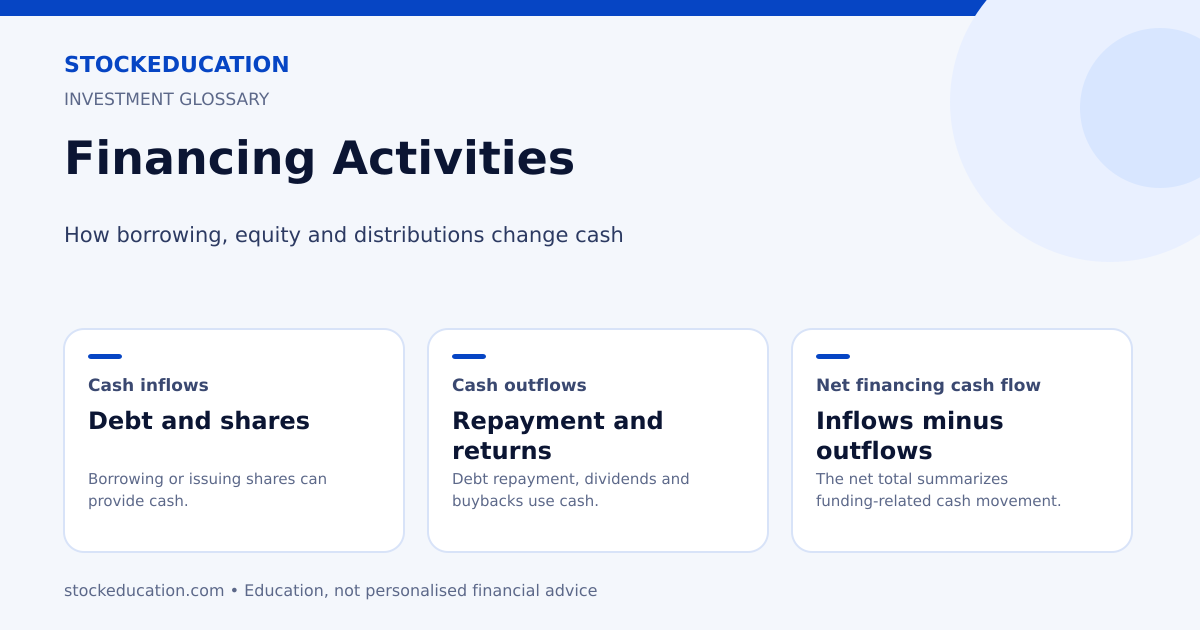
Financing activities are cash inflows and outflows related to raising money from lenders and owners, repaying financing, issuing or repurchasing shares, and distributing dividends.

Key takeaways
- Financing activities show how a company raises and returns capital during a reporting period.
- Debt proceeds and share issuance generally create financing cash inflows.
- Debt repayments, share repurchases and dividends generally create financing cash outflows.
- A positive financing cash flow can reflect new borrowing rather than stronger business operations.
- Interpret financing cash flow with operating cash flow, investing cash flow, debt and equity balances, and the notes to the financial statements.
What is Financing Activities?
Financing activities are cash inflows and outflows connected with how a company raises capital from lenders and owners, and how it returns capital to them. On the cash flow statement, borrowing and issuing shares generally provide cash, while repaying debt, repurchasing shares and paying dividends generally use cash. The section explains how financing decisions changed cash during a reporting period, not whether the financing was economically beneficial by itself.
Read financing activities alongside operating cash flow, investing cash flow, debt balances and shareholders’ equity. A positive financing cash flow may result from new borrowing or an equity issue, while a negative amount may reflect debt repayment, share repurchases or dividends. Use the cash flow statement to review the full reconciliation and compare the financing section with operating cash flow before drawing conclusions.
How Financing Activities works
| Step | What happens |
|---|---|
| 01 · Identify the period and units | Confirm the company, reporting dates, currency and whether the statement includes restricted cash or other separately presented items. |
| 02 · List financing line items | Separate debt issuance, debt repayment, equity issuance, dividends, repurchases and other material financing movements. |
| 03 · Calculate the net amount | Add financing inflows and subtract financing outflows using the signs and units shown in the filing. |
| 04 · Reconcile related balances | Compare the cash flow lines with changes in debt, treasury stock, shares outstanding and retained earnings where relevant. |
| 05 · Read the notes | Check maturity dates, interest rates, covenants, issuance costs, noncash transactions and management’s explanation before forming a conclusion. |
| 06 · Compare with operations | Review operating cash flow and investing cash flow so financing is not mistaken for business-generated cash. |
The formula
Net cash from financing activities = financing cash inflows − financing cash outflows
Financing cash inflows can include debt issuance and share issuance. Financing cash outflows can include debt repayment, dividends, share repurchases and certain financing costs.
A worked example
Illustrative example only: suppose a company receives $80 million from issuing debt and $20 million from issuing shares. It repays $35 million of debt, pays $10 million in dividends and repurchases $15 million of shares. Net cash from financing activities is calculated as $80 million + $20 million − $35 million − $10 million − $15 million = $40 million. This is a hypothetical teaching example, not a real market quote or company forecast. The $40 million means financing inflows exceeded financing outflows; it does not mean the company produced $40 million from its operations or that the financing was beneficial.
Why it matters
Financing activities help investors understand how a company funds its operations and investments, how much capital it returns to owners, and whether changes in debt or share count may affect liquidity, financial risk and valuation.
What financing activities mean
Financing activities form one of the three principal sections of a statement of cash flows. They focus on cash movements associated with the company’s funding sources, especially creditors and shareholders. The section is separate from operating activities, which relate to the company’s main business, and investing activities, which commonly relate to long-lived assets and investments. A financing cash flow is therefore a classification of cash movement, not a standalone measure of financial strength. The company’s accounting policies and the facts of a transaction determine the presentation, so investors should read the statement and related notes rather than infer a conclusion from the total alone.
Common financing cash inflows
A company may report cash inflows when it borrows under a loan or issues bonds, notes or other debt instruments. It may also receive cash when it issues common or preferred shares, including proceeds from certain employee share plans or option exercises. These inflows can increase liquidity, fund capital expenditure, refinance maturities or support an acquisition. They also create obligations or dilution. New debt normally requires future principal and interest payments, while new shares can reduce existing owners’ proportional interest. The cash inflow should therefore be compared with the purpose, cost, maturity and terms of the financing.
Common financing cash outflows
Financing cash outflows commonly include repayments of loan principal, payments on finance lease obligations where presented in financing, share repurchases and dividends. Debt repayment can reduce future interest burden and refinancing risk, but it also uses cash that could have funded operations or investment. Repurchases reduce shares outstanding when executed, while dividends distribute cash to shareholders. A company can have a large negative financing total because it is returning capital, reducing debt, or both. The reason matters, so examine individual line items and reconcile them with changes in debt and equity accounts.
How to read the financing section
Start with the reporting period, currency and units, then list each material financing line rather than relying only on the net total. Identify whether the largest movement came from borrowing, repayment, equity issuance, repurchases, dividends or another item. Next, compare the cash flow statement with the balance sheet and notes. A debt issuance should usually be considered alongside the change in debt balances and any noncash conversion, discount or issuance costs. A share repurchase should be considered alongside treasury stock, shares outstanding and the company’s stated capital-allocation policy.
Positive and negative financing cash flow
A positive net financing cash flow means the listed financing inflows exceeded financing outflows for the period. It may indicate that the company raised debt or equity, but it does not prove that the company generated cash from operations. A negative net financing cash flow means financing outflows exceeded inflows. That can reflect debt reduction, dividends or buybacks, and may be consistent with a mature company returning capital. It can also create liquidity pressure if the company is using scarce cash to meet obligations. The direction is a starting point for analysis, not a final verdict.
Financing activities and valuation
Financing activities can affect valuation indirectly by changing financial risk, interest costs, share count and the cash available to owners. New borrowing may increase financial leverage and alter the cost of capital, while repayment may reduce leverage. Equity issuance can provide funding but dilute existing shareholders. Dividends and repurchases return cash but may reduce funds available for expansion. When using a valuation method, keep financing cash flow distinct from operating performance and avoid adding debt proceeds to an estimate of recurring free cash flow.
Limits of the classification
Not every economically important financing event appears as an immediate cash flow. A noncash debt conversion, a lease entered without an immediate cash payment, or an equity transaction settled without cash may require separate disclosure rather than inclusion in the net cash total. Classification can also depend on accounting rules and the transaction’s facts. For that reason, read supplemental disclosures and notes, check whether restricted cash or exchange-rate effects are separately shown, and avoid comparing companies without checking whether their presentations are comparable.
Comparison
| Category | Typical cash direction | What it can indicate |
|---|---|---|
| Debt issuance | Inflow | New borrowing, refinancing or funding for operations and investment |
| Debt repayment | Outflow | Reduced principal balance and potentially lower future financing risk |
| Share issuance | Inflow | New equity funding, potentially with dilution |
| Dividends or share repurchases | Outflow | Cash returned to owners and potentially lower retained liquidity |
Check yourself
A company receives $50 million from new debt, repays $20 million of debt, pays $10 million in dividends and repurchases $5 million of shares. What is its illustrative net cash from financing activities?
The calculation is $50 million − $20 million − $10 million − $5 million = $15 million net cash provided by financing activities. This hypothetical calculation does not measure operating cash flow or profitability.
Show the answer
$15 million inflow
Things people get wrong
Mistake 01 Treating positive financing cash flow as operating strength
New borrowing or share issuance can make financing cash flow positive without improving the underlying business.
Mistake 02 Ignoring the individual line items
The net total can hide whether cash came from debt, equity, or another source and why cash was used.
Mistake 03 Confusing debt proceeds with income
Borrowed cash is a financing inflow but creates repayment obligations and is not revenue or profit.
Mistake 04 Assuming every negative financing total is bad
Debt repayment, dividends and repurchases can produce negative financing cash flow for different reasons.
Mistake 05 Overlooking noncash financing disclosures
Debt conversions, lease arrangements and other transactions may affect financing without appearing as ordinary cash inflows or outflows.
Questions people ask about Financing Activities
What are financing activities on a cash flow statement?
Financing activities are cash transactions involving a company’s lenders and owners, such as borrowing, debt repayment, share issuance, repurchases and dividends.
What creates a financing cash inflow?
Common inflows include proceeds from issuing debt and shares, although the exact presentation depends on the transaction and applicable accounting rules.
What creates a financing cash outflow?
Common outflows include debt principal repayment, share repurchases, dividends and some financing-related costs.
Is positive cash flow from financing good?
Not automatically. It may reflect useful funding, but it may also signal increased leverage or dilution. Review the purpose and terms of the financing.
Is negative cash flow from financing bad?
Not automatically. It may reflect debt reduction or shareholder distributions, but it can also reduce liquidity. Read the separate line items and compare them with operating cash flow.
Are financing activities the same as free cash flow?
No. Financing activities describe funding-related cash movements, while free cash flow is a separate analytical measure commonly based on operating cash flow less capital expenditure.
Where can I find financing activities?
Look in the cash flow statement in a company’s Form 10-K or Form 10-Q, then read the related debt, equity and dividend disclosures in the notes.
The bottom line
Financing activities explain how cash moved because of borrowing, equity transactions and distributions to owners. Use the detailed line items, not just the net total, and compare them with operating cash flow, investing cash flow, debt, equity and the notes. Financing cash flow is useful context for liquidity and capital allocation, but it is not a measure of operating profitability or investment quality by itself.
Sources
About this page. Written by Associate Professor Charles Lo, CPA, PhD and edited by Felix La Spina. No ads and no paywall. Editorial standards · How we fact check · Corrections log · Report an error
Educational information only. Nothing on this page is personal financial, tax or legal advice. Investing involves risk, including the possible loss of principal.


