
Investment Glossary · Quick read · No ads
Intrinsic Value
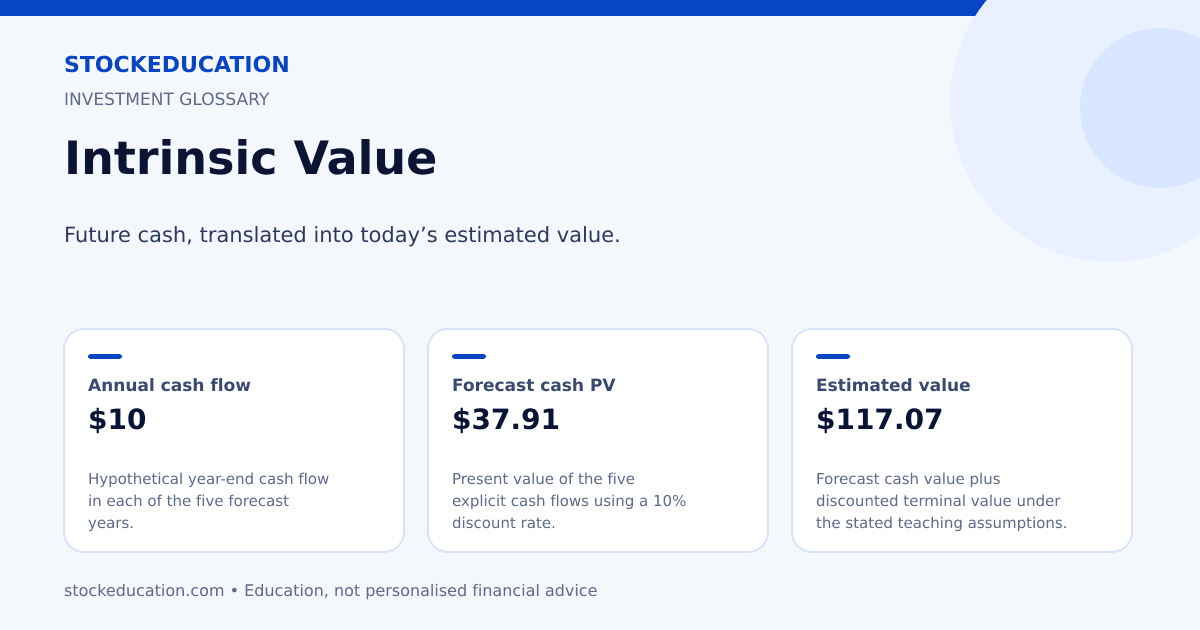
Intrinsic value is an estimate of the economic worth of a business or asset based on the future cash it may provide and the risk and timing of receiving that cash. It is not directly observable or guaranteed. If a hypothetical business is expected to produce five annual cash flows of $10, followed by cash growing at 2% indefinitely, discounting at 10% produces an estimated value of about $117.07.

Key takeaways
- Intrinsic value is an estimate of economic worth, while market price is an observable trading price.
- A discounted cash flow model converts expected future cash flows into present value.
- Growth, cash flow, discount rate and terminal value assumptions can materially change the result.
- Use scenarios or a range instead of treating one precise estimate as a fact.
- A price below estimated intrinsic value may warrant further research, but it does not guarantee a gain.
What is Intrinsic Value?
Intrinsic value is an estimate of what a business is worth based on the cash it may generate for owners, the timing and uncertainty of that cash, and the return an investor requires. Unlike market price, intrinsic value cannot be observed directly. It depends on forecasts that reasonable analysts may interpret differently.
This guide explains those judgments with a hypothetical calculation. Continue with the intrinsic value lesson, then use the Stock Screener to create a research shortlist. A screen supplies candidates and reported data, not proof that a stock is undervalued.
How Intrinsic Value works
| Step | What happens |
|---|---|
| 01 · Define the valuation claim | Decide whether the model estimates enterprise value, equity value or value per share. |
| 02 · Collect primary evidence | Read current financial statements, notes and later filings for cash flow, obligations, reinvestment and risks. |
| 03 · Build explicit forecasts | Estimate a reasonable period of cash flows and state the operational assumptions behind them. |
| 04 · Select a matching discount rate | Use a required return consistent with the cash flow definition and its risk. |
| 05 · Estimate terminal value | Apply a defensible continuing-growth or exit approach and keep terminal assumptions visible. |
| 06 · Discount and reconcile | Bring forecast cash flows and terminal value to the valuation date, then bridge consistently to equity and per-share value if needed. |
| 07 · Test scenarios | Vary the most important cash flow, growth and discount-rate assumptions rather than relying on one case. |
| 08 · Compare and update | Compare the range with a dated market price and revise the work when material evidence changes. |
The formula
Intrinsic value = Σ[CFₜ ÷ (1 + r)ᵗ] + [TVₙ ÷ (1 + r)ⁿ]
CFₜ = expected cash flow in forecast period t r = discount rate consistent with the cash flow and its risk t = number of periods until a forecast cash flow is received TVₙ = terminal value at the end of forecast period n n = final period in the explicit forecast
A worked example
Consider a hypothetical business, not a real company or market quote. Assume it can distribute $10 at the end of each of the next five years. After year five, assume cash flow grows at 2% indefinitely. Use a 10% discount rate.
The present value of the five explicit cash flows is $10 ÷ 1.10 + $10 ÷ 1.10² + $10 ÷ 1.10³ + $10 ÷ 1.10⁴ + $10 ÷ 1.10⁵ = $37.91.
Year-six cash flow is $10 × 1.02 = $10.20. Terminal value at the end of year five is $10.20 ÷ (0.10 − 0.02) = $127.50. Discounting that amount for five years gives $127.50 ÷ 1.10⁵ = $79.16. Estimated intrinsic value is therefore $37.91 + $79.16 = $117.07, subject to rounding.
If the discount rate were 12% with all other assumptions unchanged, the estimate would fall materially. That sensitivity is the lesson: $117.07 is the output of stated teaching assumptions, not an observed fact, prediction or recommendation. The SEC-hosted FTI report provides a real historical example of an income approach that projected debt-free cash flow, discounted forecast periods and terminal value, and applied different discount rates to business segments. It is a filing exhibit, not an SEC endorsement of the report or its conclusions.
Why it matters
Intrinsic value gives investors a disciplined way to separate the economics of a business from its current quotation. The exercise forces assumptions about cash generation, reinvestment, growth and risk into view. It can help compare opportunities and test whether a conclusion survives less favorable scenarios. It cannot remove uncertainty, identify a guaranteed bargain or establish suitability for an individual investor.
Intrinsic value versus market price
Market price is the amount buyers and sellers agree on at a particular moment. Intrinsic value is an estimate produced from evidence and assumptions about a business’s future economics. News, liquidity, expectations and investor sentiment can move price without producing an equal change in a careful value estimate. Conversely, new evidence about competition, cash generation, debt or reinvestment needs can change estimated value even before the market reacts. Comparing the two can frame further research, but neither a model nor a price gap guarantees a particular return.
Cash flow is the economic foundation
A cash flow valuation asks how much cash the business can ultimately make available to its capital providers or equity owners. The cash flow definition must match the discount rate and the type of value being estimated. Enterprise cash flow is generally discounted at a rate reflecting both debt and equity financing, while equity cash flow requires an equity return. Analysts also examine taxes, capital expenditure, working capital, acquisitions, financing and dilution. Accounting earnings can inform a forecast, but they are not automatically cash available to owners.
Why the discount rate matters
A dollar expected later is worth less than a dollar available today, and uncertain business cash flows require compensation for risk. The discount rate expresses those ideas in the model. Raising the rate reduces present value because every forecast cash flow is divided by a larger compounding factor. The required rate should be consistent with the risk and cash flow being valued; it should not be chosen merely to produce a preferred answer. Testing several reasonable rates makes the model’s sensitivity visible and discourages false precision.
Forecasts and terminal value
Most models forecast individual years and then estimate a terminal value for the period beyond the explicit forecast. Terminal value can form a large portion of the result, so a small change in perpetual growth or the discount rate may have an outsized effect. In a constant-growth model, the discount rate must exceed the perpetual growth rate. Long-term growth also needs an economic rationale: a business cannot indefinitely outgrow the economy without eventually becoming implausibly large. Analysts should disclose the forecast horizon and terminal assumptions separately.
From enterprise value to equity value
A model using cash flow available to debt and equity providers normally produces enterprise value. To estimate value attributable to common shareholders, an analyst then makes consistent adjustments for items such as debt, excess cash and other nonoperating assets or claims. The exact bridge depends on the company and the cash flow definition. Dividing the resulting equity value by diluted shares can produce an estimated value per share. Mixing an enterprise cash flow with an equity discount rate, or subtracting debt twice, creates an internally inconsistent result.
Uncertainty and scenario analysis
Intrinsic value is better treated as a range than as an exact destination for the share price. A base case can sit beside cautious and optimistic cases using different cash flow, margin, reinvestment, growth and discount rate assumptions. The purpose is not to disguise uncertainty with more calculations; it is to identify which assumptions drive the conclusion. An estimate should be revised when filings, business conditions, capital structure or interest rates change. A model dated today can become stale as soon as its important inputs change.
Comparison
| Measure | What it represents | Main input | Key limitation |
|---|---|---|---|
| Intrinsic value | Estimated present economic worth | Forecast cash flows and required return | Model dependent and unobservable |
| Market price | Current trading price | Supply and demand in the market | Can move sharply and does not prove economic worth |
| Book value | Accounting net assets | Recorded assets minus liabilities | May omit or understate valuable future economics and intangibles |
| Enterprise value | Market-based value of core operations | Equity value, debt, cash and related adjustments | A market measure, not automatically an intrinsic valuation |
Check yourself
Holding all other assumptions constant, what usually happens to a discounted cash flow estimate when the discount rate increases?
The estimate decreases because each expected future cash flow is divided by a larger discounting factor. The size of the change depends on the timing and duration of the cash flows.
Show the answer
The estimate decreases
Things people get wrong
Mistake 01 Treating the output as a fact
A model may display cents of precision even though its cash flow, growth and risk inputs are uncertain. Present a range and disclose assumptions.
Mistake 02 Mixing enterprise and equity inputs
Match the cash flow definition to the discount rate and make the debt, cash and share-count bridge consistently.
Mistake 03 Using an aggressive perpetual growth rate
The discount rate must exceed perpetual growth, and long-term growth should be economically sustainable.
Mistake 04 Ignoring reinvestment
Growth usually requires working capital, capital expenditure or acquisitions. Forecasting growth without its cash cost can overstate value.
Mistake 05 Anchoring to the current price
Choosing assumptions because they recreate today’s price reverses the purpose of independent valuation.
Mistake 06 Using stale information
Revisit the estimate when filings, financing, competitive conditions, interest rates or the investment thesis change.
Questions people ask about Intrinsic Value
Is intrinsic value the same as market price?
No. Market price is observable at a particular time; intrinsic value is an estimate based on forecasts and required returns.
Can intrinsic value be calculated exactly?
No. A calculation can be mathematically exact for its inputs, but the future cash flows and appropriate discount rate remain uncertain.
What happens when the discount rate rises?
Holding other assumptions constant, the present value of future cash flows falls.
Why is terminal value important?
It represents cash flows after the explicit forecast and can account for a large part of a going concern valuation.
Does a stock trading below estimated intrinsic value guarantee a profit?
No. The estimate may be wrong, the business may deteriorate, or the market may continue to price the shares differently.
Is book value the same as intrinsic value?
No. Book value is an accounting measure based largely on recorded assets and liabilities, while intrinsic value is forward looking and based on expected economics.
How often should an estimate be updated?
Update it when material new information changes cash flow, risk, financing, share count or long-term assumptions.
The bottom line
Intrinsic value is a reasoned estimate, not a hidden price waiting to be discovered. Build it from a clearly defined cash flow, a matching discount rate and defensible forecast and terminal assumptions. Compare scenarios, identify the inputs that matter most and revise the estimate as evidence changes. A gap between price and estimated value is a starting point for research, never a promise of profit.
Sources
About this page. Written by Associate Professor Charles Lo, CPA, PhD and edited by Felix La Spina. No ads and no paywall. Editorial standards · How we fact check · Corrections log · Report an error
Educational information only. Nothing on this page is personal financial, tax or legal advice. Investing involves risk, including the possible loss of principal.


