
Investment Glossary · Quick read · No ads
Shareholders
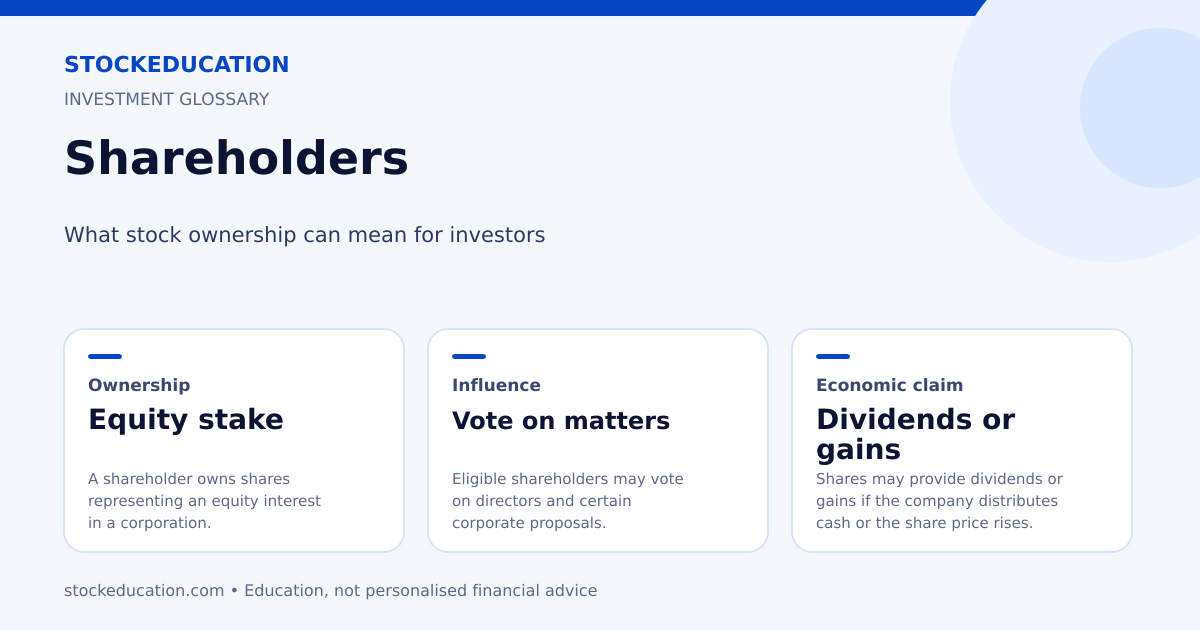
A shareholder is a person or organization that owns shares in a corporation. Ownership may create an economic claim and, depending on the share class and applicable rules, voting rights and eligibility for dividends, but it does not guarantee a profit or repayment of invested capital.

Key takeaways
- Shareholders own shares that represent an equity interest in a corporation.
- Common shares commonly carry voting rights, while preferred shares may have different voting, dividend, or liquidation terms.
- A shareholder’s return can come from distributions, price appreciation, or both, and either source is uncertain.
- Share ownership does not make the shareholder a creditor, so shareholders generally rank behind creditors if the company is liquidated.
- Proxy materials and company reports help shareholders evaluate proposals, performance, risks, and capital allocation.
What is Shareholders?
A shareholder is a person, company, or other entity that owns shares in a corporation. Ownership can provide an economic claim on the company and, depending on the share class, rights such as voting on directors or other corporate matters. A shareholder’s outcome depends on the shares owned, the company’s performance, distributions, and the rights attached to that class of stock.
To understand what ownership means in practice, review the company’s financial statements and annual report. These documents help investors assess profitability, financial position, risks, capital allocation, and disclosures before deciding whether to buy, hold, or sell shares.
How Shareholders works
| Step | What happens |
|---|---|
| 01 · Identify the ownership interest | Confirm the corporation, number of shares, ticker or security identifier, account registration, and whether the holding is direct, through a fund, or through another entity. |
| 02 · Read the class rights | Review voting rights, dividend preferences, conversion features, redemption provisions, liquidation priority, restrictions, and other terms in the relevant corporate and offering documents. |
| 03 · Review company disclosures | Use financial statements and the annual report to examine profitability, cash flows, assets, liabilities, risks, governance, capital allocation, share issuance, and repurchases. |
| 04 · Examine voting materials | Check the record date, meeting notice, proxy materials, proposals, director information, voting standards, quorum rules, and available methods for submitting a vote. |
| 05 · Assess possible returns and losses | Consider distributions, price appreciation, costs, taxes, dilution, volatility, liquidity, concentration, and the possibility of losing some or all invested capital. |
| 06 · Match the holding to the investor | Compare the security’s rights and risks with the investor’s objectives, time horizon, diversification, liquidity needs, and ability to tolerate loss. |
| 07 · Monitor changes | Revisit reports, distributions, share counts, corporate actions, voting matters, and changes in financial condition rather than relying only on the original purchase decision. |
The formula
Potential shareholder return = change in share value + distributions received − costs and taxes
Potential shareholder return: the uncertain result over the selected measurement period. Change in share value: ending market value per share minus starting market value per share, adjusted for the number of shares held. Distributions received: dividends or other declared payments received by the shareholder during the period. Costs and taxes: commissions, fund or account charges, and applicable taxes that reduce the investor’s net result. This is an analytical identity, not a forecast or guarantee; it does not capture every corporate action or personal tax circumstance automatically.
A worked example
Hypothetical worked example: Assume an investor buys 100 common shares at $20 each, for an initial investment of $2,000. During the holding period, the company declares two dividends of $0.30 per share, so distributions total 100 × ($0.30 + $0.30) = $60. If the investor later sells the shares for $23 each, the ending sale value is 100 × $23 = $2,300 and the change in share value is $300. Before costs and taxes, the potential shareholder return is $300 + $60 = $360, or 18% of the original $2,000.
This example is hypothetical and does not predict an actual result. If the investor paid $15 in commissions and other costs and owed $45 in taxes, the net result would be $360 − $15 − $45 = $300, or 15%. If the shares instead fell to $17, the change in value would be 100 × ($17 − $20) = −$300; adding the $60 distribution would produce a $240 loss before costs and taxes. Dividends can be reduced or omitted, prices can fall, and the calculation may need adjustments for reinvestment, stock splits, additional purchases, dilution, withholding, and the investor’s tax circumstances.
Why it matters
Understanding shareholders matters because the label describes both an economic position and a set of possible legal and governance rights. It helps investors distinguish equity from debt, identify whether a class can vote or receive priority distributions, and recognize that returns are uncertain. It also clarifies why financial statements, annual reports, and proxy materials matter: they provide evidence about performance, risks, ownership changes, proposals, and management decisions. Before buying or holding shares, an investor can compare the rights of the specific class with the price paid, intended holding period, diversification, and ability to tolerate loss. That framework reduces the risk of assuming that every share provides the same control, dividend, priority, or protection.
Ownership and the equity claim
A shareholder’s basic position is an equity interest in a corporation: the holder owns shares, not a promise that the company will repay a fixed amount. The number of shares and the rights attached to them determine the holder’s proportional interest and potential influence, although ownership percentage can change when a company issues additional shares or repurchases existing ones. Equity holders participate in the company’s upside and bear business risk. Their claim is generally residual, meaning creditors and other higher-priority claims are addressed before shareholders receive remaining assets in a liquidation. A share therefore combines a legal ownership interest with an uncertain economic outcome rather than functioning like a deposit or bond.
Common and preferred shares
Share classes can give shareholders materially different rights. Common shares often provide voting rights for directors and certain corporate proposals, along with a residual claim on distributions and assets. Preferred shares may receive stated dividend preferences or priority in liquidation, but may have limited, conditional, or no ordinary voting rights. These are general patterns rather than guarantees: the governing documents and offering terms control. Investors should examine the rights, preferences, conversion provisions, redemption terms, and restrictions attached to a class instead of assuming that every share has the same economic or political power. Two holders of the same corporation can therefore experience different outcomes because they own different classes.
Voting, proxies, and shareholder influence
Voting gives eligible shareholders a way to participate in selected corporate decisions, but ownership does not mean that every matter is put to a vote or that each holder has identical influence. Companies communicate voting matters through proxy materials, meeting notices, and related reports. Proposals may concern directors, compensation, capital structure, transactions, or other matters permitted by the company’s governing rules and applicable law. A shareholder may vote directly, attend where permitted, or authorize another party through a proxy. The practical weight of a vote depends on the number and class of shares held, voting standards, quorum rules, record dates, and whether other holders participate. Reviewing the proposal and its stated risks is more useful than treating voting as automatic control.
Dividends and shareholder returns
A shareholder may receive a dividend only when the company declares or otherwise authorizes a distribution under the terms applicable to that share class. Companies can retain earnings, reduce distributions, suspend them, or use cash for operations, debt reduction, acquisitions, or repurchases. A second potential source of return is an increase in the market price of the shares, but price changes are uncertain and can be negative. Total shareholder experience is therefore shaped by distributions, price movement, fees, taxes, dilution, and timing. Past distributions or a rising price do not establish that future payments or gains will occur. Evaluating the company’s finances and stated capital-allocation policy helps distinguish a possible return from a guaranteed one.
Risks, dilution, and limited liability
Shareholders can lose some or all of the money invested if the value of the shares declines or the corporation fails. Limited liability generally separates the shareholder’s personal assets from the corporation’s obligations, but it does not protect the value of the investment. Dilution can reduce an existing holder’s percentage ownership or voting influence when new shares or share-linked securities are issued, even though the company may use the proceeds productively. Other risks include business failure, leverage, concentration, governance problems, illiquidity, market volatility, and changes in law or taxation. A sound review asks both what the shares may provide and what events could weaken the holder’s economic claim or influence.
Using company disclosures to assess ownership
Shareholders need information to judge whether the ownership interest fits their objectives and risk tolerance. The company’s financial statements can help explain revenue, profitability, cash flows, assets, liabilities, and changes in equity, while the annual report usually provides broader discussion of strategy, risks, management, governance, and significant disclosures. Proxy materials add context for matters submitted to shareholders and the people or policies being considered. No single document predicts the share price or eliminates uncertainty. Investors should connect reported results with capital allocation, share issuance or repurchase activity, class rights, liquidity, and their own time horizon. This process turns the label shareholder into a practical assessment of rights, risks, and potential outcomes.
Comparison
| Feature | Common shares | Preferred shares | Why it matters |
|---|---|---|---|
| Typical voting rights | Often include voting rights | May be limited, conditional, or absent | Voting power depends on the class and governing terms. |
| Dividend position | Usually receives distributions after preferred claims, if declared | May have a stated or priority dividend | Priority does not make a dividend guaranteed. |
| Liquidation position | Generally residual after creditors and preferred claims | May rank ahead of common shares but behind creditors | The order affects what may remain if the corporation is liquidated. |
| Potential return | Price appreciation and declared distributions | Price movement and distributions subject to the class terms | Both can lose value and neither automatically guarantees a profit. |
Check yourself
Which statement best describes a shareholder’s position?
Shares represent an equity interest rather than a loan. Depending on the class and applicable rules, a shareholder may have voting rights or eligibility for declared distributions, but returns and repayment are not guaranteed, and the corporation—not the shareholder directly—owns its individual assets.
Show the answer
A shareholder owns an equity interest and may have rights such as voting or receiving declared distributions, depending on the share class.
Things people get wrong
Mistake 01 Assuming every share has identical rights
Common and preferred shares can differ in voting power, dividend priority, conversion terms, redemption provisions, and liquidation priority. Read the governing terms for the specific class.
Mistake 02 Treating dividends as guaranteed income
A company may retain cash, reduce a dividend, suspend it, or stop paying it. A past distribution does not establish a future payment.
Mistake 03 Confusing ownership with control
Owning shares may provide voting rights, but the practical influence depends on share class, number of shares, voting standards, quorum rules, participation, and the matters submitted for a vote.
Mistake 04 Ignoring dilution
New shares or share-linked securities can reduce an existing holder’s percentage ownership or voting influence. Review issuance activity and the intended use of proceeds.
Mistake 05 Believing limited liability prevents investment losses
Limited liability generally separates personal assets from corporate obligations, but it does not preserve the market value of the shares or guarantee recovery of the purchase price.
Mistake 06 Using price appreciation as a forecast
A historical increase does not prove that the price will rise again. Evaluate financial condition, risks, valuation, time horizon, and ability to tolerate loss.
Questions people ask about Shareholders
What is a shareholder?
A shareholder is a person, company, fund, or other legal entity that owns one or more shares of a corporation. The shares represent an equity interest rather than a loan.
Do shareholders own the company’s assets directly?
Generally, shareholders own shares in the corporation, not the corporation’s individual assets. The corporation owns its property, while shareholders may have rights attached to their shares and a residual claim subject to higher-priority claims.
Do all shareholders have voting rights?
No. Voting rights depend on the share class, corporate documents, applicable law, and the particular matter. Common shares often vote, while preferred shares may have limited, conditional, or no ordinary voting rights.
Are shareholder dividends guaranteed?
No. Dividends generally depend on a declaration or authorization and the terms of the relevant class. A company may retain earnings, reduce distributions, or suspend them.
Can a shareholder lose all invested money?
Yes. Share prices can decline substantially, and a corporation can fail. Shareholders generally rank behind creditors and other higher-priority claims in liquidation.
How do shareholders vote?
Eligible holders may vote directly or authorize another party through a proxy, subject to record dates, meeting procedures, voting standards, and the company’s governing rules. Proxy materials describe matters submitted for consideration.
What documents help evaluate a shareholding?
Financial statements help assess performance, financial position, cash flows, and changes in equity. The annual report provides broader information about strategy, risks, governance, and disclosures, while proxy materials explain voting matters.
What is dilution?
Dilution occurs when a corporation issues additional shares or share-linked securities, potentially reducing an existing shareholder’s percentage ownership, voting influence, or claim on future results.
The bottom line
A shareholder owns an equity interest whose rights and potential returns depend on the corporation, share class, governing documents, applicable rules, and market conditions. Shareholders may vote, receive declared distributions, and benefit from price appreciation, but none of those outcomes is guaranteed. Before investing, compare the specific class rights with the company’s disclosures, risks, valuation, diversification, time horizon, and ability to absorb a loss.
Sources
About this page. Written by Associate Professor Charles Lo, CPA, PhD and edited by Felix La Spina. No ads and no paywall. Editorial standards · How we fact check · Corrections log · Report an error
Educational information only. Nothing on this page is personal financial, tax or legal advice. Investing involves risk, including the possible loss of principal.


