
Investment Glossary · Quick read · No ads
Working Capital
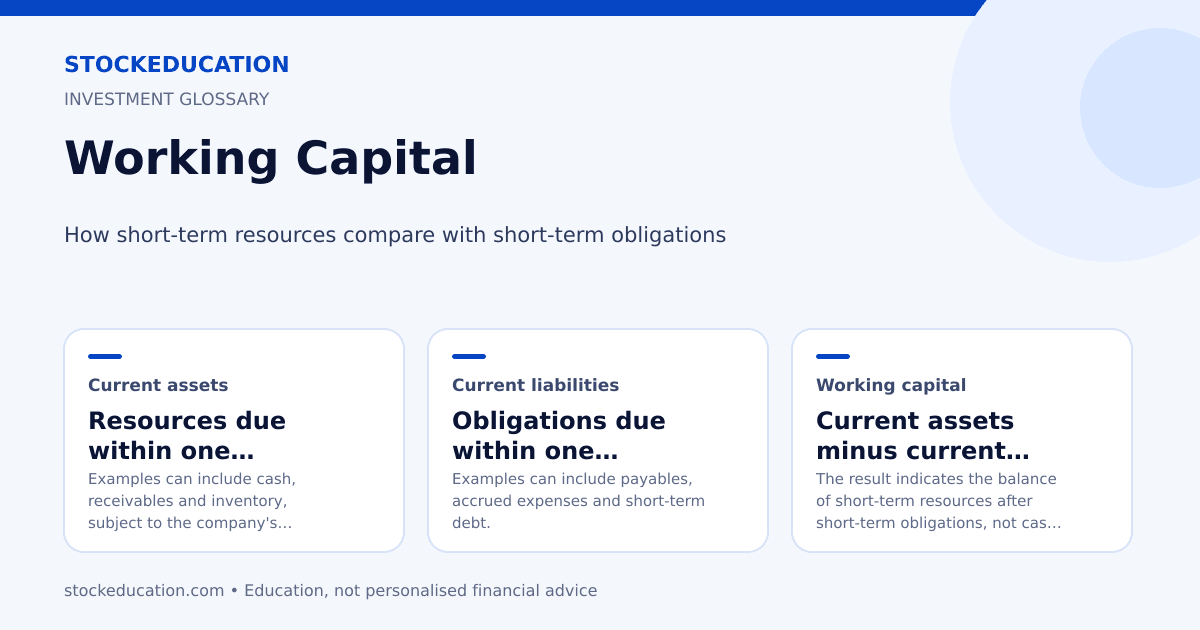
Working capital is the difference between a company’s current assets and current liabilities. It indicates the short-term resources remaining after short-term obligations, but its usefulness depends on the quality, timing and liquidity of the underlying accounts.

Key takeaways
- Working capital equals current assets minus current liabilities.
- A positive balance can support routine operations but does not guarantee financial strength.
- Receivables, inventory, payables and accrued obligations can materially affect interpretation.
- Compare changes across consistent periods and investigate unusual movements.
- Use working capital with cash-flow information rather than treating it as cash on hand.
What is Working Capital?
Working capital shows the short-term resources a business has available after covering its short-term obligations. It is calculated from current assets and current liabilities reported on the balance sheet. A positive amount can support routine operations, but it is not automatically a sign of financial strength: the quality and timing of receivables, inventory, payables and other current items also matter.
Investors can study working capital alongside the cash flow statement and operating cash flow to understand whether reported earnings are converting into cash. Compare consistent periods, read the company's filing disclosures and investigate large changes rather than treating one period's balance as a standalone conclusion.
How Working Capital works
| Step | What happens |
|---|---|
| 01 · 1. Identify the accounts | Locate total current assets and total current liabilities on the balance sheet, noting the company’s operating-cycle and reporting classifications. |
| 02 · 2. Apply the formula | Subtract total current liabilities from total current assets to calculate the absolute working-capital balance. |
| 03 · 3. Inspect the composition | Break the totals into cash, receivables, inventory, payables, accrued obligations and short-term debt where disclosed. |
| 04 · 4. Compare consistent periods | Review several comparable reporting periods and investigate large changes, reversals, seasonality and unusual movements. |
| 05 · 5. Connect to cash flow | Use the cash-flow statement and operating cash flow to assess whether changes in working capital are consuming or providing cash. |
| 06 · 6. Add business context | Consider customer payment terms, supplier financing, inventory turnover, debt maturities and the economics of the company’s business model. |
The formula
Working capital = Current assets − Current liabilities
Current assets: resources expected to be converted, used or realized during the normal operating cycle or within one year, depending on the reporting framework. Current liabilities: obligations expected to be settled during the normal operating cycle or within one year, depending on the reporting framework. Working capital: the resulting absolute balance of short-term resources after short-term obligations; it is not the current ratio or cash balance.
A worked example
Hypothetical example: suppose Company A reports current assets of $480 million and current liabilities of $360 million at year-end. Working capital is calculated as $480 million − $360 million = $120 million. This means reported current assets exceed reported current liabilities by $120 million; it does not mean the company has $120 million in cash. Assume $160 million of the assets are receivables and $190 million are inventory. If customers pay slowly or inventory becomes obsolete, the practical cushion may be less useful than the headline figure suggests. If the following year current assets rise to $540 million while current liabilities rise to $470 million, working capital becomes $70 million, a decline of $50 million despite higher assets. That change could reflect inventory investment, slower collections, lower cash, or increased short-term obligations. The arithmetic is illustrative only: investors should review the company’s classifications, operating cycle, seasonality, disclosures and cash-flow statement before drawing a conclusion. A negative result is not automatically a failure, because some businesses collect customer cash before paying suppliers; a positive result is not automatically safe, because assets may be illiquid or liabilities may mature quickly.
Why it matters
Working capital matters because it links a company’s reported short-term resources to the obligations that support its day-to-day operations. Changes can reveal whether growth is absorbing cash through receivables and inventory or benefiting from supplier and customer timing. It can also expose liquidity pressure that headline earnings do not show. However, the measure is most useful when investors examine its components, compare trends and connect movements with operating cash flow, business-model economics and filing disclosures.
What Working Capital Measures
Working capital measures the net balance between resources expected to support near-term operations and obligations expected to require near-term settlement. Current assets may include cash, trade receivables, inventory and other short-term assets, while current liabilities may include trade payables, accrued expenses and short-term debt. The calculation is simple, but the economic meaning depends on how quickly assets can become cash, how reliably customers pay and when liabilities must be settled. A positive balance can provide flexibility, whereas a negative balance may reflect pressure or a business model that collects cash before paying suppliers. Neither result is automatically good or bad without context.
Current Assets and Current Liabilities
The components of working capital deserve more attention than the headline number. Cash is immediately available, but inventory may require production or sales before conversion, and receivables depend on customer payment behavior. On the liabilities side, accounts payable can represent ordinary supplier financing, while accrued expenses and short-term borrowings may have different timing and refinancing risks. Investors should read the balance-sheet classifications and filing disclosures to understand what is included. A company can report positive working capital while holding slow-moving inventory or overdue receivables, so the composition and expected timing of each item matter.
Interpreting Positive and Negative Balances
A positive working-capital balance means current assets exceed current liabilities under the reported classification; it does not establish that the business is financially strong. The assets may be difficult to realize, or liabilities may mature sooner than expected. Negative working capital can signal a funding need, but some retailers, subscription businesses and other models collect customer cash quickly while paying suppliers or incurring costs later. In those cases, a negative balance may be consistent with efficient operating economics. Interpretation should therefore consider the business model, contractual terms, seasonality and the company’s history rather than relying on a universal threshold.
Changes Over Time and Cash Conversion
The direction and causes of working-capital changes can help explain why accounting earnings differ from cash generation. A build in receivables may indicate sales that have not yet been collected, while an inventory increase may consume cash if goods are not sold promptly. Higher payables can temporarily support cash flow, but may also reflect delayed payments or changing supplier terms. Investors should compare consistent periods and connect balance-sheet movements with the cash flow statement and operating cash flow. One period’s change is not conclusive; recurring patterns, reversals and unusual movements often provide more informative evidence.
Working Capital and Liquidity Analysis
Working capital is related to liquidity, but it is not a complete liquidity test. Liquidity analysis asks whether a company can meet obligations as they fall due, considering cash availability, receivable collectability, inventory turnover, committed credit and liability maturities. Two companies with the same working-capital amount can have very different risk profiles if one holds cash and the other holds slow-moving inventory. The current ratio divides current assets by current liabilities and expresses relative coverage, while working capital expresses an absolute balance. Both measures require industry and company context.
Practical Investor Review
A practical review begins with the balance sheet, then examines the notes and cash-flow statement for explanations. Identify the largest current-asset and current-liability categories, compare them over several consistent reporting periods and ask whether changes match revenue growth, production plans, seasonality or disclosed business events. Check for concentration in receivables, inventory write-down risk, unusual payable movements and short-term debt maturities. Avoid treating a single positive or negative figure as a verdict. The strongest conclusion combines the calculation with operating conditions, disclosure quality and evidence of actual cash conversion.
Comparison
| Measure | Calculation | What it indicates | Key limitation |
|---|---|---|---|
| Working capital | Current assets − current liabilities | Absolute short-term resource balance after obligations | Does not show asset quality, timing or immediate cash availability |
| Current ratio | Current assets ÷ current liabilities | Relative coverage of current liabilities by current assets | Can look strong when assets include slow-moving inventory or doubtful receivables |
| Operating cash flow | Cash generated by operating activities | Whether operations generated or used cash during the period | Can be affected by working-capital timing and may require context from the cash-flow statement |
Check yourself
A company reports current assets of $250 million and current liabilities of $175 million. What is its working capital, before considering the quality or timing of the accounts?
Working capital is calculated by subtracting current liabilities from current assets: $250 million − $175 million = $75 million. This is an absolute balance, not a cash balance or current ratio, and its usefulness depends on the underlying accounts.
Show the answer
$75 million
Things people get wrong
Mistake 01 Treating working capital as cash
Working capital includes receivables, inventory and other current assets, so the total is not the same as immediately available cash.
Mistake 02 Assuming positive is always good
A positive balance can include slow-moving inventory or doubtful receivables, while some efficient business models operate with negative working capital.
Mistake 03 Ignoring the components
The headline amount can hide important differences in collection timing, inventory quality, payable terms and short-term debt maturities.
Mistake 04 Relying on one reporting period
Seasonality, acquisitions and temporary supplier or customer timing can distort a single balance; compare consistent periods and investigate changes.
Mistake 05 Confusing it with the current ratio
Working capital is an absolute difference, whereas the current ratio divides current assets by current liabilities and provides relative coverage.
Questions people ask about Working Capital
What is the basic working capital formula?
Working capital equals total current assets minus total current liabilities.
What does positive working capital mean?
It means reported current assets exceed reported current liabilities, but it does not guarantee strong liquidity or cash availability.
Can working capital be negative?
Yes. Negative working capital can indicate funding pressure, but it may also fit business models that collect cash quickly and pay suppliers later.
Why do investors examine changes in working capital?
Changes can show whether receivables or inventory are absorbing cash, or whether payables and other liabilities are temporarily supporting cash generation.
Is working capital the same as the current ratio?
No. Working capital is an absolute dollar or currency amount; the current ratio is current assets divided by current liabilities.
Which accounts commonly affect working capital?
Common items include cash, trade receivables, inventory, accounts payable, accrued expenses and short-term debt, subject to the company’s reporting presentation.
How should working capital be analyzed?
Compare several consistent periods, study the component accounts and filing notes, and connect movements with operating cash flow, seasonality and the company’s business model.
The bottom line
Working capital is a useful starting point for evaluating short-term operating resources, but the headline balance is not a complete liquidity judgment. Analyze its components, timing and trend alongside cash-flow information and company-specific context.
Sources
About this page. Written by Associate Professor Charles Lo, CPA, PhD and edited by Felix La Spina. No ads and no paywall. Editorial standards · How we fact check · Corrections log · Report an error
Educational information only. Nothing on this page is personal financial, tax or legal advice. Investing involves risk, including the possible loss of principal.


