
Free course · 16 min read
Ray Dalio
Ray Dalio built Bridgewater on written decision rules, a model of debt cycles and a portfolio designed to survive any economic environment.
Written by the StockEducation Editorial Team · Reviewed by Associate Professor Charles Lo, CPA, PhD · Updated · How we check lessons

What is Ray Dalio’s investment philosophy?
Dalio’s philosophy is to understand how economic and debt cycles shape markets, diversify across return streams that genuinely do not move together, and make decisions with written principles rather than emotion. Instead of relying on forecasts, he balances risk across environments of stronger and weaker growth and higher and lower inflation, so the portfolio can survive whichever one arrives.
Key takeaways
- Dalio writes his decision rules down as principles and tests them against what actually happens.
- He teaches that pain plus reflection equals progress: mistakes are useful when you study them.
- He argues that combining fifteen to twenty good, uncorrelated return streams can cut risk sharply without giving up much return, but only if they really are uncorrelated.
- All Weather puts equal risk, not equal dollars, on four environments: stronger and weaker growth, and higher and lower inflation.
- Asset relationships change: Treasury bonds offset the 2008 stock loss but fell alongside stocks in 2022.
- He studies long term debt cycles, which he says last roughly 50 to 75 years, alongside shorter business cycles.
Start the lessonTake the quick checkRead the FAQSee the sources
Part 1 of 6 · Dalio in brief
Who is Ray Dalio?
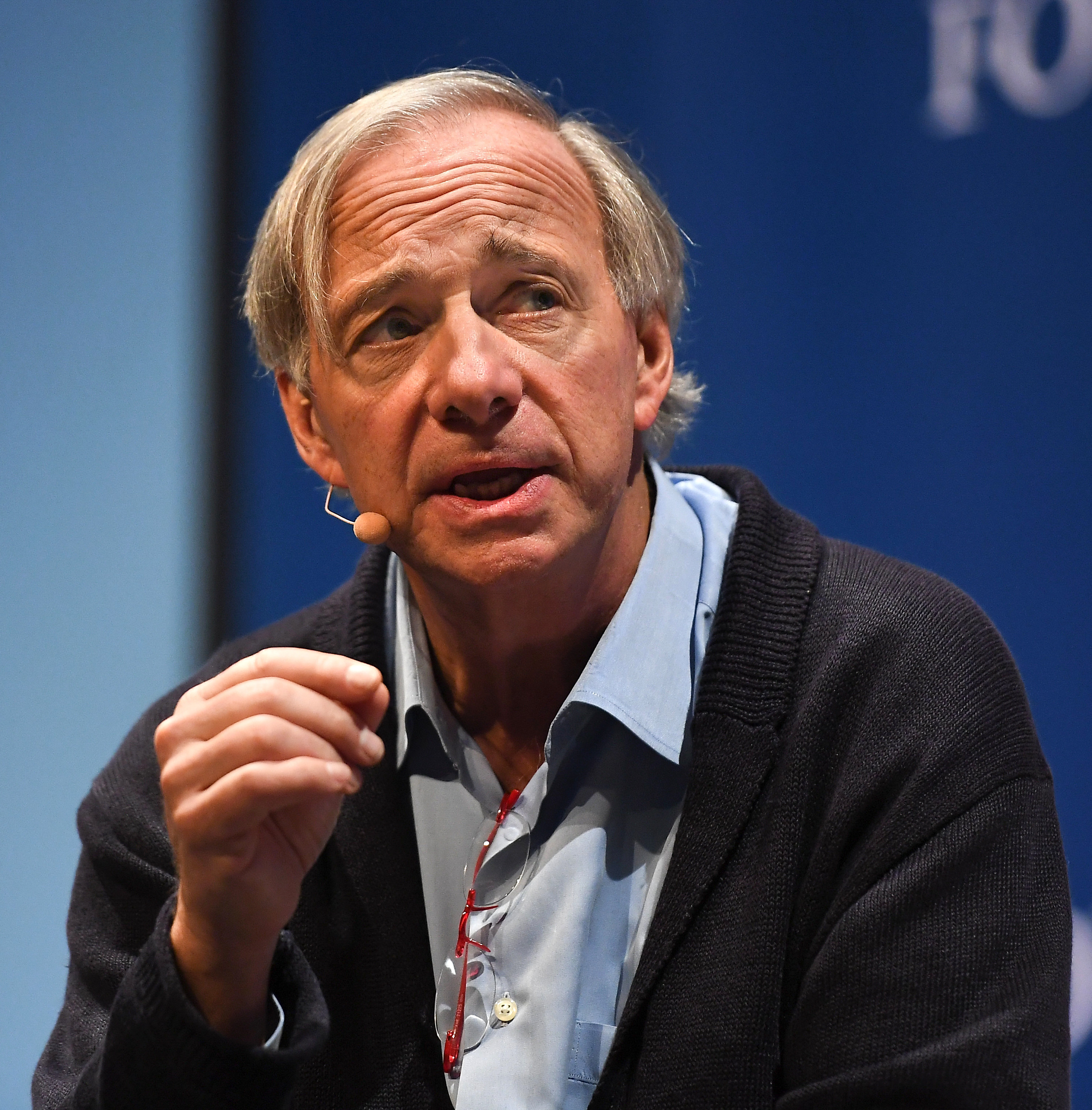
Ray Dalio built Bridgewater Associates from his New York City apartment into what has been widely reported as the largest hedge fund in the world.1 His edge was never a single famous trade. It was a written system: principles for making decisions, a model of how debt cycles drive economies, and a culture of radical transparency, all set down so others could test, debate and improve them.
His central lesson is simple. Markets move through repeating economic cycles, so a portfolio needs to survive several of them, and decisions go better with rules written down in advance than with emotion.
From caddy to Bridgewater
Raymond Dalio was born in 1949 in Queens, New York, the son of a jazz musician and a homemaker. He caddied at a local golf course and, at age twelve, used his earnings to buy his first stock, Northeast Airlines. The stock tripled, and he was hooked on markets.2
He earned his undergraduate degree at Long Island University and an MBA from Harvard Business School in 1973. After short stints at brokerage firms, he founded Bridgewater in 1975, at first helping corporate clients manage currency and interest rate risk rather than running money.
Ray Dalio’s career
- 1949BornQueens, New York.
- 1973Harvard MBAThen short stints at brokerage firms.
- 1975Founds BridgewaterFrom his apartment, advising companies on currency and rate risk.
- 1982The depression callPublicly wrong; nearly wiped out.
- 1991Pure AlphaThe active macro strategy launches.
- 1996All WeatherFirst for his own trust assets.
- 2017PrinciplesHundreds of written decision rules published.
- 2022Hands over controlAfter a succession planned over many years.
Three experiences that shaped him
The 1971 dollar shock. When President Nixon ended the dollar’s link to gold in August 1971, Dalio expected stocks to fall, but they rose. He took it as a lesson that big surprises often come from events that have happened before, just not in your lifetime.
The 1982 depression call. In 1982 Dalio publicly and wrongly predicted a U.S. depression, and the losses nearly wiped him out.2 It taught him to write down his reasoning, seek out smart people who disagreed with him and treat his own mind as fallible. Rebuilding Bridgewater after that failure produced both its investment approach and its distinctive culture.2
“I saw that I had been an arrogant jerk who was totally confident in a totally incorrect view.”
Ray Dalio, Principles, 2017
Paul Volcker. The Federal Reserve chairman’s sharp monetary tightening in the early 1980s shaped Dalio’s understanding of how central banks drive credit cycles. His 1982 depression call went wrong partly because he underestimated how the Fed could ease once inflation broke.
Dalio’s edge was a written system of decision rules, not a single famous trade.
Part 2 of 6 · Track record
What did Bridgewater achieve under Dalio?
Dalio’s record is best told through the frameworks Bridgewater used to read major economic moments, not through individual trades. The firm manages money for sovereign wealth funds, pension plans and other institutions, and its two best known strategies are Pure Alpha, an active macro portfolio, and All Weather, a risk balanced mix of assets.1
Pure Alpha, since 1991
Bridgewater’s flagship hedge fund strategy has run since 1991 through several very different economic regimes.1
The 2008 financial crisis
Bridgewater began warning of an approaching debt crisis as early as 2007.3 Pure Alpha was widely reported to have gained in 2008, a year when the S&P 500 lost about 37 percent with dividends included.4 Dalio credits his debt cycle framework for the call. One well timed call does not prove a framework can time the next crisis, which is why his approach leans on diversification more than prediction.
All Weather, since 1996
Dalio designed All Weather to perform reasonably in any economic environment by balancing exposure to stronger and weaker growth and higher and lower inflation.1 It popularized risk parity investing, which spreads risk, not dollars, evenly across assets, and it remains one of Bridgewater’s flagship offerings. Part 4 shows how it works.
Principles for Navigating Big Debt Crises, 2018
Dalio published a book, offered free as a PDF, that sets out his framework for 48 historical debt crises.3 It made public the lens Bridgewater had used internally for decades. He later added Principles for Dealing with the Changing World Order.
China and succession
Dalio has been one of the most prominent Western voices urging investors to understand China’s economic rise, and Bridgewater built a business there. In 2022 he formally handed control of the firm to a new generation of leaders after a handover planned over many years, and he now focuses on writing and philanthropy.
His legacy
Dalio showed that decision making itself can be engineered: he wrote his principles down, tested them, updated them and built a long running macro firm on them. His writing on radical transparency, honest disagreement and structured reflection has influenced thinking far beyond finance. The principles are uncomfortable to apply, and their benefits are hard to measure outside Bridgewater.
Bridgewater’s two flagship strategies are Pure Alpha, an active macro fund since 1991, and All Weather, a risk balanced mix since 1996.
Part 3 of 6 · The framework
What are Dalio’s four core principles?
Dalio’s framework rests on four connected principles, and he applies each one to investing and to life.
- Decide by principles. Write down the rules you use to make decisions, test them against outcomes and update them when reality shows they are wrong. Written rules compound into better judgment, just as documented mistakes speed up learning.
- Seek radical truth and transparency. Real improvement needs honest feedback. Surround yourself with people who will tell you the truth and build systems where unpleasant facts surface fast; polite conformity is the enemy of good outcomes.
- Diversify through uncorrelated bets. Combining many return streams that genuinely move independently reduces risk without reducing expected return, which Dalio calls the holy grail of investing (Part 4).
- Understand the machine. Markets are driven by forces you can study: productivity growth, short term debt cycles and long term debt cycles. If you know how the machine works, fewer phases will surprise you.
How Bridgewater put it into practice
At Bridgewater, radical truth and radical transparency meant meetings were recorded, employees rated each other openly and disagreements were aired in front of everyone affected. Dalio argues that the discomfort costs far less than polite conformity. The firm also practiced believability weighting: in group decisions, opinions count in proportion to a person’s demonstrated record in that area, and Bridgewater built software to track the scores.
For personal improvement, Dalio uses a five step process: set goals, identify problems, diagnose their root causes, design solutions, and push through to results. The cycle repeats for life. He also stresses putting your best thinking into the few big decisions that drive outcomes, seeing yourself objectively, and never confusing what you wish were true with what is true.
Dalio’s five step process
- Set goalsDecide what you are after.
- Identify problemsFind what stands in the way.
- DiagnoseTrace each problem to its root cause.
- DesignPlan a change that removes the cause.
- Push throughDo it, then measure the result.
The two debt cycles
The short term debt cycle is the ordinary business cycle of expansion and contraction, typically lasting several years and driven largely by central banks tightening and loosening credit. The long term debt cycle lasts several decades, roughly 50 to 75 years in Dalio’s account: debt grows faster than incomes until it must be reduced through deleveraging.3 Dalio argues these long cycles shape the major regimes investors face.
One practical consequence: over long periods, cash tends to lose buying power after inflation. At Davos in 2020 Dalio called cash trash. That is a cost of holding too much cash for decades, not a reason to hold none; cash for emergencies and planned spending serves a different purpose.
Dalio’s long term debt cycle runs roughly 50 to 75 years, with ordinary business cycles of a few years nested inside it.
Part 4 of 6 · The holy grail
Why does Dalio call uncorrelated bets the holy grail?
Dalio’s best known investing idea is a piece of arithmetic. If you combine fifteen to twenty good return streams that do not move together, the ups of some offset the downs of others, and the mix swings far less than any single part. Your expected return stays about the same, but your risk falls sharply.
The catch is the word uncorrelated. Correlation measures how closely two investments move together, from 1 (in lockstep) to 0 (unrelated). If your holdings are all, say, U.S. stocks in different wrappers, adding more of them barely lowers your risk.
How risk falls as you add return streams (hypothetical)
Uncorrelated streams (correlation 0) Correlated streams (correlation 0.6)
Look at the two lines. With truly independent streams, twenty holdings cut the portfolio’s swings from 10% to about 2.2% a year. With streams that are 60% correlated, twenty holdings only get you to about 7.9%, because they all fall together.
Worked example: stocks and Treasury bonds in two bad years
In 2008 the S&P 500 lost 36.6 percent while ten year Treasury bonds returned 20.1 percent: the two offset each other, which is what diversification is supposed to do. In 2022 the S&P 500 lost 18.0 percent and the same bonds lost 17.8 percent, because rising inflation and interest rates hurt both at once.4 The pair that diversified in one crisis did not in the next.
S&P 500 and ten year Treasury bonds: 2008 versus 2022
S&P 500 10 year T bond
Real diversification shows up when it is needed, not just when it is comfortable. Many portfolios hold assets that look different but fall together in a crisis, and the only way to see it is to check how each holding behaved in stress years such as 2008 and 2022.
Twenty independent return streams cut risk by nearly four fifths; twenty streams that are 60 percent correlated cut it by a fifth.
Part 5 of 6 · All Weather
How does All Weather prepare for any economy?
All Weather starts from a humble premise: nobody knows which economy comes next. Bridgewater sorts the possibilities into four environments, when inflation rises, inflation falls, growth rises, and growth falls relative to expectations, and notes that each favors different assets.1
Four environments and what Bridgewater says tends to do well
| Environment | Tends to do well | Tends to struggle |
|---|---|---|
| Rising growth | Stocks | Nominal government bonds |
| Falling growth, low inflation (disinflationary recession) | Nominal bonds | Stocks |
| Rising inflation, as in the 1970s | Inflation linked bonds and commodities | Stocks and nominal bonds |
| Falling inflation | Nominal bonds and stocks | Commodities and inflation linked bonds |
In Bridgewater’s words, the key was “to put equal risk on each scenario to achieve balance.”1 That is different from putting equal dollars in each asset. Stocks swing much more than bonds, so a risk balanced portfolio holds a smaller dollar amount of stocks and more of the steadier assets.
Worked example (hypothetical volatilities)
Suppose stocks swing about 15 percent a year and bonds about 5 percent. A 50/50 dollar split is not balanced in risk: stocks contribute 7.5 points of swing and bonds 2.5, so three quarters of the portfolio’s risk comes from stocks. To give each the same risk, the dollars go 25 percent to stocks and 75 percent to bonds. All Weather applies that logic across four environments rather than two assets, and in practice uses borrowing to lift the return of the steadier assets.
Equal dollars versus equal risk (hypothetical)
Stocks Bonds
The scenario exercise
The same test works on any portfolio: take it through the four combinations of stronger or weaker growth and higher or lower inflation, and describe how each holding could be affected, including the role of any borrowing (leverage) and how quickly it could be sold (liquidity).
Keep the limits visible. The scenarios are a thinking tool, not a guarantee. Asset relationships and policy responses can change, as 2022 showed when stocks and bonds fell together, so a label such as all weather does not ensure balance in every environment.
All Weather puts equal risk, not equal dollars, on four environments: growth and inflation, each rising or falling.
Part 6 of 6 · In his own words
What does Dalio say about decisions, truth and markets?
The first six cards are Dalio’s own words with where he published them. The last two restate ideas from his writing in our words.
Quotes
Quote
“Principles are ways of successfully dealing with reality to get what you want out of life.”
Source: Ray Dalio, Principles: Life and Work (2017)
Means. Principles are tested rules of thumb. They convert raw experience into transferable wisdom that can be applied repeatedly rather than relearned every time.
Quote
“Pain + Reflection = Progress”
Source: Ray Dalio, Principles: Life and Work (2017), Life Principles
Means. Painful experiences are the highest leverage learning opportunities, but only if you reflect on them. Pain without reflection is just suffering.
Quote
“Truth (or, more precisely, an accurate understanding of reality) is the essential foundation for any good outcome.”
Source: Ray Dalio, Principles: Life and Work (2017), Life Principles, chapter 1
Means. Decisions made on flawed inputs produce flawed outputs, no matter how skilled the analysis. Accurate perception is the precondition for accurate action.
Quote
“Don’t worry about looking good; worry about achieving your goals.”
Source: Ray Dalio, Principles: Life and Work (2017), Life Principles
Means. Preserving image consumes mental energy and produces conservative, conformity driven decisions. Letting it go frees you to take useful contrarian positions.
Quote
“Embrace Reality and Deal with It”
Source: Ray Dalio, Principles: Life and Work (2017), title of Life Principles chapter 1
Means. Wishing reality were different is the most common form of mental inefficiency. Accepting it as the starting point unlocks effective action.
Quote
“Be radically open minded and radically transparent.”
Source: Ray Dalio, Principles: Life and Work (2017), Life Principles, chapter 1
Means. These twin disciplines accelerate learning by exposing your thinking to challenge and exposing reality to scrutiny.
Lesson ideas
Lesson idea
Dalio argues that to beat the market you have to bet against the consensus and be right, since the consensus view is already in the price.
Means. Consensus is already in the price. Returns come from positions where you disagree with the prevailing view and are correct.
Lesson idea
Dalio says that when you think you have the answer, you should worry most about what you do not know.
Means. Confidence can hide gaps in knowledge. Losses often come from risks no one considered.
Dalio treats confidence as the moment to list what would prove him wrong.
Quick check
Quick quiz: test what you just read
Pick an answer to see why it is right. 5 questions, no account needed.
1. What does diversifying across uncorrelated return streams aim to do?
2. In the diversification chart, twenty streams with correlation 0.6 reduce risk from 10 percent to about what?
3. What happened to the S&P 500 and ten year Treasury bonds in 2022?
4. Why does All Weather hold fewer dollars in stocks than in bonds?
5. What is a limit of using a historical debt cycle model?
Questions people ask
Ray Dalio FAQ
What is the All Weather portfolio?
All Weather is a strategy Dalio designed at Bridgewater, launched in 1996, to perform reasonably across different economic environments by balancing risk across stronger and weaker growth and higher and lower inflation.1 Rather than predicting which environment comes next, it spreads risk so no single scenario dominates the outcome. It helped popularize risk parity, though changing asset relationships mean no label guarantees balance every time.
What does Dalio mean by the holy grail of investing?
He means combining fifteen to twenty good return streams that are genuinely uncorrelated, which he says can sharply reduce risk without lowering expected return. The hard part is finding streams that truly behave independently, especially in crises, when investments that looked unrelated can fall together.
What are Ray Dalio’s principles?
Principles, published in 2017, sets out hundreds of documented rules for decision making in life and work, many developed at Bridgewater. The core habit is to write down how you decide, test those rules against real outcomes and update them when they prove wrong. Radical truth and transparency sits at the center.
What is Dalio’s long term debt cycle?
It is a cycle lasting several decades in which debt builds faster than incomes and is eventually reduced through deleveraging, sitting on top of shorter business cycles. In Principles for Navigating Big Debt Crises (2018) he studied 48 historical debt crises to show how they typically unfold and how policymakers respond.3
Did Ray Dalio predict the 2008 financial crisis?
Bridgewater began warning of a debt crisis as early as 2007, and Pure Alpha was widely reported to have gained in 2008 while the S&P 500 fell about 37%. Dalio credits his debt cycle framework. One good call does not prove a framework can reliably time future crises, which is why he stresses diversification over prediction.
You finished this lesson.
You now have the main ideas from this lesson. Next, practice where mistakes cost nothing: a free account saves your progress and unlocks the practice simulator with virtual money.
Free, no card. Lessons stay free to read without an account.
Your notes on one card, and what comes next
- Step 1 · DoneRay Dalio
See your notes on one card
- Dalio writes his decision rules down as principles and tests them against what actually happens.
- He teaches that pain plus reflection equals progress: mistakes are useful when you study them.
- He argues that combining fifteen to twenty good, uncorrelated return streams can cut risk sharply without giving up much return, but only if they really are uncorrelated.
- All Weather puts equal risk, not equal dollars, on four environments: stronger and weaker growth, and higher and lower inflation.
- Asset relationships change: Treasury bonds offset the 2008 stock loss but fell alongside stocks in 2022.
- He studies long term debt cycles, which he says last roughly 50 to 75 years, alongside shorter business cycles.
- 2Step 2 · NowSave your progress with a free account
Keep your course progress and practice on real U.S. stocks with virtual cash.
Create your free account No card needed. Lessons stay free to read. - 3Step 3Follow the learning pathThe learning pathFree
Learn the rest in the right order
Ten modules of lessons, videos, tools and quizzes, ordered so each step builds on the last, from market basics to company analysis and risk.
Start the learning path
Want the full sequence? See the course outline →
Sources and assumptions
- Bridgewater Associates: The All Weather story (2012)
- Principles by Ray Dalio
- Principles for Navigating Big Debt Crises
- Aswath Damodaran, NYU Stern: annual returns on stocks, T bills and T bonds
- Bridgewater Associates research and principles
- Ray Dalio official website
- Bridgewater Associates official website
This lesson is for general financial education only. It does not provide personal financial advice, stock recommendations, or a guarantee of investment results.
StockEducation provides general education, not personal financial, tax or legal advice. Companies and funds named here are teaching examples only. Nothing here recommends buying or selling any security. Investing involves risk, including the loss of money you invest.


