
Investment Glossary · Quick read · No ads
Accrual Accounting
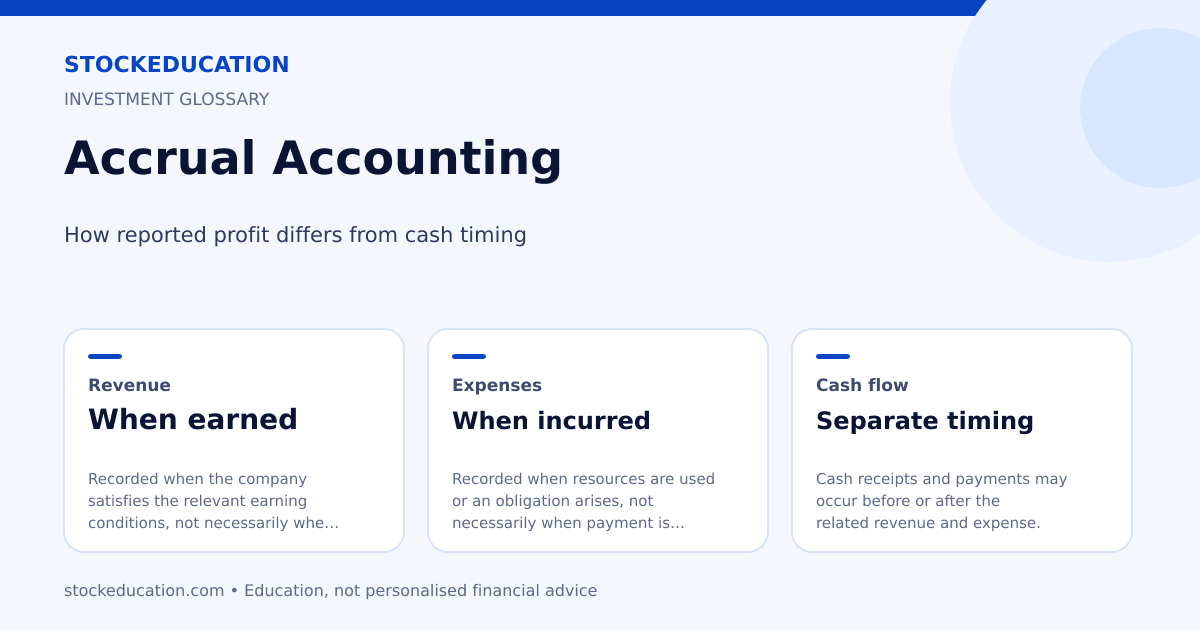
Accrual accounting records revenue when it is earned and expenses when they are incurred, even if the related cash is received or paid in a different period.

Key takeaways
- Accrual accounting matches reported activity with the period in which it occurs.
- Net income under accrual accounting is not the same as cash generated.
- Receivables, inventory and payables can create timing differences between profit and cash flow.
- Noncash expenses such as depreciation reduce profit without an immediate cash payment.
- Investors should compare accrual based earnings with operating cash flow and the balance sheet.
- Read the notes because recognition policies and estimates affect reported results.
What is Accrual Accounting?
Accrual accounting records revenue when it is earned and expenses when they are incurred, rather than waiting for cash to change hands. This timing helps investors evaluate performance for the period in which a company delivered goods, provided services or used resources, while the cash flow statement shows when cash actually moved.
When reading financial statements, compare accrual-based net income with operating cash flow and inspect receivables, inventory, payables and noncash expenses. The cash flow statement lesson explains the reconciliation, while the SEC’s Beginners’ Guide to Financial Statements provides filing context.
How Accrual Accounting works
| Step | What happens |
|---|---|
| 01 · Identify the economic event | Determine what was delivered, received or obligated during the reporting period. |
| 02 · Determine recognition timing | Apply the relevant accounting policy to decide when revenue is earned or an expense is incurred. |
| 03 · Record the accrual entry | Record revenue or expense with the related receivable, payable, deferred revenue or prepaid account. |
| 04 · Check cash timing | Identify whether collection or payment occurred in the same period or a different period. |
| 05 · Reconcile to cash flow | Review noncash adjustments and operating working capital changes to connect net income with operating cash flow. |
| 06 · Read the notes | Check material policies, estimates, changes, unusual items and explanations in the filing notes. |
The formula
Accrual profit = recognized revenue − recognized expenses Operating cash flow = net income + noncash adjustments ± changes in operating assets and liabilities
Recognized revenue: revenue earned during the reporting period under the applicable accounting rules. Recognized expenses: costs incurred or consumed during the reporting period. Noncash adjustments: items such as depreciation and amortization that affect profit without current cash movement. Operating working capital changes: movements in receivables, inventory, payables and related operating accounts.
A worked example
Illustrative example, not a market quote: A company completes a $1,000 service on December 20 and receives payment on January 15. Under accrual accounting, it records $1,000 of revenue in December and records a $1,000 receivable until collection. December profit increases by $1,000, but December cash does not increase from this transaction. In January, collection converts the receivable into cash without creating January revenue. If the company also receives a $300 utility bill for December and pays it in January, December records the expense and payable, while January records the cash payment. The example shows why accrual profit and cash flow can differ by period.
Why it matters
Accrual accounting helps investors connect reported performance with the period in which economic activity occurred. Understanding its timing differences prevents the common mistake of treating earnings as cash and supports better analysis of operating cash flow, working capital, earnings quality and valuation inputs.
What accrual accounting measures
Accrual accounting is designed to report the economic substance of transactions in the period affected. A sale may be recognized when the company has satisfied the relevant performance obligation even though the customer pays later. Likewise, an expense may be recognized when goods or services are used or an obligation arises, even when the supplier is paid later. This gives the income statement a period based view of activity, but it also means reported profit includes estimates and timing judgments that must be checked in the notes.
Accrual accounting versus cash accounting
Cash accounting records revenue when cash is received and expenses when cash is paid. Accrual accounting records the underlying revenue or expense when earned or incurred. Suppose a company provides a service in December for $1,000 and collects the money in January. Accrual accounting records the revenue in December; cash accounting records it in January. Neither method changes the eventual cash collected, but the reported period and the balance sheet accounts differ. Public company GAAP financial statements generally use accrual based reporting, while cash information remains essential for liquidity analysis.
How the balance sheet connects the timing
The balance sheet contains accounts that bridge accrual results and cash movements. Accounts receivable can rise when revenue is recognized before collection. Accounts payable or accrued expenses can rise when costs are recognized before payment. Deferred revenue can arise when cash is received before the company has earned the revenue. Prepaid expenses can arise when cash is paid before the benefit is consumed. These accounts explain why changes in working capital are included when operating cash flow reconciles net income to cash from operations.
Why profit can differ from operating cash flow
Net income includes accrual revenue, accrued costs, depreciation, amortization and other items that do not necessarily represent current period cash movement. Operating cash flow starts with accrual based profit and adjusts for noncash items and changes in operating assets and liabilities. A receivables increase can reduce operating cash flow because recognized sales have not yet been collected. A payable increase can increase operating cash flow because expenses were recognized before cash was paid. A difference is not automatically a warning, but a persistent unexplained gap deserves investigation.
Estimates and judgment matter
Accrual accounting requires management to estimate amounts and timing. Examples include expected credit losses on receivables, inventory write downs, depreciation periods, warranty obligations, employee compensation and revenue that is variable or subject to return. Estimates can be reasonable and still change as new information arrives. Investors should compare assumptions with prior periods, read accounting policy notes and identify unusual changes. A reported profit increase is more informative when its assumptions, cash conversion and recurring operating performance are understandable.
How investors should use it
Start with the income statement to understand reported performance, then examine the balance sheet accounts that carry timing differences and reconcile net income to operating cash flow. Compare several periods using consistent fiscal periods and units. Look for revenue growth accompanied by receivables growth, inventory accumulation, large changes in contract liabilities or repeated adjustments. Then read the Form 10-K or Form 10-Q notes and management discussion. Accrual accounting is not a valuation conclusion; it is the reporting framework investors must understand before interpreting margins, earnings or cash flow.
Comparison
| Accounting basis | Revenue timing | Expense timing | Investor focus |
|---|---|---|---|
| Accrual accounting | When revenue is earned | When expenses are incurred | Assess period performance and obligations |
| Cash accounting | When cash is received | When cash is paid | Assess the timing of cash receipts and payments |
| Financial statement analysis | May include receivables and deferred revenue | May include payables and accrued costs | Reconcile profit with operating cash flow |
Check yourself
A company completes a service in December, records the revenue then, and collects cash in January. Which statement is correct?
Accrual accounting recognizes revenue when it is earned. The January receipt reduces the receivable and increases cash, but it does not create a second sale.
Show the answer
December revenue is recorded under accrual accounting, while January records the collection.
Things people get wrong
Mistake 01 Treating net income as cash
Net income includes accruals and noncash items, so compare it with operating cash flow and working capital.
Mistake 02 Ignoring receivables and payables
Review balance sheet changes because uncollected revenue and unpaid costs affect the timing of cash.
Mistake 03 Assuming every accrual difference is manipulation
Timing differences can be normal; investigate persistence, magnitude, disclosures and business context.
Mistake 04 Comparing mismatched periods
Compare full year with full year or comparable quarters and check fiscal dates, units and restatements.
Mistake 05 Overlooking estimates
Read accounting policies and notes for credit losses, depreciation, warranties and revenue recognition judgments.
Questions people ask about Accrual Accounting
What is accrual accounting in simple terms?
It records revenue when earned and expenses when incurred, not necessarily when cash is received or paid.
Why can net income be positive while operating cash flow is negative?
Revenue may not yet have been collected, inventory may have absorbed cash, or other working capital changes and noncash adjustments may reduce operating cash flow.
Is accrual accounting the same as GAAP?
Accrual accounting is a basis used by GAAP financial reporting, but GAAP also includes detailed recognition, measurement, presentation and disclosure rules.
What accounts commonly explain accrual timing?
Accounts receivable, inventory, accounts payable, accrued expenses, deferred revenue and prepaid expenses commonly bridge accounting results and cash timing.
Does accrual accounting show when cash is available?
No. Use the statement of cash flows, cash balance, debt obligations and liquidity disclosures to assess available cash.
How can an investor check accrual quality?
Compare net income with operating cash flow over several periods, inspect working capital and read the filing notes for unusual estimates or changes.
Can accrual accounting affect valuation?
It affects reported earnings and therefore valuation metrics, but investors should also assess cash generation, liabilities, reinvestment needs and the durability of results.
The bottom line
Accrual accounting gives investors a period based view of revenue and expenses, but it does not measure cash by itself. Use the income statement, balance sheet and cash flow statement together, then investigate working capital, noncash charges and management estimates before drawing conclusions about business quality or valuation.
Sources
About this page. Written by Associate Professor Charles Lo, CPA, PhD and edited by Felix La Spina. No ads and no paywall. Editorial standards · How we fact check · Corrections log · Report an error
Educational information only. Nothing on this page is personal financial, tax or legal advice. Investing involves risk, including the possible loss of principal.


