
Investment Glossary · Quick read · No ads
Bonds
A bond is a debt investment: you lend money to a government, municipality or company, and the issuer promises interest payments plus repayment of principal at maturity, subject to credit and other risks.

Key takeaways
- Bonds are debt claims, not ownership interests in the issuer.
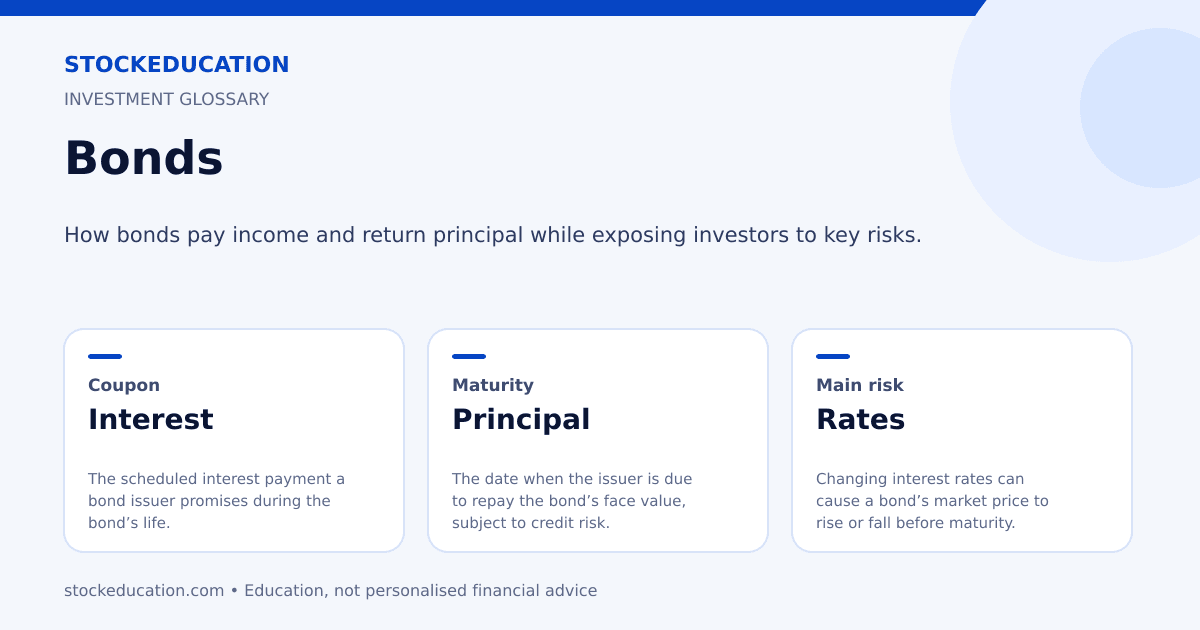
- Coupon payments provide scheduled interest, while maturity is the date principal is due.
- A bond’s market price can change when interest rates, credit conditions or inflation expectations change.
- Holding a bond to maturity does not eliminate default, call, inflation or reinvestment risk.
- Yield depends on the bond’s cash flows, purchase price, maturity, credit quality and sale price.
What is Bonds?
Bonds are debt investments: you lend money to a government, municipality or company, and the issuer agrees to make interest payments and repay the principal at maturity. Unlike common stock, a bond does not give you ownership of the issuer. A bond’s return and risk depend on its coupon, purchase price, maturity, credit quality and the possibility that you may sell before maturity.
For beginner-friendly context, compare bonds with cash equivalents when considering capital preservation and liquidity, and review the broader financial statements when assessing a corporate issuer’s ability to service debt. A bond can provide scheduled income, but it is not risk-free: issuer default, changing interest rates, inflation, liquidity and call provisions can affect results.
How Bonds works
| Step | What happens |
|---|---|
| 01 · Define the objective | Decide whether the investment is intended for income, capital preservation, diversification or a known future liability. |
| 02 · Read the terms | Check issuer, face value, coupon, payment dates, maturity, seniority, collateral, covenants and call provisions. |
| 03 · Assess the issuer | Review credit quality, leverage, liquidity, cash generation and relevant financial statements. |
| 04 · Compare the price | Evaluate yield, spread, duration, fees, taxes, liquidity and the price paid rather than relying on coupon alone. |
| 05 · Stress the risks | Consider rate increases, inflation, credit deterioration, early call, reinvestment and the need to sell before maturity. |
| 06 · Monitor the position | Revisit issuer condition, portfolio concentration, changing objectives and whether the bond still fits the plan. |
The formula
Bond return ≈ coupon income + price change + reinvested income − fees and taxes
Coupon income = scheduled interest payments received during the holding period. Price change = sale price minus purchase price, or the change in market value if the bond is still held. Reinvested income = additional return earned when coupons or principal are reinvested. Fees and taxes = transaction costs and applicable taxes that reduce the investor’s net result. This is an approximation, not a guarantee; default, call events, timing and compounding can materially change the outcome. A simple current-yield measure is: annual coupon payment ÷ current bond price. It does not include capital gain or loss, reinvestment, fees or taxes, so it is not a complete yield measure.
A worked example
Hypothetical worked example: Assume an investor buys one bond with a face value of $1,000, a 5% annual coupon, and five years remaining to maturity. The annual coupon is $1,000 × 5% = $50, normally paid as two $25 payments if the bond pays semiannually. If the investor purchases it for $950 and the issuer makes every promised payment, the investor could receive $50 of annual coupon income for five years, or $250 in total, plus the $1,000 face-value repayment at maturity. Ignoring reinvestment, fees, taxes and timing differences, total cash received would be $1,250. Compared with the $950 purchase price, the simple dollar gain would be $300, consisting of $250 coupon income and a $50 difference between face value and purchase price. The approximate holding-period return would be $300 ÷ $950 = 31.6% over five years, not an annualized yield. The investor’s actual yield would be calculated from the timing of each payment and would be higher than the 5% coupon because the bond was bought below par. If the bond were sold after two years for $920, the investor would have received $100 of coupons but would face a $30 price loss, for $70 before fees and taxes. If instead market rates rose and the bond’s price fell to $900, the investor could still receive the contractual payments while holding it, but selling early would lock in a loss. This example assumes the issuer pays in full and on time. Default, a call, inflation, taxes, bid-ask spreads, reinvestment rates and changing market prices can materially change the result. A bond held to maturity may return face value only if the issuer remains able to pay; maturity does not eliminate credit or purchasing-power risk.
Why it matters
Bonds can supply income and diversify an investment portfolio, but their label as fixed income does not mean that either price or outcome is fixed. Understanding the relationship among coupon, price, yield and maturity helps investors interpret quoted returns and decide whether they can tolerate interim losses. Credit analysis helps distinguish a higher payment from compensation for genuine default risk. Reviewing inflation, liquidity, call and reinvestment risks is essential when matching a bond with a goal, time horizon and need for accessible capital.
How a bond works
When a bond is issued, the issuer raises borrowed capital from investors under stated contractual terms. Those terms identify the face value, coupon rate, payment schedule, maturity date, ranking and any provisions allowing early redemption or changing payments. The investor receives the promised coupon, if applicable, and expects repayment of face value at maturity. A later buyer may pay more or less than face value, so the return depends on both the cash received and the purchase price. The promise is contractual rather than guaranteed: a financially weakened issuer may delay, reduce or fail to make payments.
Coupon, face value and maturity
The coupon is the stated interest rate applied to a bond’s face value, producing the scheduled coupon payment. Face value, sometimes called par value, is the principal amount the issuer is due to repay at maturity under the bond’s terms. Maturity is the contractual endpoint for repayment, although a callable bond may be redeemed earlier. Coupon rate and yield are different: the coupon is set by the bond’s terms, while yield reflects the price paid and the timing and size of expected cash flows. A bond bought below face value may have a yield above its coupon rate, while a bond bought above face value may have a yield below it.
Interest-rate and price risk
Before maturity, bond prices generally move inversely to prevailing interest rates. If new bonds begin offering higher rates, an existing bond with a lower coupon is usually less attractive, so its market price may fall. If prevailing rates decline, an existing higher-coupon bond may become more valuable and its price may rise. The size of the price response depends partly on maturity and duration: longer or more rate-sensitive cash flows typically react more to a given rate change. Investors who hold a bond to maturity may focus on contractual cash flows, but they still face the opportunity cost of locked-in rates and may need to sell at an unfavorable price.
Credit, default and recovery risk
Credit risk is the possibility that an issuer or guarantor cannot make promised interest or principal payments on time or in full. Credit quality reflects the market’s assessment of that payment capacity and can change with profitability, leverage, cash flow, economic conditions and refinancing access. Corporate analysis can include the issuer’s financial statements, debt burden, interest coverage, liquidity and seniority structure. A bond’s stated yield may compensate investors for perceived credit risk, but higher yield is not free income and does not ensure recovery. If default occurs, recovery depends on the bond’s legal terms, collateral, priority and the value available in restructuring or liquidation.
Inflation, liquidity and reinvestment
Inflation reduces the purchasing power of fixed future payments. A bond can return its promised nominal principal while providing less real purchasing power than expected. Liquidity risk is the possibility that an investor cannot sell promptly near an observed price, especially in a thinly traded issue or stressed market; the bid-ask spread and execution price can then reduce results. Reinvestment risk arises when coupons or returned principal must be invested at lower rates than the bond originally offered. These risks matter even when the issuer remains current, because an investor’s real income, flexibility and future compounding can differ from the original plan.
Callable bonds and evaluating return
A callable bond gives the issuer the right, under stated conditions, to repay the debt before its scheduled maturity. Issuers are more likely to call when refinancing becomes cheaper, which can remove an attractive coupon just when comparable reinvestment opportunities are less appealing. Investors should therefore review call dates, call prices, protection periods and yield-to-call as well as yield-to-maturity. Comparing bonds also requires attention to taxes, fees, settlement, currency, seniority, collateral, covenants and concentration. A sound evaluation separates contractual cash flows from uncertain market value and tests whether the expected return compensates for the risks actually being taken.
Comparison
| Instrument | Ownership or claim | Typical cash-flow focus | Main investor risks |
|---|---|---|---|
| Bond | Debt claim against an issuer | Coupon and principal repayment | Interest-rate, credit, inflation, liquidity and call risk |
| Common stock | Ownership interest | Dividends if declared and price appreciation | Business, market, valuation and dividend risk |
| Cash equivalent | Short-term liquid claim or deposit | Stability and readily available value | Inflation, yield, institution and limited return risk |
Check yourself
A bond has a 5% coupon on $1,000 face value and is purchased for $950. Which statement is most accurate?
The coupon is calculated from face value: $1,000 × 5% = $50 annually. Because the investor pays $950 but may receive $1,000 at maturity, the yield can exceed the coupon rate, although the exact yield depends on payment timing and other terms. The bond is a creditor claim, its market price can change, and repayment remains subject to issuer risk.
Show the answer
2. Its annual coupon is $50, and its yield may exceed 5% because the purchase price is below face value.
Things people get wrong
Mistake 01 Treating coupon as total return
Coupon is only one component; purchase price, sale price, reinvestment, fees and taxes also affect results.
Mistake 02 Assuming maturity removes all risk
The issuer may default, inflation may erode purchasing power and the investor may need to sell early.
Mistake 03 Chasing the highest yield
A high yield can signal greater credit, liquidity, duration or call risk rather than a superior opportunity.
Mistake 04 Ignoring call provisions
An issuer may redeem a bond early, ending an attractive coupon and creating reinvestment risk.
Mistake 05 Concentrating in one issuer
A single credit problem can damage the portfolio when holdings are not diversified by issuer or risk type.
Questions people ask about Bonds
What is a bond?
A bond is a debt security through which an investor lends money to an issuer in exchange for promised interest and repayment of principal under stated terms.
Do bonds represent ownership?
Generally no. Bondholders are creditors, while common shareholders hold an ownership interest and may receive dividends if declared.
What is a coupon?
A coupon is the stated interest rate or scheduled interest payment specified by the bond’s terms, usually calculated from face value.
What is maturity?
Maturity is the date when the issuer is scheduled to repay the bond’s face value, subject to credit risk and any earlier call provisions.
Why do bond prices change?
Prices change with interest rates, credit quality, inflation expectations, liquidity, time to maturity, supply and demand, and the bond’s contractual features.
Can a bond lose money?
Yes. Its market price can fall, and an investor can lose money through a sale below the purchase price, default, fees, taxes or inflation-adjusted purchasing-power loss.
What is a callable bond?
A callable bond permits the issuer to redeem the security before its scheduled maturity under specified conditions, often when refinancing becomes cheaper.
The bottom line
Bonds exchange borrowed capital for contractual cash-flow promises, but those promises are subject to issuer creditworthiness and other terms. Evaluate coupon, price, yield, maturity, call features, liquidity, inflation exposure and concentration together rather than treating a bond as risk-free.
Sources
About this page. Written by Associate Professor Charles Lo, CPA, PhD and edited by Felix La Spina. No ads and no paywall. Editorial standards · How we fact check · Corrections log · Report an error
Educational information only. Nothing on this page is personal financial, tax or legal advice. Investing involves risk, including the possible loss of principal.


