
Investment Glossary · Quick read · No ads
Cash Equivalent
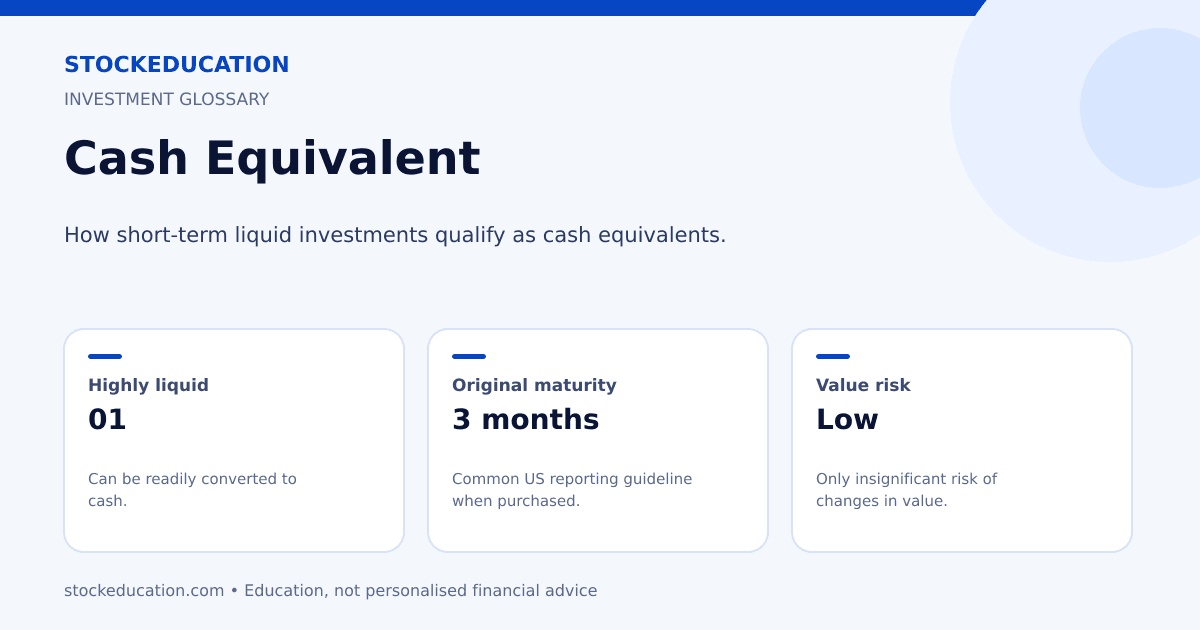
A cash equivalent is a highly liquid, short-term investment that can be converted readily to a known amount of cash and carries only an insignificant risk of changes in value. In US financial reporting, the common original-maturity guideline is three months or less when purchased.

Key takeaways
- Cash equivalents are highly liquid investments rather than every asset classified as current.
- The investment should be readily convertible to a known amount of cash.
- The risk of value changes should be insignificant.
- The three-month test generally considers original maturity when purchased, not simply time remaining at the reporting date.
- Qualifying cash equivalents are reported with cash in key financial statements.
What is Cash Equivalent?
How Cash Equivalent works
| Step | What happens |
|---|---|
| 01 · Start with the purchase date | Determine the instrument’s original contractual maturity when acquired; do not begin only with the reporting-date balance or remaining term. |
| 02 · Test liquidity | Ask whether the investment can be converted into cash promptly without an unusual delay, meaningful obstacle, or substantial price concession. |
| 03 · Assess cash certainty | Evaluate whether conversion produces a known amount of cash rather than an amount materially exposed to market-price movements. |
| 04 · Assess value-change risk | Review interest-rate, credit, market, and other risks to determine whether potential changes in value are insignificant. |
| 05 · Review restrictions and terms | Check withdrawal penalties, redemption provisions, pledged balances, trapped cash, counterparty conditions, and other limits on ordinary use. |
| 06 · Apply the reporting policy | Compare the facts with the applicable accounting framework, the issuer’s stated policy, and relevant disclosure practice. |
| 07 · Read the statement notes | Confirm which instruments management includes with cash and investigate differences between cash equivalents, short-term investments, and broader liquidity measures. |
The formula
Cash equivalents = qualifying highly liquid investments included with cash
Cash equivalents: investments meeting the applicable liquidity, convertibility, risk, and maturity criteria. Qualifying: included only when the facts and reporting framework support the classification. Original maturity: the contractual maturity measured when the investment is purchased; the common US guideline is three months or less. This is a classification expression, not a valuation formula or a calculation of total liquidity. A broader liquidity measure may include assets that are not cash equivalents, so it should not be substituted for this expression or used to infer a cash-equivalent balance without disclosure support.
A worked example
Consider this hypothetical example: On January 2, Company A buys a Treasury bill for $998,000 that pays $1,000,000 at maturity on March 15. Its original maturity is 72 days, which is less than three months, and assume the instrument is readily convertible to a known amount of cash with only insignificant value-change risk. Under those assumptions, Company A may classify the $998,000 investment as a cash equivalent. The arithmetic is simple: $1,000,000 maturity value minus the $998,000 purchase price equals $2,000 of contractual accretion. That calculation does not by itself establish classification; liquidity, marketability, restrictions, credit exposure, and the applicable reporting framework must also be considered. Now change the facts: Company A buys a note on January 2 with an original maturity of nine months, even though only two months remain at the August 2 reporting date. The remaining term is below three months, but the original-maturity analysis generally keeps the note outside cash equivalents. It might still be a current or short-term investment, depending on the facts and policy. A deposit that can be withdrawn immediately may also require review if withdrawal penalties, restrictions, or other conditions make the amount unavailable for ordinary use. This example is educational and hypothetical, not an accounting conclusion for a particular issuer.
Why it matters
Cash equivalents matter because they help identify the resources a company can use almost immediately to meet obligations and fund operations. The classification also affects the opening and ending cash amounts presented in the cash flow statement, making it relevant to cash-burn, liquidity, and treasury analysis. Investors should not treat the label as a guarantee that every short-term investment is risk-free or unrestricted. Reviewing maturity at purchase, convertibility, value-change risk, restrictions, and the related accounting policy helps distinguish genuinely available liquidity from assets that merely appear current.
Liquidity and convertibility
Liquidity is central to the classification. A qualifying instrument should be capable of being converted into cash promptly without a meaningful obstacle, unusual delay, or substantial concession in price. The phrase “known amount of cash” emphasizes predictability rather than merely the existence of a market. An investment can be actively traded and still require judgment if its price is materially exposed to market movements, credit concerns, or changing interest rates. The analysis therefore considers both how quickly the holder can obtain cash and how reliably the amount received can be determined. Cash-equivalent treatment is intended for instruments that function very much like cash in ordinary treasury and reporting activities, not for assets whose value must be managed as an investment position.
The original-maturity guideline
The frequently used three-month guideline is measured from the investment’s original maturity when it is purchased. This prevents an instrument from becoming a cash equivalent merely because it has entered its final three months before the reporting date. For example, a security bought with a substantially longer contractual term may be a short-term investment at purchase and remain outside cash equivalents even when its remaining maturity later falls below three months. The guideline is a practical indicator, not a substitute for the broader requirements of liquidity, convertibility, and insignificant value-change risk. Analysts should read the issuer’s accounting policy and disclosures when the instrument’s terms, purchase date, or classification are not clear.
Common qualifying instruments
Examples may include qualifying Treasury bills, money market instruments, and certain short-term deposits. An example is not automatically a conclusion: the specific maturity, withdrawal terms, credit quality, marketability, and exposure to changes in value all matter. A deposit may be highly accessible but subject to restrictions, penalties, or contractual conditions that affect classification. Likewise, a marketable security may have a readily observable price but still experience meaningful price volatility. The useful question is whether the instrument meets the complete definition under the relevant reporting framework, rather than whether it belongs to a familiar product category. Companies often disclose the composition of cash and cash equivalents so readers can understand what management includes.
Financial statement presentation
Cash equivalents are generally presented together with cash on the balance sheet because both represent resources available for near-term obligations. They also affect the starting cash balance and ending cash balance in the cash flow statement. This presentation does not mean that all short-term investments are interchangeable with cash equivalents. A separate short-term investment may be current and liquid while remaining outside the cash-and-cash-equivalents balance. When evaluating statements, compare the line-item definition, accounting policy, and note disclosure rather than relying only on the label. The Financial Statements lesson provides broader context for reading these classifications and their relationship to reported cash flows.
Cash equivalents versus broader liquidity measures
Cash equivalents address the quality and immediacy of a narrow pool of resources; liquidity ratios address a broader ability to meet obligations. The current ratio, for example, generally compares current assets with current liabilities and may include receivables, inventory, and other assets that are not cash equivalents. Consequently, a company can have a strong current ratio without holding a large cash-equivalent balance, or hold substantial cash equivalents while facing other liquidity constraints. Comparing the cash-equivalent balance with working capital and the Current Ratio can show whether near-term coverage depends on immediately available resources or on converting operating assets.
Judgment, disclosure, and analysis
Classification requires attention to both contractual facts and the reporting framework. Review maturity at purchase, redemption or withdrawal provisions, counterparty exposure, restrictions, and sensitivity to interest-rate or market changes. Analysts should also distinguish unrestricted cash equivalents from amounts pledged, trapped, or otherwise unavailable for ordinary corporate use. A disclosure that lists instruments without explaining the policy may still require careful interpretation of the notes and filing context. For trend analysis, changes in cash equivalents can reflect working-capital timing, financing, acquisitions, or treasury decisions rather than a simple improvement or deterioration in financial health. Use the balance as one part of a broader assessment of cash generation, obligations, and access to funding.
Comparison
| Characteristic | Cash equivalent | Other short-term investment | Current ratio |
|---|---|---|---|
| Primary purpose | Represents immediately available, cash-like resources | Represents an investment held for a short-term period | Measures broader current-asset coverage of current liabilities |
| Maturity analysis | Common US guideline considers original maturity of three months or less when purchased | May have a longer original term or fail another qualification test | Does not impose the cash-equivalent original-maturity test |
| Typical contents | Qualifying Treasury bills, money market instruments, or certain deposits | Longer-term marketable securities, restricted instruments, or other investments | Current assets such as cash, receivables, inventory, and other qualifying assets |
Check yourself
A company purchases a note with an original maturity of nine months. At the reporting date, only two months remain. Which conclusion best follows the common original-maturity analysis?
The common three-month guideline is measured from the investment’s original maturity when purchased. A longer-term note does not generally become a cash equivalent merely because its remaining maturity later falls below three months. Other classification questions may still apply, but the facts given do not support automatic cash-equivalent treatment.
Show the answer
2. It generally does not qualify solely because its remaining maturity is below three months.
Things people get wrong
Mistake 01 Treating every current investment as a cash equivalent
Current classification only means an asset is expected to be realized or used within the relevant operating or reporting period; it does not prove that the asset is highly liquid, readily convertible to a known amount, and exposed to insignificant value-change risk.
Mistake 02 Using remaining maturity instead of original maturity
A security bought with a longer original term does not generally qualify merely because fewer than three months remain at the reporting date. Start the maturity analysis at the purchase date.
Mistake 03 Assuming a familiar product automatically qualifies
Treasury bills, deposits, and money market instruments can have different terms, restrictions, risks, and withdrawal conditions. Evaluate the specific instrument and the applicable reporting policy.
Mistake 04 Calling cash equivalents risk-free or unrestricted
The definition concerns insignificant risk of changes in value, not an absolute guarantee against loss. Check credit exposure, restrictions, pledged balances, and access to the funds.
Mistake 05 Using the current ratio as a substitute for cash equivalents
The current ratio may include receivables, inventory, and other current assets. It is a broader liquidity measure and cannot establish the cash-equivalent balance without supporting disclosures.
Questions people ask about Cash Equivalent
What is a cash equivalent?
It is a highly liquid, short-term investment readily convertible to a known amount of cash and exposed to only an insignificant risk of changes in value.
What does the three-month guideline mean?
In US financial reporting, the common guideline measures original maturity from the date the investment is purchased, generally requiring three months or less.
Does a security qualify when only three months remain?
Not necessarily. A security purchased with a longer original maturity generally does not become a cash equivalent solely because its remaining maturity later falls to three months or less.
Are all Treasury bills cash equivalents?
No. The specific purchase maturity, marketability, value-change risk, restrictions, and reporting policy must support the classification.
Are cash equivalents the same as current assets?
No. Cash equivalents are generally a narrower category within resources reported with cash, while current assets can include receivables, inventory, and many other items.
Where are cash equivalents reported?
They are generally presented with cash on the balance sheet and included in the cash balance used in the cash flow statement, subject to the applicable framework and disclosure policy.
Can a cash equivalent lose value?
The definition does not promise zero risk. It requires that the risk of changes in value be insignificant, so material market, credit, or interest-rate exposure may prevent classification.
Why should investors read the notes?
Notes can identify the instruments included, maturity policy, restrictions, pledged amounts, and other facts needed to assess whether reported liquidity is genuinely available.
The bottom line
Cash equivalents are not simply all short-term investments or all current assets. The classification focuses on immediate liquidity, conversion into a known cash amount, insignificant value-change risk, and—under the common US guideline—original maturity of three months or less when purchased. A careful analysis starts with the instrument’s purchase terms and then checks restrictions, marketability, credit and interest-rate exposure, reporting policy, and note disclosures. Use cash equivalents to assess immediately available resources, but pair the balance with broader cash-flow, working-capital, and liquidity analysis.
Sources
About this page. Written by Associate Professor Charles Lo, CPA, PhD and edited by Felix La Spina. No ads and no paywall. Editorial standards · How we fact check · Corrections log · Report an error
Educational information only. Nothing on this page is personal financial, tax or legal advice. Investing involves risk, including the possible loss of principal.


