
Investment Glossary · Quick read · No ads
Credit Rating
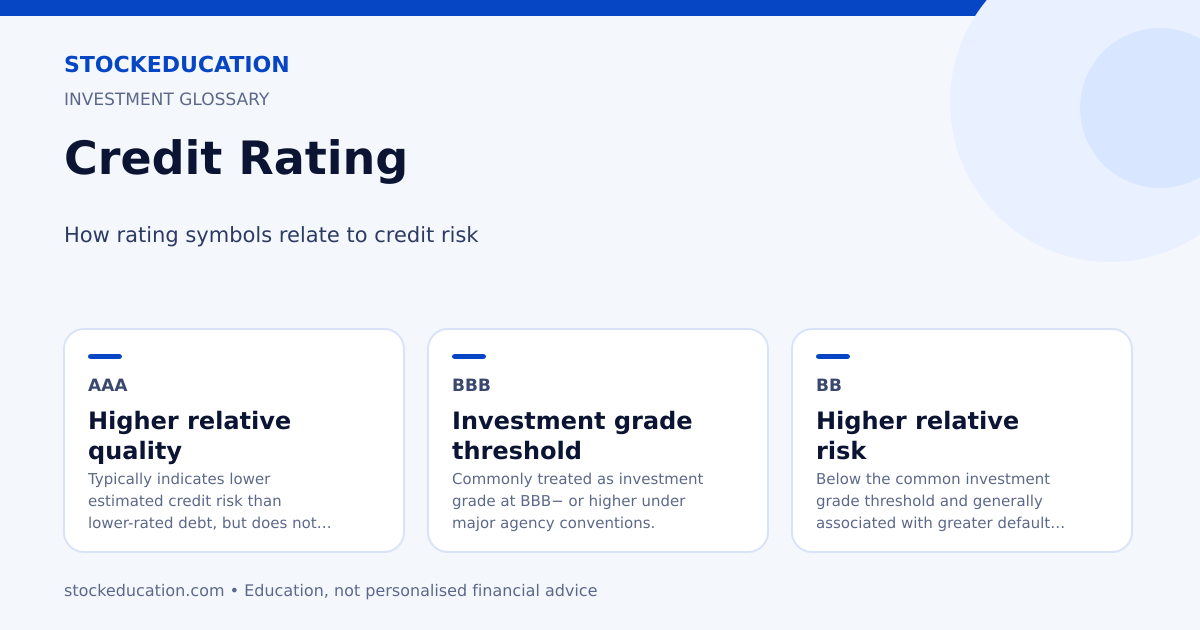
A credit rating is an opinion about the relative credit risk of a borrower or debt instrument, such as a corporate or government bond. Rating agencies assess creditworthiness and express their view with symbols such as AAA, BBB, or BB. A higher rating generally indicates a lower estimated likelihood of default than a lower rating, but it is not a guarantee of repayment or a recommendation to buy, sell, or hold an investment.Investors should read the rating definition, check whether it applies to the issuer or a specific debt issue, and consider changes in the issuer’s finances, market conditions, liquidity, collateral, and debt terms. Ratings can change over time. Compare a rating with the issuer’s balance sheet and the bond’s bond yield rather than relying on the letter grade alone.

Key takeaways
- A credit rating expresses an agency’s opinion about relative credit risk.
- Higher ratings generally correspond to lower estimated default risk, but they do not guarantee repayment.
- A rating may apply to an issuer’s overall creditworthiness or to a particular debt issue.
- Investment grade and non-investment-grade classifications summarize broad rating categories.
- Investors should review financial statements, debt terms, liquidity, collateral, yield, and rating changes alongside the letter grade.
What is Credit Rating?
Investors should read the rating definition, check whether it applies to the issuer or a specific debt issue, and consider changes in the issuer’s finances, market conditions, liquidity, collateral, and debt terms. Ratings can change over time. Compare a rating with the issuer’s balance sheet and the bond’s bond yield rather than relying on the letter grade alone.
How Credit Rating works
| Step | What happens |
|---|---|
| 01 · Identify the rated subject | Confirm whether the symbol applies to the issuer, a particular bond, a loan, or another obligation, and note the currency, maturity, seniority, and security. |
| 02 · Read the agency definition | Review the agency’s scale, modifiers, outlook, watch status, and stated rationale instead of treating the letter grade as self-explanatory. |
| 03 · Examine repayment capacity | Study revenue and cash flow, leverage, liquidity, refinancing needs, business conditions, governance, and the issuer’s balance sheet. |
| 04 · Review instrument protections | Check collateral, guarantees, covenants, call features, maturity, ranking, and the likely recovery position if the borrower experiences distress. |
| 05 · Compare market pricing | Consider yield, spread, price, duration, interest-rate sensitivity, liquidity, taxes, and expected return; a rating alone cannot determine value. |
| 06 · Monitor new information | Track financial reports, rating actions, outlook changes, major transactions, market conditions, and changes in the issuer’s ability to access financing. |
| 07 · Match risk to the investor | Consider time horizon, diversification, income needs, loss tolerance, liquidity needs, and applicable investment restrictions before deciding whether the security is appropriate. |
The formula
Relative credit risk = assessed likelihood of timely repayment and potential loss if repayment fails
The expression summarizes the two broad ideas behind credit analysis: whether payment is likely to occur and how severe the loss could be if it does not. It is a conceptual guide rather than a numerical agency formula; actual methodologies use different qualitative, quantitative, legal, and market inputs. A rating is relative and forward-looking, so it can change as the issuer, instrument, or surrounding conditions change.
A worked example
Hypothetical worked example: Assume Company A issues a five-year bond with a BBB rating and a $1,000 face value. An investor buys it at $980 and receives a 5% annual coupon, or $50 per year. If the bond is held to maturity and all payments are made, the investor receives four interim coupon payments of $50, a final coupon of $50, and $1,000 principal. The simple cash received is $1,250, compared with the $980 purchase price, but this is not the investor’s annual return because the cash arrives at different times.
The rating indicates that the agency views Company A’s relative credit risk as lower than that of a BB-rated issuer, but it does not guarantee that the $50 coupons or $1,000 principal will be paid. If the market yield for comparable risk rises, the bond’s price could fall below $980 even if Company A’s rating remains BBB. If the company defaults and investors ultimately recover 60% of face value, the recovered principal would be $600 rather than $1,000, a $400 shortfall before considering missed interest. The calculation also ignores taxes, commissions, reinvestment of coupons, inflation, liquidity, call provisions, and the time value of money.
This example is hypothetical and does not predict any issuer’s result. A careful investor would compare the issue rating with the issuer’s financial statements, debt seniority, collateral, covenants, maturity, market price, yield, and current rating outlook. The rating may apply to this specific bond rather than to every obligation of Company A, and another agency could assign a different symbol.
Why it matters
Credit ratings matter because they provide a standardized starting point for evaluating the relative credit risk of borrowers and debt instruments. They can affect how investors compare bonds, how issuers access financing, and how institutions apply investment policies or mandates. Yet the usefulness of a rating depends on understanding its scope and limitations. A high rating does not remove default risk, and a low rating does not by itself establish that a security is overpriced or unsuitable. Ratings can lag changing conditions, differ across agencies, and omit risks unrelated to repayment. Investors who combine the rating with financial statements, bond terms, liquidity analysis, market pricing, and a clear assessment of potential loss are less likely to mistake a convenient symbol for a complete investment decision.
What a Credit Rating Measures
A credit rating measures relative creditworthiness: how an agency assesses the likelihood that a borrower will meet scheduled interest and principal payments under stated terms. Analysts examine business strength, cash generation, leverage, liquidity, refinancing needs, industry conditions, governance, and the legal features of the obligation. The result is expressed through a scale intended to make broad comparisons easier, not to predict every outcome with certainty. A rating does not say that default is impossible at the top of the scale, nor does a lower rating prove that default will occur. It is an opinion formed from available information and assumptions that may change. Investors therefore need to identify exactly what is being rated and which obligations the assessment covers.
How Rating Symbols and Scales Work
Most widely used long-term scales place higher-quality obligations near AAA and progressively riskier obligations lower on the scale, with symbols such as BBB and BB commonly serving as important reference points. Agencies may add plus or minus modifiers, outlooks, or watch indicators to communicate relative position and possible direction. Short-term obligations can use a different scale, and symbols are not automatically identical across agencies. The common investment-grade boundary is generally around BBB− or its equivalent, while BB and lower are commonly described as non-investment grade, though terminology and regulatory treatment can vary. A scale is useful as a shorthand, but its labels require context: the same symbol may conceal differences in maturity, seniority, security, recovery prospects, and issue-specific protections.
Issuer Ratings Versus Issue Ratings
A rating can describe an issuer’s general credit profile or a particular bond, loan, or other obligation. An issuer rating considers the borrower broadly, whereas an issue rating may incorporate the instrument’s priority, collateral, guarantees, covenants, maturity, and structural position in the capital stack. Senior secured debt and subordinated unsecured debt from the same borrower may not receive the same assessment because investors could face different repayment prospects in distress. A rating also may cover only the obligations defined in the agency’s methodology. Before using a symbol in an investment decision, read the full rating action or definition and confirm the rated entity, instrument, currency, maturity, and ranking. Confusing these levels can lead to an inaccurate comparison.
Ratings, Default Risk, and Bond Prices
A rating addresses credit risk, but a bond’s price and yield reflect more than credit quality. Interest rates, inflation expectations, liquidity, maturity, call features, tax treatment, market sentiment, and supply and demand can all affect valuation. A lower-rated bond may offer a higher yield because investors demand compensation for greater perceived risk, but the extra yield is not free return and may not fully compensate for default, loss severity, or illiquidity. Prices can move before a formal rating change if investors anticipate weaker finances or improved conditions. Conversely, a rating may remain unchanged while market prices react to other risks. Comparing a rating with the bond yield helps, but neither measure alone establishes whether an investment is attractive.
Rating Changes, Outlooks, and Reviews
Ratings are not permanent. Agencies periodically review issuers and instruments as financial results, economic conditions, transactions, regulations, or market access change. An upgrade can signal improved assessed credit quality, while a downgrade can indicate increased relative risk; either event may influence borrowing costs and market prices, although the market may have anticipated it. An outlook often describes the likely direction over a stated period, while a watch or review can indicate that a more immediate decision is being considered. These indicators are not forecasts of a guaranteed outcome. Investors should examine the agency’s stated rationale, the assumptions behind the action, and whether the change affects the issuer, a specific security, or both.
Limitations and Responsible Use
A credit rating is one input rather than a complete investment analysis. Agencies may use different methodologies, have incomplete or delayed information, and make judgments that can prove wrong. Ratings also do not measure every important risk, including market-price volatility, liquidity, concentration, currency exposure, reinvestment risk, or whether a return is adequate for the risk taken. Investors should read offering documents and debt terms, review the borrower’s financial position, consider the security’s place in the capital structure, and assess their own time horizon and loss tolerance. A rating should support due diligence, not replace it. Treating a letter grade as a guarantee or as a buy and sell signal can create false confidence precisely when conditions are changing fastest.
Comparison
| Rating area | What it generally indicates | What it does not establish | Investor check |
|---|---|---|---|
| Higher-rated debt | Lower estimated relative default risk than lower-rated debt | Guaranteed repayment, stable price, or adequate return | Review financial strength, price, yield, maturity, and terms |
| Investment-grade boundary | Often BBB− or equivalent and above under common conventions | That the bond is risk-free or suitable for every investor | Check agency definitions, mandate rules, and issue-specific details |
| Below-investment-grade debt | Higher estimated relative credit risk and often a higher required yield | That default will occur or that the yield compensates for every possible loss | Assess cash flow, recovery prospects, seniority, collateral, liquidity, and loss tolerance |
| Issuer rating | Broad view of the borrower’s credit profile | The exact risk of every bond or obligation it issues | Confirm the instrument’s ranking, guarantees, currency, maturity, and covenants |
Check yourself
A bond is rated BBB, but its market price falls after interest rates rise. Which conclusion is most accurate?
A credit rating primarily expresses an agency’s opinion about relative creditworthiness and repayment risk. Bond prices can move because of interest rates, duration, liquidity, inflation expectations, market sentiment, and other factors even when the rating is unchanged. A price decline does not by itself prove default or a rating downgrade.
Show the answer
2. The rating addresses relative credit risk, while interest rates and other factors can still affect the bond’s price.
Things people get wrong
Mistake 01 Treating a rating as a guarantee
A high rating means the agency currently assesses relatively lower credit risk; it does not eliminate default, restructuring, delayed payment, or loss risk.
Mistake 02 Confusing issuer and issue ratings
An issuer rating may describe the borrower broadly, while an issue rating can reflect seniority, collateral, guarantees, covenants, maturity, and the instrument’s position in the capital structure.
Mistake 03 Assuming ratings are identical across agencies
Agencies use different methodologies, symbols, definitions, and review processes, so investors should read the relevant scale and rationale rather than comparing letters mechanically.
Mistake 04 Ignoring rating changes and outlooks
A stable rating can still mask changing fundamentals, while an outlook or review may signal a possible direction without guaranteeing an upgrade or downgrade.
Mistake 05 Using the rating as a buy or sell signal
Ratings address credit risk, not whether a bond’s price, yield, liquidity, duration, tax treatment, or expected return is attractive for a particular investor.
Mistake 06 Overlooking below-grade recovery risk
Default probability is only part of the potential loss. Seniority, collateral, guarantees, restructuring terms, and asset values can materially affect recovery after default.
Questions people ask about Credit Rating
What is a credit rating?
It is an agency’s opinion about the relative ability and willingness of an issuer or debt instrument to meet financial obligations in full and on time. It is an assessment, not a repayment promise or personalized investment recommendation.
Does a higher credit rating always mean a safer investment?
Generally, a higher rating indicates lower estimated relative default risk than a lower rating, but it does not remove default, price, liquidity, inflation, interest-rate, currency, or other investment risks.
What do AAA, BBB, and BB mean?
They are symbols on commonly used rating scales. AAA is near the highest-quality end, BBB is commonly around the investment-grade boundary, and BB is commonly below that boundary. Exact definitions and modifiers vary by agency.
What is investment grade?
Investment grade generally refers to ratings at or above approximately BBB− or an equivalent agency category for long-term debt. Definitions, mandates, regulations, and treatment can vary, so investors should check the applicable rules.
Can a bond rating change after purchase?
Yes. Agencies review issuers and instruments as finances, market access, transactions, economic conditions, or other assumptions change. An upgrade or downgrade can affect market prices, but the market may anticipate the action.
Is an issuer rating the same as a bond rating?
No. An issuer rating considers the borrower broadly, while a particular bond rating may reflect the bond’s seniority, security, guarantees, covenants, maturity, currency, and legal structure.
Why can a highly rated bond lose value?
Bond prices can fall when market interest rates rise or when liquidity, inflation expectations, duration, supply and demand, or investor sentiment change. A rating does not measure all drivers of market price.
Should investors rely on one agency?
No single rating should replace due diligence. Comparing agency opinions can identify differences, but investors should also review financial statements, offering documents, debt terms, yield, liquidity, and potential loss severity.
The bottom line
A credit rating is a useful shorthand for relative credit risk, not a guarantee of repayment or a complete investment analysis. Confirm whether the rating covers the issuer or a particular security, understand the agency’s scale and rationale, and monitor changes over time. Use the rating alongside financial statements, debt terms, seniority, collateral, liquidity, market price, and yield. A higher yield may compensate for greater perceived risk, but it can also reflect a meaningful possibility of default or loss. The most responsible interpretation is that a rating provides a starting point for research rather than a final buy, sell, or hold decision.
Sources
About this page. Written by Associate Professor Charles Lo, CPA, PhD and edited by Felix La Spina. No ads and no paywall. Editorial standards · How we fact check · Corrections log · Report an error
Educational information only. Nothing on this page is personal financial, tax or legal advice. Investing involves risk, including the possible loss of principal.


