
Investment Glossary · Quick read · No ads
Day Trading
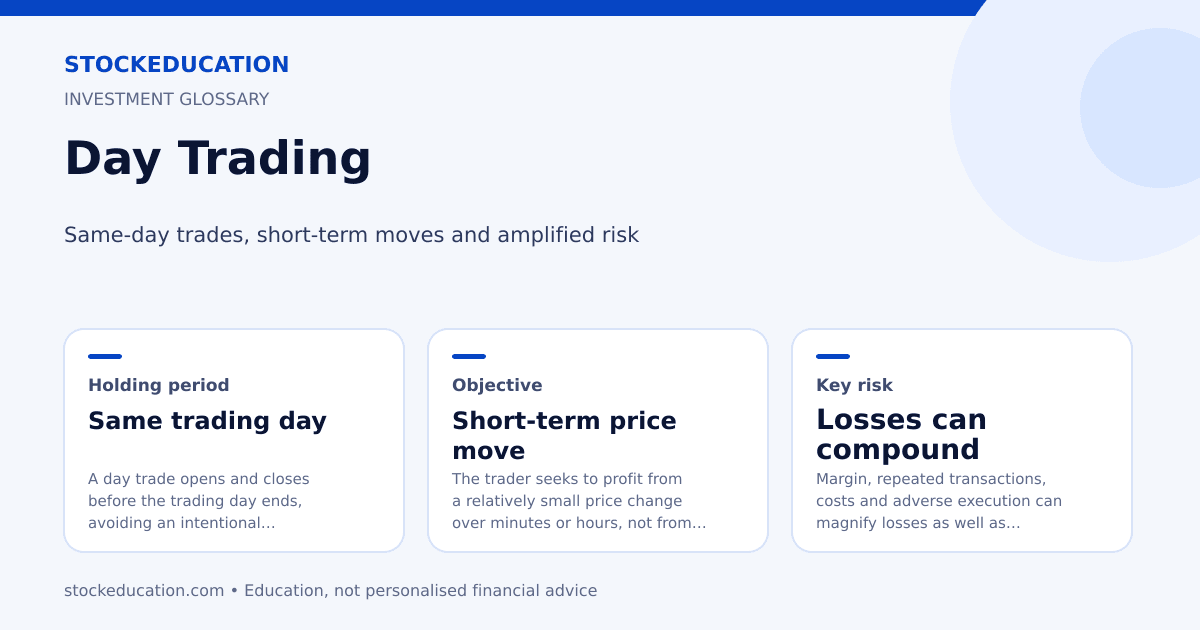
Day trading is a speculative trading approach in which a trader opens and closes positions during the same trading day, seeking to benefit from short-term price movements rather than holding the position overnight. The strategy can involve stocks or options, and some traders use margin, which can magnify both gains and losses. Before considering this approach, review Is Day Trading Profitable? and the site's studies on day trading rules. Regulators warn that frequent intraday trading can involve substantial costs, leverage, execution risk and the possible loss of some or all of the money committed.

Key takeaways
- Day trading opens and closes a position within the same trading day rather than intentionally carrying it overnight.
- The objective is generally to capture short-term price movements over minutes or hours, not to build a long-term ownership position.
- Stocks and options may be traded, while margin can increase purchasing power and magnify losses.
- Commissions, spreads, fees, taxes and poor execution can make a strategy unprofitable even when some trades are successful.
- A trader can lose some or all of the money committed, and losses may be larger when leverage or repeated transactions are involved.
What is Day Trading?
Day trading is a speculative trading approach in which a trader opens and closes positions during the same trading day, seeking to benefit from short-term price movements rather than holding the position overnight. The strategy can involve stocks or options, and some traders use margin, which can magnify both gains and losses.
Before considering this approach, review Is Day Trading Profitable? and the site’s studies on day trading rules. Regulators warn that frequent intraday trading can involve substantial costs, leverage, execution risk and the possible loss of some or all of the money committed.
How Day Trading works
| Step | What happens |
|---|---|
| 01 · Define the trade | State the security, direction, entry rationale, intended exit and conditions that would invalidate the idea. |
| 02 · Assess exposure | Determine position size, available cash or margin, liquidity and the maximum acceptable loss before entering. |
| 03 · Plan execution | Choose suitable order types and account for spread, slippage, partial fills, commissions, fees and possible delays. |
| 04 · Monitor the position | Reassess the trade against the written plan rather than reacting impulsively to every price movement. |
| 05 · Close and review | Exit according to the plan or risk limit, record the realized result after costs and review whether assumptions matched actual execution. |
| 06 · Check cumulative results | Evaluate a meaningful sample of trades, including costs, financing and applicable taxes, instead of relying on one win or loss. |
The formula
Net trading result = gross price-change result − transaction costs − financing and other charges − taxes
Gross price-change result is the gain or loss from the position's entry and exit prices, adjusted for the position size and direction. Transaction costs can include spreads, commissions, fees, slippage and borrow charges; financing includes margin interest, while tax effects depend on the trader's circumstances.
A worked example
Hypothetical example: A trader buys 100 shares at $20.00 and sells them later the same day at $20.30. The gross price-change result is 100 × ($20.30 − $20.00) = $30.00. If the spread, commissions and fees total $8.00, the result before taxes is $22.00. If the shares instead fall to $19.70, the gross loss is 100 × ($19.70 − $20.00) = −$30.00, or −$38.00 after the same $8.00 in costs.
This example is purely hypothetical and does not predict results. It excludes complications such as slippage, partial fills, taxes, margin interest, borrowing costs and changing fees. If margin were used, the position could represent more exposure than the trader's cash, magnifying the percentage effect on account equity and potentially creating additional obligations or forced liquidation.
Why it matters
Day trading matters because the short holding period can make execution, costs and risk control unusually important. A trader may need to overcome the spread and other expenses repeatedly, while a quick adverse move can erase several small gains. Margin can enlarge exposure and may create obligations or forced liquidation when account equity falls. Intraday trading also requires decisions under time pressure, so a plan that appears reasonable in a calm review may be difficult to follow in a fast market. Understanding the definition helps separate day trading from long-term investing, while understanding its mechanics helps a reader ask practical questions about account rules, order types, liquidity, taxes, leverage and the amount of money that could be lost. No description of a method should be treated as a promise of profitability.
How a day trade works
A day trade has an opening transaction and a closing transaction within the same trading day. A trader may buy first and later sell, or sell short and later buy back if the account and rules permit. The central idea is to seek a relatively small favorable move while the market is open. That process requires an entry decision, an exit plan and enough liquidity for orders to execute at acceptable prices. A trade is not automatically low risk because it lasts only minutes or hours: prices can move sharply, orders can fill at unexpected prices, and a small adverse move can become significant when the position is large relative to the account. Closing before the session ends avoids an intentional overnight position, but it does not guarantee a profit or prevent losses during the session.
Short-term price movement and execution
Day traders attempt to benefit from intraday changes caused by shifting supply and demand, news, market sentiment, order flow or other factors. The targeted move may be small, so the difference between the displayed price and the actual fill can matter. A bid-ask spread, commission, platform charge or other transaction expense reduces the result of each completed trade. Slippage can occur when a market moves between order submission and execution, especially in a fast or thin market. A limit order can constrain the maximum acceptable price but may not execute; a market order prioritizes execution but may produce a less favorable price than expected. These mechanics mean that a strategy must be evaluated on realized results after costs, not on a chart's theoretical entry and exit.
Margin and leverage
Margin allows an eligible trader to control a position using borrowed funds or account collateral, subject to the broker's terms and applicable requirements. It can increase exposure relative to cash, so a favorable price move may produce a larger percentage gain on the trader's capital. The same relationship works in reverse: an adverse move can produce a larger percentage loss and may require additional funds or prompt the broker to reduce positions. Margin interest and other charges can further affect results. Leverage does not improve the underlying probability of a trade succeeding; it changes the size of the financial consequence. Traders should understand maintenance requirements, forced liquidation policies, eligible securities and the possibility that losses can happen quickly before using margin.
Costs, taxes and account rules
Frequent trading creates repeated opportunities for costs to accumulate. Relevant items can include commissions, spread, exchange or regulatory fees, borrow charges for some short positions, margin interest and data or platform costs. Tax treatment depends on the person's circumstances, jurisdiction, account type and transaction history, so a gross trading result is not the same as money retained after taxes. Brokers and regulators may also apply account, margin, settlement or pattern-related requirements. Rules can differ by security and account type and can change over time. A person considering day trading should read the broker's current disclosures, understand how orders settle, identify every expected charge and obtain qualified tax or financial guidance when needed rather than assuming that frequent activity receives ordinary long-term investment treatment.
Risk management and discipline
Risk management cannot turn a speculative strategy into a guaranteed one, but it can define how much capital is exposed to a single idea and how a trader responds when conditions change. A written plan may specify an entry rationale, an invalidation point, a maximum position size, a daily loss limit and circumstances in which trading stops. Traders also need to account for gaps within the session, partial fills, platform interruptions and emotional decisions after a loss. Diversification may be difficult when positions are concentrated in one fast-moving security or market theme. Paper trading can help someone learn order mechanics, but simulated results may not reproduce real spreads, fills, liquidity, stress or discipline. Only risk capital that can be lost without impairing essential financial needs should be considered.
What day trading does not prove
A profitable trade, a short winning streak or a favorable backtest does not establish that a person has a durable edge. Historical results can depend on selected periods, assumptions about fills, omitted costs and market conditions that may not recur. Likewise, a losing trade does not by itself prove that every intraday method is invalid; it does show that outcomes are uncertain. The important evaluation is broader: whether results persist after realistic costs, whether risk is acceptable, whether leverage is controlled and whether the activity fits the person's resources, knowledge, time and tolerance for loss. Regulatory education emphasizes that day trading is highly risky and that many participants may not have the experience or financial capacity required. Treat claims of easy, reliable or guaranteed profits with caution.
Comparison
| Characteristic | Day trading | Long-term investing |
|---|---|---|
| Typical holding period | Within the same trading day | Months, years or longer |
| Primary objective | Capture short-term price movements | Participate in long-term business, income or market growth |
| Main practical pressures | Intraday execution, liquidity, repeated costs and time-sensitive decisions | Valuation, portfolio allocation, patience and long-term risk tolerance |
| Use of leverage | May be used and can magnify gains and losses | May be used in some strategies but is not required and still increases risk |
Check yourself
A trader buys 100 shares at $20.00 and sells them at $20.30, paying $8.00 in costs. What is the hypothetical result before taxes?
The gross result is 100 × ($20.30 − $20.00) = $30.00. Subtracting $8.00 of stated costs leaves a $22.00 result before taxes. This illustration does not predict actual trading outcomes.
Show the answer
$22.00 profit
Things people get wrong
Mistake 01 Treating a short holding period as low risk
Closing before the market close avoids intentional overnight exposure but does not prevent sharp intraday losses, poor fills, liquidity problems or execution risk.
Mistake 02 Ignoring costs because each trade is small
Spreads, commissions, fees, slippage, borrow charges and financing can accumulate across frequent trades and turn a seemingly profitable method into a loss.
Mistake 03 Using margin without understanding the consequences
Leverage increases exposure and can magnify losses, margin interest, maintenance requirements and the possibility of forced liquidation.
Mistake 04 Judging a strategy by gross gains alone
Results should be evaluated after realistic costs, taxes where applicable and assumptions about actual fills rather than from a chart's theoretical prices.
Mistake 05 Assuming a winning streak proves a durable edge
A short run of favorable outcomes or a backtest may depend on selected conditions and does not establish future profitability.
Questions people ask about Day Trading
What is day trading?
Day trading is opening and closing a security position during the same trading day to pursue short-term price movements rather than intentionally holding overnight.
What securities can be day traded?
Stocks and options can be used, among other products, but the definition depends on the intraday holding period rather than on one specific security.
Can day trading be profitable?
Some trades or periods may be profitable, but profitability is not guaranteed and must overcome costs, execution risks, taxes where applicable and potential losses.
How does margin affect day trading?
Margin can increase purchasing power and exposure, so it can magnify gains and losses and may lead to additional funding demands or forced liquidation.
What costs should a day trader consider?
Relevant costs may include spreads, commissions, platform or data charges, regulatory or exchange fees, slippage, borrow charges and margin interest.
Is paper trading the same as live trading?
No. Simulation may not reproduce real spreads, fills, liquidity, interruptions, emotional pressure or the financial consequences of losses.
What money should be used for day trading?
Only money that could be lost without impairing essential financial needs should be considered, subject to the person's circumstances and applicable rules.
The bottom line
Day trading seeks short-term price movements through positions opened and closed within one trading day. Its results depend on direction, position size, execution, liquidity and costs, while margin can magnify both gains and losses. It is speculative and does not guarantee income or financial success.
Sources
About this page. Written by Associate Professor Charles Lo, CPA, PhD and edited by Felix La Spina. No ads and no paywall. Editorial standards · How we fact check · Corrections log · Report an error
Educational information only. Nothing on this page is personal financial, tax or legal advice. Investing involves risk, including the possible loss of principal.


