
Investment Glossary · Quick read · No ads
Credit Default Swap (CDS)
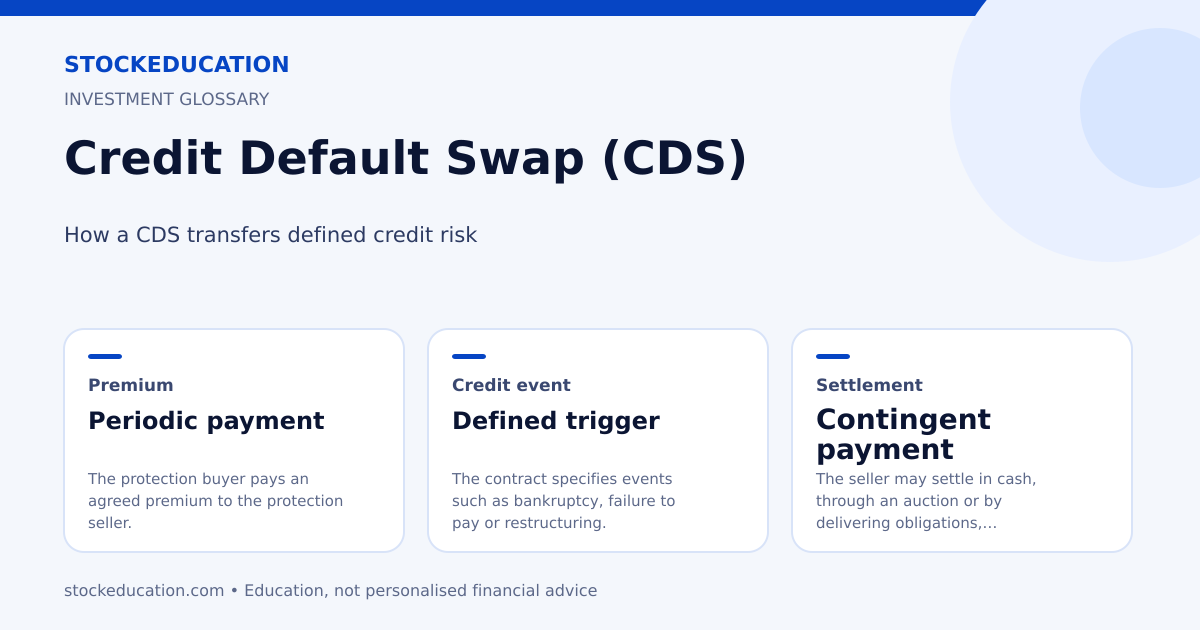
A credit default swap (CDS) is a derivative in which a protection buyer pays premiums to a protection seller in exchange for a contingent payment if a contractually defined credit event affects a specified reference entity or obligation.

Key takeaways
- A CDS transfers defined credit risk rather than eliminating it.
- The protection buyer pays a premium, commonly tied to a specified notional amount.
- A credit event and reference obligation must be defined in the contract.
- Settlement may be cash, auction-based or physical, depending on the terms.
- Counterparty, collateral, liquidity and documentation risks can materially affect outcomes.
What is Credit Default Swap (CDS)?
How Credit Default Swap (CDS) works
| Step | What happens |
|---|---|
| 01 · Define the reference risk | Identify the reference entity, reference obligation, notional amount, maturity, seniority and other eligibility terms. |
| 02 · Set the premium | Agree the premium, payment schedule, accrual rules and any upfront amount under the contract. |
| 03 · Specify the trigger | Review the precise credit-event definitions, notices, thresholds, grace periods and determination process. |
| 04 · Choose settlement | Establish whether the contract uses cash, auction-based or physical settlement and what obligations are eligible. |
| 05 · Manage collateral and performance | Assess margin, collateral, counterparty strength, liquidity, documentation and the ability to close or transfer the position. |
| 06 · Assess the outcome | If an event occurs, apply the settlement price, recovery value, deliverability and contractual adjustments to determine the payment. |
The formula
Contingent settlement amount ≈ Notional amount × (1 − Recovery value or settlement price as a fraction of par)
Notional amount: the contractual amount used to scale premiums and potential settlement. Recovery value or settlement price: the post-credit-event value used under the applicable settlement method. Contingent settlement amount: the approximate gross protection payment before premiums, collateral, fees and other adjustments. The formula is illustrative; the contract, auction result, deliverability rules and settlement terms control the actual payment calculation. Premium cash flows are separate from the contingent settlement and continue or terminate according to the contract’s provisions and event timing. A CDS spread or premium is not, by itself, a guaranteed probability of default or a complete measure of expected loss because recovery, discounting, liquidity and risk premia also matter.
A worked example
Hypothetical example: An investor buys CDS protection on a $10,000,000 notional amount of debt. Assume a defined credit event occurs and the applicable settlement price is 40% of par, implying a 60% loss rate. The approximate gross contingent settlement is $10,000,000 × (1 − 0.40) = $6,000,000. If the buyer paid an annual premium of 2.5% of notional for one year, the simple annual premium would be $10,000,000 × 0.025 = $250,000, before accruals, upfront payments, collateral costs, fees and other adjustments. This is only an illustration: the actual payment depends on the contract, event determination, settlement method, auction result, eligible obligations, recovery value and timing. The notional amount is not necessarily exchanged when the CDS is entered, and the premium is not a guaranteed probability of default.
Why it matters
CDS terms can change how credit deterioration affects a portfolio, but the apparent simplicity of paying a premium for protection can conceal substantial legal, market and counterparty dependencies. Understanding the reference entity, reference obligation, credit-event definition, notional amount and settlement method helps investors distinguish a true hedge from a mismatched position. It also prevents a CDS premium from being treated as a complete probability estimate or a contract from being treated as risk-free insurance. The same discipline is useful when assessing protection sellers, because premium income can be small relative to a contingent settlement obligation.
Contract Structure
A CDS has two principal sides: the protection buyer and the protection seller. The buyer pays an agreed premium over the life of the contract, while the seller accepts the obligation to compensate the buyer if the specified trigger occurs. The reference entity may be an issuer, borrower or group, and the reference obligation may be a bond, loan or other eligible debt instrument. The contract also states the notional amount, maturity, payment schedule, applicable credit-event definitions, settlement procedure and any collateral arrangements. These details determine what risk has actually been transferred; a CDS is not a generic promise to cover every decline in a security’s price.
Premiums and Notional Amount
The CDS premium is the price paid for protection, while the notional amount is the contractual scale used to determine potential settlement and premium obligations. The notional amount is not necessarily exchanged at the start of the trade and should not automatically be treated as the buyer’s cash investment or the seller’s immediate loss. Premium payments continue according to the contract until maturity, termination or an applicable credit event, subject to its precise accrual and settlement conventions. A rising market premium generally indicates that protection is becoming more expensive, but interpretation requires care because pricing can also reflect liquidity, interest rates, technical positioning, recovery assumptions and differences between the reference obligation and the holder’s actual exposure.
Credit Events and Triggers
A CDS does not respond to every fall in a bond’s market price or every deterioration in an issuer’s credit rating. It responds to credit events defined by the contract and applicable documentation. Common examples identified in standard descriptions include bankruptcy, failure to pay and restructuring, although the exact wording, thresholds, notice requirements and covered obligations matter. Determining whether a trigger occurred can involve formal notices, information about payment failures, grace periods, legal interpretation and an established determination process. Investors therefore need to distinguish economic distress from a contractually recognized event. A reference entity can appear financially weak without producing a settlement obligation, while a defined event can create operational and valuation consequences even when market narratives are unsettled.
Settlement Methods
After a valid credit event, a CDS may settle in cash, through an auction process or physically, depending on the contract. In cash settlement, the seller generally pays an amount based on the difference between the relevant par amount and an established post-event value or recovery-related price. An auction can establish a common price used to calculate obligations across participating contracts. Physical settlement instead involves delivery of eligible debt obligations in exchange for the applicable payment, subject to contract rules and deliverability. Settlement mechanics matter because they influence timing, valuation, deliverable supply, recovery outcomes and the parties’ operational obligations. The stated notional amount alone does not reveal the final cash flow without the event, settlement price and other contractual inputs.
Uses and Risk Transfer
A bank, fund or other investor may buy CDS protection to reduce exposure to a borrower or issuer, manage a portfolio’s credit risk or express a negative view on credit quality. A seller may receive premium income while accepting contingent exposure to losses. The hedge may not match the holder’s asset perfectly: differences in maturity, seniority, currency, documentation, reference entity or deliverability create basis risk. The contract also transfers risk rather than making it disappear. A seller can face a large obligation after receiving relatively small periodic premiums, and a buyer may not receive expected protection if documentation, event determination, collateral or counterparty performance becomes contested.
Counterparty, Collateral and Liquidity Risk
A CDS depends on both parties being able to perform and on the market being sufficiently liquid to value, collateralize or close the position. A protection buyer can face counterparty risk if the seller cannot make the required payment; a seller can face funding and collateral demands when the position moves against it. Margin and collateral arrangements may reduce some exposure but do not remove legal, operational or market risks. Bid-offer spreads, limited trading activity and uncertainty about recovery values can make a position costly to unwind. Analysis should therefore review the contract, collateral terms, counterparty strength, liquidity, settlement process and the relationship between the CDS reference risk and the investor’s underlying asset.
Comparison
| Position | Cash flow | Main exposure | Typical objective |
|---|---|---|---|
| Protection buyer | Pays periodic premium; may receive contingent settlement | Premium cost, basis and seller performance | Hedge defined credit exposure or take a negative credit view |
| Protection seller | Receives premium; may owe contingent settlement | Credit-event loss, collateral and funding pressure | Accept credit exposure for premium income |
| Underlying debt holder without CDS | Receives debt cash flows; bears asset value and default risk | Direct issuer, recovery and liquidity risk | Hold or manage the debt instrument itself |
Check yourself
Which statement best describes a credit default swap?
A CDS transfers specified credit risk from a protection buyer to a protection seller. The buyer pays premiums, and the seller may owe a contingent payment after a contractually defined credit event. The contract does not cover every investment loss, necessarily exchange notional at inception, or eliminate counterparty and liquidity risks.
Show the answer
2. It transfers defined credit risk through premium payments and a contingent settlement obligation.
Things people get wrong
Mistake 01 Confusing price declines with credit events
A CDS generally responds only to events defined in its documentation, not to every fall in a bond price or every rating change.
Mistake 02 Treating notional as an upfront investment
Notional scales contractual obligations but is not necessarily exchanged at inception or equal to the buyer’s cash outlay.
Mistake 03 Calling a CDS risk-free insurance
Counterparty, basis, collateral, liquidity, legal and settlement risks can all affect whether protection performs as expected.
Mistake 04 Ignoring settlement mechanics
Cash, auction and physical settlement can produce different timing, valuation, deliverability and operational consequences.
Mistake 05 Reading the premium as a complete default forecast
Premiums also reflect recovery expectations, liquidity, risk premia, interest rates and technical market conditions.
Questions people ask about Credit Default Swap (CDS)
What is a CDS?
It is a derivative that transfers defined credit risk from a protection buyer to a protection seller in exchange for premiums and a contingent settlement obligation.
Who pays the CDS premium?
The protection buyer pays the agreed periodic premium to the protection seller while the contract remains active, subject to its terms.
What triggers CDS settlement?
A contractually specified credit event, such as bankruptcy, failure to pay or restructuring where applicable, can trigger settlement.
Does a CDS cover any investment loss?
No. It covers the defined reference risk and events in the contract, so mismatches and excluded events can leave losses unprotected.
How can a CDS settle?
Depending on the contract, it may settle in cash, through an auction or physically by delivery of eligible obligations.
Is selling CDS the same as earning risk-free income?
No. Premium income is compensation for accepting contingent credit, funding, collateral, liquidity and counterparty exposure.
The bottom line
A CDS can transfer defined credit risk, but it does not make that risk disappear. Analyze the reference entity, reference obligation, premium, notional amount, credit-event definitions, settlement method, collateral, liquidity, basis risk and counterparty before treating a CDS as a hedge or an income strategy.
Sources
About this page. Written by Associate Professor Charles Lo, CPA, PhD and edited by Felix La Spina. No ads and no paywall. Editorial standards · How we fact check · Corrections log · Report an error
Educational information only. Nothing on this page is personal financial, tax or legal advice. Investing involves risk, including the possible loss of principal.


