
Investment Glossary · Quick read · No ads
Exchange Traded Fund (ETF)
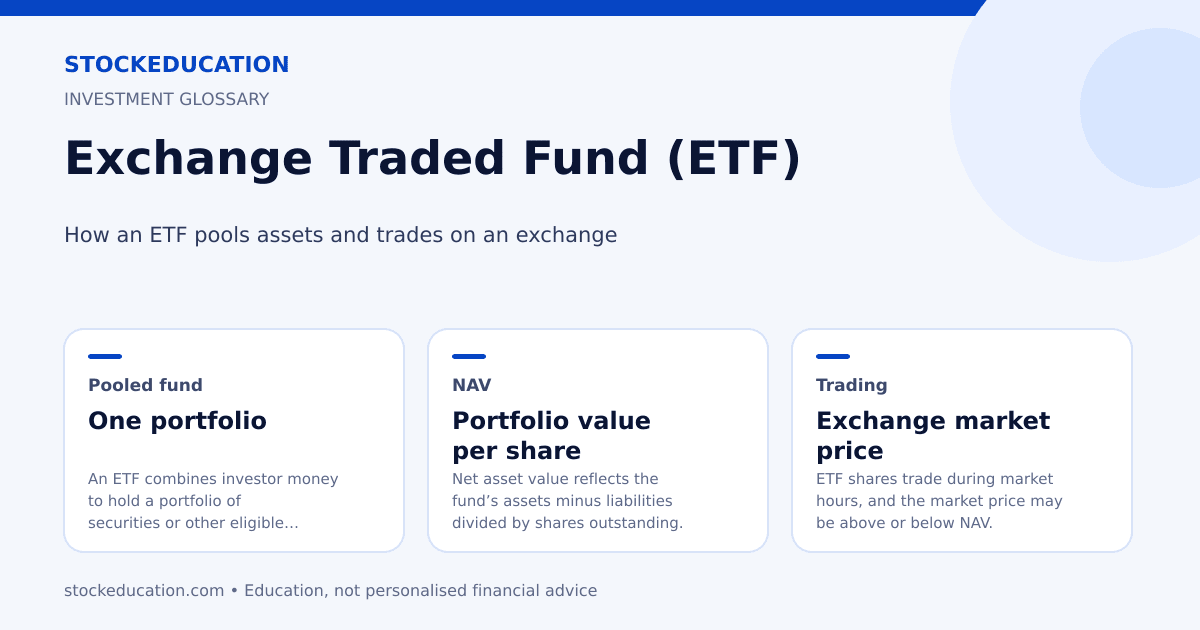
An exchange-traded fund (ETF) is a pooled investment fund whose shares trade on a national securities exchange during market hours. An ETF can track an index or be actively managed, so the term describes the fund’s structure and trading method rather than a particular investment strategy.

Key takeaways
- An ETF pools investor money into a portfolio of securities or other eligible assets.
- ETF shares trade throughout the trading day at a market price on an exchange.
- An ETF’s market price can be above or below its net asset value, or NAV.
- ETFs may follow an index or use active management, so strategies and risks vary.
- Before investing, review an ETF’s objective, holdings, fees, trading conditions, risks and prospectus.
What is Exchange Traded Fund (ETF)?
An exchange-traded fund (ETF) is a pooled investment fund whose shares trade on a national securities exchange during market hours. An ETF may seek to track an index or may be actively managed, so the term describes how the fund is structured and traded rather than requiring a particular investment strategy.
ETF shares trade at market prices that can differ from the fund’s net asset value (NAV). Investors should review the fund’s objective, holdings, fees, risks and prospectus before investing. Learn more with the SEC Investor Bulletin on exchange-traded funds and compare available funds with the ETF Screener.
How Exchange Traded Fund (ETF) works
| Step | What happens |
|---|---|
| 01 · 1. Define the purpose | Identify the exposure, time horizon, diversification goal and risk level the investment is intended to serve. |
| 02 · 2. Read the objective and strategy | Determine whether the ETF tracks an index, uses a rules-based approach or is actively managed, and note any concentration or leverage. |
| 03 · 3. Inspect holdings and risks | Review current holdings, sectors, countries, asset types, derivatives, credit exposure, liquidity and the principal risks in the prospectus. |
| 04 · 4. Compare costs and trading conditions | Check the expense ratio, bid-ask spread, volume, commissions or platform charges where applicable, and whether the fund commonly trades near NAV. |
| 05 · 5. Choose an order approach | Review the live bid and ask and consider whether a limit order provides useful price control; remember that a limit order may not execute. |
| 06 · 6. Monitor the investment | Recheck the fund’s objective, holdings, costs, risks, tax implications and fit with the portfolio rather than judging it solely by recent performance. |
The formula
NAV per share = (Total fund assets − Total fund liabilities) ÷ Shares outstanding
Total fund assets include the market value of securities, cash and other assets held by the ETF. Total fund liabilities include amounts the fund owes, and shares outstanding are the ETF shares used in the calculation. NAV is an accounting value per share; the exchange market price can trade above or below it.
A worked example
Hypothetical example: Assume an ETF owns a portfolio worth $10,000,000, has $100,000 in liabilities, and has 1,000,000 shares outstanding. Its NAV per share is ($10,000,000 − $100,000) ÷ 1,000,000 = $9.90. If exchange buyers and sellers currently agree on a market price of $9.95, the ETF is trading at a $0.05 premium to NAV, or approximately 0.51% above NAV. If the quoted market price were $9.85, it would be trading at a $0.05 discount, or approximately 0.51% below NAV. This arithmetic is illustrative only. Actual NAV calculations use the fund’s valuation procedures, liabilities, share count and the values of its holdings, while the market price changes with orders, liquidity and market conditions. The example does not predict performance, guarantee that an ETF will remain close to NAV, or show the investor’s complete return. An investor buying at $9.95 could also pay a bid-ask spread, brokerage or platform charges where applicable, taxes and the fund’s ongoing expenses. The investor should review the prospectus, current holdings, objective, principal risks and trading quotations before deciding whether the ETF fits the intended time horizon and risk tolerance.
Why it matters
Understanding ETFs helps investors distinguish the fund’s pooled structure from its investment strategy. The exchange listing provides intraday trading, but it also means an investor must consider market orders, bid-ask spreads, liquidity and the possibility that the trading price differs from NAV. Reviewing the objective, holdings, expenses, risks and prospectus can help an investor avoid assuming that every ETF is broadly diversified, inexpensive, passive or low risk. The same review is important when comparing ETFs with mutual funds or selecting among funds with similar names.
How an ETF is structured
An ETF combines money from many investors into one portfolio. Depending on its objective and legal structure, that portfolio may contain stocks, bonds, commodities, cash, derivatives or other eligible holdings. Investors generally own shares of the fund rather than the underlying securities directly. The fund’s documents describe what it may hold, how it seeks to achieve its objective, how risks are managed and what expenses are charged. ETFs are commonly organized as registered investment companies or unit investment trusts under the Investment Company Act of 1940. This pooled structure can give investors access to a diversified collection of assets through a single exchange-traded security, but diversification does not remove investment risk or guarantee a profit.
Trading price and NAV
An ETF has a net asset value, or NAV, calculated from the value of its assets minus liabilities, divided by the number of shares outstanding. Its shares also have a market price determined by buy and sell orders on an exchange. These figures are related but are not required to be identical at every moment. The market price may be above NAV, called a premium, or below NAV, called a discount. Price differences can reflect supply and demand, trading costs, bid-ask spreads, market volatility, the timing of NAV calculations and the liquidity of the fund’s holdings. During market hours, the price investors receive is the available market price for their order, not necessarily the latest published NAV. A limit order can provide more control over execution price than a market order, but it may not execute.
Index and active ETF strategies
Some ETFs seek to track an index by holding all or a representative sample of its components, while others use rules-based methods, optimization or derivatives to pursue a stated benchmark. Tracking an index does not mean the fund will match it perfectly because fees, trading costs, sampling and portfolio changes can create tracking differences. Actively managed ETFs allow a portfolio manager to select or adjust holdings according to the fund’s strategy rather than simply replicating an index. The active or passive label does not by itself establish that one approach is better. Investors should examine the objective, methodology, holdings, turnover, concentration, benchmark, restrictions and management process. A narrow thematic or sector ETF may hold many securities yet remain exposed to a small part of the economy.
Costs and order execution
An ETF’s expense ratio represents ongoing fund operating expenses charged against assets, but it is only one part of the investor’s total cost. Investors may also encounter bid-ask spreads, brokerage commissions where applicable, exchange or platform charges, taxes and the effects of buying or selling at a premium or discount to NAV. A fund with a low expense ratio can still be costly to trade if its spread is wide or its shares are thinly traded. Conversely, a higher-expense fund may have trading characteristics that matter for a particular strategy. Before placing an order, investors can review the quoted bid and ask, trading volume, order type and the fund’s prospectus. Costs reduce returns over time, although no fee measure predicts future performance.
Risks investors should review
ETF risks depend on what the fund owns and how it operates. Broad funds can fall when markets decline, while bond ETFs may face interest-rate, credit and liquidity risks. Sector, country, commodity, leveraged and inverse funds can be more concentrated or complex than a diversified stock or bond fund. Foreign holdings may involve currency, political and settlement risks. Derivatives can add counterparty, leverage and valuation risks. Securities-lending practices, premiums or discounts, tracking differences and the liquidity of underlying assets can also affect results. Past performance does not establish future returns. Investors should read the prospectus and shareholder reports, understand the fund’s objective and principal risks, and consider whether the product fits their time horizon, diversification needs, risk tolerance and tax situation.
Comparing ETFs with other funds
ETFs and mutual funds both pool investor money and can provide diversified exposure, but their trading mechanics differ. ETF shares are bought and sold on an exchange during market hours at negotiated market prices. Mutual fund shares are generally purchased from or redeemed with the fund at the next calculated NAV. ETFs may offer intraday trading and transparent exchange quotations, while mutual funds may provide automatic investment or redemption features that differ by provider. Neither structure is automatically safer or more suitable. The relevant comparison includes the investment objective, holdings, costs, liquidity, tax considerations, minimums, transaction process and risks. A fund’s legal wrapper and exchange listing should not substitute for reviewing its actual portfolio and disclosures.
Comparison
| Characteristic | ETF | Mutual fund |
|---|---|---|
| Trading venue and timing | Shares generally trade on an exchange throughout market hours | Shares are generally bought from or redeemed with the fund at the next calculated NAV |
| Price received | Market price determined by orders; it can be above or below NAV | Generally the next calculated NAV, subject to applicable rules and charges |
| Investment management | May track an index or be actively managed | May track an index or be actively managed |
| Costs and features | Expense ratio plus possible spread, commissions or platform charges; intraday trading is available | Expense ratio and applicable charges; automatic investment or redemption features may be available |
Check yourself
An ETF has total assets of $5,000,000, liabilities of $50,000, and 500,000 shares outstanding. What is its hypothetical NAV per share?
NAV per share is calculated as (total assets − total liabilities) ÷ shares outstanding: ($5,000,000 − $50,000) ÷ 500,000 = $4,950,000 ÷ 500,000 = $9.90. The exchange market price could nevertheless be above or below that NAV.
Show the answer
2. $9.90
Things people get wrong
Mistake 01 Assuming every ETF is broadly diversified
An ETF can focus on one sector, country, commodity, theme or strategy, so investors should inspect its holdings, concentration and objective rather than relying on the ETF label.
Mistake 02 Treating the expense ratio as the complete cost
Trading spreads, commissions or platform charges, taxes, premiums or discounts to NAV, and portfolio trading effects can also affect results.
Mistake 03 Believing market price and NAV are always identical
They are related but distinct figures; supply and demand, volatility, liquidity and valuation timing can produce a premium or discount.
Mistake 04 Using a market order without checking execution conditions
A market order prioritizes execution rather than a specified price, so investors should consider the bid, ask, spread and liquidity before trading.
Mistake 05 Assuming passive means risk-free
Index tracking can still involve market, concentration, tracking, liquidity and other risks, and an index fund can lose value when its holdings decline.
Questions people ask about Exchange Traded Fund (ETF)
What does ETF stand for?
ETF stands for exchange-traded fund, a pooled investment fund whose shares trade on an exchange during market hours.
How is an ETF different from a mutual fund?
ETF shares generally trade between investors on an exchange at market prices during the day, while mutual fund shares are generally bought from or redeemed with the fund at the next calculated NAV.
Can an ETF be actively managed?
Yes. Some ETFs track indexes or use rules-based methods, while actively managed ETFs use a manager’s investment decisions to pursue the stated objective.
What is NAV?
Net asset value is the fund’s assets minus liabilities, divided by shares outstanding. It is an accounting value that may differ from the exchange market price.
Are ETFs less risky than individual stocks?
Not automatically. Risk depends on the ETF’s holdings, concentration, strategy, leverage, derivatives, geography, liquidity and other characteristics.
What costs should an ETF investor review?
Review the expense ratio, bid-ask spread, commissions or platform charges where applicable, taxes, premiums or discounts to NAV and other costs described in the fund documents.
Can an ETF lose money?
Yes. The value of ETF shares can fall, and past performance does not guarantee future results. Read the prospectus and consider whether the fund suits your circumstances.
What should I check before buying an ETF?
Review the objective, holdings, benchmark or management process, risks, expenses, liquidity, spread, order type, tax considerations and prospectus.
The bottom line
An ETF is a pooled fund that trades like a stock during market hours, but its label does not tell you whether it is diversified, passive, inexpensive or low risk. Compare the objective, holdings, NAV relationship, trading costs and principal risks before investing.
Sources
About this page. Written by Associate Professor Charles Lo, CPA, PhD and edited by Felix La Spina. No ads and no paywall. Editorial standards · How we fact check · Corrections log · Report an error
Educational information only. Nothing on this page is personal financial, tax or legal advice. Investing involves risk, including the possible loss of principal.


