
Investment Glossary · Quick read · No ads
Large Cap
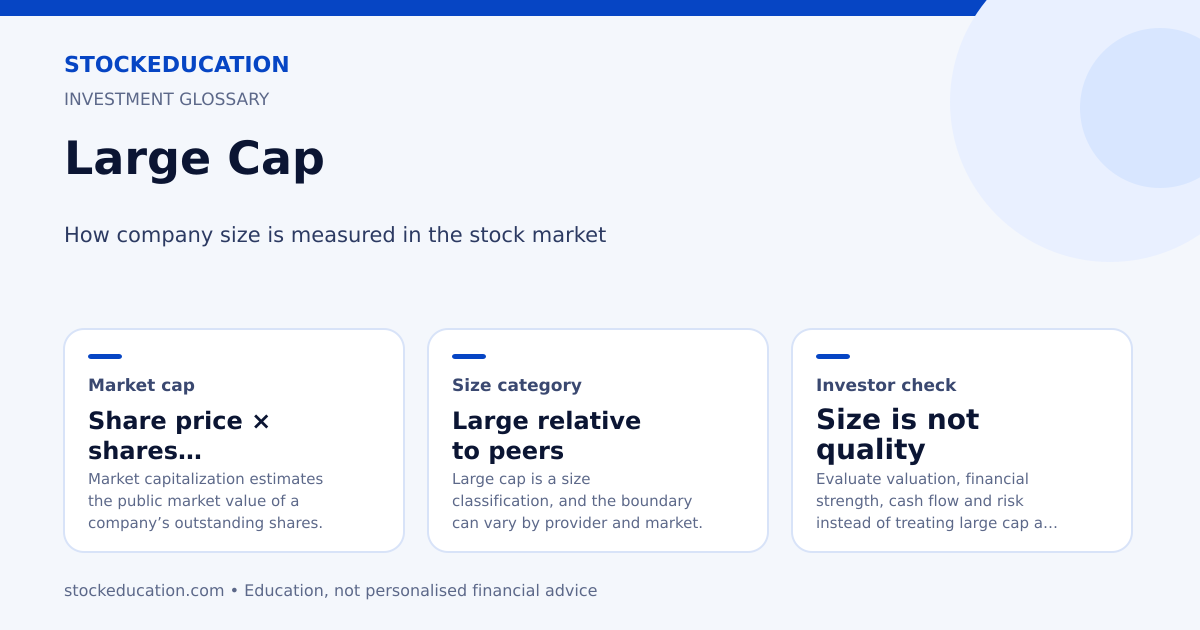
Large cap describes a company with a relatively large market capitalization. It is a size classification, not a promise of safety, profitability, quality or superior returns.

Key takeaways
- Large cap refers to company size measured by market capitalization.
- Market capitalization equals share price multiplied by total outstanding shares.
- The boundary between large cap and other size categories can vary by index provider and market conditions.
- Large cap companies may have scale and established operations, but they can still face valuation, debt, cash-flow and competitive risks.
- Investors should evaluate the company or fund’s methodology rather than treating a size label as a complete investment analysis.
What is Large Cap?
Large cap describes a company with a relatively large market capitalization, calculated by multiplying its share price by its total outstanding shares. The label helps investors compare company size, but it is not a guarantee of quality, safety, profitability or future returns. Size classifications can also vary by index provider and market conditions, so investors should check the methodology behind any fund or screen they use.
For a practical starting point, review Market Capitalization and compare how Index Funds use market capitalization in portfolio construction. A large cap company may offer scale and established operations, but investors should still examine valuation, financial statements, debt, cash flow and competitive risks.
How Large Cap works
| Step | What happens |
|---|---|
| 01 · Define the universe | Identify the market, region, index or fund methodology being used because a size classification is relative to a defined comparison group. |
| 02 · Calculate market capitalization | Multiply the current public market price per share by the total outstanding shares, while noting whether the source uses basic, diluted or free-float-adjusted shares. |
| 03 · Check the classification rules | Review the provider’s cutoff, ranking method, eligible securities, rebalancing schedule and treatment of companies near category boundaries. |
| 04 · Review the actual exposure | For a fund, inspect holdings, weighting method, sector and geographic concentration, expenses, turnover and tracking approach; for a stock, examine the company directly. |
| 05 · Evaluate investment risk | Study valuation, revenue and earnings quality, cash flow, debt, liquidity, competition, regulation and disruption instead of relying on the large-cap label. |
| 06 · Fit it to the portfolio | Consider diversification, existing exposures, time horizon, objectives and tolerance for loss before deciding whether the stock or fund belongs in the portfolio. |
The formula
Market capitalization = share price × total outstanding shares
Share price is the current public market price for one share. Total outstanding shares are the shares issued and currently held by shareholders, subject to the measurement convention used. The result is an estimate of public market value and may change with price movements or share-count changes. A company’s market capitalization does not by itself establish quality, safety, fair value or future performance。
A worked example
Hypothetical example: suppose Company A has a share price of $40 and 2 billion total outstanding shares. Its market capitalization is $40 × 2,000,000,000 = $80,000,000,000, or $80 billion. If the share price rises to $44 while the share count stays unchanged, market capitalization becomes $88 billion. If the company instead repurchases 100 million shares at the original $40 price, the simplified calculation becomes $40 × 1.9 billion = $76 billion. In practice, prices move continuously, share counts can change, and providers may use basic, diluted, free-float-adjusted or other conventions. The example shows how market value is calculated; it does not show that Company A is fairly valued, financially strong, safe or likely to outperform. A real evaluation would also examine earnings, cash flow, debt, valuation, competition and the methodology used by the relevant index or fund.
Why it matters
The label matters because it helps investors understand the intended size exposure of a stock, index or fund and compare that exposure with other portfolio holdings. Large cap securities may provide scale, liquidity and diversification within a market segment, but those traits do not guarantee stable prices or good results. A classification can change, and different providers can classify the same company differently. Checking the calculation, methodology, concentration and valuation helps prevent investors from mistaking a convenient category for a complete assessment of risk and expected return.
How large cap is measured
Large cap begins with market capitalization, an estimate of the public market value represented by a company’s outstanding shares. The basic calculation uses the current share price and total shares outstanding, so the result changes as the share price changes and may also change when a company issues, repurchases or otherwise alters its shares. A high share price alone does not make a company large cap because share count matters equally. Investors should also distinguish basic shares from diluted measures when reading a fund methodology or company filing. The resulting figure is most useful as a comparative measure within a defined market universe, not as a permanent physical attribute of the business.
Why classifications vary
There is no universal cutoff that makes every company large cap. Index providers and fund managers may rank companies by market value, divide a market into segments, use investable or free-float-adjusted capitalization, or apply rules for rebalancing and migration between categories. A company near a boundary can therefore appear in different classifications across products, especially when markets move sharply. A classification may also be based on a company’s position in a particular national, regional or global universe rather than on one fixed dollar threshold. Before comparing funds or screens, investors should read the provider’s stated methodology, eligible universe, weighting rules and review schedule.
What large cap can suggest
Large cap companies often have substantial revenue bases, recognizable operations, broader access to capital and greater trading liquidity than many smaller companies. Those characteristics can make them useful building blocks for diversified portfolios and may reduce some business-specific constraints associated with very small firms. They do not remove risk. A large company can be exposed to economic cycles, regulation, technological change, currency movements, litigation, disruption and management mistakes. Mature scale can also mean slower growth, while a popular company can become expensive relative to its earnings or cash generation. Size is therefore a starting point for comparison, not an investment conclusion.
Large cap stocks and funds
An investor can encounter large cap exposure by purchasing individual shares, a mutual fund, an exchange-traded fund or an index fund. A fund labeled large cap may hold many companies, but its actual exposure depends on its benchmark, selection process, capitalization weighting, sector limits, geography and rebalancing rules. A capitalization-weighted fund can give its largest holdings a substantial influence, while an equal-weighted or actively managed fund may produce a different risk pattern. Review the prospectus, holdings, expenses, concentration, turnover and tracking approach. The label should explain the intended size segment, not substitute for understanding what the product actually owns.
How to evaluate a large cap company
After identifying a company as large cap, examine the business on its own terms. Consider revenue and earnings quality, operating margins, free cash flow, balance-sheet liquidity, debt maturities, capital allocation, competitive advantages and exposure to disruption. Compare valuation measures with the company’s growth prospects, profitability and industry conditions rather than assuming a large company is fairly priced. Read financial statements and risk disclosures, and consider whether a single holding would create excessive sector or company concentration. For funds, assess the benchmark and costs as well as the underlying holdings. A disciplined review separates the useful size description from the broader question of whether the investment fits the portfolio.
Limits of the label
Large cap is backward-looking in the sense that it summarizes a market value at a point in time, while investment outcomes depend on future business performance, expectations and price. Market capitalization can fall quickly during a selloff, and a company can move between categories without any immediate change in its underlying operations. Conversely, a rising price can enlarge market capitalization even when fundamentals have not improved. The category also says little about valuation, dividend policy, governance, resilience or downside risk. Treat large cap as one descriptive data point, verify the definition used, and combine it with fundamental, valuation and portfolio-level analysis.
Comparison
| Category | What it describes | Common use | Important limitation |
|---|---|---|---|
| Large cap | Relatively large market capitalization within a defined universe | Identifying exposure to larger established companies or large-cap funds | The boundary varies, and size does not guarantee safety, quality or superior returns |
| Mid cap | Intermediate market capitalization within a defined universe | Comparing companies between larger and smaller size segments | Definitions differ by provider, and businesses can migrate between categories |
| Small cap | Relatively small market capitalization within a defined universe | Identifying exposure to smaller companies and their potential growth or volatility | Smaller size can involve liquidity, financing and business risks, but the label alone does not predict performance |
| Market capitalization | Share price multiplied by outstanding shares | Estimating a company’s public market value | The figure changes with price and share count and may use different measurement conventions |
Check yourself
A hypothetical company has a share price of $25 and 400 million outstanding shares. What is its market capitalization before considering any provider-specific adjustments?
Market capitalization equals share price multiplied by total outstanding shares: $25 × 400,000,000 = $10,000,000,000, or $10 billion. This calculation describes market value; it does not determine whether the company is fairly valued, safe or likely to outperform.
Show the answer
3. $10 billion
Things people get wrong
Mistake 01 Treating large cap as a safety guarantee
Large companies can still face falling prices, debt pressure, weak cash flow, disruption, regulation and expensive valuations. Size describes relative market value, not the quality or risk of an investment.
Mistake 02 Assuming there is one universal large-cap cutoff
Index providers and funds may use different market universes, free-float adjustments, ranking methods and review schedules. Read the specific methodology before comparing classifications.
Mistake 03 Ignoring share count in the calculation
A high share price alone does not determine company size. Market capitalization depends on both the price per share and the number of outstanding shares.
Mistake 04 Using the label instead of evaluating the investment
A large-cap stock or fund still requires review of valuation, financial statements, concentration, expenses, debt, cash flow and competitive risks.
Mistake 05 Assuming a large-cap fund has identical exposure to every other large-cap fund
Benchmarks, weighting methods, sector limits, holdings, geography, turnover and rebalancing rules can produce materially different portfolios.
Questions people ask about Large Cap
What does large cap mean?
Large cap describes a company with a relatively large market capitalization compared with companies in a defined market or index universe. It is a size classification, not a guarantee of quality or performance.
How is market capitalization calculated?
Multiply the current public market price per share by the company’s total outstanding shares. The result changes when the share price or share count changes.
Is there one official large-cap dollar threshold?
No. Definitions vary by provider, market, eligible universe, ranking approach, free-float treatment and review date, so investors should check the methodology behind a classification.
Are large-cap stocks safer than small-cap stocks?
Large companies may have scale, liquidity and established operations, but they can still suffer substantial losses and face business, valuation, financial and market risks. Size alone does not establish safety.
Can a company move out of the large-cap category?
Yes. Market values change with share prices and share-count changes, and providers periodically rebalance or update classifications. A company near a boundary may also be classified differently by different providers.
What is the difference between a large-cap stock and a large-cap fund?
A stock represents an individual company, while a fund owns a portfolio selected according to its stated benchmark or strategy. Funds can differ in concentration, weighting, expenses, geography, sector exposure and turnover.
Should investors buy a stock because it is large cap?
The label can help describe portfolio exposure, but it is not a buy signal. Investors should examine valuation, financial strength, growth prospects, risks, diversification and whether the investment fits their objectives.
The bottom line
Large cap is a useful description of relative company size based on market capitalization, but it is not an investment verdict. Calculate or verify the market value, read the provider’s classification rules, and then assess valuation, financial strength, concentration and risk. A large company can be durable and liquid while still being overpriced, exposed to disruption or capable of producing poor returns.
Sources
About this page. Written by Associate Professor Charles Lo, CPA, PhD and edited by Felix La Spina. No ads and no paywall. Editorial standards · How we fact check · Corrections log · Report an error
Educational information only. Nothing on this page is personal financial, tax or legal advice. Investing involves risk, including the possible loss of principal.


