
Cash Flow, Financial Analysis and Valuation · Beginner · 8 minutes · No ads
Financing Cash Flow
Also called cash flow from financing activities financing activities cash flow net cash provided by financing activities net cash used in financing activities
Financing cash flow is the net cash a company receives from or pays to lenders and shareholders during a period. Borrowing and issuing shares generally create inflows; debt principal repayments, dividends and share repurchases generally create outflows. A positive or negative total is not inherently good or bad because the underlying transactions and the company’s circumstances determine its meaning.

Key takeaways
- Financing cash flow records cash transactions with lenders and shareholders rather than cash generated by normal operations.
- Borrowing and cash proceeds from issuing shares usually increase financing cash flow.
- Debt principal repayments, dividends and share repurchases usually reduce financing cash flow.
- A positive financing total can indicate fresh funding, not business profitability or stronger operations.
- Interpret the total with the operating and investing sections, balance sheet, notes and management’s liquidity discussion.
What is financing cash flow?
Financing cash flow shows cash exchanged with lenders and shareholders during a reporting period. Borrowing and issuing shares can bring cash in, while repaying principal, repurchasing shares and paying dividends can send cash out. The result explains how management funded the company or returned capital, but it does not measure operating performance.
Read financing activity alongside the other sections using the lesson on how to read a cash flow statement. For a public company, confirm the reported lines, periods and accounting notes in its filings; Investor.gov explains how to read a Form 10-K.
How Financing Cash Flow works
| Step | What happens |
|---|---|
| 01 · Find the correct statement and period | Open the consolidated statement of cash flows and confirm the dates, currency and unit scale before comparing figures. |
| 02 · List every financing line | Record debt proceeds, principal repayments, share issues, buybacks, dividends and other reported financing cash items without relying only on the subtotal. |
| 03 · Separate inflows from outflows | Treat cash received as an inflow and cash paid as an outflow while preserving the filing’s sign convention. |
| 04 · Recalculate the subtotal | Add all financing inflows and subtract all financing outflows, then compare the result with the reported net financing cash flow. |
| 05 · Connect the other statements | Compare debt and equity changes with the balance sheet, statement of shareholders’ equity and explanatory notes. |
| 06 · Assess purpose and sustainability | Ask why capital was raised or returned, whether operating cash supports distributions and what obligations remain. |
The formula
Net financing cash flow = financing cash inflows − financing cash outflows
Financing cash inflows = cash proceeds from borrowing, issuing shares and other qualifying financing transactions. Financing cash outflows = debt principal repaid, dividends paid, shares repurchased and other qualifying financing payments. Net financing cash flow = the resulting net cash provided by or used in financing activities for the period.
Worked example: calculating financing cash flow
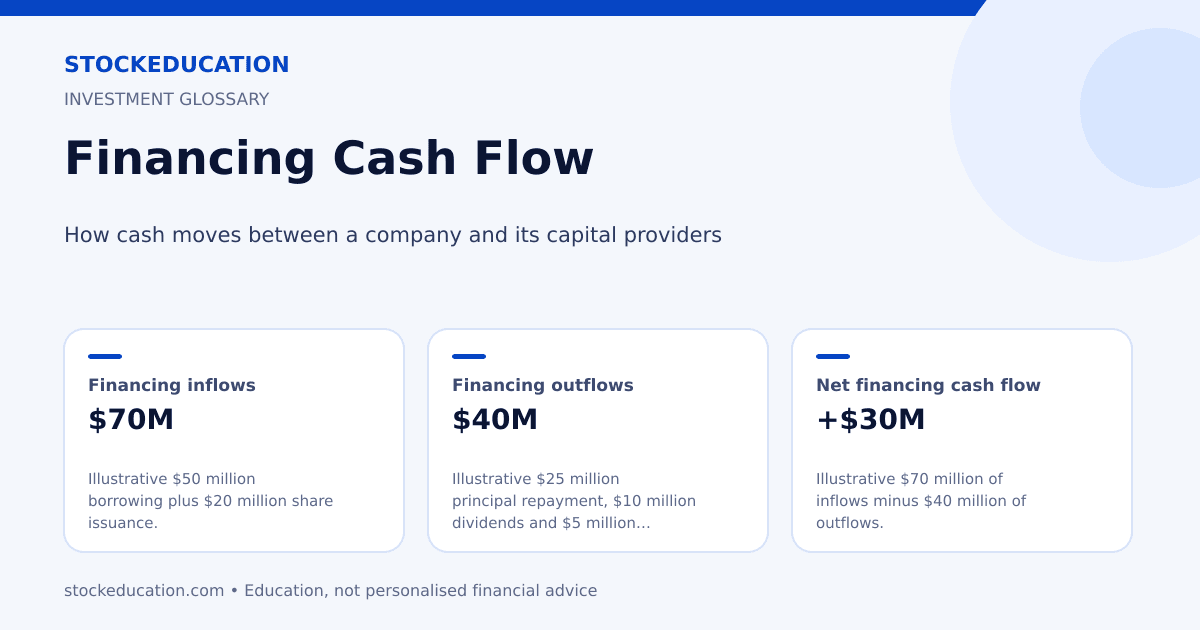
Consider a fictional company during one year. It receives $50 million from a new loan and $20 million from issuing shares. It repays $25 million of debt principal, pays $10 million of cash dividends and spends $5 million repurchasing shares. Its financing inflows are $70 million, while its financing outflows are $40 million. Net financing cash flow is therefore $70 million − $40 million = +$30 million. This illustrative result means financing activities added $30 million of cash during the period. It does not mean the company earned $30 million or created $30 million of value. An investor would still examine why the company raised capital, whether its operations produce cash, how its debt changed and what the funds financed.
Why it matters
Financing cash flow helps investors see whether a company is raising outside capital, paying down obligations or returning cash to shareholders. It can reveal a reliance on new debt or equity that is not obvious from revenue or profit alone. It also helps connect changes in debt and shareholders’ equity on the balance sheet with cash movements during the period. Because the net total can combine transactions with very different implications, investors should inspect each line rather than treating the sign as a quality score.
Check the company’s filing
Use the Form 10-K statement, notes and liquidity discussion to verify why financing cash changed.
What belongs in financing activities?
Financing activities generally involve obtaining capital from creditors or owners and returning capital to those providers. Cash proceeds from issuing debt or shares are typical inflows. Repayment of borrowed principal, cash dividends and purchases of the company’s own shares are typical outflows. Labels differ among issuers, so read the individual statement lines and related notes. Interest classification and some specialized transactions can depend on the applicable accounting framework and facts, which is another reason not to classify an item from its name alone.
How should you interpret a positive total?
Positive financing cash flow means financing transactions supplied more cash than they used during the period. A young or expanding company might borrow or issue shares to fund equipment, acquisitions or working capital. A mature company might refinance debt before a maturity. The positive sign does not show that customers generated cash, that the financing terms were favorable or that shareholders benefited. Check operating cash flow, the planned use of proceeds, interest costs, maturities, covenants and any increase in shares outstanding before reaching a conclusion.
How should you interpret a negative total?
Negative financing cash flow means the company paid more cash to capital providers than it received from them during the period. Debt repayment, dividends and share repurchases can produce this result. That may reflect strong operating cash generation and a deliberate return of excess cash, but it may also reduce liquidity or occur while the business is underinvesting. Separate recurring distributions from unusual transactions, compare them with operating cash flow and upcoming obligations, and avoid assuming that every negative financing total is automatically healthy.
How do debt transactions affect the section?
Cash received from a new loan, bond or other borrowing generally appears as a financing inflow, while repayment of principal generally appears as a financing outflow. Borrowing and repayment can occur in the same period, so a small net amount may conceal substantial refinancing activity. Compare the gross lines where presented, then reconcile them with current and long-term debt balances and the debt note. Review maturity dates, rates, security, covenant terms and unused credit capacity because the cash flow statement alone does not describe the full financing risk.
How do dividends, share issues and buybacks differ?
Issuing shares brings cash into the company but may increase the number of shares among which future earnings are divided. A share repurchase sends cash out and may reduce shares outstanding, although employee share issuance or other transactions can offset that reduction. Cash dividends also send cash to shareholders but do not reduce the share count. These uses of cash have different economic effects, so investors should examine the equity statement, earnings per share disclosures, authorization terms and notes rather than combining them mentally as one generic shareholder payment.
How does financing cash flow connect the statements?
The financing section helps explain changes between opening and closing balance sheet amounts, but the connection is not always one-for-one. New borrowing can increase both cash and debt, principal repayment can reduce both, and share issuance can increase cash and contributed equity. Dividends and repurchases can reduce cash and components of shareholders’ equity. Accrued amounts, foreign exchange effects, noncash transactions and presentation rules can create differences, so reconcile the cash flow statement with the balance sheet, statement of equity and notes.
What can the net number hide?
A single net figure can offset a large borrowing against a nearly equal repayment, or a major share issue against buybacks and dividends. Those combinations carry different implications even when they produce the same total. Compare several periods and preserve the reported units and signs. Read management’s discussion of liquidity and capital resources for explanations, then verify those explanations against the audited statements and notes. Financing cash flow is most useful as a map to further questions, not as a stand-alone valuation signal.
Comparison
| Cash flow section | Main question | Common examples | Interpretation focus |
|---|---|---|---|
| Operating activities | Does the business generate cash through operations? | Customer receipts, supplier payments and operating working capital changes | Cash generation from the business under applicable accounting rules |
| Investing activities | How is cash used for or received from longer-term assets and investments? | Capital expenditure, asset sales, acquisitions and certain investments | Reinvestment, asset changes and investment decisions |
| Financing activities | How does the company obtain or return capital? | Borrowing, principal repayment, share issuance, dividends and buybacks | Funding sources, leverage, dilution and capital returns |
Check yourself
A fictional company borrows $40 million, repays $15 million of principal and pays $5 million in cash dividends. With no other financing transactions, what is its net financing cash flow?
The $40 million borrowing is an inflow. The $15 million principal repayment and $5 million dividend are outflows. Therefore, $40 million − $15 million − $5 million = +$20 million. This is an illustrative calculation, not a market quote or a forecast.
Show the answer
+$20 million
Things people get wrong
Mistake 01 Treating positive as automatically good
A positive total may result from additional debt or equity funding rather than stronger operations.
Mistake 02 Treating negative as automatically bad
A negative total may reflect sustainable debt repayment, dividends or repurchases funded by operating cash, although context remains essential.
Mistake 03 Looking only at the subtotal
Large borrowing and repayment transactions can offset each other and disappear inside a modest net figure.
Mistake 04 Confusing principal with interest
Debt principal repayment is generally a financing outflow under US GAAP, while interest paid is generally classified in operating activities; verify the reporting framework and filing.
Mistake 05 Ignoring dilution and leverage
Cash raised through equity can dilute existing ownership, while debt adds contractual obligations and financing risk.
Mistake 06 Counting noncash transactions as cash flow
Debt converted into shares or assets acquired through financing may require disclosure without entering the cash subtotal because no cash changed hands.
Questions people ask about Financing Cash Flow
What does financing cash flow tell investors?
It shows how much cash a company received from or paid to lenders and shareholders during a reporting period and identifies the transactions behind that net amount.
Is positive financing cash flow good?
Not necessarily. It can provide useful funding, but it may also show reliance on borrowing or share issuance. The terms, purpose and effect on leverage or dilution matter.
Is negative financing cash flow good?
Not necessarily. It may reflect debt reduction or shareholder distributions, but those payments can strain liquidity if operations do not generate enough cash.
Are dividends financing cash flow?
Cash dividends paid to owners are generally financing outflows under US GAAP. Confirm the company’s reported classification and applicable accounting framework.
Are share repurchases financing activities?
Cash paid to repurchase the company’s own shares is generally a financing outflow. The equity statement and notes provide additional details about authorization, timing and share-count effects.
Does financing cash flow include interest payments?
Under US GAAP, interest paid is generally classified as an operating cash flow rather than financing cash flow. Classification may differ under another accounting framework, so check the filing.
Can financing cash flow be used to value a company?
It can inform analysis of funding, leverage, dilution and capital returns, but it is not a stand-alone measure of intrinsic value or operating performance.
Where can I find financing cash flow?
Look in the consolidated statement of cash flows within a company’s Form 10-K or Form 10-Q, then read the debt, equity, dividend and liquidity disclosures.
The bottom line
Financing cash flow shows how cash moved between a company and its lenders or shareholders. The net amount is useful, but its components matter more: new debt, debt repayment, share issuance, buybacks and dividends can have very different effects on risk and ownership. Read the section with operating and investing cash flow, the balance sheet, equity statement, notes and liquidity discussion before judging whether the company’s financing choices are sustainable.
Sources
- SEC Beginners’ Guide to Financial Statements
- SEC Cash Flow Statement Data Element Presentation
- Investor.gov How to Read a 10-K
How we produced the figuresPrimary regulatory guidance was used to define the three cash flow sections, identify representative financing transactions and explain where investors can verify cash flow information in public company filings. The numerical example is fictional and shown solely to demonstrate the arithmetic.
Read the full cash flow statement
Learn how operating, investing and financing activities reconcile beginning cash with ending cash.
About this page. Written by Associate Professor Charles Lo, CPA, PhD and edited by Felix La Spina. No ads and no paywall. Editorial standards · How we fact check · Corrections log · Report an error
Educational information only. Nothing on this page is personal financial, tax or legal advice. Investing involves risk, including the possible loss of principal.


