
Investment Glossary · Quick read · No ads
Fiscal Year
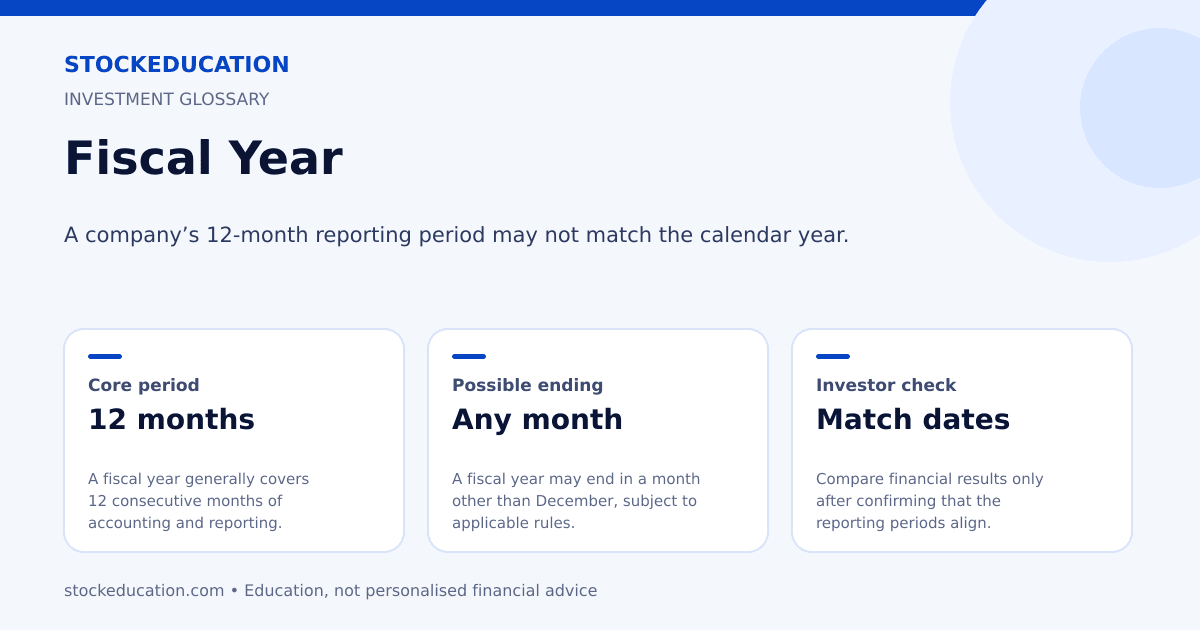
A fiscal year is a company’s 12-month accounting period for recording financial results, budgeting and reporting. It may follow the January-to-December calendar year, but it can also end in another month or follow a permitted 52-53-week reporting cycle. When comparing companies, first identify each fiscal year-end and make sure the periods match. Use the annual report and 10-K to confirm the reporting dates before comparing revenue, earnings or cash flow.

Key takeaways
- A fiscal year is a company’s chosen 12-month accounting and reporting period.
- A fiscal year may end in a month other than December.
- Some businesses use a 52- or 53-week reporting cycle to keep reporting weeks consistent.
- Investors should confirm fiscal year-end dates before comparing companies or periods.
- An annual report and 10-K can help verify the periods covered by reported results.
What is Fiscal Year?
A fiscal year is a company’s 12-month accounting period for recording financial results, budgeting and reporting. It may follow the January-to-December calendar year, but it can also end in another month or follow a permitted 52-53-week reporting cycle.
When comparing companies, first identify each fiscal year-end and make sure the periods match. Use the annual report and 10-K to confirm the reporting dates before comparing revenue, earnings or cash flow.
How Fiscal Year works
| Step | What happens |
|---|---|
| 01 · Identify the fiscal year-end | Find the company’s stated fiscal year-end in the annual report, 10-K, financial statement headings or notes. |
| 02 · Record the exact period dates | Write down the first and final dates included rather than relying on the fiscal-year label. |
| 03 · Count the weeks or months | Check whether the period covers a conventional 12 months, 52 weeks or 53 weeks. |
| 04 · Check for reporting changes | Look for a changed year-end, transition period, acquisition, divestiture or accounting change that could affect comparability. |
| 05 · Match the comparison periods | Compare fiscal-year totals with comparable fiscal-year totals, or align calendar dates and quarters when that better addresses the question. |
| 06 · Assess seasonality | Identify whether different periods include holidays, peak selling seasons, weather effects or other recurring timing differences. |
| 07 · Calculate and qualify growth | Use the disclosed figures for revenue, earnings or cash flow, then explain any unequal period length or unusual event. |
| 08 · Document the evidence | Preserve the filing name, statement heading, start date, end date and relevant note so the comparison can be reproduced. |
The formula
Fiscal year period = reporting end date − reporting start date + 1 day
Fiscal year period = the length of the accounting period being analyzed. Reporting start date = the first date included in the company’s fiscal year. Reporting end date = the final date included in the company’s fiscal year. A conventional period generally covers 12 months; a weekly convention may cover 52 or 53 weeks. Use the company’s disclosed dates when calculating or comparing periods; do not infer them from the fiscal-year label alone.
A worked example
Hypothetical worked example: Suppose Northstar Outdoor reports a fiscal year ending June 30, while Harbor Home reports a fiscal year ending December 31. Northstar’s fiscal 2025 covers July 1, 2024 through June 30, 2025, and Harbor’s calendar-year 2025 covers January 1 through December 31, 2025. Their labels both contain “2025,” but the periods do not cover the same months.
Assume Northstar reports revenue of $120 million for fiscal 2024 and $132 million for fiscal 2025. Its reported growth is calculated as ($132 million − $120 million) ÷ $120 million = $12 million ÷ $120 million = 0.10, or 10%. That arithmetic describes growth between Northstar’s two disclosed fiscal periods. It does not prove that Northstar grew 10% in every calendar month, and it should not automatically be compared with Harbor’s calendar-year growth without checking seasonality and period dates.
Now suppose Northstar uses a 52-week year and reports $132 million, while the next year contains 53 weeks and reports $140 million. The simple year-over-year calculation is ($140 million − $132 million) ÷ $132 million = $8 million ÷ $132 million, or approximately 6.1%. However, one extra week may have contributed to revenue and expenses. An analyst might review a comparable 52-week view, weekly sales disclosures or trailing-twelve-month figures before concluding that underlying growth was 6.1%.
This example is hypothetical and omits currency effects, acquisitions, divestitures, accounting changes and unusual events. The exact start and end dates should come from the company’s filing rather than being inferred from a fiscal-year label. For a real analysis, confirm the annual report or 10-K, identify the number of weeks, and compare matching periods wherever possible.
Why it matters
Fiscal year-end dates determine which months, weeks and business conditions are included in reported annual results. Investors who overlook those dates can compare mismatched periods, mistake seasonal timing for growth, or overlook the effect of an extra reporting week. Correctly identifying the fiscal year improves comparisons of revenue, earnings, margins and cash flow and helps place management guidance and valuation metrics in the right time frame. It also makes filings easier to interpret because fiscal quarters and annual totals can be tied to their actual start and end dates.
Fiscal year versus calendar year
A calendar year always runs from January through December. A fiscal year uses the organization’s selected annual reporting cycle and can end in another month. Businesses may choose a non-calendar year when their operating cycle makes that timing more useful, such as when a seasonal business has completed its busiest selling period. The distinction does not necessarily change the length of the annual period, but it changes which months are grouped together in annual and quarterly results. Investors should therefore read the stated period dates rather than assume that “fiscal 2025” means January through December 2025. A company’s fiscal year may also be different from the tax year used by another entity, so the label alone is not enough to establish comparability.
Why companies use different year-ends
A company may select a fiscal year-end that better reflects its operating cycle, inventory pattern or industry convention. A retailer, for example, may prefer a year-end after the holiday selling season so that the annual report captures the completed seasonal cycle. A school, government body or service organization may use dates that fit its planning and funding calendar. The choice can make internal budgeting and performance analysis more coherent, but it also means that two companies in the same calendar year may report different seasonal conditions in their annual results. A year-end can also move when a company changes its reporting structure, merges with another organization or adopts a 52- or 53-week convention. The investor’s task is not to assume that one year-end is standard, but to identify the dates and understand what the period contains.
Fiscal quarters and annual results
Fiscal quarters are subdivisions of a company’s fiscal year, but they do not always correspond to calendar quarters. A company with a June fiscal year-end may label its first fiscal quarter as the three months ending in September, while another company may use a different schedule. Quarter numbers therefore need to be read alongside the beginning and ending dates. Annual revenue, earnings and cash flow combine the quarters within the stated fiscal year, which can affect seasonal comparisons and the timing of major events. When reviewing results, compare the same type of period: a fiscal-year total with another fiscal-year total, or comparable fiscal quarters with matching dates. If the company changes its year-end or reports a transition period, the annual figures may cover an unusual number of months and require separate interpretation.
52- and 53-week reporting cycles
Some organizations use a weekly accounting structure rather than ending on the same numbered calendar date every year. A 52-week fiscal year contains 364 days, while a 53-week fiscal year contains 371 days. The extra week is added according to the organization’s reporting convention so that the year-end remains aligned with a particular weekday or week-ending pattern. This approach can make weekly operations, staffing and inventory analysis easier, but it means that an extra week may affect reported revenue, expenses and margins in the year that contains it. A 53-week year should not automatically be treated as evidence of stronger underlying growth. Investors should check the company’s disclosures for the period length and consider whether results need a 52-week adjustment or a comparable prior-period view.
Comparing companies with different fiscal years
Comparing companies requires more than placing annual figures beside one another. First identify each company’s fiscal year-end and the exact dates covered by the reported period. Then consider whether the periods include different seasonal conditions, unusual events or different numbers of weeks. A retailer reporting after its peak season may have a different revenue and margin profile from a company whose year ends before that season. For more precise analysis, investors may compare trailing-twelve-month results, matching calendar periods or comparable fiscal quarters, while still checking for accounting and business differences. The annual report and 10-K can provide the stated year-end, period dates and explanations of changes. A date-aligned comparison is a foundation, not a guarantee that the businesses are economically identical.
How to verify the reporting period
Begin with the cover page, financial statement headings and notes in the company’s filings. Look for wording that identifies the fiscal year-end, the months or weeks included, and whether the current period is longer or shorter than the prior period. Confirm the dates for the income statement, balance sheet and cash flow statement because each statement may present comparative columns differently. Next, check whether the company changed its fiscal year, adopted a 52- or 53-week convention, completed an acquisition or described a transition period. Record the exact start and end dates before calculating growth rates or comparing margins. The reporting period is part of the data, not a minor label: without it, an apparently simple year-over-year comparison may combine unlike seasonal windows or unequal numbers of weeks.
Comparison
| Period type | Typical dates | Investor consideration | Illustrative use |
|---|---|---|---|
| Calendar year | January 1–December 31 | Provides a common calendar basis, but may not match a company’s operating cycle | Comparing businesses with aligned calendar reporting |
| Non-calendar fiscal year | Any disclosed 12-month span ending in a non-December month | Check seasonal exposure and exact start and end dates | Retailer reporting after its peak season |
| 52-week fiscal year | 52 weeks or 364 days under a weekly convention | Weekly alignment may help operations, but dates differ from calendar months | Businesses tracking week-ending sales |
| 53-week fiscal year | 53 weeks or 371 days under the reporting convention | Extra week can affect revenue, expenses and growth rates | Adjusting or qualifying year-over-year analysis |
Check yourself
A company’s fiscal year ends on June 30. Which statement is most accurate about its fiscal 2025 period?
A June 30 fiscal year-end generally means the fiscal year runs from July 1 of the prior year through June 30 of the named year. The exact dates and any 52- or 53-week convention should be confirmed in the company’s filing.
Show the answer
2. It generally runs from July 1, 2024 through June 30, 2025, subject to the company’s disclosed reporting convention.
Things people get wrong
Mistake 01 Assuming fiscal year means calendar year
A fiscal year may end in any month, so read the exact beginning and ending dates instead of assuming January through December.
Mistake 02 Comparing fiscal-year labels without checking dates
Two companies can both report “fiscal 2025” while covering different months, seasons or numbers of weeks.
Mistake 03 Treating a 53-week year as ordinary growth
An extra reporting week can increase reported revenue and expenses, so assess comparable weeks and the company’s disclosure before drawing a growth conclusion.
Mistake 04 Ignoring a changed fiscal year-end
A transition period may be shorter or longer than a normal year and can make year-over-year percentages misleading.
Mistake 05 Comparing only revenue totals
Period length and seasonal mix can affect margins, earnings and cash flow too, so review all relevant statements and notes.
Mistake 06 Using a fiscal quarter number without its dates
“First quarter” is company-specific; confirm the start and end dates before comparing it with another company’s first quarter.
Questions people ask about Fiscal Year
What is a fiscal year?
A fiscal year is an organization’s recurring accounting and reporting period, generally covering 12 consecutive months or an accepted 52- or 53-week cycle.
Is a fiscal year the same as a calendar year?
Not necessarily. A calendar year runs from January 1 through December 31, while a fiscal year may begin and end in different months.
Why would a company choose a non-calendar fiscal year?
It may better match the company’s seasonal sales cycle, inventory pattern, budgeting process or industry convention.
Does fiscal year 2025 always mean January through December 2025?
No. The label is not enough to establish the covered dates. Check the company’s filing for the fiscal year-end and period start date.
What is a 52-week fiscal year?
It is a reporting cycle organized into 52 weeks, or 364 days, often to keep week-ending dates consistent. Some years contain 53 weeks under the company’s convention.
How should investors compare companies with different fiscal year-ends?
Identify the exact periods, consider seasonal differences and, where appropriate, compare matching calendar periods, comparable quarters or trailing-twelve-month results.
Can a fiscal year change?
Yes. A company can change its year-end or reporting convention, creating a transition period that may not be comparable with a normal prior year.
Where can I verify a company’s fiscal year?
Review the cover page, financial statement headings, notes and period descriptions in the company’s annual report or 10-K.
The bottom line
A fiscal year is a reporting timetable, not necessarily the January-to-December calendar. Always record the exact start date, end date and number of weeks before comparing results. A matching label does not guarantee matching seasonal exposure. Treat 53-week years and transition periods as special cases. Use disclosed filing dates as the basis for calculations and investment comparisons.
Sources
About this page. Written by Associate Professor Charles Lo, CPA, PhD and edited by Felix La Spina. No ads and no paywall. Editorial standards · How we fact check · Corrections log · Report an error
Educational information only. Nothing on this page is personal financial, tax or legal advice. Investing involves risk, including the possible loss of principal.


