
Investment Glossary · Quick read · No ads
Liquidity
Liquidity is the ease with which an investment can be bought or sold promptly, in the desired amount, and near its current quoted price without causing a significant price change.

Key takeaways
- Liquidity reflects how readily a security can be traded, not whether it is a good or profitable investment.
- Trading volume, bid-ask spread, order size, market depth, and market conditions all affect execution.
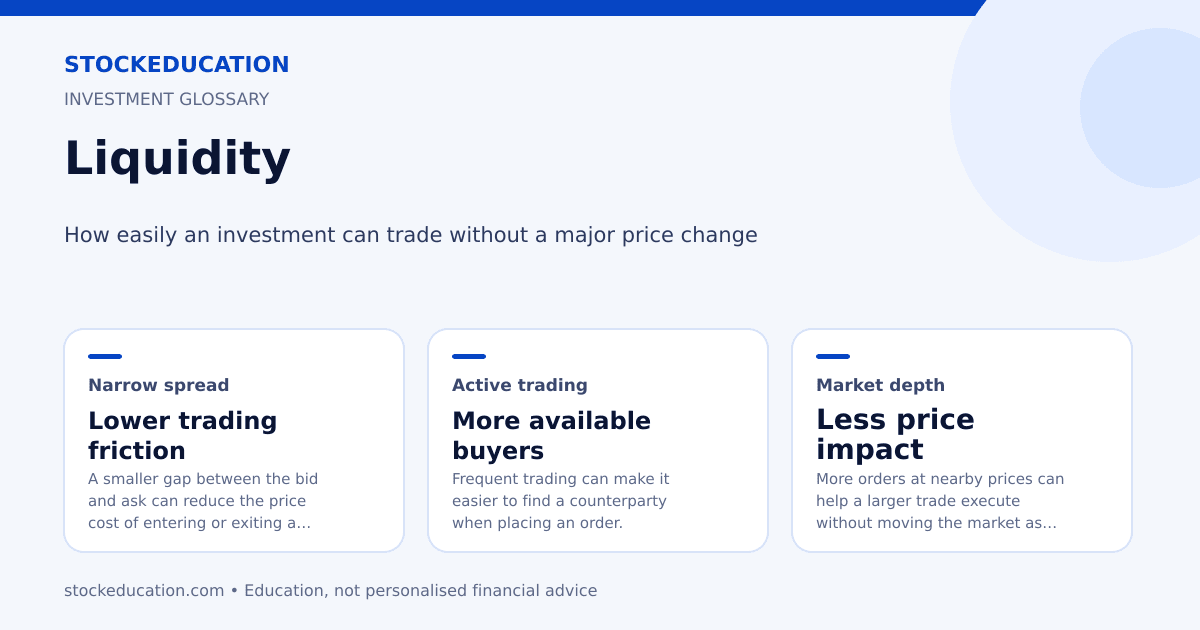
- A narrow spread can reduce trading friction, while a wider spread can increase the cost of entering or leaving a position.
- Large orders may create meaningful price impact even in a security that appears liquid for small trades.
- Liquidity can weaken during market stress, so normal trading conditions may not describe the risk of an urgent sale.
What is Liquidity?
Liquidity describes how easily an investment can be bought or sold without causing a significant change in its price. A liquid security generally has active buyers and sellers, frequent trading, and a narrower gap between the highest available buying price and lowest available selling price. An illiquid security may take longer to sell, require a price concession, or be difficult to value when trading activity is limited.
When evaluating liquidity, consider trading volume, the bid-ask spread, order size, market depth, and the time of day or market conditions. Liquidity is one part of investment risk, not a guarantee of a fair price or a profitable investment. Review a company’s financial statements and notes for information about its business and financial position, and use its Form 10-K for broader disclosures about risks, operations, and known uncertainties.
How Liquidity works
| Step | What happens |
|---|---|
| 01 · Define the trade need | Identify the intended position size, deadline, acceptable price range, and whether speed or price control is more important. |
| 02 · Review trading activity | Examine typical volume, turnover, transaction frequency, and whether activity is consistent rather than concentrated in unusual periods. |
| 03 · Check the current spread | Compare the bid, ask, midpoint, and relative spread at the time and approximate size of the planned order. |
| 04 · Assess market depth | Review the quantity available at and near quoted prices to estimate whether the order could consume multiple price levels. |
| 05 · Consider market conditions | Account for news, volatility, trading hours, settlement, market stress, and the possibility that displayed liquidity may change. |
| 06 · Choose an order approach | Consider whether a market, limit, staged, or smaller order better matches the objective, while recognizing that no method guarantees execution or price. |
The formula
Liquidity indicators = bid-ask spread, trading activity, market depth, order size, and execution conditions
Bid-ask spread: the difference between the highest available buying price and lowest available selling price. Trading activity: the frequency and amount of buying and selling, commonly considered through volume and turnover. Market depth: the quantity of orders available at or near quoted prices. Order size: the amount an investor wants to buy or sell relative to available liquidity. Execution conditions: timing, urgency, volatility, settlement, and other factors that can affect fill quality and price impact. This is a practical assessment framework, not a single standardized accounting ratio or guarantee of execution price. A commonly used relative spread measure is: relative spread = (ask price − bid price) ÷ midpoint price, where midpoint price = (ask price + bid price) ÷ 2. Lower values generally indicate less quoted friction, all else equal, but do not prove that a large order will have low price impact.
A worked example
Hypothetical example: Assume a stock shows a $19.90 bid and a $20.10 ask, so the quoted spread is $0.20 and the midpoint is $20.00. The relative spread is ($20.10 − $19.90) ÷ $20.00 = $0.20 ÷ $20.00 = 1%. If an investor immediately buys 100 shares at the ask and later sells 100 shares at the bid without any price movement, the quoted round-trip difference is 100 × ($20.10 − $19.90) = $20, before commissions, fees, taxes, price changes, or partial fills. Now suppose only 50 shares are offered at $20.10 and the next available 50 shares are offered at $20.25. Buying 100 shares could produce an average execution price of [(50 × $20.10) + (50 × $20.25)] ÷ 100 = $20.175, illustrating how limited depth can increase the cost beyond the displayed best ask. This is hypothetical and simplified; real execution depends on the venue, order type, timing, volatility, available orders, and market conditions. A narrow quoted spread does not guarantee that a large order can be completed at that spread or that the investment will be profitable.
Why it matters
Liquidity matters because execution conditions affect both the cash received from a sale and the cost of a purchase. A liquid market may allow an investor to transact with less delay and less price impact, while an illiquid market can make an ordinary portfolio decision expensive or impractical. Liquidity risk is especially important for large positions, emergency cash needs, concentrated holdings, thinly traded securities, and periods of market stress. It should be evaluated alongside business, financial, market, and valuation risks rather than treated as a substitute for them. A security can be fundamentally attractive and still be unsuitable if the investor cannot tolerate delayed execution or a possible price concession.
Trading activity and counterparties
Trading activity is one visible indication of how readily a buyer or seller may find a counterparty. A security with frequent transactions may offer more opportunities to execute an order, while sparse trading can mean that an order waits longer or must accept a less favorable price. Volume alone is not a complete liquidity measure: high reported volume can reflect many small trades, temporary activity, or trading concentrated at particular times. Investors should consider whether the observed activity is consistent, whether quotes remain available across the session, and whether the security’s normal trading pattern matches the size and urgency of the intended order. The relevant question is not simply how much traded, but how reliably trades can occur near the quoted market.
Bid-ask spreads and trading friction
The bid is the highest displayed price a buyer is offering, and the ask is the lowest displayed price at which a seller is offering the security. The difference between them is the bid-ask spread. A narrower spread generally indicates lower immediate trading friction, while a wider spread can make an immediate purchase more expensive and an immediate sale less rewarding relative to the midpoint. Spreads can vary by security, order size, time of day, news, and market stress. A quoted spread is not a guaranteed total cost: commissions, fees, price movement during execution, and the possibility of partial fills may also matter. Comparing spreads at the time and size of the planned trade gives a more useful picture than relying on a historical average alone.
Market depth and price impact
Market depth describes how many buy and sell orders are available at prices near the current quote. A market may display a narrow spread but still have limited depth, meaning a larger order could consume the nearest available offers or bids and move the execution price. Price impact is the change in the market price caused by the trade itself, rather than by new information about the investment. It tends to become more important when an order is large relative to normal trading activity or when nearby orders are thin. Investors can reduce potential impact by considering order size, using appropriate order instructions, allowing more time, and checking available quotes, although no method guarantees a particular execution price.
Time, urgency, and market conditions
Liquidity is relative to both time and circumstances. A security may usually trade smoothly but become difficult to sell after unexpected news, during a market-wide disruption, outside its main trading hours, or when dealers and other participants reduce their willingness to quote. An investor who must exit immediately has fewer choices than one who can wait for a suitable counterparty. Market orders may prioritize speed but accept uncertain prices; limit orders can specify a price boundary but may remain unfilled. The practical liquidity question therefore includes the investor’s deadline, acceptable price range, position size, and ability to tolerate a partial or delayed execution.
Liquidity risk and valuation
Liquidity risk is the possibility that an investor cannot transact promptly, in the desired amount, or near an indicated price. It can increase losses independently of a security’s underlying business performance because an urgent sale may require a price concession. It can also complicate valuation: when transactions are infrequent or quotes are wide, a recent trade may not represent a readily achievable exit price. Financial statements and notes can provide context about a company and its financial position, but they do not eliminate market-liquidity risk. Investors should distinguish an accounting estimate of value from the cash price actually available in the market at a particular moment.
Applying liquidity to an investment decision
Liquidity should be assessed in relation to the intended holding and trade rather than as a single permanent label. Before investing, consider ordinary volume, spread behavior, market depth, listing venue, trading hours, settlement timing, and the size of the proposed position relative to typical activity. Consider also whether the investment may need to be sold quickly to meet a cash need or rebalance a portfolio. Diversification does not guarantee liquidity, and a familiar or widely discussed security can still experience difficult execution in stressed conditions. Reviewing disclosures, observing current quotes, and using an order method suited to the objective can improve decision-making, but liquidity analysis cannot guarantee a fair price or a profitable result.
Comparison
| Feature | More liquid conditions | Less liquid conditions |
|---|---|---|
| Trading activity | Frequent transactions and more available counterparties | Sparse transactions and fewer reliable counterparties |
| Bid-ask spread | Generally narrower quoted gap and lower immediate friction | Generally wider quoted gap and higher immediate friction |
| Market depth | More orders near current prices, often reducing price impact | Fewer nearby orders, so larger trades may move the price more |
| Execution | More likely to transact promptly in ordinary conditions | May require delay, a price concession, or acceptance of a partial fill |
Check yourself
Which statement best describes liquidity in investing?
Liquidity concerns how readily an investment can be bought or sold in the desired amount and near the prevailing quoted price. Trading activity, spreads, market depth, order size, urgency, and market conditions all influence execution.
Show the answer
2. The ease of buying or selling an investment near its quoted price without significant price impact
Things people get wrong
Mistake 01 Treating volume as the entire liquidity analysis
High trading volume can help indicate active participation, but it does not show whether sufficient buyers or sellers are available near the quoted price for the specific order size.
Mistake 02 Assuming a narrow spread guarantees a low-cost trade
The best displayed spread may apply to only a small number of shares, while depth, price movement, fees, and partial fills can materially affect total execution cost.
Mistake 03 Ignoring liquidity during market stress
Normal trading conditions may not persist after news or during volatility, when spreads can widen, quotes can disappear, and an urgent order may cause greater price impact.
Mistake 04 Confusing liquidity with investment quality
A security can be easy to trade and still be overvalued, risky, or unsuitable for an investor’s objectives.
Mistake 05 Using a market order without considering urgency and price tolerance
Market orders may prioritize execution speed but can fill at uncertain prices, especially in thin or rapidly moving markets.
Questions people ask about Liquidity
What does liquidity mean in investing?
Liquidity is the ease of buying or selling an investment promptly, in the desired amount, and near its current quoted price without causing a significant price change.
Why does the bid-ask spread matter?
The spread is the gap between the highest available bid and lowest available ask. A wider spread generally increases the immediate trading friction faced by buyers and sellers.
Is a high-volume security always liquid?
No. Volume is only one indicator. Order size, market depth, spread stability, trading frequency, and market conditions also affect whether a trade can be completed efficiently.
What is market depth?
Market depth is the quantity of buy and sell orders available at or near quoted prices. Limited depth can cause a large order to move through several price levels.
Can liquidity disappear?
Yes. Liquidity can weaken during market stress, unexpected news, trading interruptions, or periods when market participants withdraw or reduce their quotes.
How can investors assess liquidity before trading?
Review typical activity, current spreads, available depth, order size relative to normal trading, trading hours, settlement timing, and the urgency and acceptable price range for the transaction.
Does liquidity guarantee a fair price?
No. Liquidity concerns execution conditions, not intrinsic value, investment quality, expected return, or profitability.
The bottom line
Liquidity describes execution ease rather than investment quality. Assess the spread, trading activity, depth, order size, and market conditions together. A security that appears liquid for a small trade may be difficult to trade in a large position or during stress. Liquidity analysis can inform order selection and risk assessment, but it cannot guarantee a fill, a fair price, or a profit.
Sources
About this page. Written by Associate Professor Charles Lo, CPA, PhD and edited by Felix La Spina. No ads and no paywall. Editorial standards · How we fact check · Corrections log · Report an error
Educational information only. Nothing on this page is personal financial, tax or legal advice. Investing involves risk, including the possible loss of principal.


