
Investment Glossary · Quick read · No ads
Margin Of Safety
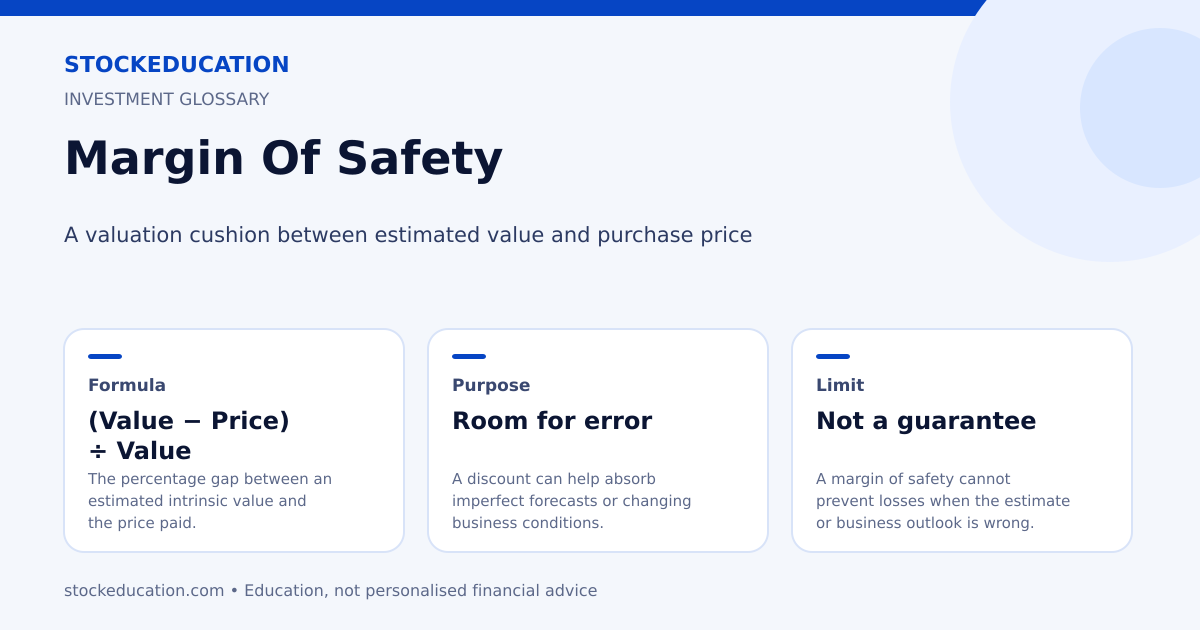
Margin of safety is the percentage difference between an investment’s estimated intrinsic value and its market price. It represents a valuation cushion intended to provide room for errors in forecasts, changing conditions and uncertainty; it does not guarantee a profit or prevent a loss.

Key takeaways
- A margin of safety compares estimated intrinsic value with the price paid.
- A larger discount can provide more room for error, but it does not make an investment risk-free.
- The result is only as reliable as the assumptions used to estimate value.
- Sensitivity testing can show whether the cushion survives weaker growth, cash flow or discount-rate assumptions.
- Diversification may reduce portfolio risk, but it cannot eliminate investment losses.
What is Margin Of Safety?
A margin of safety is the gap between what an investment is worth under a cautious estimate and the price paid for it. Investors use the concept to allow for errors in forecasts, changing business conditions and uncertainty in valuation. A larger discount can provide more room for error, but it cannot guarantee a profit or prevent a loss.
To study the idea, compare an estimated intrinsic value with the current price, then test how the result changes when growth, cash flow or the discount rate changes. A discounted cash flow model can provide one valuation estimate, but the quality of the margin depends on the reliability of the assumptions behind it.
How Margin Of Safety works
| Step | What happens |
|---|---|
| 01 · Estimate intrinsic value | Use a suitable method, such as owner earnings, earnings multiples, asset analysis or discounted cash flow, and state the assumptions. |
| 02 · Record the purchase price | Use the current market price or the actual price that would be paid for the investment. |
| 03 · Calculate the cushion | Subtract price from estimated value, divide by estimated value, and multiply by 100. |
| 04 · Test scenarios | Vary growth, cash flow, margins, terminal value and discount rates to see whether the margin survives weaker assumptions. |
| 05 · Assess the business and portfolio | Consider durability, leverage, competition, liquidity, position size and diversification before making a decision. |
| 06 · Review over time | Revisit the valuation when results, competitive conditions or the original assumptions change. |
The formula
Margin of safety = (Estimated intrinsic value − Market price) ÷ Estimated intrinsic value × 100
Estimated intrinsic value: the investor’s assessment of what the investment is worth based on stated assumptions. Market price: the current price or purchase price of the investment. The result is expressed as a percentage; a positive result means estimated value exceeds price, while a negative result means price exceeds estimated value. The formula describes a valuation gap, not a forecast of investment return or a guarantee against loss. A DCF model may be one way to estimate value, but its assumptions determine how dependable the resulting margin is.
A worked example
Hypothetical example: Suppose an investor estimates that a share is worth $100 based on conservative assumptions and can buy it for $70. The margin of safety is ($100 − $70) ÷ $100 × 100 = 30%. The $30 gap is a valuation cushion, not a predicted 30% return. If weaker growth, lower cash flow or a higher discount rate reduces estimated value to $80, the margin falls to ($80 − $70) ÷ $80 × 100 = 12.5%. If the revised value becomes $65, the margin is negative: ($65 − $70) ÷ $65 × 100 = −7.7%. This example is hypothetical and depends entirely on the valuation assumptions; the market price may fall, the business may deteriorate, and the estimate may be wrong.
Why it matters
Margin of safety matters because valuation is an estimate rather than a known fact. Requiring a discount between estimated intrinsic value and purchase price can make an investment decision less dependent on one optimistic forecast and can provide some room for weaker results. The protection is conditional: it depends on the quality of the estimate, the durability of the business and the price actually paid. Investors should test assumptions, compare scenarios and consider diversification rather than treating a calculated percentage as a guarantee.
How the Margin Is Defined
The concept begins with two inputs: an estimate of what the investment is worth and the price required to buy it. The difference is the nominal cushion, while dividing that difference by estimated value expresses the cushion as a percentage. For example, if a cautious valuation estimate is higher than the market price, the calculated margin is positive. If price equals value, the margin is zero; if price exceeds the estimate, the result is negative. The calculation is simple, but the difficult work lies in producing a valuation that is reasonable, conservative and consistent with the business’s economics. A margin should therefore be read as a relationship between an uncertain estimate and a known price, not as an objective score detached from judgment.
Why Investors Seek a Cushion
Future revenue, profitability, cash generation, competition and financing conditions cannot be known with certainty. A valuation model converts expectations about those factors into an estimate, and even a carefully prepared estimate can be wrong. Buying below an assessment of value can help absorb some of that error: weaker growth may still leave the investment acceptable, or a temporary setback may be less damaging when the purchase price already reflects caution. This is the central purpose of a margin of safety. It is not a mechanism that makes every purchase attractive, and it does not replace analysis of the business, balance sheet or price. It is a discipline for demanding compensation for uncertainty before committing capital.
Formula and Interpretation
The standard percentage formula is (intrinsic value minus price) divided by intrinsic value. Multiplying the result by 100 expresses it as a percentage. A hypothetical estimate of 100 and a price of 70 would produce a 30% margin, but that figure does not mean the investor has a guaranteed 30% return. It says only that the price is 30% below the stated estimate, assuming the estimate is the appropriate reference point. Using price in the denominator would answer a different question and can make comparisons less consistent. Investors should also distinguish a positive calculated margin from a genuinely conservative one: a large-looking discount based on unrealistic assumptions may offer less protection than a smaller discount based on a robust assessment.
Valuation Methods and Assumptions
A margin of safety can be applied to several valuation approaches, including asset-based analysis, earnings multiples, owner earnings or a discounted cash flow model. A discounted cash flow model may estimate value by projecting future cash flows and discounting them to the present, but its output depends heavily on growth, margins, reinvestment and discount-rate assumptions. Other methods have their own weaknesses: a multiple can obscure changes in business quality, while asset values may be difficult to realize. Comparing methods and checking whether they produce broadly sensible conclusions can improve judgment. The goal is not to manufacture a precise number; it is to understand the range of plausible values and pay a price that remains defensible when favorable assumptions are reduced.
Sensitivity, Scenarios and Uncertainty
A reported margin can change quickly when a key assumption changes. Investors can test a base case, a cautious case and a more adverse case by varying growth, cash flow, margins, terminal value or the discount rate. If a small adjustment eliminates the apparent cushion, the valuation is highly sensitive and the margin deserves less confidence. If several reasonable scenarios still place value above price, the conclusion may be more resilient, though never certain. Scenario analysis also helps identify what actually drives the estimate instead of treating the final percentage as a standalone fact. The appropriate amount of caution depends on predictability, leverage, cyclicality, competitive pressure and the consequences of being wrong.
Limits and Portfolio Context
A margin of safety cannot protect against every source of loss. The business may deteriorate permanently, management may allocate capital poorly, a valuation may contain an unnoticed error, or the market may remain below estimated value for a long period. Even a sound estimate can be undermined by concentrated exposure or a need to sell at an unfavorable time. The concept should therefore be combined with business analysis, position sizing, liquidity awareness and diversification. Diversification can reduce the effect of one holding’s poor outcome, but it cannot eliminate portfolio risk. A margin is best understood as one part of a decision process: it improves the relationship between estimated value and price while leaving uncertainty, execution risk and market risk in place.
Comparison
| Basis | Margin of safety | Valuation estimate | Investment risk |
|---|---|---|---|
| Primary question | How much is estimated value above price? | What might the investment be worth? | What could cause a loss or poor outcome? |
| Main input | Estimated intrinsic value and market price | Cash flows, earnings, assets, growth and discount rate | Business, financial, market and portfolio conditions |
| Interpretation | A positive percentage indicates a discount to estimated value | An uncertain assessment based on assumptions | A possibility that remains even when a margin exists |
| Limitation | It cannot guarantee profit or prevent loss | It can be materially wrong or overly precise | Diversification may reduce but cannot eliminate risk |
Check yourself
An investor estimates intrinsic value at $120 and can buy at $90. What is the approximate margin of safety?
The calculation is (estimated intrinsic value − market price) ÷ estimated intrinsic value × 100: ($120 − $90) ÷ $120 × 100 = $30 ÷ $120 × 100 = 25%. This describes the valuation gap, not a guaranteed return.
Show the answer
3. 25%
Things people get wrong
Mistake 01 Treating the percentage as a guaranteed return
A 30% margin means the price is 30% below the stated value estimate; it does not promise a 30% gain or prevent a loss.
Mistake 02 Using optimistic assumptions
Excessive growth, margins or terminal values can create an apparently large cushion that disappears under reasonable scenarios.
Mistake 03 Ignoring sensitivity and business quality
A margin should be tested against weaker conditions and considered alongside leverage, competition, cyclicality, liquidity and management risk.
Mistake 04 Confusing a low price with low risk
A falling or inexpensive security may reflect permanent business deterioration rather than an attractive discount to intrinsic value.
Questions people ask about Margin Of Safety
What is a margin of safety?
It is the percentage difference between estimated intrinsic value and the market or purchase price, intended to provide room for valuation errors and unfavorable outcomes.
How is margin of safety calculated?
Subtract the market price from estimated intrinsic value, divide by estimated intrinsic value, and multiply by 100.
Is a higher margin always better?
Not necessarily. A high result based on unreliable or overly optimistic assumptions may provide less protection than a smaller margin based on a robust estimate.
Can a margin of safety prevent losses?
No. The estimate may be wrong, the business may deteriorate, the market may remain below value, or an investor may need to sell at an unfavorable time.
How should investors test a margin of safety?
Use base, cautious and adverse scenarios that vary growth, cash flow, margins, terminal value and discount rates, then assess whether value remains above price.
Can margin of safety be used with a DCF model?
Yes, but the resulting cushion is only as dependable as the DCF assumptions and should be checked against other valuation approaches where appropriate.
The bottom line
Margin of safety is a valuation cushion, not a promise of safety or profit. It is strongest when the value estimate is conservative, the business is understandable and the discount remains after reasonable sensitivity tests. Diversification and position sizing can help manage portfolio risk, but they cannot eliminate losses.
Sources
About this page. Written by Associate Professor Charles Lo, CPA, PhD and edited by Felix La Spina. No ads and no paywall. Editorial standards · How we fact check · Corrections log · Report an error
Educational information only. Nothing on this page is personal financial, tax or legal advice. Investing involves risk, including the possible loss of principal.


