
Investment Glossary · Quick read · No ads
Operating Cash Flow (OCF)
Operating cash flow is the cash generated or used by a company's normal business operations during a reporting period. It starts with operating results and reflects noncash adjustments plus changes in operating assets and liabilities.

Key takeaways
- OCF measures cash generated or used by core operations, not total change in cash.
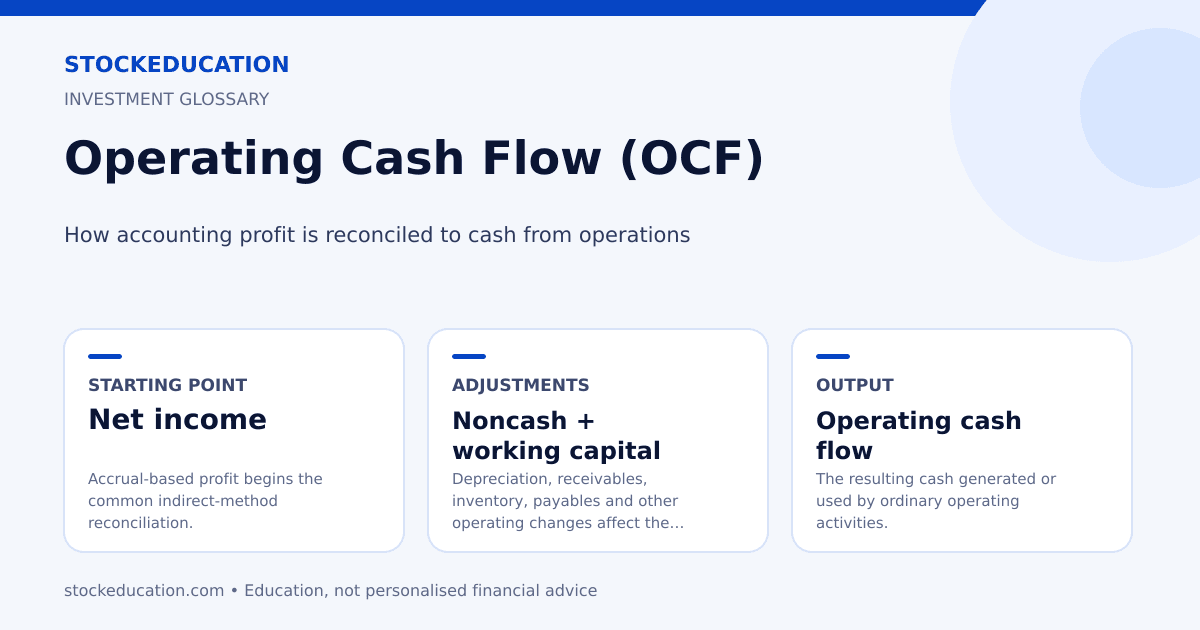
- The indirect method commonly reconciles net income to operating cash by adjusting for noncash items and working-capital changes.
- A rise in receivables or inventory can reduce OCF even when reported revenue or profit increases.
- Positive OCF does not automatically mean that a company is financially strong or that its shares are attractively valued.
- Compare OCF across consistent periods and read the filing notes for unusual or one-time movements.
- OCF minus capital expenditure is a useful cash-flow research measure, but it is not automatically a company's reported free-cash-flow definition.
What is Operating Cash Flow (OCF)?
Operating cash flow (OCF) is the cash a company generates or uses through its normal business activities during a reporting period. It helps connect accounting profit with cash actually produced by operations, but it should be read with the income statement, balance sheet, notes and the other sections of the cash flow statement.
Use OCF to study cash generation, working-capital changes and the quality of reported earnings. For a practical next step, compare OCF with capital expenditure and use the cash flow statement lesson to trace the company’s filing figures. An illustrative example in this lesson uses hypothetical amounts and is not a market quote or forecast.
How Operating Cash Flow (OCF) works
| Step | What happens |
|---|---|
| 01 · Find the filing period and units | Record the company, fiscal period, currency and scale before comparing OCF. |
| 02 · Locate the operating section | Find the line for net cash provided by or used in operating activities. |
| 03 · Read the reconciliation | Review net income, noncash adjustments and operating asset and liability changes. |
| 04 · Compare with profit | Examine OCF and net income across consistent periods and investigate material gaps. |
| 05 · Check the other sections | Read investing and financing cash flow so OCF is not mistaken for total cash change. |
| 06 · Investigate unusual items | Use the notes and management discussion to identify one-time or timing-related movements. |
| 07 · State limitations | Explain that historical OCF does not guarantee future cash generation or investment returns. |
The formula
Operating cash flow = Net income + Relevant noncash expenses and losses − Relevant noncash gains ± Changes in operating assets and liabilities
Net income | Accounting profit or loss for the reporting period. Noncash expenses | Items such as depreciation that reduce profit without a current-period cash payment. Operating assets and liabilities | Items such as receivables, inventory, payables and deferred revenue that affect operating cash timing.
A worked example
Assume, purely for teaching, that a company reports net income of $100 million, depreciation of $20 million, a $15 million increase in accounts receivable, a $10 million increase in inventory and an $8 million increase in accounts payable. Using a simplified indirect calculation, OCF = $100 million + $20 million − $15 million − $10 million + $8 million = $103 million. The example is hypothetical and is not a market quote, company filing, forecast or investment recommendation. In a real filing, inspect every reconciliation line, the period, units, accounting policy and notes before calculating or comparing OCF.
Why it matters
OCF helps show whether ordinary operations are producing cash rather than only accounting profit. It is especially useful when read over several periods and compared with net income, capital spending, liquidity needs and debt obligations.
What operating cash flow measures
Operating cash flow measures cash produced or consumed by the business activities that support ordinary operations. The SEC describes the operating section as a reconciliation from net income to cash received from or used in operating activities, with adjustments for noncash items and operating assets and liabilities. OCF is therefore different from revenue, net income and the overall change in cash. A company can report positive OCF while investing heavily in equipment, repaying debt or returning cash to shareholders. Conversely, negative OCF may reflect temporary working-capital investment, but persistent negative OCF requires careful investigation of the business model, funding needs and disclosures.
How the indirect method works
Many companies present OCF using the indirect method. The reconciliation begins with net income or loss, adds back expenses that reduced accounting profit without using current-period cash, and adjusts for gains, losses and changes in operating assets and liabilities. Depreciation is a common add-back because it is a noncash expense in the current period. An increase in accounts receivable generally reduces OCF because revenue may have been recognized before collection. An increase in accounts payable can increase OCF because the company has recorded costs without yet paying all of the related cash. These directions are general guides; read the filing's exact labels and notes before interpreting a large movement.
OCF versus net income
Net income follows accrual accounting, while OCF focuses on cash movements classified as operating activities. Profit can exceed OCF when customers have not paid, inventory has absorbed cash, or other operating assets have increased. OCF can exceed profit when noncash expenses are added back or operating liabilities increase. Neither measure is automatically superior. Compare both over several consistent periods, then investigate large gaps through the cash-flow reconciliation, management discussion and notes. A recurring gap may be economically reasonable in a growing business, but it can also signal collection pressure, unusual working-capital movements or reliance on adjustments that deserve further review.
OCF and investing or financing cash flow
The cash flow statement normally separates operating, investing and financing activities. Purchases of property and equipment generally appear in investing cash flow, while borrowing, debt repayment, share transactions and dividends can appear in financing cash flow. OCF should not be confused with the net change in cash, which combines the relevant sections and may include other reconciling items. A company can have strong OCF and still reduce its cash balance because it is investing or repaying debt. It can also show a cash increase because of new borrowing even while operations consume cash. Read all three sections together and check the notes for classification details.
Working capital and OCF
Working capital explains why reported earnings and OCF can diverge. Receivables represent amounts billed or earned that have not necessarily been collected. Inventory uses cash before products are sold. Payables and accrued liabilities can preserve cash temporarily because payment occurs after the expense is recognized. Deferred revenue can support OCF when customers pay before the company delivers the related goods or services. These movements are not automatically good or bad. Assess whether they reflect growth, timing, seasonality, supplier terms, customer concentration, inventory risk or a reversal that may affect future periods.
A numerical OCF example
Assume a hypothetical company reports net income of $100 million, depreciation of $20 million, an increase in accounts receivable of $15 million, an increase in inventory of $10 million and an increase in accounts payable of $8 million. A simplified indirect calculation is: OCF = $100 million + $20 million − $15 million − $10 million + $8 million = $103 million. The figures are illustrative only and are not a real company result, market quote or forecast. The example shows why OCF can differ from net income: noncash depreciation is added back, while cash absorbed by receivables and inventory is subtracted.
How to assess OCF quality
Start with the reported amount, period, currency and units. Compare OCF with net income over multiple periods, then inspect the major reconciliation lines. Ask whether receivables, inventory, payables or deferred revenue moved in a way consistent with sales and operating conditions. Separate recurring operations from acquisitions, litigation payments, tax timing, restructuring, customer prepayments and other unusual items where the filing provides information. OCF is evidence, not a verdict. Combine it with liquidity, debt maturities, capital spending, competitive conditions and the company's own disclosures before drawing an investment conclusion.
Comparison
| Measure | What it captures | Where it appears | Main caution |
|---|---|---|---|
| Operating cash flow | Cash generated or used by ordinary operations | Cash flow statement, operating section | Can be affected by timing and working-capital movements |
| Net income | Accrual-based accounting profit or loss | Income statement | Includes noncash items and accrual timing |
| Investing cash flow | Cash from or used for long-term assets and investments | Cash flow statement, investing section | A negative amount may reflect productive investment |
| Financing cash flow | Cash from or used for borrowing, equity and distributions | Cash flow statement, financing section | A positive amount may reflect new borrowing rather than operating strength |
Check yourself
A hypothetical company reports net income of $100 million, depreciation of $20 million, a $15 million increase in receivables, a $10 million increase in inventory and an $8 million increase in accounts payable. What is its simplified operating cash flow?
Using the simplified indirect method, OCF = $100 million + $20 million − $15 million − $10 million + $8 million = $103 million. The example is hypothetical and excludes other possible filing adjustments.
Show the answer
$103 million
Things people get wrong
Mistake 01 Treating OCF as total cash change
OCF covers operating activities; total cash change also reflects investing, financing and other reconciling items.
Mistake 02 Assuming positive OCF proves financial strength
Positive OCF can coexist with heavy debt, large capital needs, weak liquidity or declining operations.
Mistake 03 Ignoring working-capital movements
Receivables, inventory, payables and deferred revenue can materially change OCF relative to profit.
Mistake 04 Calling OCF minus capital expenditure universally defined free cash flow
Companies and analysts may define free cash flow differently, so identify the stated definition and reconcile it.
Mistake 05 Comparing mismatched periods or units
Compare like-for-like fiscal periods and confirm currency, scale, restatements and continuing operations.
Questions people ask about Operating Cash Flow (OCF)
Is operating cash flow the same as net income?
No. Net income uses accrual accounting, while OCF reflects cash classified as operating activities after noncash and working-capital adjustments.
Where do I find operating cash flow?
Look for the cash flow statement in a company's Form 10-K or Form 10-Q and locate the line usually labeled net cash provided by or used in operating activities.
Can operating cash flow be negative?
Yes. Negative OCF means operating activities used more cash than they generated during the stated period; investigate the reasons and whether the pattern is temporary or persistent.
Why is depreciation added back to OCF?
Depreciation reduces accounting profit but generally does not represent a current-period cash payment, so the indirect reconciliation adds it back.
Does positive OCF mean a stock is a good investment?
No. OCF is one financial measure and does not by itself determine business quality, valuation, suitability or future returns.
How is OCF related to free cash flow?
A common research measure subtracts capital expenditure from OCF, but definitions vary and the result should not be treated as universally standardized.
What can a large increase in receivables mean?
It may reflect growth and timing, but it can also indicate slower collections or pressure on cash; compare receivables with sales and read the notes.
The bottom line
Operating cash flow is a core cash-generation measure that helps investors connect reported profit with cash produced by ordinary operations. Read the reconciliation, investigate working-capital changes, compare consistent periods and distinguish OCF from investing, financing and free-cash-flow measures. It is useful evidence, but never a complete investment conclusion by itself.
Sources
About this page. Written by Associate Professor Charles Lo, CPA, PhD and edited by Felix La Spina. No ads and no paywall. Editorial standards · How we fact check · Corrections log · Report an error
Educational information only. Nothing on this page is personal financial, tax or legal advice. Investing involves risk, including the possible loss of principal.


