
Financial Analysis · Beginner · 8 minutes · No ads
Operating Income
Also called Income from operations Operating profit Operating earnings
Operating income is the profit or loss a company reports from its operations after subtracting operating costs from revenue, but before interest and income taxes. It helps investors assess operating profitability without directly mixing in financing costs or income tax expense.

Key takeaways
- Operating income measures reported operating profitability for a specific accounting period.
- It is generally calculated before interest and income taxes, separating operations from financing and tax effects.
- A positive figure does not necessarily mean the company generated positive operating cash flow.
- Operating margin divides operating income by revenue, making differently sized periods or companies easier to compare.
- Always check the filing notes because expense classifications, impairments and unusual operating items can affect comparability.
What is operating income?
Operating income shows the profit or loss produced by a company’s operations after operating costs, but before interest and income taxes. It appears on the income statement and is also commonly labeled income from operations or operating profit. The SEC’s financial statement guide explains how revenue is reduced by costs and operating expenses to reach this subtotal.
Investors can compare operating income across periods, calculate operating margin and investigate changes in the filing notes. Because accounting profit is not the same as cash generated, also compare it with the cash flow statement. A US stock screener can identify research candidates, but reported figures should be checked against the company’s filings.
How Operating Income works
| Step | What happens |
|---|---|
| 01 · Confirm the period and units | Identify whether the statement covers a quarter or year and whether figures are in dollars, thousands or millions. |
| 02 · Find revenue and operating costs | Locate revenue, cost of revenue and every expense included before the operating income subtotal. |
| 03 · Recalculate the subtotal | Subtract the reported operating costs from revenue using the statement’s presentation and classifications. |
| 04 · Calculate operating margin | Divide operating income by revenue from the same period and multiply by 100. |
| 05 · Explain the change | Compare consistent periods and trace the movement to revenue, gross profit and individual operating expenses. |
| 06 · Cross-check cash and disclosures | Read the notes and MD&A, then compare operating income with operating cash flow. |
The formula
Operating income = Gross profit − Operating expenses
Gross profit = Revenue minus cost of revenue or cost of sales, when that subtotal is presented. Operating expenses = Costs classified below gross profit as operating, such as selling, general and administrative expense, research and development, and applicable depreciation or amortization. Equivalent expanded form = Revenue minus cost of revenue minus operating expenses, when the statement uses those classifications.
Illustrative operating income calculation
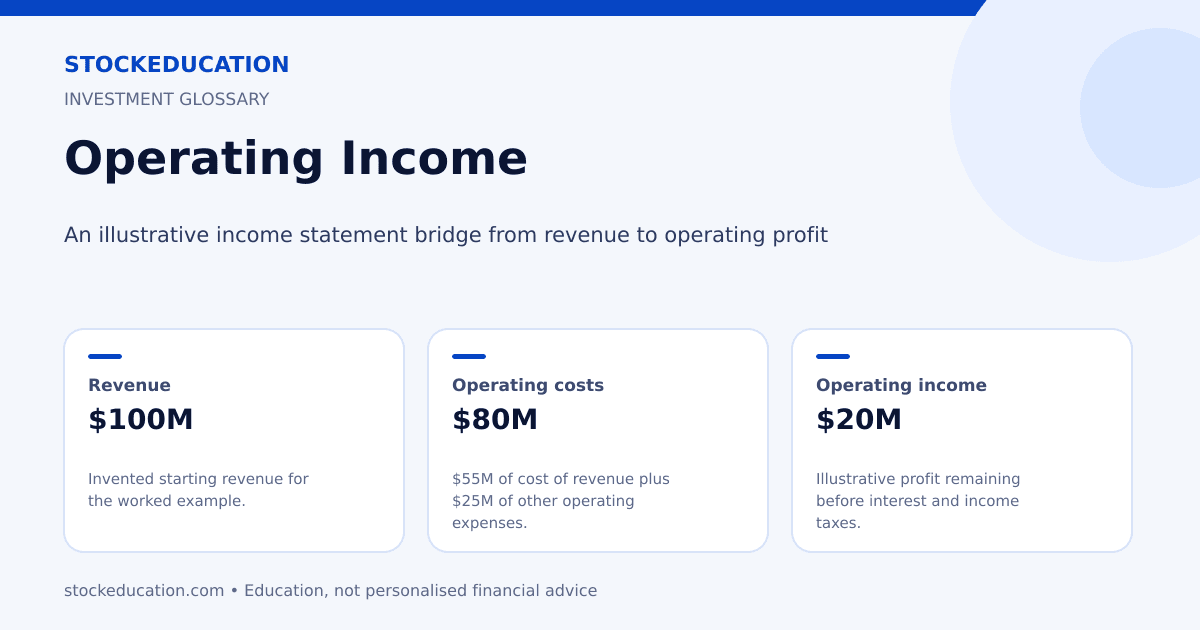
Assume a fictional company reports $100 million of revenue, $55 million of cost of revenue, $12 million of selling and administrative expense, $8 million of research and development expense, and $5 million of depreciation classified as an operating expense. Gross profit is $45 million: $100 million minus $55 million. Total operating expenses below gross profit are $25 million: $12 million plus $8 million plus $5 million. Operating income is therefore $20 million: $45 million minus $25 million. Its operating margin is 20%: $20 million divided by $100 million. These invented figures demonstrate the calculation and are not a market quote, forecast or report from a real company.
Why it matters
Operating income helps investors examine whether a company’s main activities are profitable before financing and income tax effects. Following it over several comparable periods can reveal changes in pricing, sales volume, input costs and overhead. It is also the numerator in operating margin. However, it remains an accrual accounting measure: it can include noncash expenses and revenue not yet collected, so it should be assessed with operating cash flow, the balance sheet, filing notes and management’s discussion.
Compare profit with cash generation
Continue with operating cash flow to understand why reported operating profit and cash generated can differ.
- Educational tools only; verify company figures in official filings.
Save lessons and track your progress through financial statement analysis. Create a free account
Where operating income appears
Operating income normally appears as a subtotal on the income statement, which may be titled the statement of operations, statement of income or statement of earnings. The calculation starts with revenue and deducts the operating costs reported above that subtotal. Some companies present gross profit first, while others show operating revenue and several expense categories without a gross profit line. Use the company’s stated labels and reporting units, and confirm whether the period is a quarter, fiscal year or another interval.
What operating expenses include
Operating expenses can include selling, general and administrative costs, research and development, marketing, employee compensation, depreciation, amortization and other costs of running the business. Cost of revenue or cost of sales is also deducted before operating income, although it may appear above a separate gross profit subtotal. Classification varies by industry and accounting policy. Read the notes to learn where stock compensation, restructuring charges, impairments and acquisition costs have been recorded before comparing companies.
Operating income versus operating cash flow
Operating income is calculated under accrual accounting, while operating cash flow reports cash generated or used by operating activities. Revenue can increase operating income before a customer pays, and depreciation can reduce operating income without an equivalent current-period cash outflow. The cash flow statement reconciles net income to operating cash flow for most companies by adjusting noncash items and changes in operating assets and liabilities. Neither measure replaces the other: together they show profitability and cash conversion.
How operating margin adds context
A dollar amount is difficult to compare when company size or revenue changes. Operating margin divides operating income by revenue for the same period and expresses the result as a percentage. In the invented example, $20 million of operating income divided by $100 million of revenue produces a 20% operating margin. Compare consistent periods and similar businesses because cost structures vary widely by industry. A rising margin warrants investigation into prices, sales mix, costs and classification changes rather than an automatic conclusion.
Why reported classifications matter
Operating income is a GAAP subtotal when presented in GAAP financial statements, but judgment and accounting policies still affect the inputs. A company may classify a restructuring charge, asset impairment or gain within operations, causing a large movement that may not recur. Another company may have a different presentation. Review the accounting policies, expense notes, segment information and management’s discussion to understand the drivers. If management presents an adjusted operating measure, reconcile it to the reported figure and examine every excluded item.
How to analyze a change over time
Begin with revenue, gross profit where available, each major operating expense and operating income for comparable periods. Calculate both the dollar change and operating margin, then identify which lines explain the movement. Check for acquisitions, disposals, currency effects, changes in product mix, impairments and restructuring. Compare full years with full years or equivalent quarters, not a seasonal quarter with an annual period. Finally, test whether operating cash flow moved in the same direction and read management’s explanation without treating it as independent verification.
Comparison
| Measure | What it deducts | Main use | Important limitation |
|---|---|---|---|
| Gross profit | Cost of revenue or cost of sales | Assess profit after direct or production costs | Does not deduct broader operating expenses |
| Operating income | Cost of revenue and operating expenses | Assess reported operating profitability | Classification and unusual operating items can affect comparisons |
| Net income | Operating and nonoperating items, including tax | Show earnings attributable after all reported expenses and gains | Financing, taxes and one-time items may obscure operations |
| Operating cash flow | Operating cash receipts and payments through cash flow adjustments | Assess cash generated or used by operations | Working capital timing can cause large period-to-period swings |
Check yourself
A fictional company reports $80 million of revenue, $45 million of cost of revenue and $20 million of other operating expenses. What is its operating income?
Subtract both categories of operating costs from revenue: $80 million minus $45 million minus $20 million equals $15 million. The figures are invented for education.
Show the answer
$15 million
Things people get wrong
Mistake 01 Treating it as cash
Operating income is an accrual accounting measure and can differ substantially from cash generated by operations.
Mistake 02 Assuming EBIT is always identical
EBIT is used with varying definitions, while operating income follows the operating subtotal presented in the financial statements; nonoperating gains or losses can create differences.
Mistake 03 Ignoring expense classifications
Companies can classify costs differently, so a surface-level comparison may mix unlike figures.
Mistake 04 Comparing mismatched periods
A quarter, trailing period and fiscal year are not directly comparable without adjustment and context.
Mistake 05 Automatically removing unusual costs
An item described as unusual may still be a reported operating expense and may recur in some businesses.
Mistake 06 Using margin as a buy signal
A high operating margin says nothing by itself about valuation, debt, cash conversion or future competitive pressure.
Questions people ask about Operating Income
Is operating income the same as net income?
No. Net income generally includes nonoperating items, interest and income taxes that come after operating income.
Is operating income the same as EBIT?
Not necessarily. The terms are sometimes used interchangeably, but EBIT definitions can include nonoperating items. Check the stated calculation.
Can operating income be negative?
Yes. A negative amount is an operating loss, meaning reported operating costs exceeded revenue for that period.
Does depreciation reduce operating income?
It generally does when depreciation is included in cost of revenue or operating expenses, although presentation varies.
What is operating margin?
Operating margin is operating income divided by revenue for the same period, usually expressed as a percentage.
Why can operating income rise while operating cash flow falls?
Accruals, noncash expenses and changes in receivables, inventory, payables or other working capital accounts can make the measures move differently.
Where can I find operating income?
Look on the income statement in a company’s Form 10-K or Form 10-Q for operating income, income from operations, operating profit or operating loss.
The bottom line
Operating income shows how much reported profit or loss remains after a company deducts its operating costs from revenue but before interest and income taxes. It is useful for studying operating performance and calculating operating margin, but it is not cash flow or a complete measure of investment quality. Compare consistent periods, inspect expense classifications and unusual items, and read it alongside operating cash flow, the notes and management’s discussion.
Sources
How we produced the figuresPrimary-source definitions and calculation guidance were checked against current official SEC pages. The numerical example is deliberately fictional and is not drawn from a company quote or filing.
Research the company behind the number
Use the screener to build a research list, then verify operating income and its components in each company’s SEC filings.
About this page. Written by Associate Professor Charles Lo, CPA, PhD and edited by Felix La Spina. No ads and no paywall. Editorial standards · How we fact check · Corrections log · Report an error
Educational information only. Nothing on this page is personal financial, tax or legal advice. Investing involves risk, including the possible loss of principal.


