
Investment Glossary · Quick read · No ads
Preferred Stock
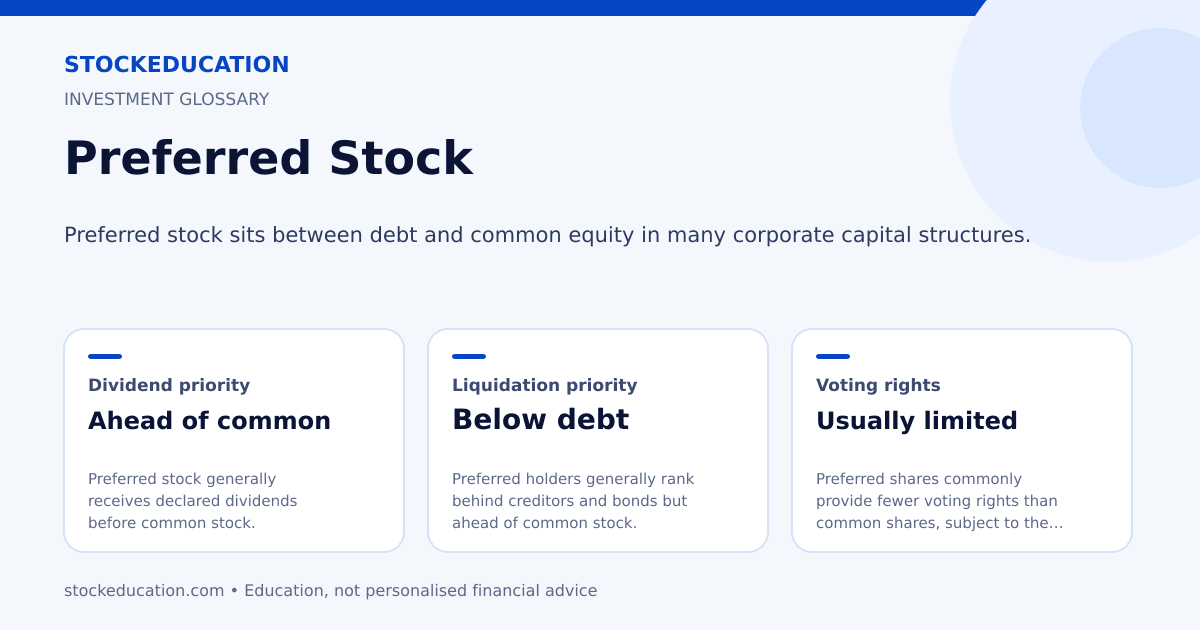
Preferred stock is equity that generally receives priority over common stock for declared dividends and liquidation distributions, while usually offering fewer voting rights. It is not corporate debt, and its exact protections depend on the share series and offering documents.

Key takeaways
- Preferred stock generally ranks ahead of common stock for declared dividends and liquidation proceeds.
- It usually ranks behind corporate debt and other senior creditors.
- Dividend payments may be cumulative or non-cumulative, depending on the issue terms.
- Call, conversion and rate-reset provisions can materially change an investor’s outcome.
- A preferred share’s stated dividend does not eliminate issuer, interest-rate, credit or liquidity risk.
What is Preferred Stock?
Preferred stock is a class of equity that generally gives its holders priority over common stockholders for dividends and distributions if the company is liquidated, but it usually provides fewer voting rights and does not have the same claim as corporate debt. The exact rights depend on the individual series and its offering documents.
For example, a preferred share with a stated annual dividend may provide income, but the payment can depend on the security’s terms and the board’s declaration. Investors should compare preferred stock with common stock and bonds, review whether dividends are cumulative, and understand call, conversion, rate-reset and liquidation-preference provisions before investing. See the related glossary lessons on common stock and capital structure.
How Preferred Stock works
| Step | What happens |
|---|---|
| 01 · Read the issue documents | Identify the series, stated value, dividend rate, payment schedule, cumulative status, liquidation preference, maturity or perpetuity and any restrictions on common dividends. |
| 02 · Map the capital-structure ranking | Determine which debt and creditor claims rank ahead of the preferred shares and whether other preferred classes or subsidiaries affect recovery in a liquidation. |
| 03 · Analyze payment features | Check whether dividends can be deferred, whether missed payments accumulate, and whether issuer financial or regulatory conditions can limit distributions. |
| 04 · Test call and conversion outcomes | Record the first call date, redemption price, conversion ratio, conversion triggers and rate-reset formula, then consider how each could change income, duration and price. |
| 05 · Assess issuer capacity | Review debt burden, cash flow, dividend coverage, refinancing needs, credit quality and history of meeting obligations rather than relying only on the stated yield. |
| 06 · Compare market value and liquidity | Calculate yield using the actual purchase price and plausible call or conversion outcomes, and consider bid-ask spreads, trading volume, taxes and the possibility of selling below cost. |
The formula
Preferred-stock value = present value of expected preferred dividends + present value of expected redemption or conversion proceeds
Expected preferred dividends are the payments the investor anticipates receiving under the issue terms; cumulative status affects whether missed dividends may be carried forward. Redemption or conversion proceeds depend on call terms, liquidation preference, conversion provisions, issuer actions and the security’s market conditions, so the formula is an analytical framework rather than a guarantee. The present-value calculation uses a required return that reflects interest rates, credit risk, liquidity, call risk and other features of the specific preferred issue.
A worked example
Hypothetical example: Assume an investor buys 100 shares of a preferred issue with a $25 stated value and a 6% annual dividend. The expected annual dividend is 100 × $25 × 0.06 = $150, or $12.50 per quarter if paid in four installments. If the shares are cumulative and the issuer skips two quarterly payments, the unpaid amount would be $25.00 per share, or $2,500 for 100 shares, before common dividends could generally resume, subject to the issue terms. If the shares are non-cumulative, those skipped payments may not be recoverable. Suppose the shares are later called at $25 per share: the redemption amount would be 100 × $25 = $2,500, excluding any declared dividend. If the investor paid $26 per share, the purchase cost was $2,600, so redemption alone would produce a $100 loss before dividends, taxes and transaction costs. This example is hypothetical. It does not guarantee payment, assume a particular tax result, or capture changes in market price, credit quality, liquidity, conversion value, rate resets or the issuer’s right to defer or redeem the security. The prospectus and governing documents control.
Why it matters
Preferred stock can look like an income investment while carrying equity-level risks. Understanding its rank helps investors distinguish priority over common stock from seniority over creditors. Reviewing cumulative status, call and conversion terms, rate resets, voting provisions, liquidation preference, issuer credit quality and market liquidity can reveal why two preferred issues with similar stated dividends may behave very differently. The security’s documents, not its name alone, determine the practical rights and risks.
Dividend priority and payment terms
Preferred stock is commonly designed to receive dividends before common stock, but priority does not mean an unconditional payment. The board generally must declare an equity dividend, and the security’s documents determine whether unpaid dividends accumulate. With cumulative preferred stock, missed dividends are generally carried forward before common dividends resume; with non-cumulative preferred stock, missed payments may not be recoverable. Investors should examine the stated dividend rate, payment frequency, cumulative status, restrictions on common dividends, and any provisions allowing dividends to be deferred. A stated rate can describe the contractual framework without guaranteeing income, because the issuer’s financial condition and governing terms still matter.
Position in the capital structure
Preferred stock sits within equity, even though its income profile can resemble a bond. In a simplified capital structure, secured and unsecured creditors generally have claims ahead of preferred shareholders, while preferred shareholders generally rank ahead of common shareholders for liquidation distributions. This intermediate position creates a trade-off: preferred stock may offer greater distribution priority than common equity, but it does not receive the same creditor protections as debt. A liquidation preference states how the preferred claim is calculated, subject to the issue terms and available assets. Priority is therefore relative, not a promise that investors will recover their full investment.
Voting rights and control
Preferred shares often provide fewer ordinary voting rights than common shares because the security is structured around dividend and liquidation preferences rather than day-to-day corporate control. The terms may still grant special voting rights in defined circumstances, such as prolonged dividend arrears, proposed changes to the preferred class, or a merger that adversely affects its rights. Those protections differ substantially among issuers and series. Investors should not assume that the label preferred stock identifies a uniform instrument. The prospectus, charter provisions and exchange-specific disclosures should be reviewed to determine when holders can vote, what matters require consent, and whether voting rights expire when a condition is corrected.
Calls, conversions and rate resets
Many preferred securities include features that can change their expected income or duration. A callable issue may allow the company to redeem shares after a specified date and price, limiting the investor’s ability to keep receiving an attractive dividend when market rates fall. A convertible preferred share may be exchanged for common stock under stated conditions, adding equity upside but also exposing the holder to common-stock volatility. Fixed-rate, floating-rate and rate-reset structures respond differently to interest-rate changes. Investors should identify the first call date, redemption price, conversion ratio, reset formula, trigger conditions and any protective provisions rather than evaluating the security solely by its current yield.
Risks and valuation
Preferred stock can lose value when interest rates rise, when the issuer’s credit quality weakens, or when market liquidity is limited. Its price may also react to expectations about a call, dividend suspension, conversion or regulatory treatment. A high stated or market yield can reflect meaningful risk rather than free compensation. Because preferred shares have a specified place in the capital structure, analysis should include the issuer’s debt burden, cash flow, dividend coverage, refinancing needs and history of meeting obligations. Market price, yield measures and tax treatment should be considered together with the legal rights attached to the specific series.
Comparing preferred stock with alternatives
Common stock usually offers greater voting participation and more direct exposure to residual company growth, but it generally ranks behind preferred stock for dividends and liquidation. Bonds generally have contractual interest and creditor status ahead of preferred equity, although they carry their own default, call and interest-rate risks. Preferred stock occupies a middle position: it may provide a defined distribution preference without providing the full protections of debt or the full upside and control of common equity. A useful comparison begins with ranking, payment enforceability, maturity or perpetuity, voting rights, call terms, conversion features, liquidity and the issuer’s ability to support the obligation.
Comparison
| Feature | Preferred stock | Common stock | Corporate bonds |
|---|---|---|---|
| Claim priority | Generally ahead of common equity but behind creditors | Generally last among these three for liquidation | Generally ahead of equity, subject to debt ranking and security |
| Payments | Preferred dividends may be fixed, variable, cumulative or non-cumulative | Dividends are discretionary and commonly more variable | Interest is generally contractual, subject to default and debt terms |
| Voting and upside | Usually limited voting; some issues convert or reset | Usually greater voting participation and residual upside | Usually no ordinary ownership vote and typically limited equity upside |
| Main risks | Credit, rate, call, conversion, liquidity and dividend risks | Business, market, dilution and dividend risks | Default, interest-rate, refinancing, call and credit risks |
Check yourself
A preferred share is cumulative, has a $25 stated value, pays 5% annually, and an investor owns 80 shares. If the issuer declares the dividend, what annual amount is expected before taxes and fees?
The calculation is 80 shares × $25 stated value × 5% = $100. Cumulative status affects treatment of skipped payments; it does not change the ordinary annual calculation when the dividend is declared and paid.
Show the answer
$100
Things people get wrong
Mistake 01 Treating dividend priority as a guarantee
Preferred stock generally ranks ahead of common stock for declared dividends, but payments can depend on issuer condition, board action and the specific terms. Priority does not eliminate issuer or market risk.
Mistake 02 Assuming preferred stock is safer than bonds because it pays a stated dividend
Preferred stock is equity and commonly ranks behind corporate debt and other creditors. Its stated rate does not provide the same creditor status as bond interest.
Mistake 03 Ignoring cumulative status and call provisions
A cumulative issue may carry unpaid dividends forward, while a non-cumulative issue may not. A callable issue can be redeemed when keeping its dividend would otherwise be attractive.
Mistake 04 Comparing yields without reviewing price and terms
Yield can change with purchase price, call assumptions, reset provisions, conversion features, taxes and liquidity. A higher yield may signal greater risk rather than a better bargain.
Mistake 05 Assuming every preferred issue has the same rights
Voting rights, liquidation preference, maturity, conversion ratio, reset formula and dividend restrictions vary by series. The prospectus and charter documents should be checked before investing.
Questions people ask about Preferred Stock
What is preferred stock?
Preferred stock is corporate equity with specified rights that generally place it ahead of common stock for declared dividends and liquidation distributions, while usually providing fewer ordinary voting rights.
Does preferred stock rank ahead of bonds?
Generally no. Preferred stock normally ranks below secured and unsecured creditors and other corporate debt, although the precise ranking depends on the issuer and security documents.
Are preferred-stock dividends guaranteed?
No. A stated dividend is not the same as a guaranteed payment. Dividends may depend on issuer finances, board declaration and whether the issue is cumulative or non-cumulative.
What does cumulative preferred stock mean?
If permitted by the terms, unpaid dividends on cumulative preferred stock generally accumulate and must be addressed before common dividends resume. Non-cumulative shares may not recover missed payments.
Why might an issuer call preferred stock?
A callable issue may let the issuer redeem shares after a specified date and price. The issuer may call when refinancing is attractive or when market rates make the existing dividend expensive.
Can preferred stock be converted into common stock?
Some issues are convertible under stated conditions, ratios and dates. Conversion can provide equity exposure but may also increase sensitivity to common-stock volatility and issuer performance.
How does preferred stock respond to interest rates?
Prices often fall when required market returns rise, especially for fixed-rate issues. Floating-rate or reset structures may respond differently, but they introduce their own formulas and risks.
What should investors review before buying?
Review the prospectus, ranking, dividend rate, cumulative status, liquidation preference, call date and price, conversion terms, reset formula, voting rights, issuer credit quality, liquidity and tax treatment.
The bottom line
Preferred stock can combine an equity claim with a distribution priority over common stock, but it remains subordinate to corporate debt and carries issuer, interest-rate, call, liquidity and market risks. The exact series documents determine whether the apparent income and priority are meaningful in practice.
Sources
About this page. Written by Associate Professor Charles Lo, CPA, PhD and edited by Felix La Spina. No ads and no paywall. Editorial standards · How we fact check · Corrections log · Report an error
Educational information only. Nothing on this page is personal financial, tax or legal advice. Investing involves risk, including the possible loss of principal.


