
Investment Glossary · Quick read · No ads
Real Return
Real return is the investment result after adjusting for inflation and, in broader usage, taxes, fees and other costs. It focuses on whether your purchasing power increased, not merely whether the account balance rose.

Key takeaways
- Real return measures investment growth after adjusting for inflation and purchasing-power changes.
- Nominal return is the stated investment gain before inflation, taxes, fees and other costs.
- The exact inflation-adjusted calculation uses division rather than simple subtraction.
- A positive nominal return can still produce a negative real return when inflation is higher.
- Returns and inflation should cover matching periods and use compatible compounding conventions.
- Taxes, fees and personal spending patterns may make an investor’s realized result different.
What is Real Return?
A real return shows how much an investment gained or lost after accounting for inflation and, depending on the measurement, taxes. It is more useful than a nominal return when you want to know whether your money’s purchasing power increased. A positive account balance change does not necessarily mean that you can buy more goods and services.
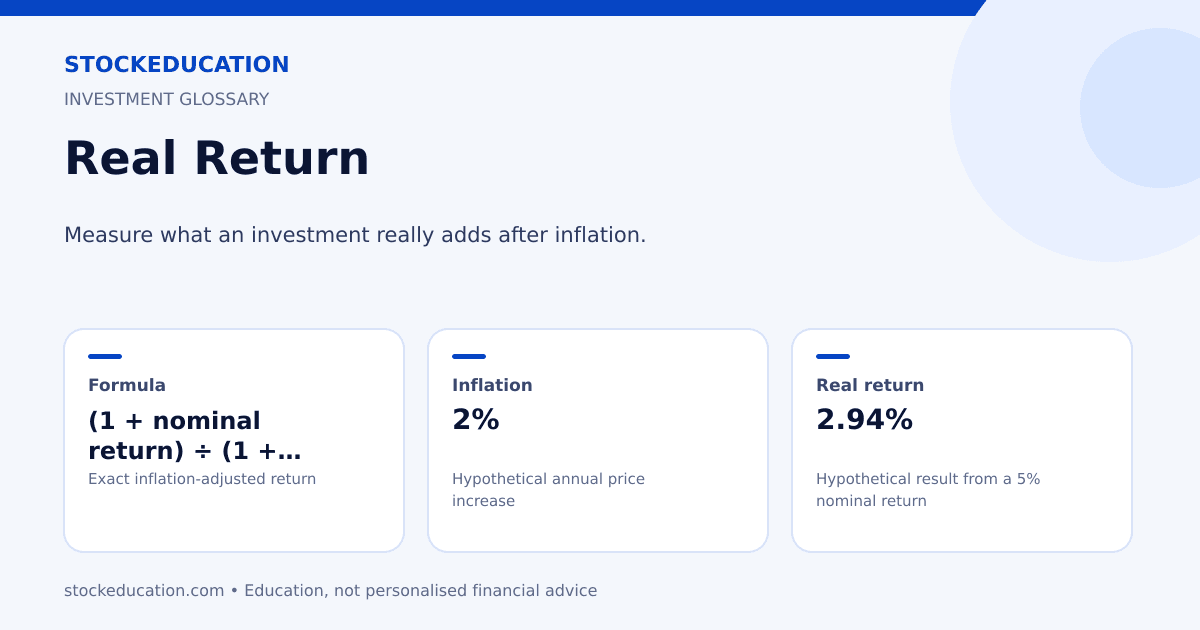
For example, a hypothetical 5% nominal return with 2% inflation produces an exact inflation-adjusted return of about 2.94%, using (1.05 ÷ 1.02) − 1. Investors should distinguish this measure from the broader definition that also considers taxes, fees and other costs. Learn more about purchasing power and the investment risks that inflation can create.
How Real Return works
| Step | What happens |
|---|---|
| 01 · 1. Define the period | Select matching start and end dates for the investment result and the inflation measure. |
| 02 · 2. Identify the return basis | State whether the nominal figure includes reinvested distributions and whether it is before or after fees. |
| 03 · 3. Convert percentages | Express the nominal return and inflation rate as decimals before applying the formula. |
| 04 · 4. Calculate the exact result | Divide one plus nominal return by one plus inflation, then subtract one. |
| 05 · 5. Add investor-specific adjustments | If needed, account separately for taxes, fees, withdrawals and other costs. |
| 06 · 6. Interpret purchasing power | Decide whether the resulting percentage supports the relevant spending or savings objective. |
The formula
Real return = (1 + nominal return) ÷ (1 + inflation rate) − 1
Nominal return is the investment’s percentage gain or loss before inflation adjustment. Inflation rate is the percentage change in prices over the same measurement period. The formula gives the exact inflation-adjusted result; taxes, fees and other costs require additional deductions or a separately defined net-return calculation. For a 5% nominal return and 2% inflation, (1.05 ÷ 1.02) − 1 equals approximately 2.94%; direct subtraction gives only the approximate 3% result. Use decimal inputs such as 0.05 and 0.02, then express the final result as a percentage after subtracting one. Returns and inflation must use matching periods and compatible compounding conventions for the comparison to be meaningful. A negative result means purchasing power declined during the measured period, even if the investment’s nominal value increased. If taxes, fees, withdrawals or reinvested distributions are included, define those items clearly before calculating an investor-specific result.
A worked example
Hypothetical worked example: Suppose an investment earns a 5% nominal return during a year when inflation is 2%. Express the rates as decimals and calculate: (1 + 0.05) ÷ (1 + 0.02) − 1 = 1.05 ÷ 1.02 − 1 = 0.0294118, or approximately 2.94%. The account balance increased by 5% in dollars, but prices increased as well, so the investment’s purchasing power increased by about 2.94% before taxes, fees and other costs. Direct subtraction, 5% − 2% = 3%, is a reasonable rough estimate but not the exact compounded result. If the investment had earned 1% while inflation was 2%, its real return would be (1.01 ÷ 1.02) − 1, or approximately −0.98%, even though the account balance rose. This example is hypothetical and does not forecast performance. The conclusion can change when taxes, management fees, trading costs, withdrawals, reinvested distributions, measurement dates or a different personal spending pattern are included.
Why it matters
Real return matters because financial goals are paid for with goods and services, not percentages on a statement. Ignoring inflation can overstate future wealth, make a savings target look easier than it is and encourage unsuitable comparisons between investments. Including taxes and costs where relevant produces a more realistic estimate of what the investor can actually spend. The measure is especially useful for long-term planning, although it remains an estimate based on selected inflation data and does not remove investment risk.
Real Return Versus Nominal Return
Nominal return is the unadjusted percentage gain or loss reported by an investment, fund or account. Real return asks what that result means after prices changed during the same period. If an investment rises 5% while prices rise 2%, the investor has not gained the full 5% in purchasing-power terms. The distinction matters for comparing investments with different time horizons, evaluating savings goals and judging whether portfolio growth is keeping pace with the cost of living. Nominal performance remains useful for account statements and tax calculations, but real performance gives a better economic interpretation.
The Exact Inflation Adjustment
The standard exact calculation divides one plus the nominal return by one plus the inflation rate, then subtracts one. For a 5% nominal return and 2% inflation, the result is (1.05 ÷ 1.02) − 1, or approximately 2.94%. Subtracting 2% directly from 5% gives a convenient approximation of 3%, but it is not mathematically exact because returns compound multiplicatively. The difference may seem small in one year, yet repeated over long periods or applied to large balances, even small calculation differences can affect planning conclusions.
Purchasing Power and Spending Ability
Purchasing power is the quantity of goods and services a unit of currency can buy. Inflation reduces that quantity when prices rise, so an investment can show a positive dollar gain while failing to preserve the investor’s economic position. Real return connects performance to a future spending objective: retirement income, education costs, a home purchase or an emergency reserve. The relevant inflation rate may not match a general index because households buy different baskets of goods. Housing, medical care, tuition and food can change at different rates, making personal spending patterns important.
Taxes, Fees and Other Costs
A quoted real return commonly adjusts nominal performance for inflation, while a more comprehensive personal result also considers taxes, management fees, trading costs and other charges. These deductions reduce the amount actually available to spend or reinvest. Taxes may apply to interest, dividends, realized gains or withdrawals and can vary by account type and jurisdiction. Fees may be deducted continuously rather than appearing as a single charge. Investors should therefore identify whether a comparison is gross or net, use returns measured on the same basis, and avoid presenting an inflation-only figure as a complete after-tax outcome.
Measuring Returns Across Periods
Inflation and investment returns must cover matching periods before they can be compared. A monthly investment return should be paired with a monthly inflation measure, while an annual return should be paired with annual inflation. For multi-year analysis, compounding each period is generally more informative than averaging reported percentages. Timing also matters: a return earned early or late in a period can affect contributions, withdrawals and the ending balance. A consistent methodology should state the measurement dates, whether distributions are reinvested, and whether the result is nominal, inflation-adjusted, pre-tax or after-cost.
Using Real Return in Decisions
Real return is a decision tool rather than a guarantee of future purchasing power. It can help investors set savings targets, compare cash with bonds or equities, assess whether a fixed interest rate is keeping pace with inflation and understand the trade-off between risk and expected spending growth. It should be viewed alongside volatility, liquidity, credit risk, taxes, fees and the possibility of loss. A historical positive real return does not ensure a positive future result, and a short period can be dominated by unusual inflation or market conditions. Good analysis states its assumptions clearly.
Comparison
| Measure | Inflation included | Typical use | Main limitation |
|---|---|---|---|
| Nominal return | No inflation adjustment | Reported account performance | Can overstate purchasing-power growth |
| Inflation-adjusted real return | Inflation included | Compare growth with price changes | Depends on the selected inflation measure |
| After-tax real return | Inflation included | Estimate spendable purchasing power | Tax treatment varies by investor and account |
| Net real return | Inflation and costs included | Include stated costs in the comparison | Fees and other costs must be identified consistently |
Check yourself
An investment earns a 5% nominal return while inflation is 2%. What is the approximate exact real return before taxes and fees?
The exact inflation-adjusted calculation is (1.05 ÷ 1.02) − 1 = 0.0294118, or approximately 2.94%. Subtracting 2% directly from 5% gives 3%, which is only an approximation.
Show the answer
3. 2.94%
Things people get wrong
Mistake 01 Using subtraction as the exact result
Subtracting inflation from nominal return is a useful approximation but does not capture compounding; use division for the exact inflation adjustment.
Mistake 02 Mixing periods
Comparing an annual investment return with a monthly or differently dated inflation figure can produce a misleading result.
Mistake 03 Ignoring taxes and fees
An inflation-adjusted gross return may be higher than the amount the investor actually keeps or can spend.
Mistake 04 Treating one index as universal
A broad inflation index may not reflect a household’s personal mix of housing, healthcare, food and other expenses.
Mistake 05 Reading positive dollars as positive purchasing power
A higher account balance does not prove that the investor can buy more goods and services.
Mistake 06 Presenting history as a forecast
A past real return describes a completed period and does not guarantee a future outcome.
Questions people ask about Real Return
What is real return?
Real return is investment performance after adjusting for inflation, with broader calculations sometimes also including taxes, fees and other costs.
How is real return calculated?
Use (1 + nominal return) ÷ (1 + inflation rate) − 1, using rates for the same period.
Is real return the same as nominal return?
No. Nominal return is unadjusted, while real return reflects the effect of changing prices on purchasing power.
Can real return be negative?
Yes. If inflation exceeds the investment result, or if costs reduce the result sufficiently, purchasing power can decline.
Why not simply subtract inflation?
Direct subtraction is a close approximation for modest rates, but division provides the exact compounded relationship.
Does real return include taxes?
Not automatically. The narrow measure adjusts for inflation; an after-tax real return must specify and include applicable taxes.
Which inflation rate should an investor use?
Use a credible measure that matches the period and, where appropriate, consider whether it reflects the investor’s actual spending pattern.
Does a positive real return eliminate risk?
No. It describes a past or assumed purchasing-power result and does not remove volatility, credit, liquidity or loss risk.
The bottom line
Real return shows whether an investment increased purchasing power after inflation. Use matching periods and the exact division-based formula, then identify taxes, fees and other costs before treating the result as a personal spendable outcome. A positive nominal return is not necessarily a positive real return.
Sources
About this page. Written by Associate Professor Charles Lo, CPA, PhD and edited by Felix La Spina. No ads and no paywall. Editorial standards · How we fact check · Corrections log · Report an error
Educational information only. Nothing on this page is personal financial, tax or legal advice. Investing involves risk, including the possible loss of principal.


