
Investment Glossary · Quick read · No ads
Stock Split
A stock split changes the number of shares outstanding and adjusts the price per share by a stated ratio. In a conventional split, your share count rises while the per-share price falls proportionally, so the immediate total market value of your position normally remains unchanged.

Key takeaways
- A two-for-one split gives each shareholder twice as many shares and halves the price per share.
- A split does not normally create value by itself or dilute an existing ownership interest.
- Per-share measures such as dividends and earnings per share must be adjusted for the new share count.
- A reverse stock split reduces shares and proportionally increases the price per share.
- Market prices can move after a split because investors respond to the company, not because the arithmetic changed.
What is Stock Split?
How Stock Split works
| Step | What happens |
|---|---|
| 01 · Identify the action | Confirm whether the announcement describes a forward split, reverse split, or another corporate action. |
| 02 · Read the ratio | Record the exact ratio and effective date before changing share or price calculations. |
| 03 · Update share count | Multiply the old share count by the forward-split multiplier or apply the reverse-split reduction. |
| 04 · Adjust per-share data | Restate price, earnings per share, dividends per share, and other per-share figures consistently. |
| 05 · Check the position | Compare shares multiplied by price per share while allowing for market movement and settlement details. |
| 06 · Review the business | Analyze valuation, financial condition, dilution, listing status, and operating results separately from the split. |
The formula
Post-split shares = pre-split shares × split multiplier; post-split price = pre-split price ÷ split multiplier
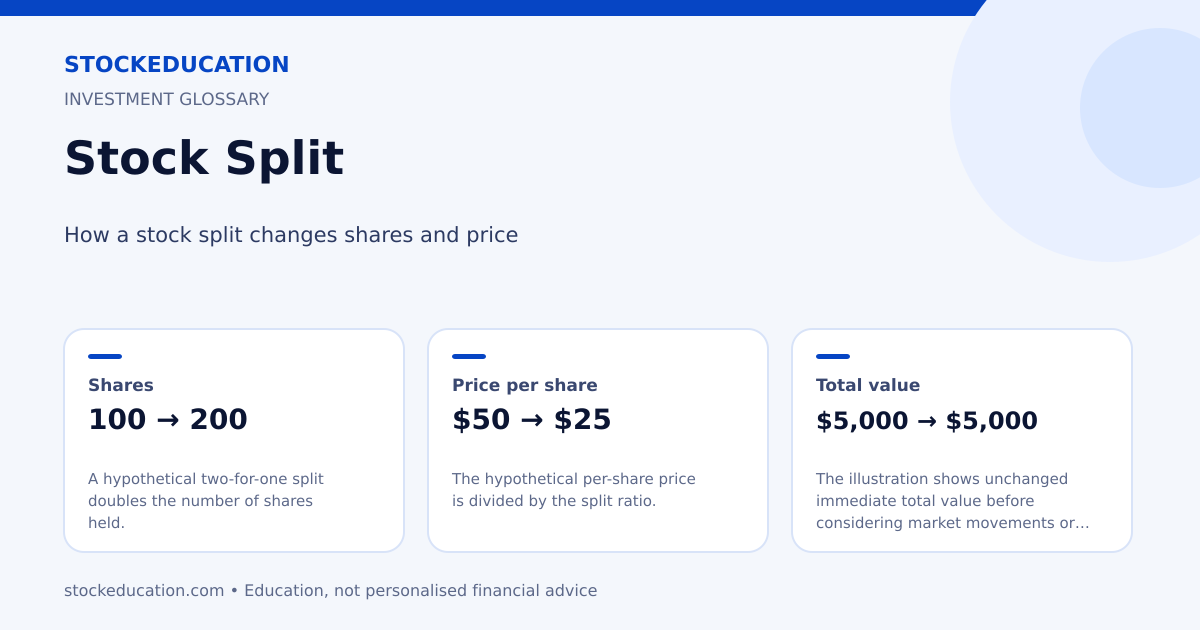
The split multiplier expresses how many new shares correspond to one old share. In a two-for-one split, the multiplier is 2: 100 shares become 200, while a hypothetical $50 price becomes $25. For a reverse split, the effective share-count multiplier is below 1, so the number of shares decreases while the reference price increases proportionally. A three-for-one reverse split changes 300 shares into 100 shares and multiplies the reference price by 3. The calculation assumes no separate market movement, fees, taxes, fractional-share settlement, or other corporate-action effects at the comparison point. Position value is shares multiplied by price per share, so the mechanical adjustment normally leaves immediate value unchanged. Per-share dividends, earnings, book value, and historical prices may require corresponding split adjustments for meaningful comparisons. A split changes the denomination of ownership; it does not by itself measure valuation, business quality, dilution, or expected return.
A worked example
Hypothetical worked example: Suppose you own 100 shares priced at $50 each before a two-for-one split. Before the split, your position is 100 × $50 = $5,000. The split multiplier is 2, so your new share count is 100 × 2 = 200 shares, and the reference price becomes $50 ÷ 2 = $25 per share. After the mechanical adjustment, 200 × $25 = $5,000. This does not guarantee that the market value will remain $5,000 after trading resumes: news, investor demand, market conditions, fees, taxes, fractional-share treatment, and other corporate actions can affect the result. The figures are hypothetical and are not a market quote or forecast.
Why it matters
Understanding stock splits prevents arithmetic errors in portfolio records, return calculations, charts, dividends, and per-share analysis. A split can make a quoted price look dramatically different without changing the investor’s immediate proportional ownership or total position value. Correctly distinguishing a forward split from a reverse split also helps investors recognize when a corporate action is mainly administrative and when it may warrant deeper review of listing status, financial condition, dilution risk, and business performance. Split-adjusted data is essential for comparing historical prices and earnings measures fairly.
How the ratio changes your position
The split ratio determines the mechanical adjustment. In a two-for-one split, every old share becomes two new shares, so 100 shares become 200. If the pre-split price were a hypothetical $50, the post-split reference price would be approximately $25. The position would therefore still have a hypothetical value of $5,000 immediately after the adjustment. A three-for-two split would multiply the share count by 1.5 and divide the reference price by 1.5. The ratio affects units, not the underlying business, assets, cash flows, or proportional claim. Brokerage records generally update automatically, although investors should verify fractional-share treatment, cost-basis records, and the effective date.
Why total value usually stays unchanged
A conventional split is arithmetic rather than an automatic gain. Before the action, value can be represented as shares multiplied by price per share. After a two-for-one split, shares double while the reference price halves, leaving that product unchanged at the instant of adjustment. This does not mean the stock cannot rise or fall around the event. Investor expectations, broad market conditions, earnings news, liquidity, taxes, and trading behavior can change the market price. The unchanged-value principle is therefore a starting point, not a forecast. It also explains why simply seeing a lower quoted price does not prove that a stock became cheaper relative to its business or valuation.
Effects on ownership and per-share measures
A forward split generally leaves each shareholder with the same percentage ownership immediately after the action, because all shares are divided on the same terms. The company’s total equity value is not mechanically increased, and an investor’s voting or economic claim is not normally diluted by the split itself. Per-share figures must nevertheless be interpreted carefully. Earnings per share, dividends per share, book value per share, and historical prices are commonly adjusted to reflect the larger share count. A dividend stated per share may be reduced proportionally even though the investor’s aggregate dividend entitlement is intended to remain comparable, subject to the company’s policy and other changes. Comparing unadjusted and adjusted figures can produce misleading conclusions.
Forward splits and reverse splits
A forward split increases the number of shares and reduces the price per share, while a reverse split does the opposite. In a ten-for-one reverse split, for example, 1,000 shares could become 100 shares and the reference price would be multiplied by ten. The immediate arithmetic can preserve total value, but reverse splits deserve additional scrutiny because companies may use them to meet exchange listing requirements or address a very low share price. A reverse split does not repair weak finances by itself. Investors should examine the company’s balance sheet, operating performance, filings, capital needs, and risk of further dilution. Fractional shares may be cashed out or handled under the issuer’s stated terms.
Reading split-adjusted investment history
Historical charts and performance records should identify whether prices are split-adjusted. A chart that retroactively divides earlier prices makes the series comparable with the current share count; an unadjusted series can show artificial jumps or drops at split dates. The same issue applies to earnings per share, dividend history, cost basis, and return calculations. When reviewing a company, establish the split ratio and effective date, then confirm that the data provider applied the adjustment consistently. Do not treat a lower post-split price as evidence of a lower valuation without considering total shares, market capitalization, earnings, cash flow, and other relevant measures. Split-adjusted history helps comparison, but it does not replace fundamental analysis.
What a split does and does not signal
A split can make a per-share price appear more accessible and may support trading convenience or investor communication, but it does not guarantee better future returns. Management may announce a split after a substantial price increase, yet the announcement alone does not establish that the company is worth more. Likewise, a reverse split can be a technical restructuring rather than proof of a particular future outcome, though it may accompany serious financial pressure. Treat the action as information about share denomination and corporate policy. Evaluate the business separately using measures such as revenue, profitability, cash flow, debt, competitive position, valuation, and risk. Use split announcements to update your records, not as a substitute for an investment thesis.
Comparison
| Action | Share count | Price per share | Immediate arithmetic |
|---|---|---|---|
| Forward split | Increases | Decreases proportionally | Total position value normally unchanged |
| Reverse split | Decreases | Increases proportionally | Total position value normally unchanged |
| No split | Unchanged | Market-determined | Changes with trading and company developments |
Check yourself
You own 100 hypothetical shares at $50 each before a two-for-one split. Ignoring market movement and other effects, what is the expected post-split position?
A two-for-one split doubles the share count and halves the reference price. Thus, 100 × $50 = $5,000 before the split and 200 × $25 = $5,000 immediately after the mechanical adjustment. Trading can change the value afterward.
Show the answer
2. 200 shares at $25 each
Things people get wrong
Mistake 01 Treating a lower price as a bargain
A split changes the unit price mechanically, so valuation must be assessed using market capitalization, earnings, cash flow, and other measures.
Mistake 02 Ignoring split-adjusted history
Unadjusted charts and per-share figures can create artificial jumps, misleading return calculations, or false comparisons.
Mistake 03 Confusing a reverse split with dilution
A reverse split reduces share count and raises the reference price; dilution is a separate change in ownership economics.
Mistake 04 Expecting an automatic return
The split itself normally preserves immediate value and does not guarantee that the market price will rise afterward.
Mistake 05 Forgetting settlement details
Fractional shares, cash in lieu, cost basis, dividends, and effective dates can require confirmation in issuer or broker records.
Questions people ask about Stock Split
What happens to my shares in a two-for-one split?
Each old share becomes two shares, while the reference price per share is ordinarily divided by two.
Does a stock split increase my investment value?
Not mechanically. The higher share count and lower price per share generally offset immediately, although later market trading can change value.
Does a split dilute shareholders?
A conventional split generally does not dilute existing proportional ownership because all shares are adjusted on the same terms.
Why do earnings per share and dividends per share change?
They are calculated on a per-share basis, so the larger or smaller share count requires proportional adjustment for meaningful comparison.
What is a reverse stock split?
It combines shares, reducing the number held and increasing the reference price proportionally; it can warrant additional review of the company’s circumstances.
Should I buy a stock because it split?
The split alone is not an investment thesis. Review the company’s valuation, results, balance sheet, risks, and prospects.
How should I read a split-adjusted chart?
Confirm that earlier prices and per-share data were restated consistently so historical periods can be compared with the current share count.
The bottom line
A stock split changes the denomination of ownership, not the underlying business value by itself. Forward splits increase shares and reduce the price per share, while reverse splits do the opposite. Check split-adjusted prices and per-share measures, then evaluate the company’s fundamentals and valuation separately.
Sources
About this page. Written by Associate Professor Charles Lo, CPA, PhD and edited by Felix La Spina. No ads and no paywall. Editorial standards · How we fact check · Corrections log · Report an error
Educational information only. Nothing on this page is personal financial, tax or legal advice. Investing involves risk, including the possible loss of principal.


