
Investment Glossary · Quick read · No ads
Valuation
Valuation is the process of estimating what a business, asset or share is worth at a specified date. Investors may estimate value from expected cash flows, comparable company multiples or net assets. The result is an informed estimate, not an observable fact or a guaranteed trading price.

Key takeaways
- Valuation estimates worth, while market price records the amount buyers and sellers currently agree to trade at.
- Discounted cash flow, comparable company and asset based methods answer the valuation question from different perspectives.
- A model is only as useful as its cash flow, growth, risk, share count and comparability assumptions.
- Enterprise value and equity value are different; debt, cash and other claims connect the two.
- Use ranges and scenarios rather than treating one calculated number as certain.
- Read the company’s current SEC filings before relying on a valuation model or screening ratio.
What is Valuation?
Valuation is the process of estimating what a business, asset or share may be worth. Investors can study expected cash flows, comparable companies and assets, but every result depends on inputs and judgment. A valuation estimate is not the same as the current market price or a guaranteed future selling price.
Start with company filings, test more than one scenario and compare the result with the quoted price. Learn the mechanics with our discounted cash flow guide, then use the US Stock Screener to identify comparable companies for further research.
How Valuation works
| Step | What happens |
|---|---|
| 01 · Define the subject | Specify the asset, valuation date and whether the estimate concerns enterprise value or equity value. |
| 02 · Collect primary information | Review current SEC filings, financial statements, notes, risk factors and material updates before setting assumptions. |
| 03 · Normalize the inputs | Align periods and units, distinguish recurring operations from unusual items and estimate diluted shares consistently. |
| 04 · Select suitable methods | Choose income, market or asset approaches that fit the evidence; learn how a discounted cash flow model converts forecast cash flows into present value. |
| 05 · State key assumptions | Document growth, margins, reinvestment, discount rates, terminal value, debt, cash and comparable-company choices. |
| 06 · Calculate and reconcile | Estimate value, bridge enterprise value to equity value and explain material differences between methods. |
| 07 · Test scenarios | Vary the most influential assumptions and present a range rather than relying on one precise result. |
| 08 · Compare with the market | Use the US Stock Screener to support comparison research, while treating screen data as a starting point rather than proof of value. |
| 09 · Update the analysis | Revise the valuation when new filings, business developments or market evidence change its inputs. |
The formula
Estimated enterprise value = Σ[FCFₜ ÷ (1 + r)ᵗ] + [terminal value ÷ (1 + r)ⁿ] Estimated equity value = enterprise value − debt + excess cash ± other nonoperating adjustments Estimated value per share = equity value ÷ diluted shares outstanding
FCFₜ = forecast free cash flow in period t r = discount rate appropriate to the cash flow and its risk t = number of periods from the valuation date n = final explicit forecast period Terminal value = estimated value of cash flows after the explicit forecast Debt and other adjustments = claims or nonoperating items used to bridge enterprise value to equity value Diluted shares outstanding = common shares plus applicable potential dilution
A worked example
Hypothetical example only; these figures are not a market quote or a valuation of a real company. Suppose an analyst forecasts free cash flow of $10 million one year from now, $11 million in year two and $12 million in year three. The analyst assumes a terminal value of $150 million at the end of year three and a 10% annual discount rate.
Present value of year-one cash flow = $10 million ÷ 1.10 = $9.09 million. Present value of year-two cash flow = $11 million ÷ 1.10² = $9.09 million. Present value of year-three cash flow = $12 million ÷ 1.10³ = $9.02 million. Present value of the terminal value = $150 million ÷ 1.10³ = $112.70 million.
The estimated enterprise value is $9.09 million + $9.09 million + $9.02 million + $112.70 million = $139.90 million. If the hypothetical company has $30 million of debt, $10 million of excess cash and no other adjustments, estimated equity value is $139.90 million − $30 million + $10 million = $119.90 million. With 20 million diluted shares, estimated value per share is $119.90 million ÷ 20 million = about $6.00.
This is a teaching calculation, not a recommendation. The terminal value contributes about 81% of enterprise value, so the estimate is especially sensitive to long-term assumptions. Changing the discount rate, forecasts, terminal value, debt, cash or diluted share count would change the answer.
Why it matters
Valuation gives investors a structured way to compare a quoted price with an estimate of economic worth. It forces the analyst to connect business performance, cash generation, reinvestment, financing and risk. The exercise is valuable even when the final estimate is uncertain because it reveals which expectations the investment case depends on and which disclosures require more research.
Value is not the same as market price
Market price is an observable transaction or quotation at a particular moment. Valuation is an estimate produced from evidence and assumptions. Investor.gov defines market capitalization as share price multiplied by total shares outstanding, so market capitalization measures the market’s current aggregate pricing of a company’s equity. An analyst’s estimated equity value may be higher or lower. That difference does not prove that the market or analyst is wrong; it identifies a claim that must be tested against business performance, risk, timing and the quality of the inputs.
Three main valuation approaches
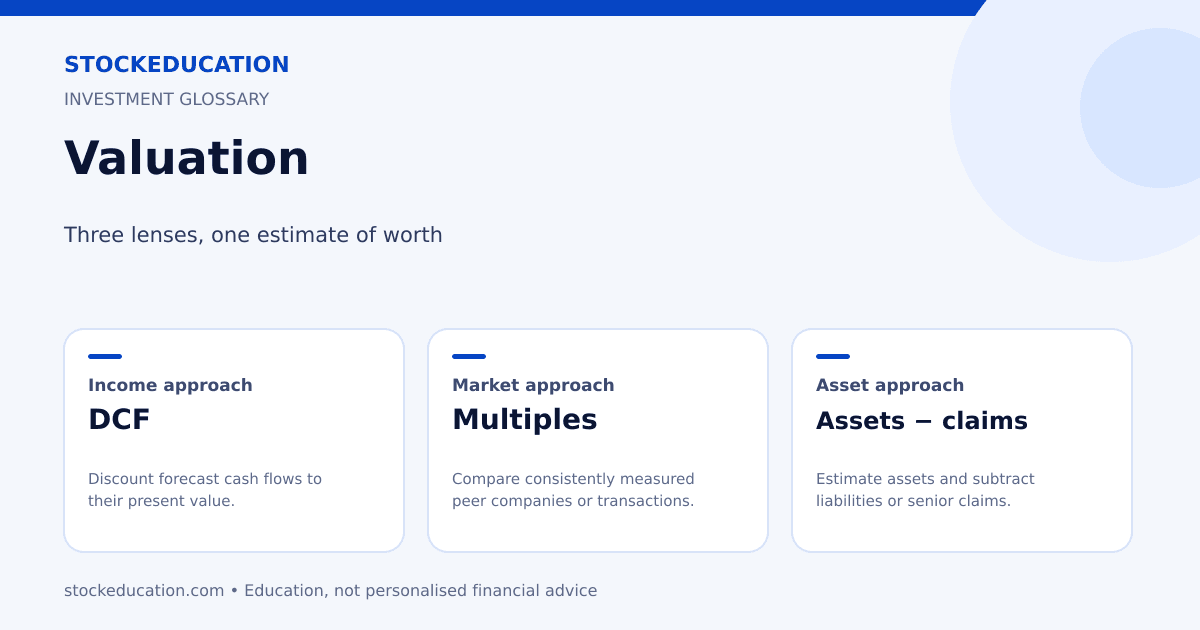
An income approach estimates value from future economic benefits, commonly by discounting expected cash flows. A market approach applies valuation multiples observed for genuinely comparable companies or transactions. An asset approach estimates the value of assets and subtracts liabilities or other senior claims. Each approach has limitations. DCF is sensitive to forecasts and discount rates, market multiples depend on valid comparables and consistent definitions, and an asset approach may miss valuable earning power or internally developed intangible assets.
Enterprise value and equity value
Enterprise value concerns the operating business available to capital providers, while equity value concerns the residual claim belonging to shareholders. A simplified bridge begins with enterprise value, subtracts debt and debt-like claims, adds excess cash and adjusts for other nonoperating assets or claims. The exact bridge depends on the purpose and available information. Dividing an equity value by diluted shares outstanding gives an estimated value per share. Dividing enterprise value directly by the common share count would mix two different claims and can produce a misleading result.
Why assumptions control the output
A valuation model translates assumptions into an estimate. Revenue growth, operating margins, taxes, reinvestment, working capital, capital expenditure, discount rates and terminal assumptions can all change the result. Even a neat spreadsheet can create false precision when inputs are weak. Record where each input came from, keep periods and units consistent, and distinguish historical figures from forecasts. A useful analysis shows how value changes under reasonable alternatives rather than hiding uncertainty behind a single decimal-heavy answer.
Reading filings before building a model
Investor.gov explains that EDGAR provides free access to company filings. A Form 10-K contains audited annual financial statements, risk factors and management’s discussion and analysis, while a Form 10-Q provides quarterly financial statements and updates. Read the income statement, balance sheet, cash flow statement and notes together. Check changes in accounting policy, acquisitions, stock compensation, commitments, debt maturities, dilution and unusual items before treating reported earnings or cash flow as a sustainable base.
Using comparable company multiples carefully
Relative valuation compares a subject company with businesses priced by the market. A price-to-earnings ratio compares equity price with earnings attributable to common shareholders; Investor.gov states that P/E is current stock price divided by current earnings per share. Enterprise value multiples instead pair enterprise value with an operating measure such as revenue or EBITDA. Comparisons require consistent numerators, denominators, periods and accounting definitions. Growth, profitability, capital intensity, leverage and business mix can justify different multiples even within one industry.
Turning an estimate into a decision range
A valuation range is more informative than a lone point estimate. Build a base case, a more cautious case and a stronger operating case, then identify which assumptions cause the largest movement. Compare the resulting equity value per share with the market price, but do not treat the gap as a guaranteed return. New filings, competitive changes, financing needs and revised expectations can alter both estimated value and market price. Valuation supports research; it does not remove uncertainty or replace portfolio risk controls.
Comparison
| Approach | Primary basis | Often useful when | Main limitation |
|---|---|---|---|
| Discounted cash flow | Forecast cash flows discounted to present value | Cash generation can be estimated with defensible assumptions | Highly sensitive to forecasts, discount rates and terminal value |
| Comparable companies | Market multiples from similar public businesses | Relevant peers and consistent measures are available | No two companies are identical, and the peer group may be mispriced |
| Precedent transactions | Multiples paid in comparable acquisitions | Relevant transactions reflect similar assets and control | Deal conditions, synergies and market dates may differ |
| Asset based | Assets less liabilities and senior claims | Assets are separable or liquidation value is important | May understate earning power and internally developed intangible value |
Check yourself
A hypothetical company has estimated enterprise value of $200 million, debt of $50 million and excess cash of $20 million. With no other adjustments, what is its estimated equity value?
Start with enterprise value, subtract debt and add excess cash: $200 million − $50 million + $20 million = $170 million.
Show the answer
$170 million
Things people get wrong
Mistake 01 Confusing price with value
A live share price is an observable market price. A valuation is an assumption-dependent estimate that may differ from that price.
Mistake 02 Mixing enterprise and equity measures
Pair enterprise value with operating measures and equity value with shareholder measures. Bridge between them before calculating per-share value.
Mistake 03 Using inconsistent periods
Do not compare a trailing numerator with an unrelated forecast denominator or mix quarterly and annual figures without adjustment.
Mistake 04 Choosing weak comparables
Companies in the same industry may have different growth, margins, leverage, geography, business mix and accounting policies.
Mistake 05 Ignoring dilution and claims
Options, restricted stock, convertible securities, debt and other claims may change the value attributable to each common share.
Mistake 06 Treating a point estimate as certain
Show scenarios and sensitivity ranges because small changes in major assumptions can materially alter estimated value.
Questions people ask about Valuation
What is valuation in investing?
It is the process of estimating the worth of a business, asset or ownership interest at a specified date using stated evidence, methods and assumptions.
Is valuation the same as market capitalization?
No. Market capitalization is current share price multiplied by total shares outstanding. Valuation may produce a different estimate of equity value.
Which valuation method is best?
No method is universally best. The appropriate approach depends on the asset, available evidence, business maturity and purpose of the analysis.
What is the difference between enterprise value and equity value?
Enterprise value represents the operating business for capital providers, while equity value represents the residual interest attributable to shareholders after relevant adjustments.
Why can two analysts reach different values?
They may use different cash flow forecasts, discount rates, terminal assumptions, comparables, adjustments or measurement dates.
Can a company with a low P/E still be overvalued?
Yes. A low multiple may reflect falling earnings, high risk, unusual profits or weak prospects. P/E is one input, not a complete valuation.
How often should a valuation be updated?
Update it when material new information arrives, such as a 10-K, 10-Q, acquisition, financing change or significant revision to the business outlook.
Does a valuation prove that a stock will rise?
No. It is an analytical estimate, and both future business results and market prices remain uncertain.
The bottom line
Valuation is a disciplined estimate of worth, not a promise about price. Define what is being valued, use current primary information, match each method’s numerator and denominator, bridge enterprise value to equity value correctly, and test the assumptions that matter most. A range built from transparent scenarios is usually more useful than one precise-looking number.
Sources
About this page. Written by Associate Professor Charles Lo, CPA, PhD and edited by Felix La Spina. No ads and no paywall. Editorial standards · How we fact check · Corrections log · Report an error
Educational information only. Nothing on this page is personal financial, tax or legal advice. Investing involves risk, including the possible loss of principal.


