
Investment Glossary · Quick read · No ads
Discount Rate
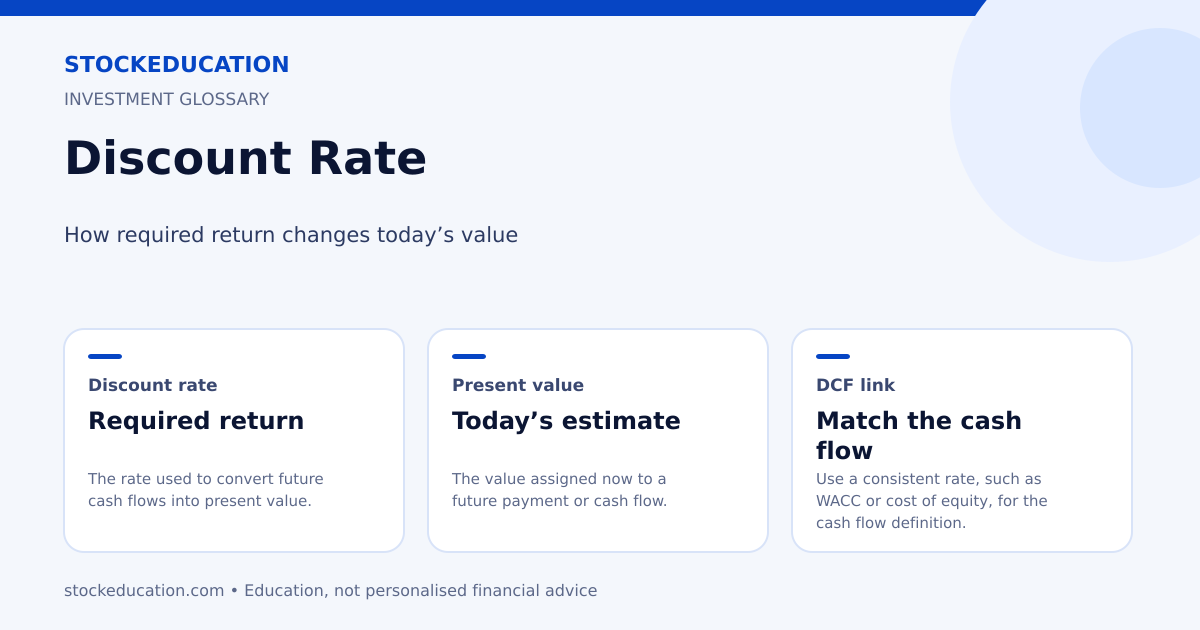
A discount rate is the required rate of return used to convert future cash flows into their estimated value today. In a DCF valuation, a higher rate usually reduces present value because future cash flows are discounted more heavily.

Key takeaways
- A discount rate converts future cash flows into present value.
- Higher discount rates generally produce lower present values for the same future cash flows.
- The rate should reflect the risk of the cash flows and match the valuation perspective.
- WACC is commonly used for unlevered free cash flow, while cost of equity is used for equity cash flows.
- Small changes in the discount rate can materially affect terminal value and estimated intrinsic value.
What is Discount Rate?
A discount rate is the required rate of return used to translate future cash flows into an estimated value today. In discounted cash flow analysis, the rate should match the risk, cash flow definition and financing perspective of the valuation.
Review the Discounted Cash Flow lesson for the full valuation process, then use the DCF Valuation Tool to test hypothetical assumptions. A higher discount rate generally lowers present value, but the result is only as reliable as the cash flow forecasts and other assumptions.
How Discount Rate works
| Step | What happens |
|---|---|
| 01 · Define the cash flow | Identify whether the model uses unlevered free cash flow, equity free cash flow or another cash flow measure. |
| 02 · Match the rate | Select WACC, cost of equity or another required return that is consistent with the cash flow and valuation purpose. |
| 03 · Assess risk | Consider operating uncertainty, leverage, industry conditions, capital structure and the forecast quality. |
| 04 · Discount each period | Apply the rate consistently to each forecast cash flow based on the timing of receipt. |
| 05 · Test sensitivity | Recalculate value using alternative discount rates and terminal growth assumptions before drawing a conclusion. |
| 06 · Compare the result | Consider market multiples, balance sheet information and other valuation evidence rather than relying on one DCF output alone. |
The formula
PV = CFₙ ÷ (1 + r)ⁿ
PV = present value of the future cash flow CFₙ = cash flow received in period n r = discount rate per period n = number of periods until the cash flow is received
A worked example
Hypothetical example: suppose an investor expects to receive $1,000 in two years and uses a 10% annual discount rate. The present value is $1,000 divided by (1 + 0.10) squared, or approximately $826.45. If the same cash flow is discounted at 15%, its present value falls to approximately $756.14. The difference does not predict a market price; it demonstrates how the required return changes the value assigned to the same future payment. In a DCF model, the same logic is applied to multiple forecast cash flows and usually to a terminal value.
Why it matters
The discount rate can materially change an estimated intrinsic value, particularly when a business is valued using long dated cash flows or a large terminal value. Understanding the rate helps investors assess whether a DCF is internally consistent and whether its output is robust across reasonable assumptions.
How a discount rate works
A discount rate recognizes that a dollar expected in the future is not equivalent to a dollar available today. The difference reflects the opportunity cost of waiting, uncertainty about receiving the cash flow and the return that investors require for taking comparable risk. Present value is calculated by discounting each future amount back to the valuation date. The farther away a cash flow is, the more periods over which the rate compounds, so distant cash flows are usually more sensitive to changes in the rate than near term cash flows.
Discount rate in a DCF valuation
A DCF model forecasts cash flows for a defined period and estimates any value remaining afterward through a terminal value. The discount rate is applied to both the forecast cash flows and the terminal value. For enterprise valuation, analysts commonly discount unlevered free cash flow at WACC because that cash flow is available to both lenders and shareholders. For an equity valuation based on cash flow available only to shareholders, the cost of equity is generally the more consistent rate. Mixing the cash flow definition and discount rate can distort the valuation.
Risk and the required return
The rate should reflect the risks embedded in the cash flow forecast, not serve as a substitute for careful forecasting. A business with uncertain demand, high leverage, customer concentration or volatile margins may warrant a higher required return than a business with more predictable cash flows. Analysts may build the rate from a risk free rate, an equity risk premium, a beta or other risk adjustments, and a capital structure. The appropriate method depends on the asset, the cash flow definition and the purpose of the valuation.
WACC, cost of equity and cost of debt
WACC blends the required returns of debt and equity providers, weighted by their proportion in the financing structure and adjusted for the tax treatment of debt. It is commonly paired with unlevered free cash flow to calculate enterprise value. The cost of equity represents the return shareholders require and is paired with equity cash flows. The cost of debt is the borrowing return required by lenders; after tax, it can be one component of WACC. The terms are related but are not interchangeable in every valuation.
Sensitivity and margin of safety
A DCF output is not a fact or a guaranteed market price. It is an estimate conditional on assumptions about cash flow, growth, capital spending, working capital, capital structure and the discount rate. Because terminal value can represent a large share of estimated enterprise value, a modest change in the rate or terminal growth assumption can produce a large change in the result. A useful analysis tests a range of rates and growth assumptions, compares the output with other valuation methods and uses a margin of safety rather than relying on one precise number.
Discount rate versus interest rate
An interest rate is commonly the contractual or market rate charged on a loan or paid on a debt instrument. A discount rate in valuation is a required return used to translate expected future cash flows into present value. They can be related, especially when market interest rates influence the risk free component of required returns, but a company's valuation discount rate may also include equity risk, business risk, liquidity considerations and capital structure. Treating the discount rate as simply the latest central bank policy rate is usually too narrow for equity valuation.
Comparison
| Feature | Discount Rate | Policy or Loan Interest Rate |
|---|---|---|
| Primary use | Values expected future cash flows today | Prices borrowing or lending |
| Risk included | May include time value, business risk and required risk premiums | Primarily reflects the terms and risk of the credit or policy setting |
| DCF role | Discounts forecast cash flows and terminal value | May influence the rate but is not automatically the complete valuation rate |
| Common matching | WACC with unlevered cash flow or cost of equity with equity cash flow | Debt principal, interest payments or policy transmission |
Check yourself
A hypothetical $1,000 payment is due in two years. Holding every other assumption constant, which discount rate produces the lower present value?
A higher discount rate reduces present value because the future payment is divided by a larger compounding factor. Therefore, 10% produces the lower present value than 5%.
Show the answer
10%
Things people get wrong
Mistake 01 Using the wrong cash flow with the rate
Do not discount unlevered cash flow at a rate intended for equity cash flow, or equity cash flow at WACC, without a clear and consistent framework.
Mistake 02 Treating the policy rate as the whole discount rate
A valuation rate can include the time value of money, business risk, equity risk and financing considerations.
Mistake 03 Using a single precise rate without sensitivity analysis
Test reasonable alternative rates because small changes can materially affect present value, especially when terminal value is large.
Mistake 04 Double counting risk
Avoid both sharply reducing cash flow forecasts for a risk and adding an unjustified large risk premium for the same risk.
Mistake 05 Ignoring capital structure changes
Reassess WACC when debt, equity value, tax assumptions or the target financing mix changes materially.
Questions people ask about Discount Rate
What is the purpose of a discount rate?
It converts expected future cash flows into an estimated value at the valuation date while reflecting the time value of money and the return required for risk.
Does a higher discount rate increase or decrease present value?
Holding all other assumptions constant, a higher discount rate decreases present value because future cash flows are divided by a larger compounding factor.
Is a discount rate the same as an interest rate?
No. An interest rate is often the rate charged or paid on debt, while a valuation discount rate is a required return used to value expected cash flows. They may be related but are not automatically identical.
What discount rate is used with unlevered free cash flow?
WACC is commonly used because unlevered free cash flow is available to both debt and equity providers.
What discount rate is used with equity free cash flow?
The cost of equity is generally used because equity free cash flow belongs to shareholders.
Why is terminal value sensitive to the discount rate?
Terminal value represents cash flows beyond the explicit forecast period and is itself discounted back to the present, so changes in the rate can affect both the terminal value calculation and its present value.
Can a discount rate be negative?
In some financial settings negative rates can occur, but a negative rate is not a default assumption for an equity DCF and would require a specific, supportable rationale.
The bottom line
The discount rate is one of the most important assumptions in present value and DCF analysis. It should match the cash flow measure, reflect the risks being valued and be tested across a reasonable range. Treat the result as an estimate based on assumptions, not as a guaranteed target price.
Sources
About this page. Written by Associate Professor Charles Lo, CPA, PhD and edited by Felix La Spina. No ads and no paywall. Editorial standards · How we fact check · Corrections log · Report an error
Educational information only. Nothing on this page is personal financial, tax or legal advice. Investing involves risk, including the possible loss of principal.


