
Financial Analysis · Beginner · 8 minutes · No ads
Net Income
Also called Net profit Net earnings Bottom line Profit after tax
Net income is the profit or loss a company reports after recognizing its revenue and deducting all applicable expenses, interest, taxes, and other gains or losses for a stated period. It is an accounting result rather than the amount of cash the business collected.

Key takeaways
- Net income is the profit or loss reported after all recognized expenses and taxes for a stated period.
- It appears on the income statement and is commonly called the bottom line.
- Positive net income does not necessarily mean operating cash flow is positive.
- Compare net income across equivalent periods and investigate the reasons for any change.
- Use net income with margins, cash flow, earnings per share, and the financial statement notes rather than alone.
What is net income?
Net income is the profit or loss remaining after a company accounts for its revenue, expenses, interest, taxes, and applicable gains or losses during a reporting period. It appears near the bottom of the income statement, which is why investors often call it the bottom line. Learn where it fits in How to Read an Income Statement.
Net income is an accounting result, not a measure of cash collected. Noncash expenses and the timing of customer receipts, supplier payments, and taxes can cause profit to differ from operating cash flow. The cash flow statement lesson explains how to investigate that difference.
How Net Income works
| Step | What happens |
|---|---|
| 01 · Confirm the period and units | Record whether the statement covers a quarter or year and whether amounts are shown in dollars, thousands, or millions. |
| 02 · Locate the income statement | Find the statement of income, operations, or earnings in the company’s 10-K or 10-Q. |
| 03 · Trace the subtotals | Follow revenue through operating costs, nonoperating items, interest, and taxes to the reported bottom line. |
| 04 · Read attribution carefully | Distinguish consolidated net income from the amount attributable to the parent or common shareholders. |
| 05 · Investigate the change | Compare like periods and use the notes and management discussion to identify the main drivers. |
| 06 · Cross-check cash flow | Reconcile the profit figure with operating cash flow and examine material noncash and working capital adjustments. |
The formula
Net income = Revenue + other income and gains − operating expenses − nonoperating expenses and losses − income tax expense
Revenue = amounts recognized from selling goods or services during the reporting period. Other income and gains = recognized items outside ordinary revenue, when applicable. Operating and nonoperating expenses = recognized costs including cost of revenue, operating costs, interest, and applicable losses. Income tax expense = the accounting tax expense recognized for the period; it may differ from cash taxes paid.
Illustrative income statement calculation
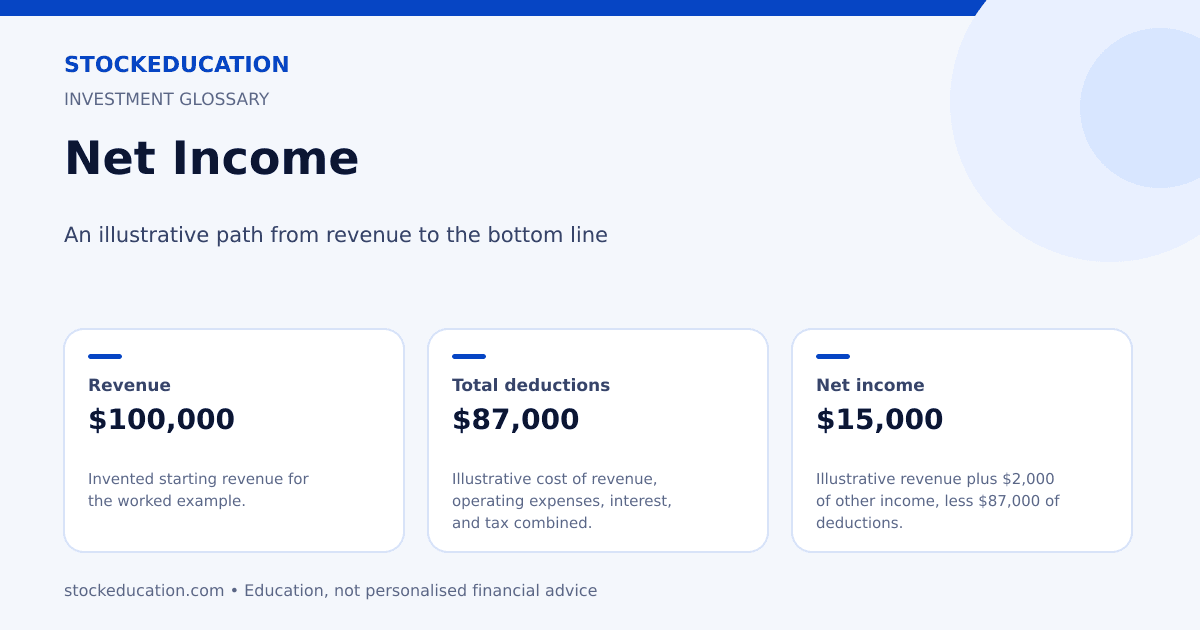
Assume a fictional company reports $100,000 of revenue, $55,000 of cost of revenue, $20,000 of operating expenses, $3,000 of interest expense, $2,000 of other income, and $9,000 of income tax expense for one year. Start with revenue and add other income: $100,000 + $2,000 = $102,000. Subtract cost of revenue, operating expenses, interest, and tax: $102,000 − $55,000 − $20,000 − $3,000 − $9,000 = $15,000 of net income. Its illustrative net profit margin is $15,000 ÷ $100,000 = 15%. These invented figures teach the calculation and are not a market quote, forecast, or result reported by a real company.
Why it matters
Net income helps investors see whether recognized revenue exceeded all recognized expenses for a period. It feeds measures such as earnings per share, net profit margin, return on assets, and return on equity. However, estimates, tax effects, financing costs, unusual gains or losses, and differences between accrual accounting and cash timing can materially affect it. Investors should therefore read the income statement, cash flow statement, balance sheet, notes, and management discussion together.
Read profit beside cash flow
See how the cash flow statement reconciles accounting profit with cash generated or used by operations.
- Educational analysis only; always verify figures in the company’s filing.
Use StockEducation lessons and tools to compare profitability, cash generation, and valuation in context. Open the Stock Screener
Where net income appears
Net income usually appears near the bottom of an income statement, which may also be titled a statement of operations or statement of earnings. In a U.S. public company’s Form 10-K, the annual statements are generally in the financial statements section and are accompanied by notes. Quarterly Form 10-Q statements cover interim periods. Check the company name, period, currency, and units before recording the figure because a table may report dollars, thousands, or millions.
How the income statement reaches the bottom line
The calculation begins with revenue and then recognizes the costs and expenses associated with the period. Depending on the company’s presentation, readers may encounter cost of revenue, gross profit, operating expenses, operating income, interest, other income or expense, income before tax, and income tax expense or benefit. Labels and subtotals vary, so follow the company’s actual statement instead of forcing every business into one standardized sequence.
Why net income and cash flow differ
Net income follows accrual accounting, which can recognize revenue before a customer pays or recognize an expense without a current-period cash payment. Depreciation, deferred taxes, receivables, inventory, payables, and other items can create differences between profit and cash generated by operations. Under the common indirect cash flow presentation, operating activities begin with net income and reconcile it for noncash items and changes in operating assets and liabilities.
How to analyze a change in net income
Compare equivalent annual periods or equivalent quarters, then trace the change through revenue, gross profit where reported, operating expenses, interest, other gains or losses, and taxes. Separate recurring operating developments from items that may not repeat. Read the notes and management discussion for acquisitions, disposals, restructuring, impairments, litigation, tax adjustments, accounting changes, or other events that a single bottom-line number cannot explain.
Net income attributable to different owners
A consolidated company can report total consolidated net income and then allocate portions to the parent company and noncontrolling interests. Earnings per share generally depends on earnings available to common shareholders of the parent, not automatically every amount bearing the words net income. Confirm the exact numerator used by reading the statement, the earnings-per-share note, and any preferred dividend or allocation disclosures.
How net income supports ratios
Net profit margin divides net income by revenue for the same period, while return on assets and return on equity compare an income measure with asset or equity bases. Earnings per share converts earnings attributable to common shareholders into a per-share figure. Each ratio answers a different question and can be distorted by mismatched periods, unusual items, a small equity denominator, or changing share counts, so record the formula and source inputs.
Limits investors should remember
Net income is historical, depends on accounting judgments, and does not by itself establish business quality or investment value. A company can report positive income while consuming cash, or report a loss while investing heavily or recognizing a large noncash charge. One period may also contain tax benefits or gains that do not recur. Use several periods, suitable peers, cash flow, balance-sheet strength, and valuation rather than treating profit as a buy or sell signal.
Comparison
| Measure | What it shows | Simplified calculation | Main caution |
|---|---|---|---|
| Net income | Profit or loss after recognized expenses and taxes | Revenue plus other income and gains minus expenses, losses, and taxes | Accrual profit is not the same as cash flow |
| Operating income | Profit from operations before the company’s later nonoperating and tax lines | Revenue minus operating costs | Company classifications and subtotals can differ |
| Operating cash flow | Cash generated or used by operating activities | Reported under applicable cash flow accounting rules | Working capital timing can make one period unusual |
| Net profit margin | Net income earned per dollar of revenue | Net income ÷ revenue × 100 | Compare consistent periods, definitions, and businesses |
Check yourself
A fictional company reports $80,000 of revenue and $68,000 of total recognized expenses, including taxes, with no other gains or losses. What is its net income?
Subtract total recognized expenses from revenue: $80,000 − $68,000 = $12,000. The figures are invented solely for this knowledge check.
Show the answer
$12,000
Things people get wrong
Mistake 01 Treating net income as cash
Accrual accounting and noncash expenses mean reported profit can differ substantially from cash generated by operations.
Mistake 02 Comparing mismatched periods
Comparing a full fiscal year with one quarter, or periods of unequal length, produces a misleading conclusion.
Mistake 03 Ignoring attribution
Consolidated net income, income attributable to the parent, and earnings available to common shareholders may not be identical.
Mistake 04 Assuming every change is recurring
Asset sales, impairments, restructurings, litigation, and unusual tax items can materially affect one period.
Mistake 05 Using profit as a complete investment verdict
Net income alone does not reveal liquidity, debt obligations, valuation, competitive position, or future prospects.
Questions people ask about Net Income
Is net income the same as profit?
Net income is commonly called net profit, net earnings, or the bottom line, although the word profit can also refer to gross profit or operating profit. Check the precise label.
Where can I find net income?
Look near the bottom of the income statement in a company’s annual Form 10-K or quarterly Form 10-Q and read the accompanying notes.
Can net income be negative?
Yes. When recognized expenses and losses exceed revenue and other income, the company reports a net loss.
Is net income the same as operating cash flow?
No. Net income is an accrual accounting result, while operating cash flow reports cash generated or used by operating activities under the applicable accounting rules.
How is net profit margin calculated?
Divide net income by revenue for the same period and multiply by 100. Confirm which net income figure is being used.
Does higher net income always mean a better investment?
No. Investors must consider what caused the increase, whether it is sustainable, cash generation, financial position, valuation, and risk.
Is net income used to calculate earnings per share?
Yes, but the relevant numerator is generally earnings attributable or available to common shareholders, with adjustments where required. Use the company’s disclosed EPS calculation.
The bottom line
Net income is the accounting profit or loss left after a company recognizes all applicable revenue, expenses, gains, losses, interest, and taxes for a reporting period. It is essential for understanding profitability and several common ratios, but it should never be read in isolation. Verify the period and attribution, investigate the drivers, and compare the result with cash flow, the balance sheet, prior periods, and the financial statement notes.
Sources
- Investor.gov — Net Income
- SEC — Beginners’ Guide to Financial Statements
- Investor.gov — How to Read a 10-K/10-Q
How we produced the figuresPrimary-source definitions and filing guidance were checked on official SEC and Investor.gov pages. The numerical example is explicitly fictional and used only to demonstrate the calculation.
Continue with profitability analysis
Learn how net income relates to revenue by exploring net profit margin and comparing consistent reporting periods.
About this page. Written by Associate Professor Charles Lo, CPA, PhD and edited by Felix La Spina. No ads and no paywall. Editorial standards · How we fact check · Corrections log · Report an error
Educational information only. Nothing on this page is personal financial, tax or legal advice. Investing involves risk, including the possible loss of principal.


