
Investment Glossary · Quick read · No ads
Operating Expense
Operating expense is a cost of running a company’s normal business activities after considering the direct costs assigned to producing goods or delivering services. It can include selling, general and administrative, research and development, marketing, rent, payroll, depreciation and professional fees.

Key takeaways
- Operating expenses support a company’s ordinary business activities but are not always direct production costs.
- Companies may present operating expenses under different labels, so read the accounting policies and notes.
- Operating expenses are analyzed in relation to revenue, gross profit and operating income.
- A rising expense ratio is not automatically bad if the spending supports profitable growth.
- Operating expenses reduce operating income, but some expenses such as depreciation are noncash accounting charges in the period reported.
- Compare several periods and similar companies instead of relying on one expense line or percentage.
What is Operating Expense?
Operating expense is a cost of running a company’s ordinary business that is not classified as a direct cost of producing the goods or services sold. Common examples include selling, general and administrative costs, research and development, marketing, rent, payroll, depreciation and professional fees. Reviewing these costs alongside revenue and gross profit helps investors understand how efficiently a company operates.
Use the income statement and Form 10-K to identify the company’s own expense categories, definitions and trends. Compare operating expenses with revenue, operating income and cash flow over several periods rather than treating one percentage or one reporting period as conclusive. For broader statement analysis, see the financial statements lesson and the operating cash flow glossary page.
How Operating Expense works
| Step | What happens |
|---|---|
| 01 · 1. Locate the income statement | Find revenue, cost of sales, operating expense lines and operating income in the latest filing. |
| 02 · 2. Read the definitions | Review the notes and accounting policies to understand what the company includes in each category. |
| 03 · 3. Calculate the ratio | Divide operating expenses by revenue for the same reporting period. |
| 04 · 4. Compare periods | Examine several quarters or years and identify unusual changes or reclassifications. |
| 05 · 5. Link to performance | Compare expense growth with revenue, gross profit, operating margin and operating cash flow. |
| 06 · 6. Investigate material changes | Read management discussion and footnotes for hiring, acquisitions, restructuring, impairment or other drivers. |
| 07 · 7. Compare peers carefully | Use companies with similar business models and confirm that classifications are reasonably comparable. |
| 08 · 8. Form a balanced conclusion | Decide whether spending appears productive, sustainable and financially manageable rather than relying on a single ratio. |
The formula
Operating expense ratio = Operating expenses ÷ Revenue × 100 Operating income = Gross profit − Operating expenses
Operating expenses = expenses assigned to ordinary business operations for the period. Revenue = sales or operating revenue reported for the same period. Gross profit = revenue minus the company’s reported cost of sales or cost of revenue. Operating income = profit from operations before items such as interest and income tax, subject to the company’s presentation.
A worked example
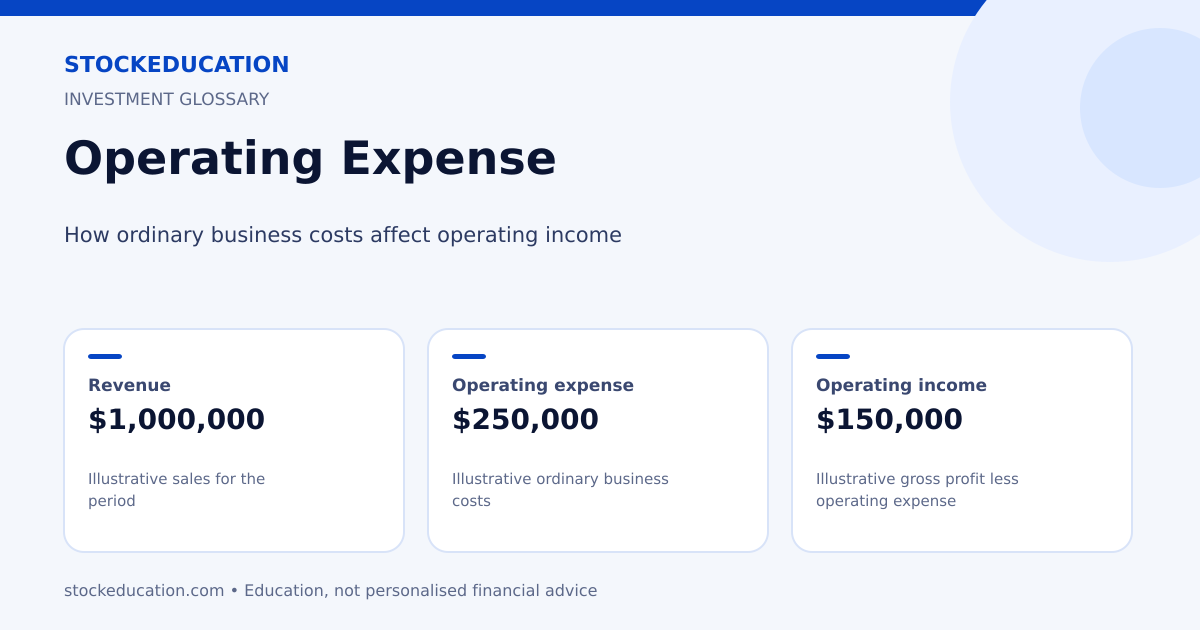
Illustrative example only: A fictional company reports revenue of $1,000,000, cost of sales of $600,000 and operating expenses of $250,000. Gross profit equals $1,000,000 − $600,000 = $400,000. Operating income equals $400,000 − $250,000 = $150,000. Operating expense as a percentage of revenue equals $250,000 ÷ $1,000,000 = 25%. If operating expenses increase to $300,000 with revenue and cost of sales unchanged, operating income falls to $100,000 and the operating expense ratio rises to 30%. This example uses invented figures for explanation only; it is not a real company result or market quote.
Why it matters
Operating expenses help investors assess how much of a company’s revenue is used to run the business after direct costs. Tracking the amount and ratio over time can reveal operating leverage, investment in growth, cost pressure or unusual charges. The analysis is most useful when combined with the company’s accounting policies, gross margin, operating income, cash flow and disclosures about recurring versus temporary items.
Where operating expense appears
On a typical income statement, revenue is followed by deductions such as returns and allowances and then direct costs or cost of revenue. The resulting gross profit is reduced by operating expenses to arrive at operating income. Companies may show separate lines for selling and marketing, research and development, general and administrative costs, depreciation and amortization, restructuring or other operating expenses. The SEC explains that an income statement reports the costs and expenses associated with earning revenue and that operating expenses are deducted before income from operations. Because presentation differs, investors should read the statement headings and the accompanying notes rather than assuming that every company uses the same subtotal.
Common categories and examples
Selling, general and administrative expense may include salaries for sales, administrative and executive staff, advertising, commissions, legal and accounting fees, insurance, information technology and office costs. Research and development may include employee costs, testing, materials and outside services for developing products. Rent, utilities, depreciation and amortization can support several functions and may be allocated across cost of revenue and operating expense. A company’s filing may also identify stock-based compensation, restructuring costs or impairment charges. A category can be recurring, temporary or partly discretionary, so the label alone does not reveal whether the cost is likely to continue.
Operating expense compared with cost of sales
Cost of sales, cost of revenue or cost of goods sold usually represents costs directly associated with producing goods or delivering services sold during the period. Operating expenses generally support selling, administration, research, development and the overall business rather than one unit of output. The boundary is not universal: a software company may classify hosting costs in cost of revenue, while another company may present similar infrastructure costs differently. Compare gross margin and operating margin only after checking the company’s definitions. Reclassifications can change reported margins without changing the company’s total expenses or cash spending.
A numerical illustration
Suppose a fictional company reports revenue of $1,000,000, cost of sales of $600,000 and operating expenses of $250,000 for one year. Gross profit is $1,000,000 minus $600,000, or $400,000. Operating income is $400,000 minus $250,000, or $150,000. The operating expense ratio is $250,000 divided by $1,000,000, or 25%. These figures are purely illustrative and are not a market quote or a company report. If operating expenses rise to $300,000 while revenue stays at $1,000,000, operating income falls to $100,000 and the expense ratio rises to 30%. The effect may be concerning, neutral or intentional depending on growth, margins and future returns on the spending.
How investors analyze the trend
Start by comparing operating expenses with revenue over several reporting periods. A ratio such as operating expenses divided by revenue can show whether overhead is growing faster or slower than sales, but it does not explain why. Break the change into payroll, marketing, research, stock compensation, depreciation, restructuring and other disclosed components. Then compare the trend with gross margin, operating margin, operating cash flow and management’s stated plans. A growing company may spend ahead of revenue on product development or distribution. A mature company may need tighter cost control. The useful question is whether the spending supports durable earnings and cash generation at an acceptable risk.
Comparison
| Category | Primary purpose | Typical examples | Analytical focus |
|---|---|---|---|
| Operating expense | Supports the company’s ordinary business activities | SG&A, R&D, marketing, rent and professional fees | Compare with revenue, operating income and operating margin |
| Cost of sales | Directly supports products or services delivered to customers | Materials, direct labor and production costs | Analyze gross profit and gross margin |
| Non-operating expense | Relates to activities outside core operations | Interest expense, income taxes and investment losses | Review effects below operating income |
Check yourself
A fictional company has revenue of $1,000,000 and operating expenses of $250,000. What is its operating expense ratio?
The operating expense ratio is operating expenses divided by revenue: $250,000 ÷ $1,000,000 = 0.25, or 25%.
Show the answer
25%
Things people get wrong
Mistake 01 Treating every operating expense as wasteful
A cost may support research, customer acquisition, infrastructure or future growth; assess its purpose and returns.
Mistake 02 Assuming all companies classify costs identically
Read the filing and notes because similar costs may appear in cost of revenue, operating expense or another line.
Mistake 03 Using one year as proof of efficiency
Compare multiple periods and investigate unusual restructuring, impairment, acquisition or stock compensation effects.
Mistake 04 Confusing expense with cash paid
Accrual accounting can recognize expenses before or after the related cash movement, and depreciation is generally noncash in the period recognized.
Mistake 05 Ignoring revenue quality and gross margin
Operating expense analysis is incomplete without considering sales growth, gross profit, operating income and cash generation.
Questions people ask about Operating Expense
What is an operating expense?
An operating expense is a cost of carrying on a company’s normal business activities, such as selling, administration, research and development, rent, payroll or professional services.
Is cost of goods sold an operating expense?
It depends on the company’s presentation and terminology. Cost of goods sold is often shown separately from operating expenses because it is directly associated with products or services sold, but classification policies should be checked.
Are operating expenses always bad for investors?
No. Spending can support product development, sales growth, infrastructure and competitive advantages. The key questions are whether the spending is controlled, productive and consistent with the company’s financial position.
How do you calculate the operating expense ratio?
Divide operating expenses by revenue for the same period and multiply by 100. For example, $250,000 of operating expenses divided by $1,000,000 of revenue equals 25%.
Why can operating expense rise while a company improves?
A company may invest ahead of expected revenue, expand its sales force, increase research spending or incur temporary launch costs. Compare the expense increase with revenue growth, margins and later cash generation.
Where can I find operating expenses?
Start with the income statement in the company’s quarterly or annual filing, then read the notes and management discussion for definitions, components, unusual items and trends.
The bottom line
Operating expense measures the cost of running a company’s ordinary business beyond the direct costs assigned to producing or delivering what it sells. Analyze the company’s own classifications, calculate the trend relative to revenue, and connect the result to gross margin, operating income and operating cash flow. A single rising line does not establish poor management, and a low ratio does not guarantee a strong business.
Sources
About this page. Written by Associate Professor Charles Lo, CPA, PhD and edited by Felix La Spina. No ads and no paywall. Editorial standards · How we fact check · Corrections log · Report an error
Educational information only. Nothing on this page is personal financial, tax or legal advice. Investing involves risk, including the possible loss of principal.


