
Investment Glossary · Quick read · No ads
Operating Margin
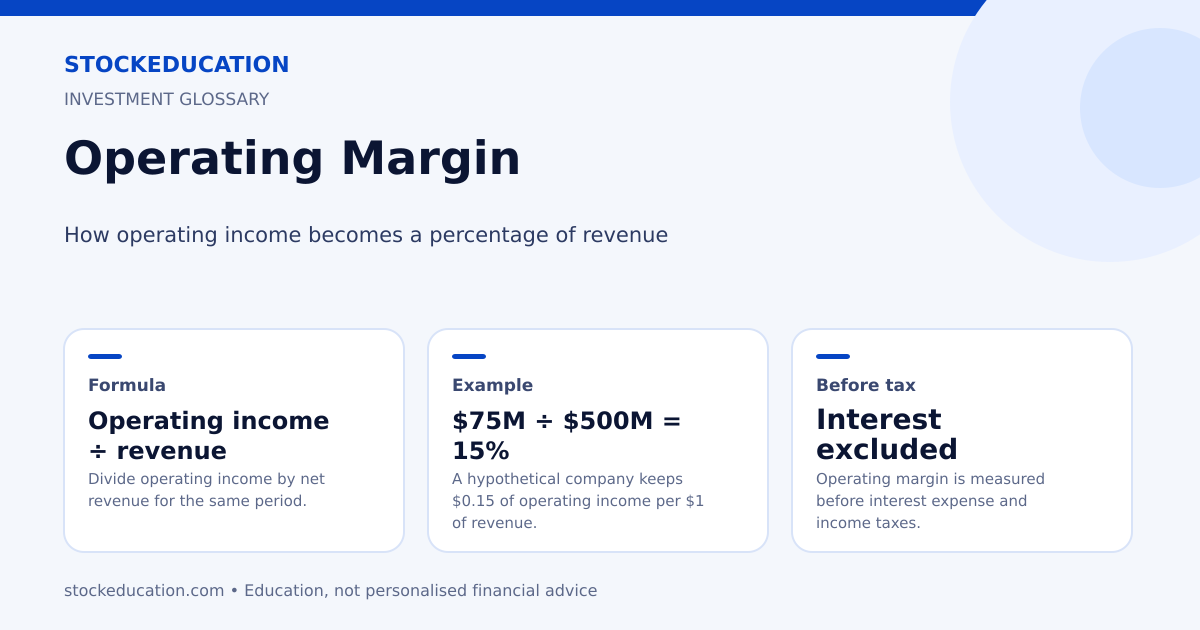
Operating margin is operating income divided by net revenue, expressed as a percentage. It shows how much operating profit a company keeps from each dollar of sales before interest and income taxes.

Key takeaways
- Operating margin equals operating income divided by net revenue.
- A 20% operating margin means the company reports $0.20 of operating income for each $1 of revenue before interest and income taxes.
- Compare the same period, accounting basis and business mix before drawing conclusions.
- Separate reported GAAP operating margin from adjusted margin and investigate the reconciliation.
- A falling margin can reflect pricing pressure, higher costs, weaker mix, investment or a one-time charge.
What is Operating Margin?
Operating margin measures how much of each dollar of revenue remains after the costs required to run the business, before interest and income taxes. It helps investors compare operating performance across periods and, with care, across companies with similar business models. The ratio is based on operating income divided by net revenue.
Use the company’s income statement in its 10-K or 10-Q, check whether the figure is GAAP or adjusted, and investigate unusual items before drawing a conclusion. A higher margin is not automatically better: revenue mix, accounting choices, reinvestment needs and one-time charges can all affect the result.
How Operating Margin works
| Step | What happens |
|---|---|
| 01 · Define the period | Select the same annual or quarterly reporting period for both operating income and net revenue. |
| 02 · Find the figures | Use the statement of operations in the company’s 10-K or 10-Q filing and confirm the units. |
| 03 · Apply the formula | Divide operating income by net revenue, then multiply the result by 100 to express a percentage. |
| 04 · Verify the basis | Check whether both figures are reported GAAP, adjusted, consolidated or segment-level amounts. |
| 05 · Review the drivers | Read the notes and management discussion for pricing, costs, sales mix, acquisitions and unusual charges. |
| 06 · Compare consistently | Compare matching periods and similar businesses rather than ranking unrelated industries. |
| 07 · Document limitations | Record factors such as seasonality, one-time items, heavy reinvestment or presentation changes that may affect interpretation. |
The formula
Operating margin = Operating income ÷ Net revenue × 100
Operating income = profit from operations before interest and income taxes. Net revenue = revenue for the same reporting period after relevant reductions such as returns or allowances. × 100 = converts the decimal ratio into a percentage.
A worked example
Hypothetical example: suppose a company reports $500 million of net revenue and $75 million of operating income for a year. Operating margin is $75 million ÷ $500 million × 100 = 15%. The result means the company reported $0.15 of operating income per $1 of revenue before interest and income taxes. If operating income later rises to $90 million while revenue stays at $500 million, the margin becomes 18%. That improvement could reflect better pricing, lower costs, a different sales mix or a one-time benefit, so the next step is to read the filing rather than assume the business permanently became more efficient.
Why it matters
Operating margin helps readers evaluate how efficiently a company converts sales into operating profit before financing and tax effects. It supports trend analysis and peer comparison, but it should be combined with cash flow, balance-sheet and valuation analysis.
Formula and inputs
Operating margin = operating income ÷ net revenue × 100. Operating income is the amount reported after revenue and operating costs such as cost of sales, selling expenses, research and development, and general and administrative expenses, subject to the company’s presentation. Net revenue is the revenue measure used for the same period. Use matching periods and units; do not divide annual operating income by quarterly revenue or mix reported and adjusted figures. The SEC’s investor guide presents the same core relationship as income from operations divided by net revenues.
Reading the income statement
Start with the consolidated statement of operations in a company’s Form 10-K or Form 10-Q. Identify revenue, operating income and the period covered, then read the notes and management discussion for acquisitions, restructuring, impairments, litigation, foreign exchange and changes in presentation. Investor.gov explains that these filings include the income statement and management discussion, while the SEC notes that operating margin is usually shown as a percentage of sales. The filing is more reliable than a ratio copied from an unsourced website because it lets you see the underlying amounts and disclosures.
Interpreting changes over time
A margin increase can result from higher prices, lower input costs, productivity, a richer product mix, scale or temporary cost relief. A decline can reflect discounting, wage or raw-material inflation, higher research spending, expansion into a lower-margin market or a one-time charge. Build a multi-period trend and connect changes to revenue growth, gross margin and operating expenses. A single period is a clue, not a complete explanation. Also check whether the company changed its segment structure or reclassified costs.
Comparing companies
Operating margin is most useful when the companies have similar products, customers, geographic exposure and accounting presentation. A software company, supermarket and regulated utility can have very different normal margins because their economics and cost structures differ. Compare both the reported percentage and the underlying dollars, then read segment disclosures. A company with a lower margin may still create more value if it reinvests profitfully and grows faster; a high margin may be vulnerable if it depends on a temporary price increase or unusually favorable mix.
GAAP, adjusted and segment margins
Reported operating margin is generally tied to the company’s GAAP income statement. Adjusted operating margin may exclude restructuring, acquisition costs, impairments or other items defined by management. Adjustments are not automatically wrong, but they can make a business look more stable than reported results. Reconcile the adjusted figure to GAAP, ask whether the excluded item recurs, and use the same definition across companies. Segment operating margins may also exclude corporate costs, so they should not be treated as interchangeable with consolidated operating margin.
Limits for investors
Operating margin excludes financing and income taxes, so it does not measure net profit, cash generation or shareholder return by itself. It also is not a direct measure of liquidity: a profitable company can have weak cash flow because customers pay slowly or because it invests heavily. Depreciation, amortization, stock compensation and capitalization policies can affect comparisons. Pair the ratio with the cash flow statement, balance sheet, return measures, debt obligations and business risks before making an investment judgment.
Comparison
| Measure | What it uses | Main question | Important caution |
|---|---|---|---|
| Operating margin | Operating income and net revenue | How profitable are core operations before interest and taxes? | Business mix and one-time items affect comparability. |
| Gross margin | Gross profit and net revenue | How much remains after cost of sales? | It excludes many operating expenses. |
| Net profit margin | Net income and net revenue | How much remains after all expenses? | Interest, taxes and non-operating items affect it. |
| EBITDA margin | EBITDA and revenue | What is earnings before interest, taxes, depreciation and amortization relative to sales? | It is not a GAAP profit measure and can overstate cash-like performance. |
Check yourself
A company reports $120 million of operating income and $800 million of net revenue. What is its operating margin?
Operating margin is operating income divided by net revenue: $120 million ÷ $800 million = 0.15, or 15%.
Show the answer
15%
Things people get wrong
Mistake 01 Using gross profit as operating income
Gross margin subtracts cost of sales, while operating margin also reflects operating expenses such as selling, research and administrative costs.
Mistake 02 Mixing GAAP and adjusted figures
Use matching definitions and read the reconciliation before comparing a reported margin with an adjusted margin.
Mistake 03 Ignoring business mix
Different industries and segments can have structurally different margins, so compare companies with similar economics.
Mistake 04 Treating one period as a trend
Review several comparable periods and investigate unusual charges, acquisitions, reclassifications and seasonal effects.
Mistake 05 Calling a high margin proof of a good investment
Operating margin does not establish valuation, cash generation, balance-sheet strength or future growth.
Questions people ask about Operating Margin
What is the operating margin formula?
Operating margin equals operating income divided by net revenue, multiplied by 100 to express the result as a percentage.
What does a 15% operating margin mean?
It means the company reported $0.15 of operating income for each $1 of revenue before interest and income taxes during the measured period.
Is operating margin the same as EBIT margin?
They are often similar because operating income commonly represents earnings before interest and taxes, but definitions and presentation can vary, so check the filing.
Is a higher operating margin always better?
No. A higher figure may reflect a different business mix, underinvestment, temporary pricing or an excluded cost. Compare quality, trend and sustainability.
Should I use reported or adjusted operating margin?
Start with reported GAAP operating margin, then study any adjusted measure and its reconciliation. Do not treat exclusions as irrelevant automatically.
Where can I find operating income?
Look in the statement of operations in the company’s Form 10-K or Form 10-Q and confirm the period and units.
The bottom line
Operating margin is a useful first measure of operating profitability, but it is not a complete investment conclusion. Calculate it from matching revenue and operating income figures, study the multi-period trend, distinguish GAAP from adjusted results and investigate the business reasons behind every major change.
Sources
About this page. Written by Associate Professor Charles Lo, CPA, PhD and edited by Felix La Spina. No ads and no paywall. Editorial standards · How we fact check · Corrections log · Report an error
Educational information only. Nothing on this page is personal financial, tax or legal advice. Investing involves risk, including the possible loss of principal.


