
Investment Glossary · Quick read · No ads
Stock Exchange
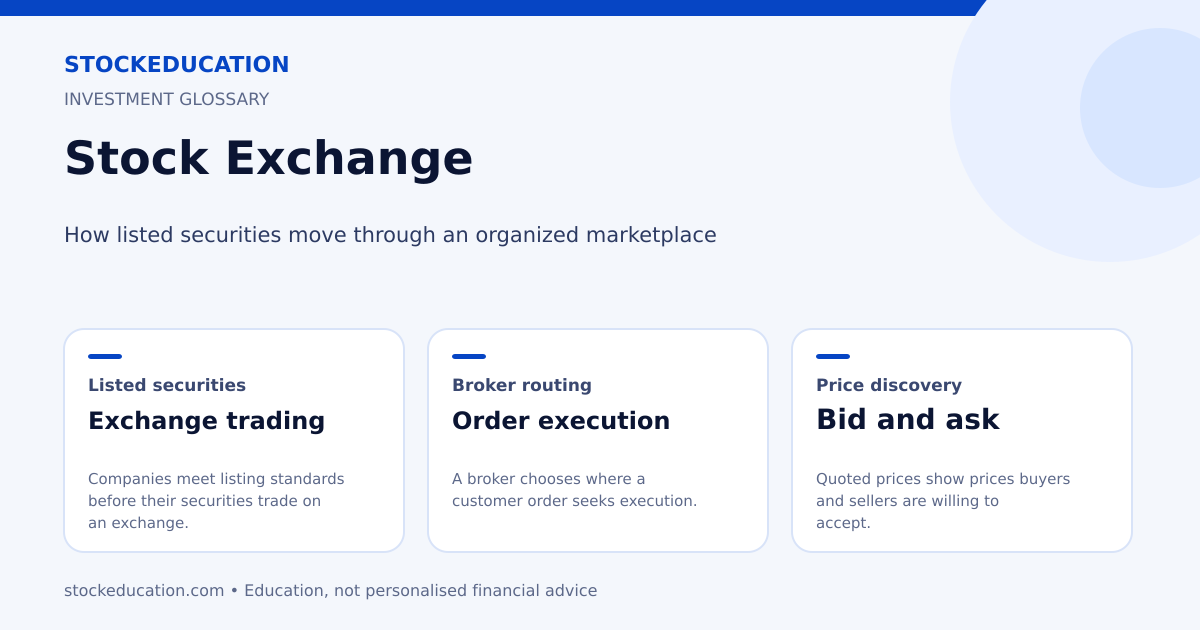
A stock exchange is an organized marketplace where listed securities are bought and sold under established rules, with quoted prices and trading information supporting orderly transactions.

Key takeaways
- A stock exchange brings buyers and sellers of listed securities together under established rules.
- Companies generally must meet listing requirements before their shares can trade on an exchange.
- A broker normally receives and routes a customer’s order, and the order may seek execution at an exchange or another venue.
- Quoted bid and ask prices help investors observe current willingness to buy and sell.
- An exchange supports trading and price discovery but is not necessarily the destination for every customer order.
What is Stock Exchange?
How Stock Exchange works
| Step | What happens |
|---|---|
| 01 · Submit the order | The investor places a buy or sell instruction through a broker, specifying the security, quantity and order conditions. |
| 02 · Assess routing | The broker considers where the order may seek execution under applicable practices, obligations and available market conditions. |
| 03 · Route the order | The broker sends the instruction to an exchange, market maker or another permitted execution venue. |
| 04 · Execute the trade | Trading interest is matched or otherwise executed according to the venue’s rules, available liquidity and prevailing prices. |
| 05 · Confirm execution | The broker reports the executed quantity and price, which may differ from an earlier displayed quote. |
| 06 · Review the transaction | The investor checks the trade details, applicable charges and remaining order status rather than assuming a guaranteed fill. |
The formula
Stock exchange = listed securities + trading rules + buyer/seller interaction + quoted market information
Listed securities are admitted to trading after meeting applicable exchange requirements and, where relevant, continuing standards. Trading rules and buyer/seller interaction provide the structure through which orders can be displayed, matched or routed, while quoted information supports price discovery. The formula describes the exchange’s market function; it does not guarantee execution, a specific price or an investment return, and it does not mean every order is executed on that exchange. A broker may route an order to an exchange, market maker or another execution venue depending on the order and applicable practices or obligations. ## Process An investor submits an order through a broker. The broker evaluates where the order may seek execution. The order is routed to an exchange or another permitted venue. Trading interest is matched or otherwise executed under the venue’s rules. Execution and market information are reported or displayed through applicable systems. ## Common Mistakes Assuming every order trades on the listing exchange | A stock’s exchange listing identifies where it is admitted to trading, but a broker may route an order elsewhere. Treating a quote as a guaranteed execution price | Bid and ask prices can change before an order is filled, and the available size may be limited. Confusing an exchange with the entire stock market | The broader market includes brokers, investors, exchanges, market makers, regulators and other venues. Assuming exchange oversight removes investment risk | Rules support market structure and conduct, but securities can still lose value. Equating a company’s listing with approval of its investment quality | Listing standards are not a promise that the company will be profitable or that its shares will rise. ## Comparison Venue type | Main role | Typical relationship to an investor order Stock exchange | Provides an organized market for listed securities | May receive a broker-routed order Market maker | Provides or quotes trading interest and may execute orders | May be selected as an execution venue Other execution venue | Handles eligible orders under its own applicable framework | May receive an order instead of an exchange ## FAQs What is a stock exchange? | It is an organized marketplace where listed securities are bought and sold under established rules. Does every stock trade on an exchange? | No. A security must be admitted to a particular market to trade there, and some securities trade through other market structures or venues. Does every investor order go directly to an exchange? | No. Investors normally submit orders to brokers, which may route them to an exchange, market maker or another execution venue. What is the difference between an exchange and the stock market? | An exchange is one organized marketplace; the stock market can refer to the broader network involved in securities trading. What do bid and ask prices show? | They indicate prices at which buyers and sellers are currently willing to trade, subject to available size and changing conditions. Does being listed guarantee a good investment? | No. Listing reflects compliance with applicable standards, not a guarantee of profits, safety or future price performance. ## Sources Market Participants | Investor.gov | https://www.investor.gov/introduction-investing/investing-basics/how-stock-markets-work/market-participants National Securities Exchanges | U.S. Securities and Exchange Commission | https://www.sec.gov/about/divisions-offices/division-trading-markets/national-securities-exchanges ## Links ETF, or exchange traded fund | https://www.stockeducation.com/glossary/exchange-traded-fund-etf/ US Stock Screener | https://www.stockeducation.com/us-stock-screener/
A worked example
Hypothetical example: Imagine that Bright Harbor Inc. has shares admitted to trading on Stock Exchange A. The current displayed bid is $24.90 for 500 shares, while the ask is $25.00 for 300 shares. The quoted spread is therefore $25.00 − $24.90 = $0.10 per share. An investor submits a market order through a broker to buy 400 shares. The first 300 shares might execute near the displayed $25.00 ask, while the remaining 100 shares could execute at a higher price if no more sellers are available at $25.00. The broker might route the order to the exchange, a market maker or another permitted venue, so the listing on Stock Exchange A does not prove that this particular order executes there. This example is hypothetical: prices, available quantities, routing decisions and execution results can change quickly, and a displayed quote is not a guarantee. If the entire order executed at an average of $25.03, the stock cost 400 × $25.03 = $10,012 before any applicable fees or other charges. The calculation describes transaction value only; it does not predict whether Bright Harbor will rise, fall or produce a profit.
Why it matters
A stock exchange matters because it gives listed securities an organized framework for trading, provides information about market interest and supports price discovery. For investors, the distinction between listing and execution is especially important: a company may be listed on an exchange, while a broker may route a particular order to an exchange, market maker or another venue. Exchange rules and regulatory oversight can promote orderly markets, but they do not remove the risk that an investment will lose value or that an order will execute at an unexpected price.
What a Stock Exchange Does
A stock exchange provides a structured setting for trading securities that have been admitted to its market. Its framework includes trading rules, listing standards, systems for displaying or matching interest, and procedures intended to support fair and orderly markets. The exchange does not create the underlying shares; rather, it provides market infrastructure through which eligible securities can be bought and sold. The resulting quotations and transaction information help participants see how the market is valuing a security at a given time, although prices can change rapidly as new orders and information arrive.
Listing Securities and Companies
Before a company’s shares trade on an exchange, the company and its security generally must satisfy applicable listing requirements. These requirements can address matters such as disclosures, governance, financial information, share distribution or continued compliance, depending on the exchange and the security. Listing is therefore different from merely having a company exist or having shares privately issued. A listed company must also continue meeting relevant exchange and regulatory standards. Failure to satisfy requirements can lead to review, restrictions or removal from the exchange, subject to the applicable rules and procedures.
How Brokers Fit In
Individual investors usually do not connect directly to an exchange’s trading system. Instead, an investor submits an order through a broker, which handles the order and determines where to seek execution under its obligations and routing practices. The destination may be an exchange, a market maker or another execution venue. This means that the name of an exchange associated with a listed stock does not prove that every customer order in that stock was executed there. Understanding this distinction helps investors separate a security’s listing venue from the broker’s order-routing and execution process.
Quotes, Bids and Asks
A market quote commonly includes a bid, representing a price available from a buyer, and an ask, representing a price at which a seller is willing to offer the security, along with relevant size or other information. The difference between those prices is the spread. Quotes can change as orders arrive, are cancelled or are filled, and they may differ among venues. Quoted information supports price discovery because it reveals current trading interest, but a quote is not a guarantee that an investor will receive that price. Order type, timing, liquidity and market conditions can affect execution.
Trading Rules and Oversight
Exchange trading operates within a network of exchange rules and securities regulations. A registered national securities exchange in the United States registers with the Securities and Exchange Commission under Section 6 of the Securities Exchange Act of 1934. Rules and oversight are intended to support transparent operations, orderly trading and compliance with market standards. They do not eliminate investment risk, guarantee a profit or prevent prices from falling. Investors should distinguish the exchange’s role in operating a marketplace from the separate risks of owning a company’s shares or other listed securities.
Exchange Versus the Broad Stock Market
The phrase stock market can describe the wider system of investors, companies, brokers, exchanges, market makers, regulators and other venues involved in securities trading. A stock exchange is one organized marketplace within that system. A company may have securities listed on an exchange while trades in those securities are also routed or executed through other permitted venues. This broader view explains why exchange listing, broker routing, execution quality and published prices are related but not identical concepts. It also helps investors avoid treating the exchange as a single physical location where every trade must occur.
Comparison
| Venue type | Main role | Relationship to an investor order |
|---|---|---|
| Stock exchange | Provides an organized market for listed securities | May receive a broker-routed order |
| Market maker | Provides or quotes trading interest and may execute orders | May be selected as an execution venue |
| Other execution venue | Handles eligible orders under its own applicable framework | May receive an order instead of an exchange |
Check yourself
An investor buys shares listed on an exchange through a broker. Which statement is most accurate?
A listing identifies a market where the security is admitted to trading, but the broker may route a customer order to an exchange, market maker or another permitted venue. Quotes can change and listing does not guarantee investment performance.
Show the answer
2. The broker may route the order to an exchange, market maker or another permitted execution venue.
Things people get wrong
Mistake 01 Assuming every order trades on the listing exchange
A stock’s listing identifies where it is admitted to trading, but a broker may route a particular order to another permitted venue.
Mistake 02 Treating a displayed quote as a guaranteed execution price
Bid and ask prices can change before an order is filled, and the displayed quantity may not cover the whole order.
Mistake 03 Confusing an exchange with the entire stock market
The wider market includes investors, companies, brokers, exchanges, market makers, regulators and other execution venues.
Mistake 04 Assuming exchange oversight eliminates investment risk
Exchange rules can support orderly markets, but a listed security can still lose value and an order can execute at an unexpected price.
Mistake 05 Equating listing status with investment quality
Meeting listing standards does not guarantee profitability, safety, suitability or future price appreciation.
Questions people ask about Stock Exchange
What is a stock exchange?
It is an organized marketplace where listed securities are bought and sold under established rules, with trading information such as quoted prices supporting market activity.
Does every stock trade on an exchange?
No. A security must be admitted to a particular market to trade there, and some orders may be executed through other permitted market structures or venues.
Does an investor send an order directly to an exchange?
Usually not. An investor normally submits the order to a broker, which determines where the order may seek execution under applicable practices and obligations.
What do bid and ask prices mean?
The bid is a price at which a buyer is willing to buy, while the ask is a price at which a seller is willing to sell, subject to available quantity and changing conditions.
What is the difference between a stock exchange and the stock market?
A stock exchange is one organized marketplace. The stock market can describe the broader network of companies, investors, brokers, exchanges, market makers, regulators and other venues.
Does a listing guarantee that a company is a good investment?
No. Listing requirements concern applicable market standards and compliance; they do not guarantee profits, financial strength, a rising share price or suitability for an investor.
The bottom line
A stock exchange provides organized infrastructure and rules for trading listed securities, but it is only one part of the wider stock market. Brokers commonly route customer orders, so the listing exchange and the actual execution venue may differ. Quotes support price discovery without guaranteeing a fill or price, and exchange oversight does not remove investment risk.
Sources
About this page. Written by Associate Professor Charles Lo, CPA, PhD and edited by Felix La Spina. No ads and no paywall. Editorial standards · How we fact check · Corrections log · Report an error
Educational information only. Nothing on this page is personal financial, tax or legal advice. Investing involves risk, including the possible loss of principal.


