
Investment Glossary · Quick read · No ads
Value Investing
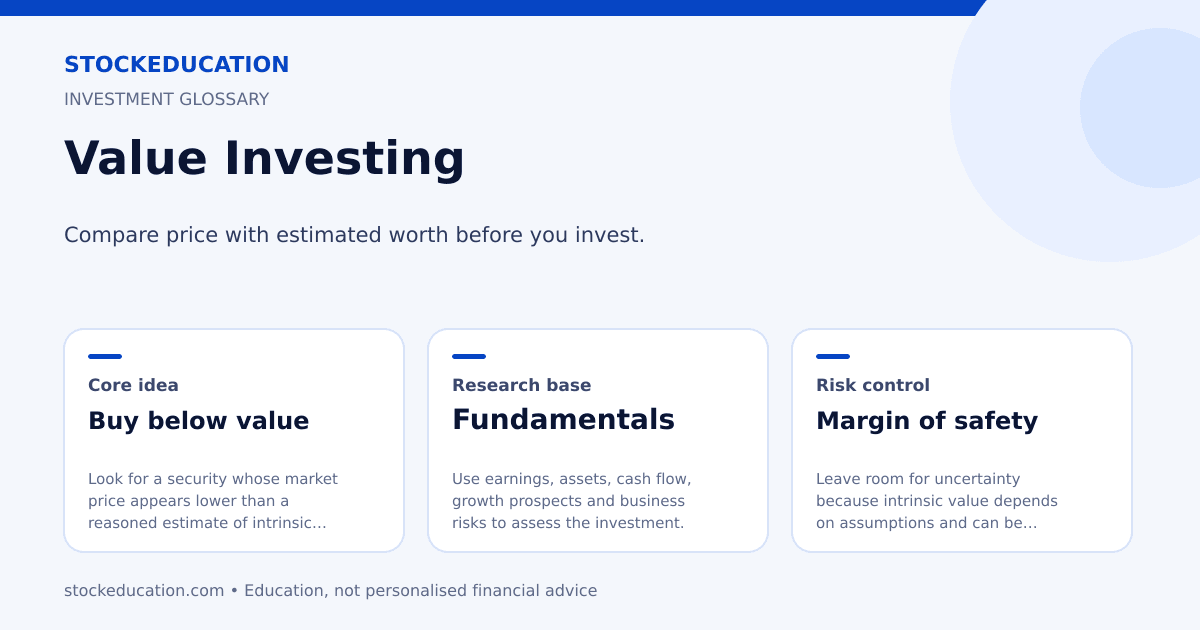
Value investing is the practice of seeking securities whose market prices appear lower than a carefully reasoned estimate of their intrinsic value. It relies on fundamental research, patience and a margin of safety rather than price movement alone.

Key takeaways
- Value investing compares market price with estimated intrinsic value.
- A low share price or low valuation multiple does not automatically indicate a bargain.
- Fundamental analysis examines earnings, assets, cash flow, growth prospects and business risks.
- Intrinsic value depends on assumptions, so estimates can be wrong.
- A margin of safety, diversification and patience help manage uncertainty.
What is Value Investing?
Value investing is an approach to selecting securities that appear to trade below a reasonable estimate of their intrinsic value. Investors study a company’s financial statements, business position, earnings, assets, cash flow, growth prospects and risks rather than relying only on recent price movements. The goal is not simply to find a low-priced stock, because a low valuation can reflect weakening fundamentals or a permanent decline in a company’s prospects.
A value investor compares market price with an estimate of intrinsic value and may require a margin of safety before investing. This estimate is uncertain: different assumptions about future cash flows, growth, interest rates and business risk can produce different results. Value investing therefore requires patience, diversification and continuing review of the original investment case.
How Value Investing works
| Step | What happens |
|---|---|
| 01 · Define the investment universe | Identify companies or securities that fit your objectives, risk tolerance, time horizon and diversification needs. |
| 02 · Understand the business | Study how the company makes money, its competitive position, customers, suppliers, management incentives and industry structure. |
| 03 · Review the fundamentals | Examine earnings, assets, liabilities, cash flow, capital spending, debt, dilution and the durability of reported results. |
| 04 · Estimate intrinsic value | Use an appropriate valuation method and test ranges or scenarios for growth, margins, interest rates and business risk. |
| 05 · Compare price with value | Determine whether the market price provides a sufficient margin of safety after considering uncertainty and downside risks. |
| 06 · Write the investment thesis | State why the security may be undervalued, what evidence supports the view and which developments would disprove it. |
| 07 · Manage the position | Use sensible position sizing, diversification and liquidity awareness rather than concentrating on a single uncertain estimate. |
| 08 · Review and decide | Monitor fundamentals and assumptions, then hold, add, reduce or sell when the valuation, thesis or risk assessment changes. |
The formula
Margin of safety = (Estimated intrinsic value − Market price) ÷ Estimated intrinsic value
Estimated intrinsic value is the investor’s reasoned estimate of what the security is worth based on business fundamentals and assumptions. Market price is the current quoted price or value paid for the security; the result expresses the discount as a proportion of estimated value. A positive result does not prove that the security is undervalued because the intrinsic-value estimate may be uncertain or incorrect.
A worked example
Hypothetical example: An investor estimates that a company is worth $50 per share after reviewing its earnings, cash flow, debt, growth prospects and business risks. The shares trade at $35. The estimated margin of safety is ($50 − $35) ÷ $50 = $15 ÷ $50 = 30%. This does not mean the investor has guaranteed 30% upside or that the estimate is correct. If weaker demand causes the investor to revise intrinsic value to $40, the apparent margin of safety becomes ($40 − $35) ÷ $40 = 12.5%. The investor would therefore review the assumptions, position size and alternative opportunities rather than relying on the original number. This example is hypothetical and excludes taxes, transaction costs, dividends and changes in market conditions.
Why it matters
Value investing matters because it gives investors a framework for making decisions when market prices and business conditions are not perfectly aligned. It encourages analysis of what a security represents, what could go wrong and how much uncertainty is already reflected in the price. That discipline can reduce dependence on momentum, headlines or fashionable narratives. It also clarifies the limits of valuation: an estimate can be wrong, a cheap security can become cheaper and patience can have an opportunity cost. Used responsibly, the approach connects research, risk management and decision-making rather than treating a single ratio as a complete investment case.
Price, Value and the Investor’s Judgment
Value investing begins by separating the price currently quoted in the market from an estimate of what the underlying business may be worth. Price is observable, while value must be assessed through evidence and assumptions. An investor may study profits, balance-sheet resources, cash generation, competitive position, management decisions and future opportunities before forming a valuation range. The result is not a perfectly precise number. It is a reasoned judgment that should be tested against alternative assumptions and updated when the business or the evidence changes.
Fundamental Research Before Valuation
A valuation is only as useful as the business understanding behind it. Research can include income statements, balance sheets, cash-flow statements, debt obligations, capital spending, share dilution and the quality of reported earnings. Investors also consider industry structure, customer concentration, suppliers, regulation, competition and management incentives. A company with attractive historical ratios may still face declining demand, weak pricing power or obligations that are not obvious from one headline metric. Fundamental analysis therefore combines financial information with a clear view of how the business earns and protects its returns.
Estimating Intrinsic Value
Intrinsic value is an estimate of the economic worth of a security based on expected future benefits and the risks surrounding them. Different methods can be appropriate in different situations, including analysis of cash flows, earnings power, assets or comparisons with similar businesses. Each method requires judgments about growth, profitability, reinvestment, interest rates and the likelihood of adverse outcomes. Rather than presenting a single calculation as certain, a careful investor can examine a range of scenarios and identify which assumptions have the greatest effect. This makes uncertainty visible instead of hiding it behind false precision.
Margin of Safety and Risk Control
A margin of safety is the discount between a security’s market price and an investor’s estimated value. It is intended to absorb errors in analysis, unfavorable developments and changes in market conditions. The required margin is not identical for every company: a stable business with predictable cash generation may warrant different assumptions from a highly leveraged or rapidly changing one. The concept does not eliminate risk, and a large apparent discount can signal deteriorating fundamentals. Risk control also involves position sizing, diversification, liquidity awareness and a willingness to reject an idea when the evidence no longer supports it.
Patience, Catalysts and Selling Decisions
Value investing often requires patience because the market may not recognize an investment’s potential quickly. A business can improve while its share price remains weak, or its price can rise before every underlying issue is resolved. Investors may consider catalysts such as improved cash generation, a strategic change, debt reduction or clearer communication, but a catalyst should not replace sound valuation. A sale may be appropriate when price approaches estimated value, the original thesis is disproved, a better opportunity appears or the investor’s risk assessment changes. Holding solely because a position has fallen is not discipline.
Common Sources of Value Traps
A value trap is a security that appears inexpensive but continues to lose economic value. It can arise when earnings are temporarily inflated, assets are difficult to realize, debt limits flexibility, an industry is structurally shrinking or management repeatedly destroys capital. Low price-to-earnings or price-to-book ratios can draw attention, but they do not establish that a company is undervalued. Investors should ask whether profits are durable, whether assets can earn acceptable returns, whether liabilities are fully understood and what could make the business stronger. The best defense is a falsifiable thesis that states both the expected value and the evidence that would invalidate it.
Comparison
| Approach | Primary focus | Main strength | Main caution |
|---|---|---|---|
| Value investing | Price compared with estimated intrinsic value | Encourages disciplined valuation and a margin of safety | Estimates can be wrong and cheap securities can be value traps |
| Growth investing | Future expansion in revenue, earnings or cash flow | Can identify businesses with substantial reinvestment opportunities | High expectations may already be reflected in the price |
| Momentum investing | Recent price and trading trends | Responds to observed market strength | Trends can reverse quickly and fundamentals may receive less attention |
| Income investing | Dividends, interest or other cash distributions | Emphasizes current cash generation | A high yield may signal financial stress or an unsustainable payout |
Check yourself
A company’s shares trade at $30 and an investor estimates intrinsic value at $40. What is the estimated margin of safety?
The margin of safety is (Estimated intrinsic value − Market price) ÷ Estimated intrinsic value. Therefore, ($40 − $30) ÷ $40 = $10 ÷ $40 = 25%. This result depends on the estimate being reasonable and does not guarantee a profit.
Show the answer
3. 25%
Things people get wrong
Mistake 01 Mistaking a low price for low value
A stock can be inexpensive because its earnings, assets or competitive position are deteriorating. Investigate the business rather than treating a low share price as proof of a bargain.
Mistake 02 Relying on one valuation ratio
A low P/E or P/B ratio can reflect temporary earnings, weak assets, excessive debt or a shrinking industry. Compare several measures with the company’s economics and risks.
Mistake 03 Using false precision
Intrinsic value depends on assumptions about growth, margins, interest rates and risk. Use scenarios or ranges and identify which assumptions could invalidate the thesis.
Mistake 04 Ignoring a value trap
A security may remain cheap while its economic value declines. Examine debt, cash generation, management decisions, competition and the durability of future profits.
Mistake 05 Refusing to revise the thesis
Patience is different from ignoring contrary evidence. Set review conditions and sell or reduce a position when the original investment case no longer holds.
Questions people ask about Value Investing
What is value investing?
Value investing seeks securities whose market prices appear lower than carefully estimated intrinsic values, using fundamental research and a margin of safety.
Is value investing the same as buying cheap stocks?
No. A low price or low valuation multiple may reflect deteriorating fundamentals, high risk or a permanent decline in the business.
How is intrinsic value estimated?
Investors may analyze cash flows, earnings power, assets, growth, financing conditions and risk. Different assumptions can produce different reasonable estimates.
What is a margin of safety?
It is the discount between estimated intrinsic value and market price, intended to provide room for analytical errors and unfavorable developments.
Does value investing guarantee a profit?
No. The valuation can be wrong, the business can deteriorate and the market may not recognize potential value. Diversification and position sizing remain important.
How long should a value investor hold a security?
Holding periods vary. An investor may hold while the thesis remains sound, but should reconsider when price reaches estimated value, evidence disproves the thesis or risk changes.
Can growth companies be value investments?
Yes. Value investing concerns the relationship between price and estimated worth, not a company’s label. A growing company may still be overvalued or undervalued depending on expectations and risks.
The bottom line
Value investing is a disciplined comparison between market price and estimated intrinsic value. The approach requires fundamental research, explicit assumptions and a margin of safety, but no valuation is certain. A low multiple is only a starting point, not a conclusion. Investors should diversify, size positions carefully and revise the thesis when evidence changes.
Sources
About this page. Written by Associate Professor Charles Lo, CPA, PhD and edited by Felix La Spina. No ads and no paywall. Editorial standards · How we fact check · Corrections log · Report an error
Educational information only. Nothing on this page is personal financial, tax or legal advice. Investing involves risk, including the possible loss of principal.


