
Investment Glossary · Quick read · No ads
Credit Event
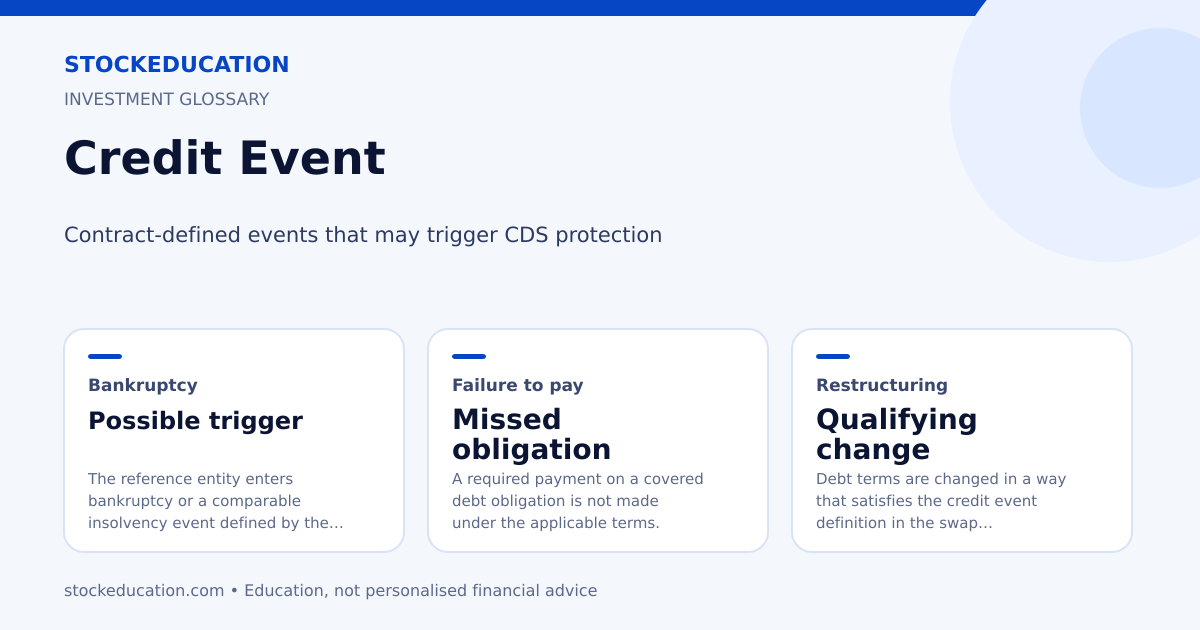
A credit event is a contract-defined occurrence—such as bankruptcy, failure to pay, or a qualifying restructuring—that may trigger protection under a credit default swap (CDS).

Key takeaways
- A credit event is determined by contract language, not by financial distress alone.
- Bankruptcy, failure to pay, and restructuring are common examples of possible triggers.
- The reference entity and reference obligation determine which facts and debts are relevant.
- A qualifying event may lead to a settlement process rather than an automatic cash payment.
- Collateral can affect counterparty exposure, but it does not replace the CDS event definition.
What is Credit Event?
How Credit Event works
| Step | What happens |
|---|---|
| 01 · Identify the reference entity and obligation | Confirm which legal entity and debt instrument are covered by the CDS and whether the relevant obligation meets the contract’s eligibility requirements. |
| 02 · Classify the reported occurrence | Determine whether the facts concern bankruptcy, failure to pay, restructuring, acceleration, default, or another event expressly listed in the documentation. |
| 03 · Test contractual conditions | Check thresholds, grace periods, cure provisions, affected holders, maturity limits, notices, evidence requirements, and any exclusions. |
| 04 · Deliver and review notice | Follow the required notification process and assemble reliable evidence such as payment records, public filings, court documents, or debt-term notices. |
| 05 · Obtain the formal determination | Use the applicable contractual or market-infrastructure procedure to determine whether protection applies and what obligations may be delivered. |
| 06 · Calculate and complete settlement | Apply the permitted physical or cash settlement method, recovery or auction result, notional amount, timing rules, and other applicable terms. |
| 07 · Assess counterparty exposure separately | Review collateral, margin, valuation, segregation, close-out, and the counterparty’s ability to perform after the reference-credit determination. |
The formula
Credit event = occurrence satisfying the CDS contract’s defined trigger conditions
The occurrence may involve bankruptcy, failure to pay, qualifying restructuring, or another event listed in the applicable documentation. The formula is a classification test, not a prediction of loss; settlement depends on the reference obligation, notices, procedures, and contract terms.
A worked example
Hypothetical worked example: Assume a CDS protects $10 million of notional debt issued by Company A. Company A misses a required $600,000 interest payment, and the contract provides a 30-day grace period. If the payment remains unpaid after that period, the obligation is covered, the missed amount exceeds any applicable threshold, and the required notice is properly delivered, the parties may determine that a failure-to-pay credit event occurred. Suppose the settlement process later establishes a recovery value of 40% of face value. A simplified loss estimate would be: $10,000,000 × (1 − 0.40) = $6,000,000. This is only an illustration, not a promised payout. Actual settlement may depend on the CDS notional, auction or physical-settlement rules, deliverable obligations, accrued amounts, restructuring terms, documentation, notice timing, and whether the event was formally determined. A missed payment below a threshold, an excluded obligation, a cured failure, or defective notice could produce a different result or no credit event at all.
Why it matters
Credit events matter because they connect a borrower’s deterioration to enforceable rights under credit-protection contracts. Investors, hedgers, lenders, and risk managers need to know whether a reported default, missed payment, or debt exchange actually satisfies the relevant definition. Misclassifying an event can lead to incorrect expectations about CDS settlement, portfolio losses, hedging effectiveness, and counterparty exposure. The analysis also separates reference-credit risk from trading-counterparty risk: the first concerns whether protection is triggered, while the second concerns whether the parties can meet their obligations.
Contract Definition Comes First
A credit event is a legal and contractual classification rather than a broad description of an issuer’s financial health. An issuer can lose value, receive a downgrade, face liquidity pressure, or trade at distressed prices without creating a CDS payout. The swap documentation identifies the events that count, the obligations that are covered, the notices that must be delivered, and the conditions that must be met. This distinction matters because market participants may use “default” informally, while the contract may require a narrower failure, a minimum amount, a cure-period outcome, or another specified test before protection can be triggered.
Bankruptcy as a Possible Trigger
Bankruptcy or a comparable insolvency proceeding is a widely recognized example of a possible credit event. The relevant definition may refer to a formal filing, appointment of a receiver, liquidation, insolvency arrangement, or another proceeding listed in the applicable documentation. The practical question is not simply whether the issuer appears unable to pay; it is whether the specified legal or procedural event has occurred for the reference entity. Jurisdiction, entity status, filing type, and documentation version can affect the analysis. A bankruptcy-related trigger can therefore require careful verification of public notices, court records, and contract terms.
Failure to Pay and Covered Obligations
Failure to pay generally concerns an amount due on a covered debt obligation that remains unpaid after any applicable grace period or contractual condition. The missed payment must relate to the relevant reference entity and an obligation that falls within the swap’s definition. Analysts must distinguish a true payment failure from an administrative delay, a disputed amount, a payment on an excluded instrument, or a missed amount below a stated threshold. Timing also matters: the due date, grace period, notice requirements, and event determination process can affect whether the failure qualifies and when protection may be processed.
Restructuring Is Not Every Amendment
A restructuring credit event involves a qualifying change to debt terms, but not every refinancing, exchange, covenant amendment, or voluntary negotiation meets that standard. The documentation may focus on changes to principal, interest, maturity, ranking, or payment terms that result from credit deterioration and affect eligible holders or obligations. A transaction must be tested against the applicable definition, including any limits on consent, scope, maturity extension, or economic impact. This is why a visible change in a bond’s terms is evidence for review, not automatic proof that CDS protection has been triggered.
From Event to CDS Settlement
When a potential credit event is identified, the parties and market infrastructure follow contractual and procedural steps to determine whether protection applies. Those steps can include notice, evidence review, a formal determination, identification of deliverable obligations, and a choice between physical and cash settlement where the contract permits it. The resulting payment is not necessarily equal to the full face amount of the protected debt. It generally reflects the contract’s notional exposure and the loss implied by the settlement outcome, subject to documentation, elections, timing, and other terms.
Collateral and Counterparty Exposure
A credit event addresses whether the reference credit has produced a contractual trigger; collateral addresses how obligations between trading counterparties are secured and managed. Margin or other collateral can reduce the unsecured exposure created by changes in a CDS’s value, but it cannot turn a non-qualifying issuer problem into a credit event. Collateral arrangements also have their own eligibility, valuation, haircut, segregation, and close-out provisions. Reviewing both dimensions gives a clearer risk picture: one concerns the reference entity and settlement right, while the other concerns the ability of counterparties to perform.
Comparison
| Situation | What it may indicate | Why it may or may not be a credit event | Key review point |
|---|---|---|---|
| Bond price falls sharply | Market-implied credit concern | Usually not a contractual trigger by itself | Read the defined event language |
| Issuer files for bankruptcy | Possible insolvency trigger | May qualify if the filing or proceeding matches the contract | Verify entity, jurisdiction, and proceeding |
| Debt payment is missed | Possible failure to pay | Depends on covered obligation, threshold, grace period, and notice | Check amount, timing, and cure status |
| Debt terms are changed | Possible restructuring | Only qualifying changes under the documentation count | Review affected terms and restructuring conditions |
Check yourself
A company misses an interest payment, but the amount is below the CDS contract’s threshold and the grace period has not expired. What is the best conclusion?
A failure-to-pay analysis depends on the covered obligation, applicable amount threshold, grace period, notices, and other contract conditions. A missed payment alone does not automatically establish a credit event.
Show the answer
2. The missed payment may not yet qualify because contractual thresholds and timing conditions have not been satisfied.
Things people get wrong
Mistake 01 Treating financial distress as an automatic trigger
A falling bond price, downgrade, liquidity crisis, or distressed trading level may indicate risk but does not itself satisfy the CDS definition.
Mistake 02 Ignoring the reference obligation
A payment problem must generally involve the relevant reference entity and an obligation covered by the contract; not every debt instrument qualifies.
Mistake 03 Assuming every restructuring counts
A refinancing, exchange, covenant amendment, or negotiated maturity change must be tested against the contract’s specific restructuring language.
Mistake 04 Overlooking thresholds and grace periods
The missed amount, cure period, notice requirements, and other conditions may determine whether an apparent failure to pay qualifies.
Mistake 05 Expecting full notional value at settlement
CDS settlement generally reflects the contractual loss or settlement result, not automatically the entire protected principal.
Mistake 06 Confusing collateral with protection
Margin can reduce counterparty exposure, but it does not create a credit event or guarantee payment after a non-qualifying occurrence.
Questions people ask about Credit Event
What is a credit event?
It is an occurrence that satisfies the triggering conditions in a CDS or related credit-protection contract, such as a defined bankruptcy, failure to pay, or qualifying restructuring.
Does a credit downgrade trigger a CDS payout?
Usually not by itself. A downgrade may signal worsening credit quality, but the contract must identify the downgrade or another qualifying occurrence as a trigger.
Does every missed payment count as failure to pay?
No. The obligation, amount, grace period, threshold, notice process, and other contractual conditions must be examined.
Can restructuring trigger CDS protection?
It can, but only when the debt-term change fits the applicable restructuring definition and any related scope, consent, maturity, or economic-impact conditions.
Who determines whether a credit event occurred?
The answer depends on the documentation and market procedures. Parties may submit information for a formal determination process, which can evaluate notices, evidence, and contract terms.
Does a credit event mean the protection buyer receives the full CDS notional?
No. Settlement commonly reflects the loss implied by the settlement value or deliverable obligation and is affected by the contract’s terms and procedures.
How does collateral relate to a credit event?
Collateral helps manage exposure between counterparties. It may reduce unsecured counterparty risk, but it does not change whether the reference credit satisfies the event definition.
The bottom line
A credit event is a contract-based determination, not simply a description of financial trouble. Bankruptcy, failure to pay, and qualifying restructuring are common possible triggers, but the reference obligation, thresholds, notices, procedures, and documentation control the result. Settlement may compensate for an established loss rather than pay the full protected notional. Investors should separate reference-entity risk from counterparty risk and review collateral arrangements independently.
Sources
About this page. Written by Associate Professor Charles Lo, CPA, PhD and edited by Felix La Spina. No ads and no paywall. Editorial standards · How we fact check · Corrections log · Report an error
Educational information only. Nothing on this page is personal financial, tax or legal advice. Investing involves risk, including the possible loss of principal.


